A blog on issues affecting Australia's newsagents, media and small business generally. More ...

greeting cards

A card company paying cash for card space says a lot about their business

Greeting card suppliers are back at retailer doors offering cash for wall space.

Before you sign, understand exactly what you are agreeing to.

I don’t get it, I really don’t.

What does it say about the card company that they have to give a retailer cash to buy their business. I would have thought that the retailer and the card company would make more money if the cards were the best and backed by the best service. A bag of cash takes consideration away from product. maybe that’s what they want.

The offers I am hearing of are big. Fifty thousand dollars. One hundred thousand. Sometimes three hundred thousand. The old structure was an interest free loan, repaid through rebates on card sales. More recent deals leave the rebate untouched and require the retailer to repay the cash on top.

Either way, the deal is the same. The supplier is not investing in your business. They are renting your wall. And you are the one carrying the debt.

It doesn’t make sense to me.

When choosing a card supplier you need to choose based on revenue for the business from cards, and what else happy card shoppers will buy in your business.

A card company should earn its space through sell-through. Once money enters the deal, performance stops being the measure. You stop asking which cards sell and start planning what the cash will pay for. That is exactly what the supplier wants.

The evidence is clear. We have seen a business where one supplier held the entire card wall. Splitting the wall fifty fifty delivered immediate double digit growth. A later supplier change lifted sales again. Competition and range drove those results. No cheque did.

One newsagent with multiple stores took around three hundred and fifty thousand dollars from a card company and later collapsed, leaving the supplier out of pocket. I wonder if retailers ended up paying for this?

Plenty of retailers are unhappy with their card company and cannot leave. The debt locks them in.

The cash is not free. You pay for it in weaker card sales and lost freedom to change suppliers. If a card company wants your wall, make them earn it with product that sells.

If a card company offers you cash up front for a commitment, pause. Sure, the cash would come in handy. The question has to be – over the lifetime of the contract, what is the real cost of the cash I might get today? Also ask: how bad are their products that they need to buy my business?

3 likes
Greeting Cards

New Year New You: Stop Watching a category decline that you built your shop on

Watching a category shrink is a slow kind of frustration. Not overnight. Gradually, a few titles at a time. Fewer customers asking. Numbers that used to feel unremarkable now feel like something worth explaining at the end of the month.

For most newsagents, that category is magazines. For some, newspapers. For others, lottery products, as customers move to buying online. The specifics differ. The feeling is familiar.

The question is not whether the decline is real. It is what happens to the floor space, the margin budget, and the foot traffic that category used to carry.

The instinct is to hold on

Magazines once drove daily foot traffic. Newspapers brought customers in before 8am. These were not minor parts of the business — they shaped the layout, the staffing, the rhythm of the day.

Protecting what built the shop makes sense. But holding floor space for a shrinking category has a real cost. Every metre could be working harder.

What is actually working in newsagency businesses right now

Greeting cards are probably the best example. Customers still want to buy them in person, and a well-curated section with decent replenishment consistently performs. The category does not get talked about much but it delivers.

Gifts and homewares have become a genuine revenue contributor for many stores, particularly where the range is local, seasonal, or hard to find online. Not generic gifts — product the owner chose because they know the customer walking through the door.

Stationery (smart stationery especially), arts and crafts, and activity products have a much bigger audience than they did five years ago. That shift is still underexploited in a lot of stores.

Advice on making the shift

Rebalancing a shop is not a quick fix. It means rethinking the floor plan, finding new suppliers, and testing product lines that may not work before you land on ones that do.

The first move is usually to reclaim the space rather than fill it. Look at which sections are underperforming per square metre. Reducing a magazine section from 12 bays to eight can free up real floor without dropping the category.

After that, test small. A limited range, careful sell-through tracking, then let the numbers guide the next order. Filling space with volume before knowing what the customer actually wants is an expensive habit that is easy to fall into.

If your POS system is not clearly showing you what is turning and what is sitting, that is worth fixing before any buying decisions. The data is there — it just needs to be used.

And talk to other newsagents. The community shares information more openly than most retail sectors. What is working two towns over may be exactly what is missing from your range.

If you;re in a marketing group, start there – they should be all over this and giving you actionable practical help. Are they?

The shops struggling did not decline because the category did

They delayed the response. The ones doing well moved earlier, tested more, and were willing to look different from what they used to be.

A newsagency does not have to be defined by what it sold in 2005. The customers are still there. The question is whether the shop gives them a reason to walk in.


Mark Fletcher founded newsagency software company Tower Systems and is the CEO of newsXpress, a marketing group serving innovative independent retailers, including newsagents, who continuously evolve their businesses to be enjoyable, relevant and successful. You can reach him on mark@newsxpress.com.au or 0418 321 338.
3 likes
Newsagency management

The customer who brought scissors

We had a humour card with a small floppy balloon penis on it. Funny card. Customers loved it. Sold consistently.

Then cards started appearing on the display with the balloon missing. We assumed a product fault — attachment not holding, supplier issue, something in the handling. We chased it down. Nothing explained it.

We checked the security footage.

A woman, late seventies or early eighties. She’d come in, browse, wait until no one was close, and snip. Clean off. She’d done it to several cards before we caught on. Came back and did it again after that.

It’s genuinely funny in hindsight. A dedicated, recurring mission to rid the shop of a balloon penis.

It also points to something that isn’t funny. Some customers believe they have standing to decide what a shop carries. Not by choosing not to buy something — that’s their right — but by removing the choice for everyone else. She didn’t want the card there. So she solved the problem herself, repeatedly, with scissors.

We see other versions of this regularly. Customers who complain about products they didn’t buy. Who tell you directly that you shouldn’t stock something because they find it offensive. Who seem genuinely surprised that their discomfort doesn’t automatically override your ranging decisions.

A retail range isn’t built for the most easily offended person in the customer base. It’s built for the whole of it. That card made people laugh and it sold. One person felt differently and handled it with craft supplies.

Stock what your customers want. Not what survives the most conservative person in the shop.

Back to our snipper. We confronted them and asked that they stop it. They complained. We invited them to shop elsewhere.

While our approach may have lost us customers through word of mouth (we certainly heard the complaint had reached others) we felt better for being true to the retailer we see ourselves as, stocking what more customers like and what we can have a laugh about.


Mark Fletcher founded newsagency software company Tower Systems and is the CEO of newsXpress, a marketing group serving innovative independent retailers, including newsagents, who continuously evolve their businesses to be enjoyable, relevant and successful. You can reach him on mark@newsxpress.com.au or 0418 321 338.

8 likes
Social responsibility

What good foot traffic in a retail newsagency actually looks like in 2026

Foot traffic is one of those metrics newsagents talk about constantly but rarely define. When someone says their traffic is down, what does that mean exactly? Fewer people through the door? Fewer transactions? Smaller baskets? The same customers buying less?

The distinction matters because the response is different in each case.

Here is what I see in the businesses that are actually performing well right now. Their traffic story is not about volume. It is about who is coming in and what they are buying.

The old model is not coming back

The newsagency of 2010 ran on high-frequency, low-value visits. A paper every morning. A scratchie. A magazine. Frequent visits, small baskets, thin margin.

That traffic is declining structurally. Newspapers are bought online or not at all. Lottery players are being pushed to apps — deliberately, by the people who run the lottery. Magazine readers have moved on. You cannot run a campaign that fixes a habit change.

The businesses I respect have stopped trying to. They are building something different.

What the better businesses are doing

The stores growing right now attract less frequent but higher-value visits. A customer who comes in three times a year to buy gifts, cards, and a collectible is worth more to the business than one who comes in five days a week for a paper and nothing else.

That requires a different shop. The product mix has to give people a reason to come in when they are not running an errand. That does not happen by stocking what your rep suggested. It happens when you look at what your customers actually respond to and build around that.

Seasonal traffic compounds

Newsagents who take seasonal execution seriously — real displays, a genuine reason to visit around Mother’s Day, Father’s Day, Christmas — see something interesting. The spike visits convert. A customer who comes in for a card and finds a gift range they like comes back.

That repeat visit did not come from advertising. It came from having something worth discovering. You earned it.

The number worth watching

Stop asking whether your traffic count is up or down. Ask whether the traffic you have is getting more valuable.

Check your average transaction value over the past year. Look at whether repeat customers are growing as a share of your total. Ask yourself whether the people coming through the door are browsing or just transacting.

If those numbers are moving the right way, the business is in better shape than the foot count suggests. If they are not, the problem is almost certainly in the product mix and presentation — not in how many people walk past the window.

Volume is a vanity metric. Value is what you actually manage.

… Mark Fletcher founded newsagency software company Tower Systems and is the CEO of newsXpress, a marketing group serving innovative independent retailers, including newsagents, who continuously evolve their businesses to be enjoyable, relevant and successful. You can reach him on mark@newsxpress.com.au or 0418 321 338.

7 likes
Newsagency management

Where is the best place to buy greeting cards in Australia?

The local newsagency near to you is likely to be the best place to buy greeting cards in Australia and here is why:

  1. Range. Typically the local newsagency will have a better range of cards for a deeper range of captions. The bigger the range the more options you have for find the card you will love giving and they will love receiving.
  2. Ease of shopping. The local newsagency will typically offer more space for comfortable shopping. You can browse easily, take your time and not get pushed by people in the aisles.
  3. Customer service. In the local newsagency, human delivered customer service is not far away. You know the owner of the shop has curated the range for local shoppers – not some office person in another state, or overseas.
  4. More likely Australian made. Local Australian newsagents are more likely to stock locally made cards. If local jobs matter to you, this is important. Locally made cards not only support local jobs, they reflect Australian words and sentiments more so than any card designed and made overseas.
  5. Local. Shop in the local newsagency and more of what you spend stays in the local community and if you live in the local community this will matter to you.
  6. Loyalty. Many local Australian newsagencies offer a loyalty program that helps you save money on cards. Ask and find out if there are loyalty options that suit you.

While you could consider buying cards from a discount shop, supermarket or big department store, it is the local newsagency where you will find more satisfaction we think and we say this as newsagents ourselves. We take pride in the cards we choose for the shop, how they are displayed and the value they offer our customers.

So, when you need a greeting card for a birthday or some other occasion, shop at a local Australian newsagency and see for yourself the difference available to you. And, if you’re not happy, let them know, so they can improve their card offer for local shoppers.

Plenty of newsagents will offer you a pen for writing on the card and even sell you a stamp to make posting the card easy.

4 likes
Uncategorized

Hallmark recordable sound cards set for Mother’s Day

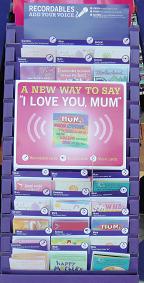
hallmark-mothers-day-2010.JPGThe Hallmark recordable sound cards are set to go off this Mother’s Day. They are part of the popular Hallmark sound card range which was launched last year and continues to lead card sales around the country.

The Hallmark sound card launch is the most successful new greeting card line launch I have ever seen in Australia.

What is interesting about the success is that all retailers accepted a small reduction in margin to take on the range. We also gave up some retail space for promotional use. The space investment paid off as it promoted the point of difference well.

I expect the Mother’s Day cards to perform particularly well because of the TV commercial planned which will support the Hallmark brand and the point of difference offered in the sound card range.

We have our Hallmark Mother’s Day sound cards in a prime position at the front of our shops – the point of sale makes this position work well (already) for us.

0 likes
Greeting Cards