A blog on issues affecting Australia's newsagents, media and small business generally. More ...

small business retail

2023 vs 2022 newsagency sales benchmark study under way

I have started collecting data for a 2023 vs. 2022 newsagency sales benchmark study. While I am doing a whole of year comparison this time around for the whole of channel study, I’ll do a last quarter only study for a smaller group for anyone interested.

My goal for the main study is to get data from at least 120 businesses as this will provide sufficient a dataset to consider the total channel results.

2 likes
Newsagency benchmark

Predictions: 2024 and the local Aussie newsagency

Hey, Happy New year.

I think 2024 will see change continue in our channel. It will impact our businesses and the businesses of our suppliers. The changes will be driven by a range of factors including but not limited to the continued rolling disruption of print media, growth in the use of social media, further decline in engagement with appointment TV and radio, AI, AI and AI, migration of more over the counter transactions to online, settling in of work from home for many and more suppliers going direct to consumers.

That’s my (incomplete) list of drivers of change. Now, to the changes I think we are likely to see in the channel.

  • A significant increase in online sales. More newsagents will have websites. More revenue will be put through websites run by businesses in our channel. I expect 2024 to be the year of biggest online revenue growth for our channel that we have see.
  • More newsagents selling products that have not been been traditionally associated with our channel. While this will be especially seen in businesses selling online, there will be some physical shops that pivot to niche specialty with the newsagency part of the business a smaller pert.
  • Continued decline in print newspaper and magazine purchases.
  • Somewhere between 100 and 200 newsagencies closed (for a variety of reasons).
  • Greater growth in online lottery product purchase than over the counter.
  • New suppliers entering our channel to replace revenue lost in other channels.
  • More direct from manufacturer opportunities as general wholesaler models are challenged.
  • More use of AI in content preparation, business performance assessment and customer contact assistance.
  • More collaboration events to drive traffic spikes.

This list is irrelevant as it’s speculation. What matters is what you are doing in your business to make the most out of 2024. Only you can figure that out. Or, you can choose to do nothing and let the year happen as it happens. This would be a mistake I think. Given the changes we can see, I think it is vital to embrace change, to ride the wave, rather than be dumped by it. This is why thinking about what might be in 2024 is useful. It lets you think about what might be so you can be ahead of the wave.

I was to finish by mentioning AI again. I think its impact on newsagencies, business generally and society more broadly will be far greater in 2024 than anything we can possibly imagine today. Some impacts will be good, while some not so good. Those less negatively impacted will be those who engaged with AI early to be aware of the rapidly evolving tools, to know what to watch out for.

Hey, Happy New year.

16 likes
newsagency of the future

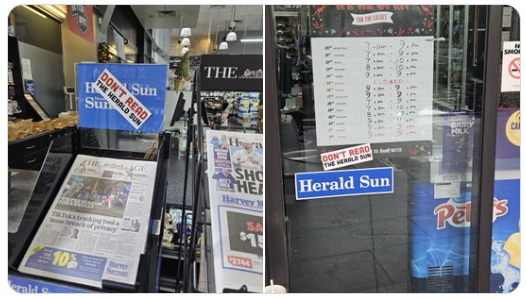
Newsagents handing back their newspaper home delivery runs need a service contract for dealing with poor newspaper publisher service

The two main newspaper publishers in Australia, News Corp. and Nine Media (Fairfax) have a poor track record managing newspaper home delivery they take over from local newsagents, regardless of whether it is a forced takeover or a voluntary hand back.

They replace what has been for 100+ years a local personal service with corporate impersonal processes.

Whereas newspaper home delivery customers could speak to someone locally with direct knowledge of the delivery situation, in the publisher driven model customers have to navigate impersonal and broken processes that pay little regard to the local delivery situation.

I think newsagents deserve a service contract to cover the first year of post home delivery option. This contract could include the following fees payable by the publisher to the newsagent:

  • $5.00 for each email contact by a home delivery customer to the newsagent asking about home delivery such as where is my paper.
  • $5.00 for each in-store contact by a home delivery customer to the newsagent asking about home delivery.
  • $10.00 for each phone contact by a home delivery customer to the newsagent asking about home delivery.
  • $25.00 additional fee for each engagement where the customer is angry.
  • $25.00 for each call or email contact with the publisher for matters not covered by the above.
  • $25.00 for each call that has to be made or email that has to be sent to the distributor asking where the papers are for the shop.
  • $50.00 per title for each day a newspaper is not delivered to the shop by 8am (or any other time as stipulated by the newsagent based on their early morning trading). The amount could vary based on the usual number of papers sold where the penalty should be double the usual GP$ for the day.
  • $100.00 per title for each day a newspaper title is not delivered to the shop. The amount could vary based on the usual number of papers sold where the penalty should be double the usual GP$ for the day.
  • 250% GP penalty for each newspaper given to a home delivery customer who missed a paper, the publisher cannot rectify and a replacement paper is given from the shop.
  • A flat insert or giveaway fee for each time the newsagent is asked to give something away with the newspaper where the fee is at least 10% of the cover price of the accompanying newspaper and is paid weekly as an automated credit to the account.
  • A fee of $50.00 per 15 minutes for any in-store visit by a newspaper pub lister representative.

I’d make reporting simple with no opportunity for dispute by the publisher for such claim and with payment monthly by direct debit initiated by the newsagent entering contact details (date, time, customer name) into a web portal setup, maintained and paid for by the publisher.

Of course, these fees will seem over the top to most reading them. I have suggested the figures I have so they act as an incentive to newspaper publishers to do better. I reckon can predict some of the reactions people will have reading this.

No publisher will agree to this.

Newsagents have to be kidding themselves if we’d agree to this.

This list is nonsense.

Who do they think they are.

I’m just happy to have given up home delivery, I don’t want to rock the boat.

I’ve moved on.

The response by publishers will be silence. They will ignore the suggestion. They’ll read it here and mutter about it to each other, but we will hear nothing because any request like this from newsagents has been treated this way, with silence.

I started thinking about the list when I saw a query from a long-term home delivery customer to the newsagent who used to deliver their paper to a nursing home. The newspaper publisher had not actioned a change request and the customer was becoming distressed after 4 attempts at contact. They reached out to the newsagent who ultimately organised for the issue to be fixed. They did this in service of a long-standing customer and because they understand personal local service. The newspaper publisher had let the customer down because of the corporate processes put in place to manage home deliveries.

Recently, we did not get the Australian Financial Review in one of my shops that ended home delivery a couple of years back. Two phone calls produced no result. Then, a couple of hours later, the distributor called a number not on the registered contacts list to say it would not be supplied at all. The person with that number had to call the shop. Next, the shop staff had to deal with customer queries and agitation. There were several unpleasant exchanges.

All of this costs money.

The newspaper publishers control the production and distribution of their product, yet they continue to expect local small business newsagents to provide free customer service to cover for their failures.

39 likes
Newspaper distribution

The Boxing Day opportunity for retailers

I see the Boxing Day sale as an opportunity to ditch dead stock and clear out any products we are discontinuing for whatever reason.

For me, it’s about decluttering the shop ahead of a reset for 2024, readying to lean into new opportunities in pursuit of new shoppers.

So, we price to quit. If the items on sale have long been paid for, the sale is about freeing cash for the business more so that chasing a profit. Stock sitting on the shelf not selling is not profitable.

With so many retailers doing sales this time of the year, it makes sense to ride on the back of their marketing coat tails and run a sale, even if in your location Boxing Day sales are not a thing.

There are people who have waited for this opportunity, and I’m happy to sell to them. Already this morning, up til 9:35am, $2,200 in sales of sale-priced items with nothing spent on marketing other than a bit of time on an email and some posters. The street is not busy, but people out are keen for deals.

On our street, we compete with Australia Post in the gift and greeting card space. They’re closed, which is good.

3 likes
Newsagency management

Online shoppers are powerful

Online shoppers tend to be savvy, and vocal if things go wrong. Being on the front foot with communication is key. This story was viral online well before A Current Affair picked it up. Now, on social media since the ACA story, the pile-on has surged.

While their comms could have been better and their back-office more organised, plenty of responses go too far.

In the last two weeks our own online businesses have shipped thousands of orders with half of those sent Express Post because of a supplier screw up that saw product arrive late.

4 likes
Newsagency management

The British relationship with magazines is so different to ours

Check out this video from Twitter a few days ago showing magazines featuring Doctor Who and (5) TV related titles in a UK newsagent.

I’m not pining for change. Rather, the difference fascinates me. I think it reflects a different relationship with print over all.

4 likes
magazines