Trends in retail: the sharing economy and opportunities for newsagents
Sharing is cool right now and engagement is growing across a number of engagement points. In cities we can see parking spots allocated to vehicles that are shared. There are websites dedicated to enabling people to share items used infrequently like tools and baby furniture. I have seen services in the US for sharing high-end fashion that would otherwise be out of reach. More and more restaurants have shared seating – large tables for eating with people you’ve never met. Sharing plates of food among people you dine with is also big – this all connected with the sharing economy.
It feels to me like there is a surge in sharing.
I wonder if there are ways we can connect with the increased interest in sharing in our newsagency businesses. On first blush it may appear not as we are retailers. We make money from selling things and not from renting them. But I don’t think it is as simple as that.
The world is changing rapidly in areas connected with social responsibility. For decades car makers resisted embracing renewable energy technology. Today, they are fully in that ocean releasing hybrid and completely battery powered vehicles at a significant pace. I was at the Consumer Electronics Show is Las Vegas last week and was thrilled to see what Tesla are doing along with their battery partner Panasonic. Here is this young car company overtaking the majors by engaging with what people want and doing it in an open way, sharing insights so others can come on that journey too – they are sharing their intellectual property!
That’s what the sharing economy discussion comes down to … what people want for the good of the community an the world.
Here are some ways in which we could connect with the interest in sharing.
Renting. What do we sell today or could sell today that we could rent to those who prefer this model to sale? Toys are a good example. Jigsaws maybe? Homewares. Jewellery?
Recycling. Are there products we are known for where we become an outlet through which people can recycle items they no longer need. Some years ago I developed a business plan for newsagencies having a book recycling outlet. While it didn’t go anywhere I think it’s worth exploring.
Clubs. Core to the sharing economy is people connecting through common interests. What products do we sell through which we could engage in creating our own clubs or connecting with clubs.
Food. We sell food magazines and books and some of us sell cooking utensils. Do we serve shoppers who love to cook but who do not have big families to feed. Can we connect them with others who would love to be cooked for. We’re the glue and while we are not necessarily increasing sales, we’re becoming known for offering a connecting service.
These are just some ideas. I present them here not as an advocate but to get you thinking of ways you could connect with the sharing economy.
Think about the person using the share vehicle, the lady renting a dress for one evening or those folks who are happy to sit at a shared table in a restaurant. How can we tap into these opportunities to make our businesses more relevant to them?
I appreciate this topic may seem quite a distance from what you do in your business today. However, embracing the sharing trend is a way you can pitch your relevance and through which you can explore new business opportunities.
The newsagent who acts in a traditional and average way will achieve traditional and average results. 2015 and beyond will be more about embracing, chasing, change than ever before.
Last call: newsagency business penalty rate survey
Share your opinion on weekend penalty rates: click here to take the survey. I’ll close the survey tomorrow sometime and share the results here soon thereafter.
Snacks and magazines
Check out how suppliers are working together in the US to offer snacks and magazines together as a deal on a purpose created shop floor stand. While I think this is a terrific initiative for convenience / transit businesses, it’s not something I’d run with as my shoppers are not likely to purchase snack products with a magazine.
I mention it to show newsagents another initiative being used in the US to drive basket size.
Do you stock Charlie Hebdo?
I’d love to hear from any newsagents in Australia who regularly stock Charlie Hebdo.
If magazine publishers and distributors do not offer viable terms, what then for newsagents?
On the issue of newsagents achieving better margin on magazines, I appreciate there are some newsagents who think there is no hope, that things will never change. I’m an optimist and think that there are enough magazine publishers who value the role we play in putting their titles in front of new eyeballs for them to want / need to engage with us in a discussion about viability.
With the majority of newsagents losing money on magazines something has to change.
There is no doubt that the current model, as I wrote earlier this week, is not financially viable for newsagents, especially those paying shopping mall rent of $1,250 per square meter a year and more. Even allowing the traffic magazines generate there is a live question about viability. That question goes to the future of the channel as it is seen today.
One alternative is that magazine publishers pursue alternative channels. No single channel can be as valuable as the newsagency channel. We’re known and, for the most part, engaged. We are also well located and locally connected.
The other alternative is they sell more through other channels they have already such as supermarkets, convenience and petrol. But these channels have space challenges and engagement costs.
I think the newsagency channel continues to be the most economically viable for magazine publishers, even at a higher margin for newsagents of, say, 40%.
I am confident that with as higher margin we as a channel would see magazines differently and engage with them as something as more valuable than agency business.
Newsagents are challenged by disorganisation and lack of national leadership. While the ANF directors and staff will say they provide good leadership, the proof they do not is lack of engagement by newsagents. Leaders have followers. The ANF has failed newsagents on matters like magazines and spent too much time on questionable commercial offers.
But back to my topic – what if publishers do not engage and provide newsagents with better margin, what then? The obvious option is to get out of magazines. Do you have the guts to do that, to quit magazines? Think about it, look at your data, what would your business look like.
Another option is to quit one of the major distributors in return for the other major distributor offering better terms. This could work if the better terms are seriously good and if they included control over stock received. Imaging the seismic shift in distributor use if this happened and newsagents started carrying titles from only one distributor.
Another option is to keep cutting range. The problem with that is that you no longer satisfy browser interest and you lose that traffic and that plays out into declines in other categories.
The fourth option is that you say bugger it yes we are treated poorly but I will prey on other newsagents cutting their magazines ranges and increase mine and become the go to newsagent for magazines. This is an interesting option, making your shop mor of a destination. But you are stuck, probably with the current terms.
There are other options too. Newsagents need to think about this, they need to explore what they could do and would do if they do not achieve more equitable terms for magazines.
To the magazine publishers reading this – take the concern seriously. The current arrangements cannot continue.
Useful magazine barcode info could help newsagents save time and money
I love the information placed with barcodes on magazines in the US. If this were included for Australian titles it would mean newsagents could choose to not label titles. – thus saving time and money. While I like knowing the quantity received when I am doing my shop floor cull, it’s not essential. Magazine publishers keen to help us drive efficiency will consider this. However, it would make it harder to re issue titles … but I’d see that as a good thing. Anything to stop magazines going around and around.
How can distribution newsagents create a more viable future?
Years ago there was discussion about distribution newsagents using their infrastructure to deliver other ietms and thereby get more value from their capital investment. Not many have gone down that road. Some have consolidated and I regularly hear that camp is not happy.
The challenge facing distribution newsagents of what to do to drive business viability is stronger than ever.
There is no upside in print media. Capital city daily newspaper sales continue to decline at an extraordinary rate. Newspaper publishers are pushing content access and advertising delivery models which cut revenue for distribution agents or eliminate it altogether through digital platform promotion. Magazine sales are declining, albeit not as fast as newspapers. The finaicial model for distribution agents is loss making in the majority of cases.
If I was a distribution agent in this climate and wanted to remiain in business I’d consider these options:
- Scale up. I’d take on more territories and chase scale with low-overhead management, no shared ownership with others. I’d be chasing 15,000 home deliveries or more.
- Be the distribution expert. I’d look for a way to be the partner for online businesses and providers to handle the last mile delivery in a personal and lcaol way. I’d use smart technology tom make this easy for retailers.
- On demand local courier service. This idea is about creating a very local, defined area, deliver service – the kind of service small businesses could use to deliver something to a local shopper. Something a shut-in could use to get you to purchase forn them and bring to their home.
- Go into retail. This is the idea I like the most., I’d look at retail in my area and create a shop of the future selling newspapers and magazines but in a way that’s fresh. Around these two categroeis I’d build other product offerings that are unexpected and traffic generating of their own. The shop would be on the high street with good parking. Probably a space that has low rent.
As things stand today, the majority of distribution newsagents rely entirely on newspaper publishers and magazine distributors for their income. Newspaper publishers are responsible for this. It’s a dangerous situation because your future relies entirely on their decisions and their decisions must put the needs of their shareholders ahead of newsagents.
Terrific newspaper stand for newsagents who want control
I love this newspaper stand I saw at a Duane Reade drug store in New York yesterday. It’s strong, has a small foot-print, makes the product the hero and can be used any way we choose.
This is the type of stand I will go for rather than a newspaper publisher specific stand that is selfish and not viable in today’s retail newsagency.
An unbranded stand like this is a move retail newsagents should make.
News Corp. offers free magazines with newspaper App subscription
This image is an ad from The Advertiser from News Corp. in Adelaide – Friday 9, page 36. The ad is promoting a subscription to the newspaper App and a bunch of magazines. It’s a compelling offer that appears set on cannibalising the print product.
I wonder how retail and distribution newsagents feel about this?
While the magazine range offered is limited, it could be enough to get some to stop purchasing the paper from their usual outlet.
The ad also appears to be encouraging existing Subscribers to ‘close’ print home delivery and convert it to digital only.
This ad was in the metro edition – it is targeting metro customers. Newsagents ought to be concerned about this in my view.
A newsagent colleague who alerted me to this ad noted:
Metropolitan Newsagents in Adelaide are beginning to realise that even the local crew, despite denials, are actively working to erode Distribution Newsagents core business.
What else are they expected to think given the actions of ANPL at a time when we are seeing plummeting HD numbers.
News needs to do what it needs to do to survive the extraordinary disruption to print. However, it ought to be transparent with newsagents about its plans. I am certain the company has timelines it could share which would help newsagents make more informed capital investment decisions.
The best indicator newsagents have of News’ intentions is ads like this.
US magazine publishers are consistent about barcode placement
Further to my post about magazine barcode placement, it is good to see US magazine publishers be consistent about barcode placement. It makes managing the category easier plus it makes selling easier. We ought to pressure Aussie magazine publishers about this.
Newspaper barcodes
And while on newspapers and harking back to my post about magazine barcodes, newspapers in the US tend to all place barcodes in the same place. Maybe Australian newspapers could boost retailer productivity with the same considerate placement. Such consistent placement would help retailers and, I suspect, distribution agents. It’s all about driving efficiency of all stakeholders.
Odd sized newspaper
Check out the size of The Atlanta Journal-Consitiution newspaper. I placed my pen next to it to provide perspective. Click on the image for a bigger version.
To me, this newspaper is too narrow. I found it awkward to handle when I opened it out as I would a broadsheet. But maybe it’s what I am used to. Others nearby reading the paper seemed to be handling it with ease.
FYI the format is what’s called a Berliner.
Cheap news
While the cover price of newspapers in Australia has increased considerably, I was surprised to realise that the New York Post is promoted at just a buck as it says next to the masthead. While the New York Post is not much of a newspaper in my view, the low price is a surprise given the strategy adopted by News Corp. elsewhere.
Newsagency business penalty rate survey
Share your opinion on weekend penalty rates: click here to take the survey.
The case for newsagents newsagents receiving more margin from magazines
Australian retail newsagents is a direct account with magazine distributors make 25% of the cover price of a magazine.
Distribution newsagents make 25% and have to share that with retailers they supply. The share they make can range from 12.5% to as high as 5% depending on terms negotiated.
Newsagents want more than 25%.
While some cover prices have increased, overall they have not kept up with CPI – meaning in real terms our gross profit is lower today than last year and prior.
The gross profit from magazines has not kept pace with the increases in rent, labour and other business costs. Rent increases at least 5% a year and labour closer to 4%.
The freight cost of handling returns has also increased.
Many newsagents say that while magazine sales have been declining on average by 8% year on year for the last three years, their magazine bill remains the same. The reality of the sales decline should be that magazine supply bills decline. That they are not declining in line with the decline in circulation speaks to the unfairness of the magazine supply model to newsagents.
Distributors would say that newsagents knowingly signed their contracts. Fair enough – but since then they have started supplying new channels and they have changed how they deal with other retailers that benefits other channels and disadvantages newsagents.
Magazine publishers would say that they have no financial capacity to pay newsagents more. To those who supply supermarkets I’d say you do have capacity given rack fees, promotion fees, zero returns and other costs of handling the supermarket channel. To those not in supermarkets, I’d say our channel offers the most cost effective way of reaching new eyeballs even if you were paying us 40% of retail sales.
Paying newsagents more could open up more certainty around shelf life, in-store promotion and overall shop floor engagement. It stands to reason … let’s say I have two product categories generating roughly the same in revenue but one delivers 25% gross profit and the other delivers 55% gross profit, both have similar space requirements and similar labour requirements. High will I focus on? 55% GP of course.
Magazine publishers should embrace our channel, give us a better margin, eliminate the need to return unsold stock and free us from the restrictions of the current supply model. Do this and entrepreneurial newsagents would emerge with a focus on magazines. I suspect they would drive sales increases.
Magazine publishers who want newsagents to be more commercial with their products need to treat us more commercially. This is what it comes down to.
Magazine Publishers Australia has been working on a code of conduct which they think will make newsagents happy – I have written about it here and I have written about it here. If you compare this code of conduct to my suggested magazine supply KPIs you will see the MPA draft is biased to serve the publisher whereas mine is biased to serve the newsagent. I think the MPA code needs some more work but it is a start. For example, the financial viability of a title in a newsagency has nothing to do with the size of the print run … the ideal sales efficiency has nothing to do with the size of a print run.
I’d also note: early returns are essential to cash-flow management in newsagencies. If Network and Gotch want to be paid they must allow early returns. If a title has not sold in two weeks it ought to be a reasonable candidate for early return.
The challenge for newsagents is what to do about magazines. If you decline your range too low you stop being a destination for the shopper who likes to browse and this could have a knock-on effect for other parts of your business, you stop being a newsagent. You would need to be bringing traffic in for other reasons.
Take a look at stand-alone businesses around you like gift shops, toy shops, stationery shops and card shops. They struggle with this single category attracting traffic. One thing that works for newsagents is the multiple reasons people come through our door.
Our businesses are very layered with different departments relying on each other for support. This is why cutting magazines too far is a serious danger for us. Magazine publishers and distributors know this and I suspect that is one reason they have not moved on offering fair compensation for our services.
The magazine supply model which makes newsagents the least competitive of all channels and the compensation paid to newsagents for magazines are issues the ANF could have and should have owned. They have failed us over and over. Most recently the ANF represented newsagents at a magazine publishers conference and if what I am told is right – they failed us abysmally. The ANF handling of the matter is a reason newsagents should stop funding the organisation in my view.
What’s the answer, what should newsagents do?
While I don’t have the answers and am not in a position to tell newsagents what to do, where is what I’d suggest are reasonable action items:
- Trim your magazine space to what is financially viable in your shop but not lower than 650 titles.
- In appropriate categories display three titles where you would in the past have displayed two. Get more value from your real estate.
- Write to your distributors with a copy of your own sell through rates report showing their gross oversupply over a twelve month period and put them on notice that you will act.
- Lodge a complaint with a government authority and ask for mediation. See my previous advice here.
- Write to publishers explaining what you would do if you received higher margin. Be specific.
It’s on you to act as no one is doing it more you. Complaining about it achieves nothing. Act, and act now.
Careful what you wish for though as we are dealing with businesses that have bullied our channel for many decades. They can be spiteful and bullying. Approach this in the wrong way and you could find yourself without magazines and what does that business look like?
I have written about this topic many times in my team years of blogging and which there have been some changes, they are not sufficient. I really do think that achieving a good outcome for newsagents depends on newsagents acting themselves.
Quick survey on weekend penalty rates
I have created a simple three-question survey for newsagents about weekend penalty rates. Please click here to take the survey.
Sunday newsagency marketing top: sell an outcome
I saw this wall of wrapped packages and immediately started choosing the packaging solutions I liked.
Show don’t tell is true in retail. This wall shows wrap outcomes customers can choose.
It’s inspiring – to staff, customers and suppliers. I love it.
This is my marketing tip today – use the wall behind your counter to inspire your customers, to drive sales. For this to happen, the wall needs to be impactful, something that stops people in their tracks.
This photo shows a wall right at the back of a retail space. It was noticeable from outside peering in. I had to go down and have a look. Yes, the wall is what got me inside and I’m not a wrap shopper. Looking at it close up I wanted to buy a gift so I could have it wrapped in one of these stunning styles.
I think it is the grouping of all the boxes as a full wall display that makes it work well.
The wall is inspiration to newsagents and, indeed, all retailers to show, don’t tell.
Click on the image for a more detailed version.
Sunday newsagency management tip: give people waiting something to buy
Supermarkets, fuel outlets and convenience retailers nail the candy lane, the floor space in front of the counter where people line and wait to be served. It’s called the candy lane because it’s where candy is often sold. I am using the term to refer to the space and not products.
What is it you present to shoppers who approach the counter, any counter in your business? Are impulse purchases by your shoppers growing?
Products need to be easily understood and relevant to your business. They need to be products on which customers can make a split-second decision.
My management tip for you today is to manage your candy lane for success.
Success is shoppers purchasing items on impulse from display units placed in your candy lane.
Track your results by knowing the quantity of an item you place in the candy lane and when. My philosophy with this is simple: do more of what works and less of what does not work. Sales results guide your decisions.
Take a look at your own candy lane and think about what you can do to get more action from customers.
The photo shows the candy lane in a US drug store (large convenience store).
Weekend penalty rate survey for newsagents
I have created a simple three-question survey for newsagents about weekend penalty rates. Please click here to take the survey.
Weekend penalty rates are the most contentious not only for newsagents but many retailers where there is no enterprise agreement.
My own experience is that it would be easy to find good people to work weekends without penalty rates. I think such a move would see newsagents have more family time and more people get work.
More Apps that challenge newsagents and magazine sales
There are several Australian Apps for mobile devices that challenge sales of TV guide related titles from TV Week to the weekly listings in newspapers – apps that list TV programs and provide even more details beyond the listing.
The various TV guide apps I have played with are easy to use and accessible anywhere thanks to our connected world.
While the example I have used is not as rich as some in newspapers or TV Week, it’s good and well serves the need to know what’s on.
If you’re someone who visits a newsagency to buy TV Week or a newspaper on the day the seven-day TV guide is published, the App could encourage you to not make that trip.
While our businesses do not live or die by the traffic generated by selling a TV guide, losing a single customer may hurt as they could then ignore us for the cards they buy through the year and other items.
We can’t stop the growth of use of TV guide Apps. But we can develop a business plan that takes into account the take up of this and other Apps.
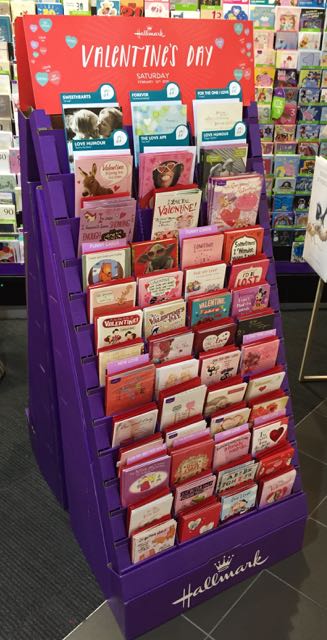
A Valentine’s Day card from your cat?
I’ve been looking at new card giving captions, at Valentine’s Day card captions from a range of companies. In the US they go all out for this season including cards from pets. I’m not sure how it works – maybe someone who knows a pet lover buys the card. The pet could not buy the card! People buy the card for themselves – or would they?
Newsagents have an opportunity to strengthen their position as card retailers by considering a broader range. That can include whole new ranges and captions within ranges. It can ilso include how we engage with the card category in store.
Too often we really on our suppliers to do this work for us. If we want a more unique business we need to be more engaged in the card category.
No, I’m not seriously stocking Valentine’s Day cards from pets. But I am looking for different product through which I can enhance my positioning.