It is great to see people support the channel in everyday practical ways
In a travel related Facebook forum to which I belong a member posted the comment below. Underneath it is my response.

Like I said, this is great to see.
In a travel related Facebook forum to which I belong a member posted the comment below. Underneath it is my response.
Like I said, this is great to see.
 I noticed the calendar pitching a Sanity store in Emerald in Queensland – two calendars for $20.00, a 20% discount off the suggested retail price. While the multi-buy offer is compelling, that it was placed in the back corner of the shop without any supporting collateral left it to be an offer for those who shop the shop rather than driving traffic from front of store placement.
The news of redundancies at News Corp. are something for newsagents to consider as they come on the back of an 11% decline in ad revenue in the first quarter of the company’s new reporting year.
The 11% decline in ad revenue matters to newsagents as this is a key figure in determining the value of putting the print product into the marketplace.
Worldwide, ad revenue in print newspapers is down, plummeting according to The Wall Street Journal – they say the global decline is expected to be 8.7% this year.
All of the gloomy data points in these stories and the year on year trajectory of the data points about newspapers tell us that print newspapers will end. The trends are too well established, habits have been changed forever.
Any newsagency business owner relying on newspapers for traffic needs to be fully aware of what is happening on newspapers. They need to factor the reality of the trend into their business plans. They need to know (or should have known more than a year ago) what the business needs to replace the traffic of newspapers.
Take the news of the redundancies this week as a prod to engage on the issue of replacing the newspaper traffic. Ensure you have a plan, and start implementing it. Many have already and for many of them it is going well.
 I love the list from Gotch yesterday listing the top 50 titles. This is a good first step. Next, I would love the list to be accessible online, by MPA category and segment. Then, I’d like the ability to click to easily order a title. This is how we can expand range and help sell more magazines, especially magazines in the long tail – niche titles that often get lost in the mix. This is what many newsagents want – an easy way to specialise without the risk of a pandora’s box being opened and unwanted titles being sent.
I have seen the Elf on the Shelf product discounted by as much a 30%, which is odd as this item sold well last year through until the week before Christmas. This year, in shops and online, I am seeing it discounted. This makes me wonder if the route to market change for this year has not worked as expected.
The retailers where I have seen Elf on the Shelf discounted have been more larger businesses where stock is given little time to perform before it is quit.
While the superannuation story that exploded Sunday claiming employers are underpaying 2.4m workers was more journalism by press release than genuine reporting, it does bringing focus the obligations of all employers in terms of superannuation.
Newsagents need to ensure they are up to date. They should emerge government resources to save time and red-tape. Yu don;t want to find yourself in trouble from an ATO audit.
Superannuation is not something to ignore. There are legal obligations on what has to be paid and when it has to be paid. Ignorance is no defence.
Like all compliance matters, the rogue behaviour of a minority tarnish the rest. In our channel, I know of a couple of sold in distressed circumstances, leaving a superannuation debt yet having plenty for an overseas holiday. yet I know of plenty of newsagents who don’t even pay themselves so they can meet all employee and other obligations on time.
Superannuation is now in the spotlight thanks to the reports driven by a super fund on the weekend. Make sure your house is in order.
 Maybe to the locals in Manchester in the UK the some days free some days paid approach for the Manchester Evening News makes sense. As a visitor to the Manchester last week I found the free / paid model odd, almost confusing as I recall checking the day of the week to see if it was a free day. They have been doing it for a while so it must work for them.
I think we are beyond a free versus paid model for the print product as the print product itself is the issue. There was time this model was a reasonable stepping stone from paid only. With more options today for direct brand / consumer engagement platforms like a newspaper (in print or digital) are not as important as they were a few years ago.
This European TVC from Lottoland is a more sophisticated pitch. I can see this resonating with Australian audiences should it air here.
This is the competition newsagents and Tatts need to confront head on.
Check out the email Lottoland sent its customers yesterday about double-size jackpots for Australian lottery games.

Lottoland is engaged with their customers through regular emails like this one. Compelling.
Paul Yardley, the new CEO of GNS wrote to newsagents last week:
Hi everyone,
I am writing to introduce myself as the new CEO of GNS. This is my sixth week in the job and I have been fortunate enough to meet some of you already on my travels around the country. I hope to meet many more of you in time.
Let me start by saying “sorry”. GNS is owned by, and operated for, you – and we have not been doing a very good job. If you’re a customer of ours, our service levels have been poor. If you’re a shareholder, our profitability has been unacceptable. That needs to change, quickly, and I have already taken some important steps to start that change.
The stationery market is under intense and sustained pressure. The trends are clear: overall revenues are fragmenting to a broader retailer base and continuing to decline, margins are under pressure and costs continue to increase. We all must evolve to stay relevant. Each part of the industry needs to examine how (and whether) they create value relevant to the end purchaser of the products we make, import, distribute or retail.
I believe GNS has some real strengths – a large, loyal, interested and passionate customer base; employees with many decades’ experience of the industry; a nationwide distribution capability; and a strong balance sheet. These position us really well for the future.
But GNS has to do better. My priorities for us to do that in the short term are:
• We will refocus on our core promise so that orders are fulfilled on time and in full by eliminating delivery delays and out-of-stocks;
• We will put the customer at the heart of everything we do by listening, acting on feedback and understanding how needs differ, so we can service based on those needs; and
• We will drive out all unnecessary cost, wherever it occurs.Earlier in November we completed a major refinancing of the business whereby we sold (and leased back) our NSW warehouse, enabling us to substantially reduce our bank debt and re-invest in inventory. That refinancing has put GNS on a financially secure footing and will support our ongoing improvement.
Over a slightly longer horizon, GNS needs to evolve into a highly efficient logistics business fit to support 21st century retailing. That means GNS needs to change substantially from where it is today, where our current operating model owes more to legacy and history than it does to being “fit for purpose”.
What that means is GNS must become a highly efficient, low-cost operator. We have made a simple task (buy, sell and ship stationery) far more complex and costly than it needs to be. So we will look to simplify our business, automate processes, reduce unnecessary costs and eliminate inefficiency in everything we do. And we will reinvest rapidly in the areas that will add to the end customer: great value product, customer-facing functions, and technology.
I do understand that some recent changes have caused angst, for example the closure of Cash & Carry, but I am committed to listening and responding to concerns on these. While hugely necessary to create the DC efficiencies that will allow reinvestment, I will implement ways to have customers access our warehouses periodically and see new product such as regular open evenings, an annual ‘Market Fair’-type event etc.
We have also overdone the centralisation of some functions vs a state-based approach, and we will look to make some changes to this shortly.
I know the industry has many questions for us as we start our transition. Some of those we can answer today but some require more work. To that end, we are undertaking a major review of all parts of our business and I will update you on the outcomes of that in the first quarter of 2017.
This is a critical time for the industry and for GNS, and it’s an exciting time for me to start working here because I believe the opportunities for GNS far outweigh the challenges. With our refinance complete, a refreshed focus and priorities, and renewed commitment to being the wholesale partner of choice for you, I am looking forward to the future.
I wish you very successful trading through the peak period and assure you of our ongoing support.
All the best,
Paul.
I’d love a dollar for every story I have heard from newsagents about a supplier rep reportedly claiming something their company does not agree to. If a rep makes a claim or offers a promise, write it down and get them to sign and date it. It is amazing the promises, competitor claims and offers that cannot be put in writing … probably because they are not true.
Unless it is in writing, don’t believe it.
I know, this seems very basic, so basic in fact that it makes almost no sense to mention it. But mention it I must.
New stock received in your business cannot be purchased unless you take it out of the boxes, receive it into your retail management software, price it and place it on display for customers to see.
This is your job to do. Not a supplier. No, your job.
Do it and the new products you have received may sell. On the other hand, if you prefer, leave the product in the boxes and complain to the supplier that their product does not sell.
Competitions are a terrific way of attracting new shoppers to any retail business.
Key factors in the success success of competitions are:
I know of small local retail businesses achieving engagement of 500+ in competitions. They have got there by being consistent and following the points noted above.
The best competitions are those you run yourself for your own business. Show yours is a genuinely local business.
One retail stores I visited yesterday used boxes of roll-wrap to guide traffic on the shop floor. It worked a treat. here is how it looked in one part of the business.
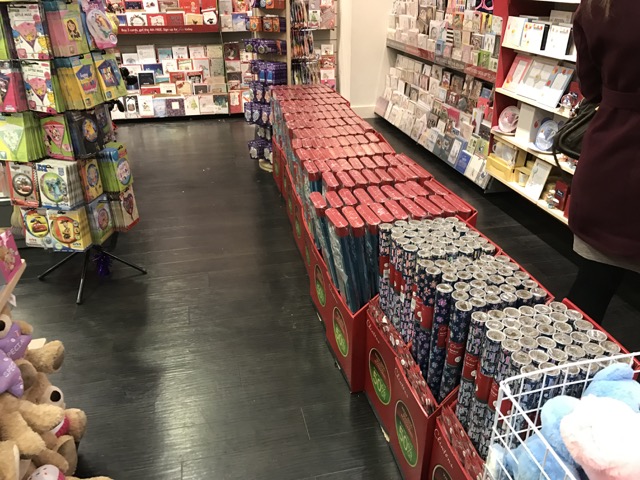
This is a simple idea that can work especially well at Christmas time. A manager in this store said this placement was key to them growing wrap sales away from the wrap section.
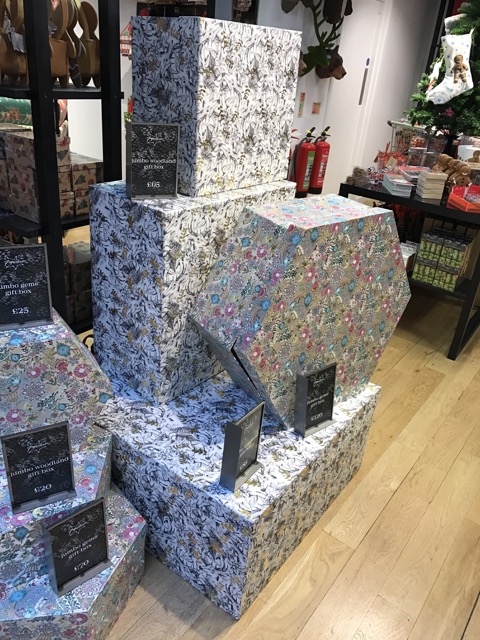
The largest of these, the one on the floor, is huge and sells for £85.00. Talk about changing expectations and creating opportunities.
At a WH Smith in Manchester yesterday, standing in front of the weekly magazines, I found myself wondering which offer they wanted me to notice.
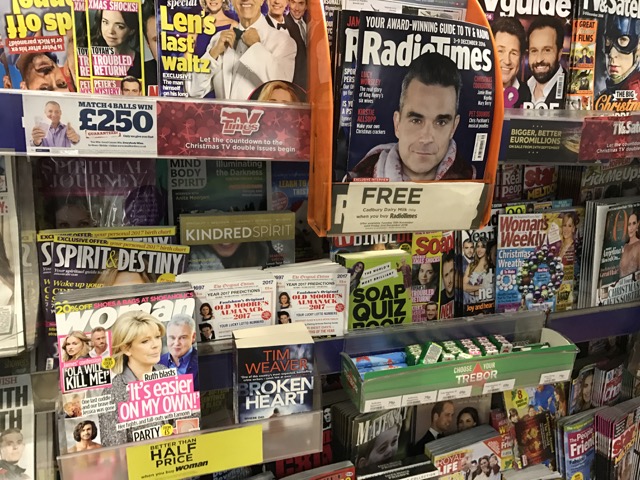
There were too many of them so I figured none. The best message sin retail are the obvious, those that cut through and make sense.
I have been in Manchester in the UK, population 500,000, for the last day and a half and have been surprised by the Christmas shopping traffic. Retailers I have spoken with tell me the traffic will not peak for at least two more weeks. So, this video I shot at one intersection does not reflect peak traffic. I’d love traffic like passing my door this time of the year.
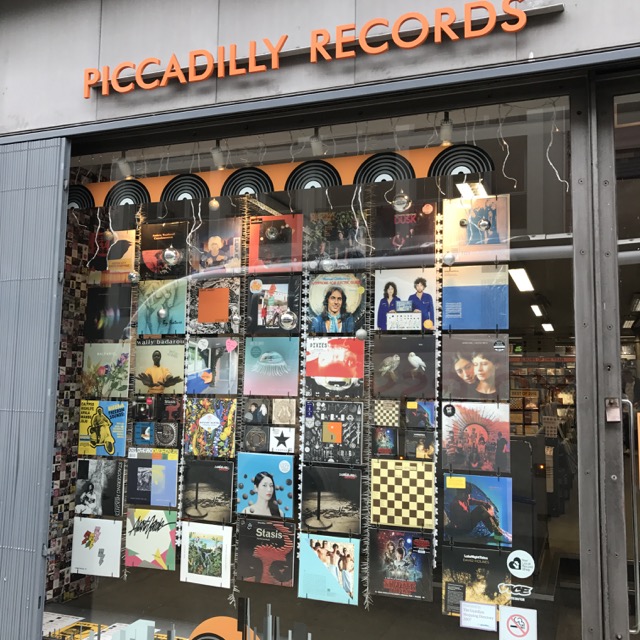
Ten years ago few could imagine the resurgence vinyl records would have. Within a couple of minutes of each other I found three shops yesterday in Manchester in the UK. Each has a point of difference yet overall serves people with a common interest. I share the photos to show that what may be losing interest today for many businesses could be successful in the future for fewer businesses.


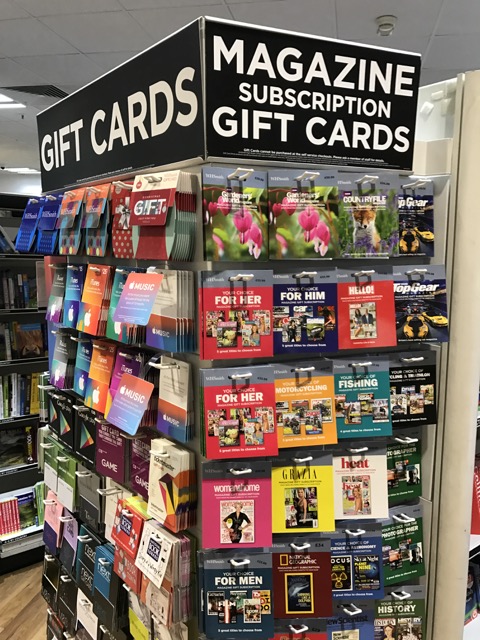 WH Smith stores in the UK sell magazine subscriptions like this now. Years ago, they were in a box on a spinner. Now, they are placed with gift cards, taking up less space and better located in-store. That they still offer subscriptions today suggests there is money in it for them. There have been several goes at newsagents selling magazine subscriptions like this in-store in Australia over the years. None has worked I think because it has not been more than one or two titles.
From Paperchase in Manchester UK. A curated selection of products in each of four displays. Brilliant.
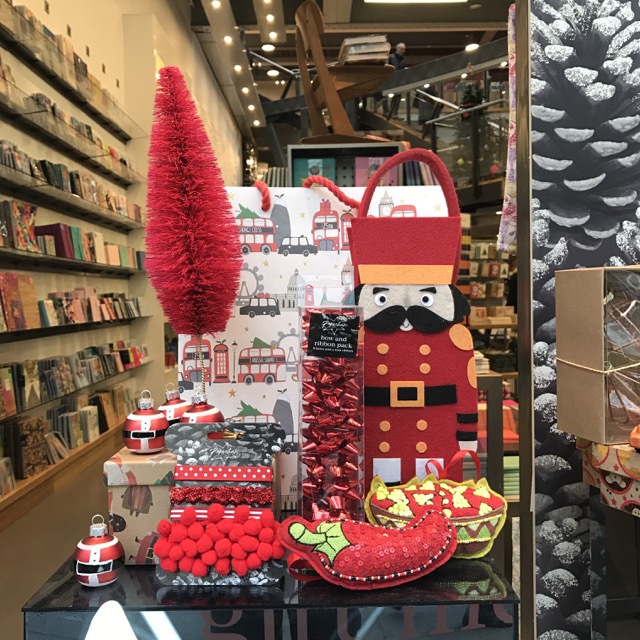
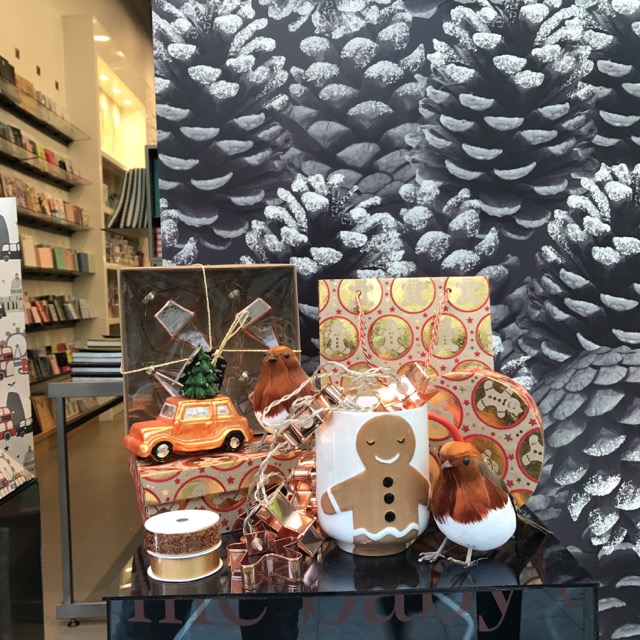

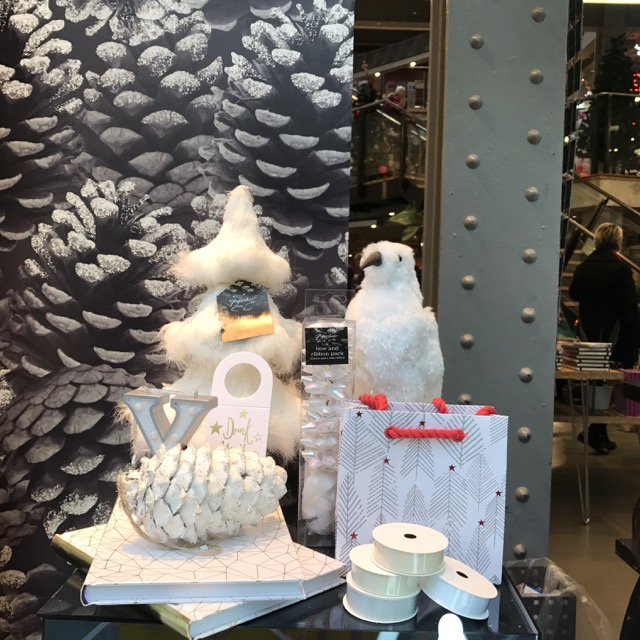
I am aware of News Corp. contacting a newsagent with four pages of amendments to the General Store Agreement. I am curious if any other newsagents have been approached and if so what did you do about it? I’m happy to receive an email response rather than commenting publicly here. mark@towersystems.com.au.
I love this Christmas window display from the team at newsXpress Bairnsdale for it pitches the business outside of what people might expect from this shop, it is fin and inspiring.

This is what the front window is all about, especially for retail businesses in high street situations country towns where attracting impulse visits depends on the window display.
This window display says come on in, this is a fun place to shop. Most important, the window appeals to kids and anyone who buys for kids and this time of the year that is most important.
The best place to start to redefine any retail business is from the front window. Start there, set your messaging and then work this into the business. Of course, any strategic change should start deep within the business, however, starting with the front window can unlock inspiration that demands to be addressed in the business itself.
This window display at newsXpress Bairnsdale is excellent, a proud representation of optimistic retail.
I hope it inspires plenty of newsagents to work on their window.
Our world has changed forever. By our world I mean the newsagency world. Changes are not stopping either. Indeed, I think the pace of change has picked up.
One of the best places to see beyond changes we are confronted by today is a place focussed on the future. That is what Slush 2016 is – a gathering of 17,000+ people talking about start-ups. There is no better place to contemplate the future than in an environment dedicated to the future.
While many of the start-ups have nothing directly to do with what newsagents do, plenty relate to changes we can contemplate – such as changing tracks to serve how people will consume in the future compared to how they consume today.
Slush 2016 is proving to be a good place to think about these things, to contemplate change, the urgency of change and what our businesses may look like. I get that some like the traditional newsagency. Nostalgia is something to appreciate. However, it may not pay the bills – not for enough newsagents at least.
There is nothing like this back in Australia. If we see a story on TV or in a newspaper about change it is already old. It is at start-up events like Slush where you hear about the idea while it is still fresh.
To set the scene, here is a brief clip from the amazing opening:
This blog is not the place for me to share specific takeaways, of which there are many – personal and business.
Here are some photos from the event.








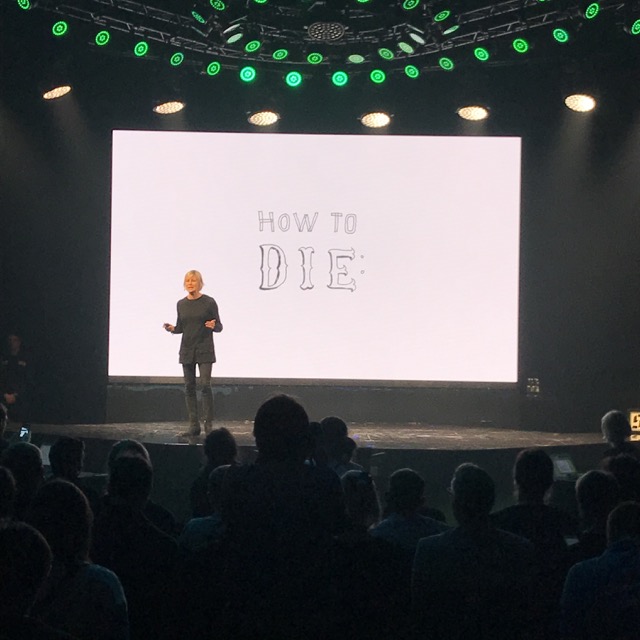
This session on dying was extraordinary.
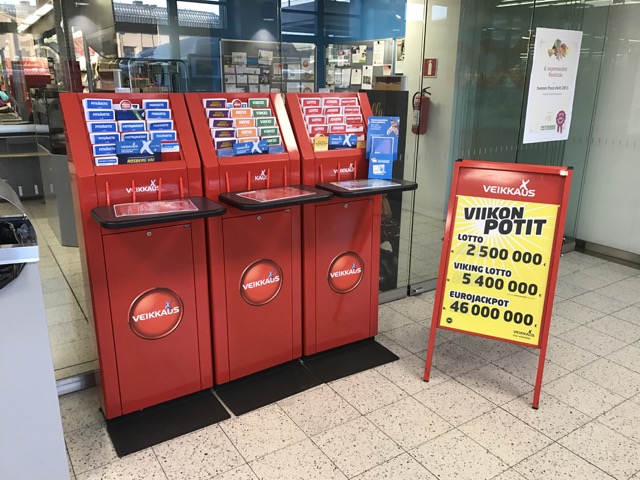 I checked out plenty of lottery outlets in Helsinki today. The only fit out apparent was the stands you see in the photo. Low key and low cost. The burden on Aussie newsagents of the fit out requirements is extraordinary. It is made worse by the double standards with small business having a what looks like higher cost obligation than big business. In Finland all look the same and all are low cost.
The December 5 issue of Dolly magazine will be the last. The masthead will continue online but for print, this is the end.
This move was only a matter of time. In 2012, Dolly was selling 90,000+ copies an issue. This year, it has been selling 30,000.
The announcement by Bauer Media to close the print edition of Dolly comes just after Pacific Magazines announced the closure of the print edition of Girlfriend.
It is a tough time to be a magazine publisher. 2016 has been a difficult year. The sales and closures have been necessary as publishers tune their businesses for changed circumstances.
The demographic served by Dolly and Girlfriend consumes information differently today than in 2012 when Dolly’s circulation was three times what it is today. In addition to this, the product brands that supported the print product back then now have their own direct to consumer channels that mean they are less reliant on the magazine brands that ‘owned’ the channel to the consumer back then.
This is digital disruption in several levels – the delivery of access to news and curated content and the disruption from brands owning and running their own direct to consumer channels.
The question for newsagents is what have you done to ensure your business attracts the Dolly / Girlfriend shopper?
The closure of the titles will not cause a significant drop-off as that has happened since 2012. What have you been doing to appear to these shoppers as you need them given the ageing population – you need new people in your pipeline?
While the closures are confronting, there are launches of more long-tail titles that present us with opportunities in specialisation. I have received three submissions this week from Australian publishers launching new niche titles into the marketplace, publishers only relying on the newsagency channel to reach their prospective readers, publishers with little or no focus on subscriptions.
While the low margin on magazines is a major challenge for gaining newsagent interest, the opportunity to be a specialist, and through that to attract new traffic, is appealing. Magazines are important to our businesses. We should welcome launches and help those titles find readers, especially the titles that sell exclusively in the newsagency channel.
Footnote: For an excellent article on the Dolly move, read Miranda Ward’s article at Mumbrella.