The NRL supports small business newsagents
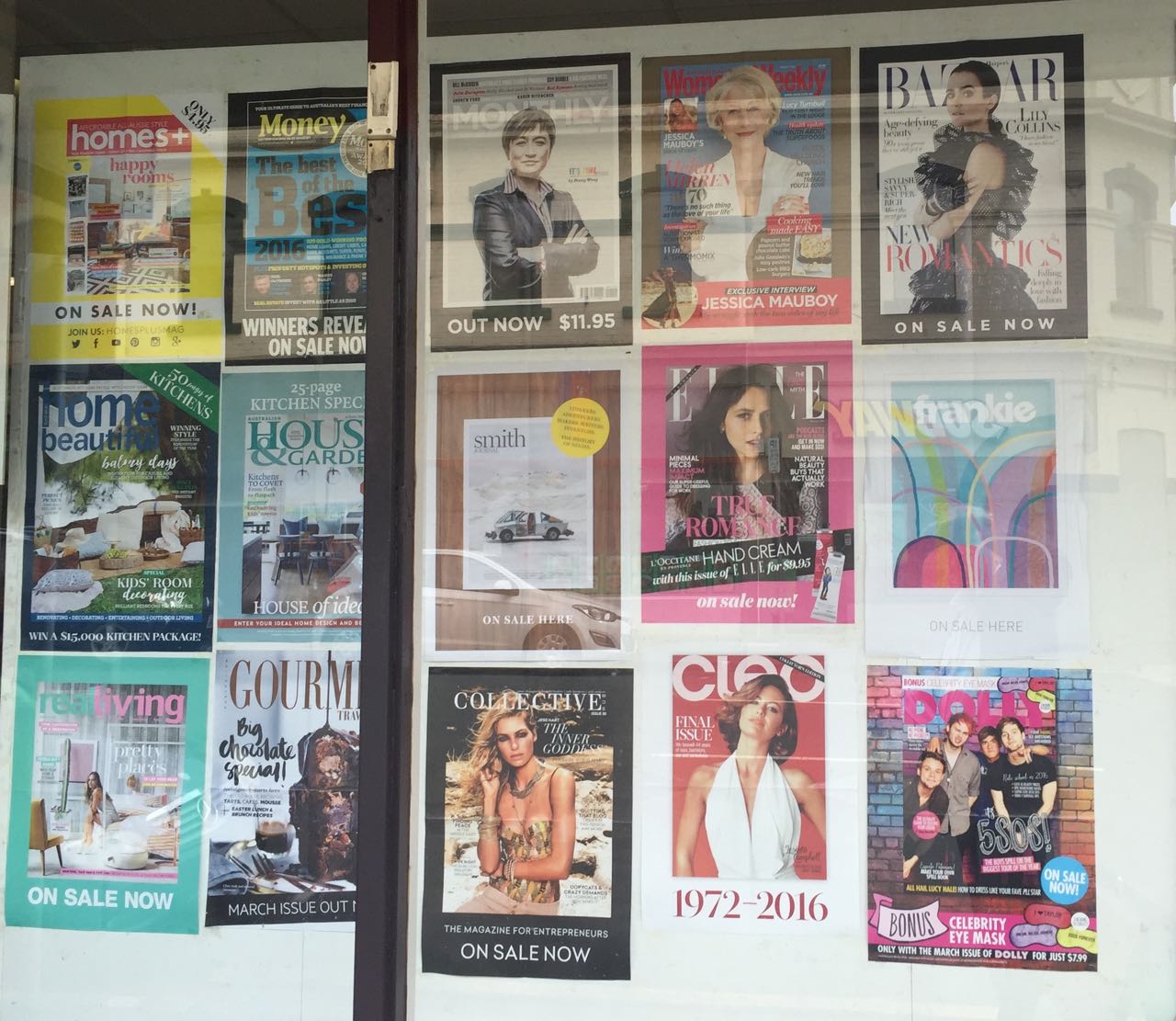
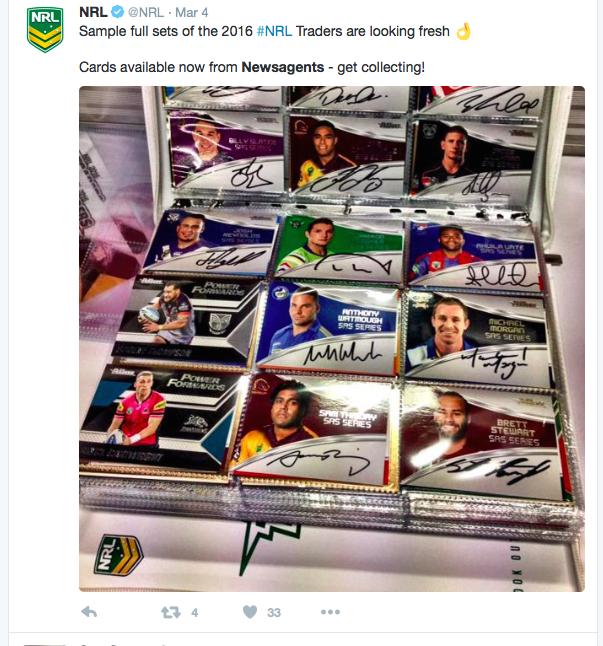
It is great to see the NRL promoting small business newsagents to their 394,000 Twitter followers.
Here’s a marketing tip, promote the collector cards on your business Facebook page and Twitter feed.
It is great to see the NRL promoting small business newsagents to their 394,000 Twitter followers.
Here’s a marketing tip, promote the collector cards on your business Facebook page and Twitter feed.
Does each person working in your newsagency business have a position description? If not, create them. This is essential if their performance is to be measured. Not having a position description leaves the business and the employee vulnerable. If you are in a marketing group ask for a template.
I love this cubby house I saw within a toy shop in Sydney recently. Kids see it and they run to it. They know it is there for their pleasure. Newsagents focussed on toys and other items for kids could create something similar for school holidays and promote it outside the business in the local paper, to parents groups and on social media. Having this in-store will change the feel of the shop and make your kid focus clear.
The newsagency channel has changed … because retail has changed because how people shop has changed because how people get news and information has changed.
Too many of our old school suppliers don’t get it. They think they can continue pay party commissions, expect premium space and expect us to focus on them ahead of where we make our real money.
Too many old school newsagents don’t get it .. you know, those who run their businesses as they did 10 and 20 years ago are in businesses with no future. these are the businesses closing, as they should.
Newsagent associations don’t get it. They focus on old school stuff and try and copy proactive marketing groups for new stuff.
I have spoken with three newsagents today who are being treated badly by suppliers because they are putting the needs of their businesses ahead of individual supplier needs. The newsagents are being smart. The are building stronger businesses from which the suppliers will most assuredly benefit yet the suppliers are too arrogant and stupid to see this. They think they can demand the newsagent serve them ahead of everything else.
My suggestion is if a supplier is being too demanding, beyond the value of the return of their products for the business, quit the supplier. Be done with them. This is true for any supplier including magazines and newspapers and lotteries. You own your business. The needs of your business have to come first.
And if you are paying association fees expecting the ANF to work on these issues for you – save your money, back yourself instead.
I like this retailer training initiative from Lotterywest. The only enhancement I’d like to see is for the training to be available online – but still live to facilitate lower cost engagement. Here is their announcement
Last week we made an exciting announcement to our retailers in our weekly e-newsletter InTouch, about the launch of our Lotterywest Retailer development workshop program.
The program has been introduced to provide retailers and their teams with regular professional and business development opportunities during the year. We’ve chosen topics based on feedback retailers have shared with us over the last six months.
Take a look below to see what’s on this year.
Workshops are for owners, store managers and staff. Meet our workshop presenter, Danielle from the Chamber of Commerce and Industry Western Australia (CCI WA) who we’ve been working with to customise the workshops to best suit the business operations of our retailers, whilst providing practical skills, knowledge and tools to enhance workplace performance.

I like this placement of the iPhone 6s instruction magazine with British weekly magazines. It was done by the manager at one of my newsagencies in response to noticing the demographic of the iPhone magazine customer. This type of deliberate off-location placement of a magazine title is the work of a magazine specialist.

We are promoting issue #2 of Lunch Lady magazine with Better Homes and Gardens, hoping the success of each will drive sales of the other. The full cover placement in prime position is key, especially for Lunch Lady, a new title people are less likely to visit to purchase.
Miranda Ward writing at mUmBRELLA has represented newsagents well in our fight with supermarkets on magazines.
I am pleased to see this quote from me as it is a message publishers need to get.
“Supermarkets treat magazines as a commodity. Newsagents continue to range the category as specialists. That has a higher cost for us yet we are not respected for this.
“The MPA needs to reconsider its focus on newsagents as the specialists as the current situation is a band aid approach that does not serve them or us well.”
While the current MPA newsagent only competition is good, it is not a strategy to revitalise magazines in our channel and for all Aussie publishers. No, to do that, we need to be respected for the specialists we are – as I have written before. If publishers do that, newsagents will reinvest in the category and, I expect, the dangerous sales decline of recent years will slow.
The current promotion is a tactic. What is needed is strategy. The MPA is not currently demonstrating an appetite for developing a strategy with and more newsagents.
This is a boring topic that many will tend to not read. Please resist that thought. Employee training is important. Employee training can help you save time, reduce theft, increase sales and retail good employees.
Through my newsagency software company I see data on engagement by retailers and their employees on a comprehensive free online software use training curriculum. The curriculum includes more than 130 videos structured into topics based on work role, live online training workshops and other activities.
Ranking seven different retail channels, newsagency businesses rank the lowest for using the free tools. Garden centres rank the highest, making the most comprehensive use of the free training resources.
I am not talking here about a large time investment. Some training videos run only five minutes.
Through engagement data I can see some businesses put a new employee through between an hour and three hours of training, earning the employee a certificate and ensuring a level of competency. This matters if training is not done and mistakes are made that cost the business money.
Regardless of the software you use, my sense is that an employee working 30+ hours a week in a newsagency ought to undertake at least twenty hours of professional development a year to improve their skills and their value to the business.
I’d note my suggested 20 hours is lower than the 2% the federal government suggested years ago for employee training annually.
Hour much time do you invest in formal employee training or professional development each year?
News Corp. today announced the results of its remuneration review for distribution newsagents.
It is appalling that a supplier can dictate the fees a small business can charge for such a labour intensive service.
Newsagents, the service providers, ought to be able to charge what they like. But, the system is the system and those in the system entered it knowing the terms.
The fee increase is disrespectful and socially irresponsible.
Victorian distribution agents looking to save money ought to consider quitting VANA, the local newsagent association as VANA is clearly not able to help them on the single most important matter, fair and equitable remuneration. Further, it has never been able to help them. Save the fees and reinvest in your business and you will be better off.
I had a good look at the magazine department at WH Smith in the Sydney International Terminal yesterday. It is impressive, far superior to what you see in WH Smith stores in the UK. Whereas in the UK they use old unwelcoming fixtures and support them with mediocre lighting, in Sydney I saw fresh fixtures you hardly notice supported by good lighting.
Here are photos. The first is of the back wall. This is what drew me in. 210 magazines. Full face display. Deep pockets negating the need for a waterfall to hold stock.
Here is business and current affairs.
Here is home and travel.
And here is an overall view for context.
While I would not allocate this much space in a more competitive situation than an airport terminal, I do like what WH Smith has done here. I hope the photos provide inspiration to newsagents considering shoplifts.
Note, not one of the fixtures is purpose built. All can be clipped in and clipped out. This is vital for any fixture in a newsagency business today.
Credit Suisse has this morning issues an update on Tatts Group that newsagents may find interesting.
Tatts was unsuccessful in retaining its A$540mn pokies licence refund after the High Court upheld the Victorian Government appeal. Tatts must also pay 20 months of accrued interest and legal costs which we estimate to be A$50mn.
I wonder if media coverage of the Tatts High Court loss will be as strong as when they won. I recall some media outlets were savage toward politicians. Will they now apologise for this? I doubt it as it would not serve their political purposes.
The next time a supplier representative offers you a product on a sale or return basis, ask for more information. Ask your buy price if you take it firm sale. Ask whether other retailers with the same product are offered sale or return.
I am not talking here about product such as newspapers, magazines you’re your main card range. No, my interest is more with gifts and related items, new card spinners and toy related items.
I label sale or return as a curse because too often I see it stop retailers being retailers, managing a product on the shop floor for maximum performance – because if the background is the knowledge they can return the product if it does not work.
I think a sale or return offer makes retailers lazy. I think suppliers offer it because it is an easy to get a product into a retail business and once there it is more likely to stay.
Compare how you treat sale or return product with firm sale product. I sell plenty of retailers treating the two differently. Firm sale product is worked hard, pushed to sell through, to achieve the necessary return on inventory, space and labour for the business. This makes sense since it is your money at risk.
With sale or return, it is easy to consider that you have no risk. Without risk, where is the pressure. While some retailers will work sale or return product hard, plenty will not and this is why I say it is a curse.
Sale or return is not a benefit. I see it most often as a lazy tactic used by some suppliers because their product is not good enough to support a firm sale approach.
To newsagents I say: take the challenge of being completely responsible for your buying decisions. Chase better deals from firm sale. Work the product hard. Drive a faster return. Look at products differently as a result.
This afternoon, Network Services released update #5 on the transition of magazine titles to Gotch. Click here to access this update.
FYI this is the last update from Network.
The decisions we make in placing magazines on our retail shelves represent a kind of storytelling. Look at the current issues of The Australian Women’s Weekly and Mindfood next to each other.
Each features Helen Mirren on the cover, and for similar reasons related to age. Whereas an average retailer will put the titles in their usual spot, most likely separately. A smart retailer places them next to each other, telling more of a story and, hopefully, driving sales.
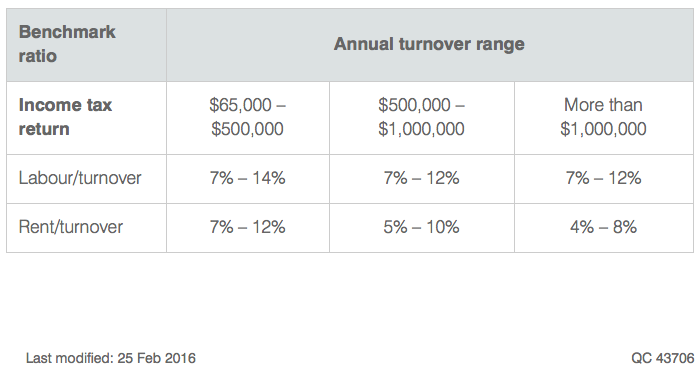
Further to a discussion here, I decided to publish updated newsagency performance benchmark targets, to reflect the rapidly changing nature of our channel. These are some of the benchmarks I have provided to newsXpress members, but not all.
I say rapidly changing nature of our channel because that is what we are seeing. The traffic mix is changing as is the mix of what successful newsagents sell.
The benchmarks below are guidelines. They are subject to change as the suggested business model evolves.
It is important to have a goal, a target and that is what these benchmarks represent in my view:
These benchmark figures don’t all need to be considered together. You can pick one, measure, work on it, measure and adjust as the numbers indicate. The goal is to continually improve to pass the benchmark and work on the next.
I acknowledge these benchmarks are not close to what newsagent associations have recommended or would recommend. My focus is on the future whereas their focus tends to be on old-school products and services. Success in the future comes from diverging dramatically from the past including past benchmarks.
If you have any questions about any benchmark, please contact me. I’d be glad to help.
Next month, News Corp. introduces changes in the handling of newspaper subscription payments by distribution newsagents. this is the next step in a project started years ago in South Australia.
On April 11 they are moving all subscriptions for News Corp product from a mixture of Pay at Publisher (Office Pay) and Pay at Newsagent (Carrier Collect) to Office Pay. This will affect around 300 newsagents as the News letter notes.
While affected newsagents will be able to handle data changes manually, it will save them time if their newsagency software companies make this easier and faster for them. That is what Tower Systems will do. Other software companies are welcome to note their planned processes here.
This is another reason to offer Touch Networks services as this is how accounts are paid. I am proud to have connected Touch and News years ago to facilitate this in-store payment method. Prior to then, the News payment model did not have an in-store payment option.
I am often asked for photos of changes made to the layout of the newsagency based on what I write here or when I speak at meetings and seminars.
This photo, takes this past Saturday, shows part of the magazine department. It runs down this fixture to the back wall where we have 250+ full face pockets.
The display area to the left of the main magazine fixture changes regularly as does what is in front of the magazine fixture to the front of the store.
We also adjust the layout of the magazines regularly.
The key point I want to make here: everything changes, nothing stays the same. I think this is essential in retail today. Shoppers are more fickle than ever. We need to keep our stores fresh and appealing. We need to push back on those few customers who complain about product location changes.
We to lay our businesses out to maximise the return we achieve.
Click on the image for a high res version.
I have focused on the magazine department in this image as it is the part of the business many newsagents continue to be reluctant to change. Some do, but not enough.
We are in a fight with supermarkets and other retailers. If we do not change our in-store offer we will lose the battle. Range and supply volume – they are topics for another day. This post is about the part of magazines over which we have control – how we lay them out in our businesses.
With more and more retailers using easels and noticeboards to signpost seasons, we are doing this for easter, with this placement of the Easter poster next to easter cards. Out of shot, to the left of the cards, is Easter gifts.
For a while now I have thought that hanging posters is not always ideal. Some seasons lend themselves to a different approach – such as what we are trying with Easter at the front of the newsagency this year.
Help desk call traffic more than trebled for my newsagency software company today as newsagents updated data managed by their software reflecting the transfer of many magazine titles from Network to Gotch. All in all it was an orderly process. With 1,750+ newsagents using the software it could have gone any one of a number of ways.
While I expect help desk calls to remain high all week and into next week, today was the day of proving the process and testing the value of all of the preparation communication including that from Network.
Small business newsagents can be proud that they are handling significant change with calm professionalism.
Newsagent suppliers ought to take note. What is happening this week is newsagents demonstrating they can deal with challenges of a technical complexity. How newsagents have gone about this is another reason to support our channel ahead of supermarkets and other mass retailers.
Newsagent associations ought to take note. This is all being done without you.
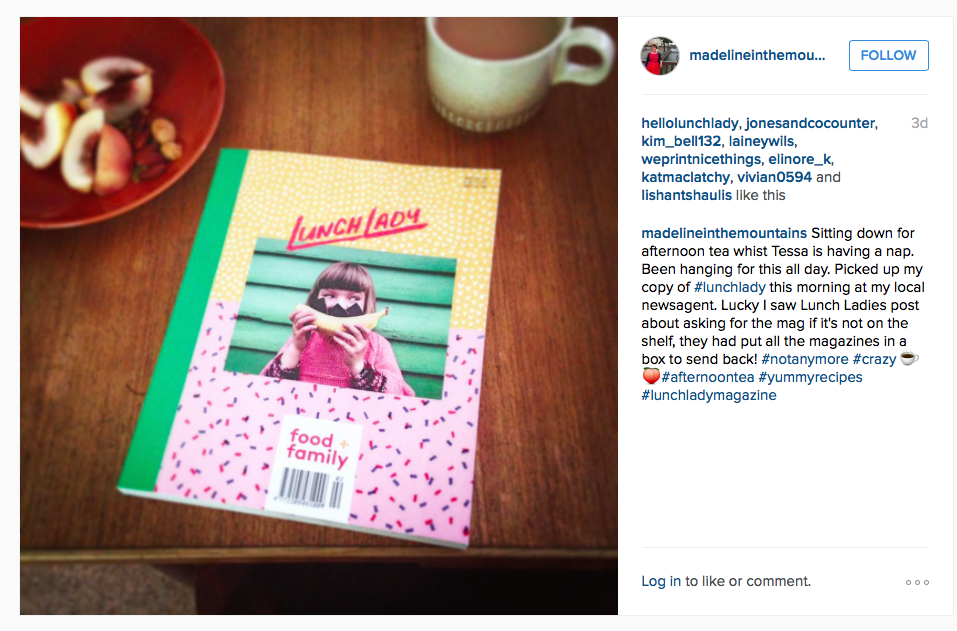
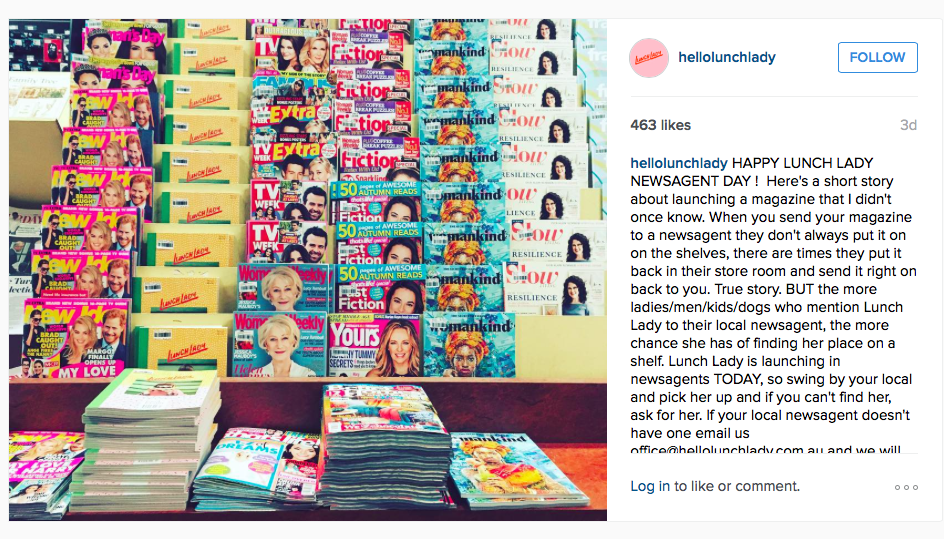
Issue #2 of Lunch Lady launches March 3. Issue #1 sold well thanks to terrific social media and word of mouth engagement. This is a niche title people love and they will get to their local newsagency for a copy. It is the type of niche title we can use to leverage our positioning as magazine specialists.
The image shows the cover of issue #2. Here is a note from Louise Bannister, publisher of Lunch Lady:
We are about to release Lunch Lady NUMBER TWO which is very exciting. Launch through newsagents is March 3rd.
We had great sales results from many newsagents who put issue one out on shelves.
We have worked really hard with our readers through social media to gauge where their local newsagents are and as a result have done a very tight allocations list for issue two.
Our social media accounts have increased significantly since the first issue from 5k to over 20k. We will be driving our readers
to newsagents through social media. Any support on getting the Lunch Lady message out there is much appreciated.A good description of what Lunch Lady is ::
Lunch Lady is a quarterly for people who used to read frankie magazine but are now grown up, have kids and are searching for a funny,
unique, creative NEW parenting magazine (which is packed with kid friendly recipes).SOME READER LETTERS::
“I stumbled upon the magazine in my local West End news agency. There it was. The colours catching my eye amongst the sea of tiered perfect binding.I guess I just really wanted to write to you to say, I feel like we are pals. Pals through pages, tasty ideas and grubby paws. I am enjoying the read so very much, you should be immensely proud of what you have created. I’m also now a walking marketing machine telling everyone and everything my affections for your publication.”“ Ladies, I just wanted to say well done! Read some blurb on your new mag on Instagram, went out and found it this morning. The look, the feel = excitement!! So came home and read it from cover to cover – lalalalalaloved it! Definitely the most interesting read on the shelf right now!”s
“Hi Lara, Lou and Kate,
I hope you’re all really well.
Congratulations on the launch of Lunch Lady – I LOVE IT! For years I have been thinking, when is there going to be a cool parenting magazine?? And now there is one. So thank you, from this young mum, who struggles to find anything online/in print that’s actually relevant to my parenting world. THANK YOU!”
Coles is promoting Easter confectionery at 25% off in-store on in the media, trashing the margin opportunity for other retailers, especially small business retailers who can’t strong-arm suppliers to discount to allow 25% off retail to be profitable.
So rather than compete with Coles, Woolworths and other mass retailers and the price games they play, I pitch other products for seasons like Easter, products the majors tent to not pitch or, at least, not discount like this.
I wish we had politicians in this country with the requisite guts to dilute the market power of Coles and Woolworths. The pressure they put on suppliers and primary producers is not socially responsible.
A cool pub venue in Melbourne has old magazine covers on wallpaper plastered all over the wall including the very cool image of an old New Idea cover.
I mention this today as it connects with my post a couple of days ago about Mojo ’60s. There are plenty of opportunities in the retro space in products we can sell including circulation product. At the gift fair in Sydney last week many suppliers were promoting retro product. I need this retro wallpaper as a backdrop.