A blog on issues affecting Australia's newsagents, media and small business generally. More ...

Author: Mark Fletcher

More ATM providers remove ATMs from tobacco retailers

It is good to see more ATM providers removing ATMs from tobacco shops.

One of Australia’s largest private ATM suppliers, Macquarie Group-backed Next Payments, is removing more than 40 of its machines from suspected illegal tobacco stores.

Next Payments chief executive Tim Wildash announced the move after an ABC investigation found ATM companies were cutting deals with tobacco criminals and installing their machines in high turnover illegal cigarette shops.

Mr Wildash said he had not been aware of the extent of the issue until the ABC’s reporting, and he was insisting the company remove ATMs from the outlets.

A large number of illegal tobacco retailers use card payments terminals provided by banks and fintechs to sell illegal products according to multiple news reports. So, this latest move. by Macquarie, is a good step against this support for illegal tobacco retailers.

The latest move is on the back of this story from the ABC.

Tobacco shop ATMs can do triple the business

The ABC has obtained court documents from a legal action sparked by the turf war between the ATM suppliers over Al Deleymi’s business.

The documents reveal the normally secret returns generated by ATMs in tobacco shops, including how in some cases such machines do triple the business of a normal ATM.

Transaction rate dwarfs typical ATMs

To prove how much revenue was lost, atm2go offered up details of how fee deals for private ATMs are structured.

Atm2go stated it charged customers $2.50 for each cash withdrawal and that Al Deleymi would earn a cut of each transaction fee of up to $1.30.

One machine at a Caboolture tobacco store recorded 165 transactions daily throughout May 2022, while a second racked up 155. Together, they reaped daily average fees of $408.79.

This transaction rate dwarfs that of typical Australian ATMs, which record an average of only 38 cash withdrawals a day, according to Reserve Bank of Australia figures.

This high transaction rate came despite the presence of other ATMs nearby.

With tobacco products present in around 20% of retail newsagencies, this story is one of interest for our channel.

It is good to see action on illegal tobacco.

5 likes
Social responsibility

Why parcel pickup is not a good service for Australian newsagents to offer

Before I get into this I note that by parcel pickup service I do not mean Australia Post parcel services through a Licensed Post Office. I happen to think an LPO in the right location inside a newsagency can be a good move.

No, here I am writing about agency business, where a newsagent acts as an agent for a parcel pick up or drop off service.

The financial compensation is low. You get paid peanuts, often not reflecting the time involved.

The time spent can be considerable. Customer queries and more can take up too much time.

Customer anger can be high. Having to wait while you serve people buying products tends to frustrate parcel people who want immediate service. Product customers can be angry too when you serve parcel pickup customers ahead of them.

Space requirements at a premium location in store can be high. And it can vary based on volume.

Distraction from high margin retail can cost profit. The time spent dealing with parcels is time spent not being a retailer.

These are the key reasons why I think offering a parcel pickup and drop off service is hot good for an Australian. newsagency business.

A core argument for these services, that they generate valuable foot traffic, is often a myth in my experience, looking at plenty of business performance data from newsagencies over the years.

The parcel customer is typically a destination visitor, not a shopper prepared to browse.  Their goal is speed and efficiency. Any delay, whether waiting for you to finish with a retail customer or seeing you serve someone else, creates friction, not a sales opportunity.

Newsagents offering parcel pickup and drop off services are absorbing the courier company’s final-mile delivery costs. These newsagents are often seen as the face of service failures. When a parcel is late, damaged, or missing, it is the newsagent who can cop the customer’s frustration.

Regulars here would know I am not a fan of agency business as it is not good retail, it is not you investing in your business. Parcel services are that – not you working on and in your business for your profit.


Mark Fletcher founded newsagency software company Tower Systems and is the CEO of newsXpress, a marketing group serving innovative newsagents keen to evolve their businesses for a bright future. You can reach him on mark@newsxpress.com.au or 0418 321 338.

10 likes
Newsagency management

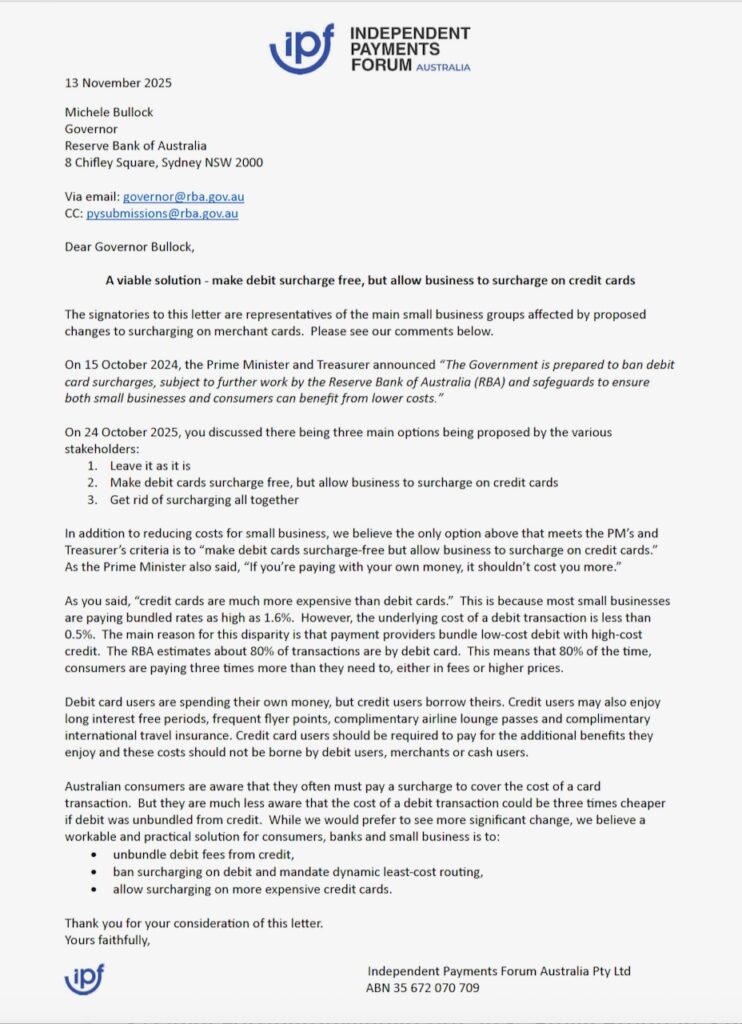
Kudos to ALNA for their strong position on the RBA surcharge position

ALNA issued a good and strong response to the RBA position on payments surcharges:

RBA Surcharge Ban Fails Small Business
The Australian Lottery and Newsagents Association (ALNA) has expressed disgust at the Reserve Bank of Australia’s proposed surcharge ban, condemning it as a bureaucratic failure that demonstrates a shocking lack of understanding of how small businesses operate.

ALNA CEO Ben Kearney slammed the RBA’s consultation paper on merchant card payment costs, describing the proposed surcharge ban as “adding insult to injury” during an unprecedented cost-of-doing-business crisis. “The RBA’s payment costs paper represents a fundamental failure to understand the realities facing small businesses,” Kearney said.

ALNA prepared a detailed submission HERE to the consultation so far and will continue to advocate strongly through the next phase of the RBA consultation.

ALNA also put out a media release on the proposed ban HERE. In the release ALNA highlighted the brutal mathematics facing our members, where newsagencies and lottery retailers processing an average of 1,000 daily transactions worth just $15.20 are selling fixed-price lottery tickets with regulated pricing and earning just 10-11.3% commission, losing surcharging rights means payment costs will consume around 7% or more of the entire profit margin.

ALNA is particularly disgusted by the RBA’s lack of courage to take on more courageous cost reduction reforms, our impression is that the real culprits are the card schemes whose huge profits are protected by complex regulations, the RBA are protecting the status quo while small businesses paying 300-400% higher card fees than large retailers, may effectively subsidise the low rates negotiated by giants like Coles and Woolworths.

“Small businesses currently bear the lion’s share of processing fees charged by banks, payment service providers and card schemes,” Kearney explained. “The RBA’s proposed interchange reductions are modest improvements that don’t address the core problem of cross-subsidisation.”

The association demands the RBA show real guts by implementing genuine structural reforms including mandatory least cost routing, deeper interchange cuts, and scheme fee caps. Instead of protecting big business interests, the RBA should deliver cost relief to small businesses fighting through the toughest operating environment in decades

ALNA is part of the Independent Payments Forum, which is lobbying on behalf of small business retailers. newsXpress is part of the IPF as well.

The ALNA statement is more emotive than the IPF statement. This is a good move by ALNA.

11 likes
Newsagent representation

Thanks Mediaweek of covering the sale of Are Media

I am grateful to Mediaweek for their interest in the impact of a possible sale of Are Media for local small business newsagents.

Magazine health check: What the industry has to say about the current state of mags

Campsie newsagency

With Are Media for sale, Mediaweek spoke with Mark Fletcher, Jackie Frank, and Nate Vella to consider the health of the local magazine industry.

Fifteen years ago, Mark Fletcher predicted that magazine publishing in Australia would face such a steep and sustained decline that newsagents would need to diversify quickly or risk shutting down altogether.

Fletcher, who is the CEO of newsagency marketing group NewsXpress and has been at the coal face of what he describes as print’s “slow and steady decline”, was anything but surprised when Are Media officially went up for sale last week.

With prospective buyers now kicking the tires on Are Media, Mediaweek took the opportunity to consider the health of the local magazine industry. Along with Fletcher, Mediaweek also spoke with Bench Media Head of Strategy Nate Vella and the vocal Jackie Frank, founding editor of marie claire Australia.

Unit sales continue downward trend

According to Fletcher, overall magazine sales in newsagents have dropped significantly in 2025.

“What we’re seeing so far in 2025 is that we’re sitting at around a 10% unit sale decline across the board. A lot of that decline is occurring in high-volume weeklies and monthlies.”

While many mass-market titles are losing ground, he says niche and puzzle magazines are proving more resilient.

“Special interest titles, such as Victorian Railroad Lines or Model Railway, are selling well… crossword year-on-year decline is sitting at around 2% or 3%.”

TikTok and portfolio overlap among key pressures

Fletcher sees digital platforms—particularly TikTok—as a major challenge to general-interest and entertainment-led print brands.

“Because Are Media is producing mass titles, they’re facing the challenge because that’s where you’ve got the biggest competition from TikTok and elsewhere.”

He also highlights a misalignment between Are Media’s focus and the categories showing the most growth:

“Special interest titles generally account for 20 to 25% of all magazines sold… women’s weeklies… account for about 8% now. 20 years ago, they would have accounted for easily 35 to 40%.”

He argues Are’s current magazine portfolio is too crowded: “Part of the challenge for the portfolio is how do they rationalise the portfolio rather than creating so much content that’s similar across different mastheads?”

“Right now, in terms of weeklies, you’ve got New Idea, Woman’s Day and Who, and for our marketplace, that’s probably at least one too many titles.”

Format stability and retail strategy shifts

Fletcher contrasts the volatility of lifestyle magazines with the reliability of formats like puzzles and established brands.

“You’ve got a tentpole product like Women’s Weekly, which is fantastic… but it’s so much cover-dependent.”

Meanwhile, puzzle publications attract steady buyers: “If people enjoy doing crosswords daily, they’ll likely continue… They can use their backpack, handbag, or whatever, and just do it whenever they’re on the train, tram, or road.”

Newsagents are adapting by shifting store layouts and diversifying offerings.

“Previously, a typical news agency would have prime real estate taken up by magazines and newspapers. Now that prime real estate is for gifts and homewares.”

“Magazine customers are still satisfied, and the news agency can diversify… Intelligent news agents have adapted their businesses… less competent news agents have ended up closing as a result.”

Reps from our channel are not always heard on matters like this. Mediaweek listened.

6 likes
magazines

The Reserve Bank of Australia fails small business retailers in its Review of Merchant Card Payment Costs and Surcharging Consultation Paper

The Reserve Bank of Australia has released its Review of Merchant Card Payment Costs and Surcharging Consultation Paper.

The RBA consultation paper proposed no changes that support or protect small businesses from the absolute dominance of the payments space by the big four banks in Australia and multi national corporations that put offshore profits ahead of Aussie consumers and small business owners.

The RBA could have taken a clearer position. What the Governor wrote in a OpEd in News Corp papers today reflects breathtaking ignorance on surcharges, the costs businesses, especially small businesses, face and how banks and others behave in relation to small business retailers.

Least cost routing (LCR). The RBA is considering whether a formal mandate for LCR is necessary, particularly for in-person and online transactions. For small businesses, wider adoption of LCR could lead to significant savings on merchant fees. Evidence indicates that merchants with LCR enabled have nearly 20% lower debit card transaction costs.

Interchange fees. A huge gap exists between the interchange fees paid by large and small businesses yet each transaction for each business has the same costs for the providers. The RBA says it is exploring measures to address this, which could include setting a floor on interchange rates or introducing lower caps on these fees for transactions at small businesses. While I’m no expert, I don’t see what has to be explored: regulate so everyone is on the same playing field.

Ban on surcharging. Without fixing the above to be fair for small businesses, a ban on surcharging will not save $1.2B for Aussies as the cost will still be there. Without corresponding reductions in underlying costs, could force small businesses to either absorb losses or increase prices, potentially making them less competitive.

A ban on surcharging without fairness on interchange fees and mandated least cost routing would be unfair to small business retailers.

The RBA may say they need to do their thing in isolation. They con’t. They and the government need to work hand in hand to fix the current broken and fundamentally unfair system.

If small business retailers really are as important to Australia as politicians from all parties tell us we are, right now is the time for them to step up for as things look, small business retailers are about to be fed a turd sandwich.

If you are a small business retailer here is what you can do today in addition to lobbying your local federal member and senators.

  1. Activate Least-Cost Routing:
    • What to do: Call the merchant services number for your bank or payment provider (e.g., your bank, Tyro, ANZ, Suncorp etc).
    • What to say: “I am calling to ensure that Least-Cost Routing is enabled on my payment terminal(s). I want all eligible debit card transactions to be processed through the cheapest network, which is typically eftpos.”
    • Why: LCR is not always enabled by default. Activating it can immediately reduce your fees on debit card tap-and-go payments by 15-20% without changing anything else. There is generally no cost to enable it.
  2. Audit Your Current Merchant Fees:
    • What to do: Find your most recent merchant statement. Don’t just look at the total fee. Look for the different rates you’re being charged for different cards (e.g., Visa Debit, Mastercard Debit, eftpos, Visa Credit, Amex).
    • Why: You need to understand your “blended rate” or your true average cost. Calculate it by dividing your total fees by your total card sales for that month. A rate of 1.5% means you pay $1.50 for every $100 in sales. Your figure should be considerably less than this.
  3. Shop Around for a Better Deal:
    • What to do: Armed with your true cost from the audit, contact other payment providers. Get quotes from both traditional banks and newer fintech providers.
    • What to ask: “My current blended rate for card acceptance is X%. Can you offer a better rate? What are your terminal rental fees? Is there a lock-in contract?”
    • Why: The payments market is competitive. Your loyalty to one provider could be costing you money. Providers are often willing to negotiate to win your business.

If small business retailers really are as important to Australia as politicians from all parties tell us we are, right now is the time for them to step up for as things look, small business retailers are about to be fed a turd sandwich.

29 likes
Newsagency management

Beware consultants and others offering AI training, workshops, retreats and more

Sheesh there are some shonks out there offering workshops, retreats and consulting packages in using AI.

My advice is don’t pay anything. Instead, take a step, and then another, and another. Fall over. Learn. Get up. Take another step. Pretty soon, you’ll be running.

Where AI is at today is not a destination. We are barely at the first stop on a long journey into a future and no one today is an expert on that future.

Anyone who tells you they have the secret sauce is just selling you a bottle of their own snake oil. The real secret is there is no secret. Just the graft. Just the curiosity.

The “gurus” selling you a weekend workshop are probably only a few chapters ahead of you. The landscape is changing so fast that any manual they print is out of date by the time the ink is dry. Don’t buy their map. Draw your own. It’ll be a mess, for sure. But it’ll be yours, and it’ll lead somewhere far more interesting.

So go on, be curious. Muck around. Break things. That’s how you’ll get good, not by lining someone else’s pockets. Give it a report, a business challenge, a question on your mind, a copy of your business plan, and ask what do you think?

The more you use it, the more you learn, and the more useful it becomes.

Do all this for free.

Don’t pay for a course, a workshop or a retreat. I saw one AI retreat in Australia promoted recently costing thousands for content and context that is available for free. Nice work if you can get it.

Beware. There are people making a ton of cash because AI feels so far removed what many know and understand. Clever marketers are leveraging ignorance for their own profit. Don’t do it!

Go on, try ChatGPT or Google Gemini now for free. Once you have played with them there are other tools you can use, plenty are free, and worth it.

Footnote: yes I have written a bit here about the AI tools embedded in the Tower Systems newsagency software. That’s different. It’s built in, included, ready for immediate use without the need for training, a course, a workshop or a retreat, no need to pay extra.

13 likes
Ethics

Lotterywest helps WA newsagents with free lease assistance

This service from Lotterywest for its retailers in Western Australia is terrific

Kick off the new financial year with potential savings.
Don’t forget, you have access to FREE information to support you in your lease negotiations, thanks to our partnership with LeaseMap. LeaseMap can help you negotiate better lease terms by benchmarking your lease conditions against similar businesses and providing you with evidence-based market data.

Lease negotiation is complex, stressful and all too often handled poorly by retailers, and there are some sharks out there who offer help, charge a lot, and achieve little. Any good professional assistance is good. This LeaseMap offer looks good to me.

6 likes
Lotteries

Nostalgia for the old newspaper delivery days

This Twitter post is a reminder of suburban newsagency life years ago

As I note in my comment, these decades of young kids delivering papers provided generations of good experiences in teamwork, responsibility and more.

6 likes
newspaper home delivery

Beanie Boos set to make a comeback in Australia

The mess with the distribution of Ty Beanie Boos in Australia created by Ty Inc when they made distribution changes three years ago than say supply stall and interest collapse is finally being cleaned up.

Ty has appointed a new distributor with good toy credentials and a plan for rebuilding interest in Beanie Boos in Australia. They have product on the way and have orders in place for new designs for our marketplace.

Beanie Boos is a beloved brand. Interest faded due to poor local management by the most recent distributor. It will be good to see it rebuild.

3 likes
Newsagent suppliers

Forget Labubu, you likely have better opportunities in your shop today

Stop chasing fleeting social media trends and instead focus on opportunities at your doorstep.

In your shop today is likely a more sustainable path to retail success by focusing on the everyday items customers are actively searching for.

It’s a simple shift in perspective that can lead to lasting stability and growth.

I made this video early today after I was asked by a retailer about how to access Labubu for their toy / gift shop.

In our newsagency channel I see newsagents chase hot properties too late and ignore better opportunities along the way.

15 likes
Newsagency management

What an awful user interface

Software developers are trained in the importance of the user interface for ease of use, customer enjoyment and engagement focus. You can see this play out especially well at companies like Apple. At News Corp. they appear to care little for the principles of a good user interface if you look at their website this morning. It is truly awful.

Screenshot

7 likes
Ugh!

The future of the Australian newsagency relies on newsagents being retailers and not agents

While the Aussie newsagency channel was created in the 1800s to be agents of media outlets, today, in 2025, newsagents with growing businesses are achieving this by being retailers. There is no growth in agency business. There is a ton of growth in retail.

Given the diversity among the 2,800 newsagency businesses in the channel, it is impossible to guide a course that fits all.

The future of your newsagency business is entirely dependent on you. I appreciate that to some who bought their business because they wanted to be an agent offering easy to manage services or because they did not see themselves as a retailer this may seem daunting. Don’t be put off. I have seen plenty transition their businesses from agency-focussed to retail-focussed on the back of minimal retail skills.

If sales in your newsagency are flat or declining, you need to act for if you don’t act, one day in the future you will see closing as the only option.


The future success of Australian newsagencies hinges on three critical areas: product selection, business narrative, and sales approach.

The traditional model, reliant on newspapers, magazines, lotteries, convenience items, tobacco, and discount variety products, is no longer viable. Similarly, suppliers, particularly print media businesses, offer little support for the channel’s future.

Instead, newsagents must embrace a shift towards premium and unique offerings, prioritizing value over low price points and strategically managing margins. The principle of “find a need and fill it” is crucial for evolving local businesses.

I see there key pillars for success, there are others, these three are the key:

Products

Focus on products uncommon to the newsagency channel. This includes items such as:

  • Clothing
  • High-value gifts (e.g., $300 and above)
  • Non-remainder books
  • Cookware
  • Collectibles that draw customers from a distance
  • Toys – not crap but higher end, good brands.

Your list could vary depending on location and interest. For example: pets, outdoors, haberdashery. There is no limit here.

You are looking for products not currently supplied through traditional newsagency channels. While everyday items like stationery and greeting cards will remain, their success depends on smart curation and pricing to manage inventory burden. For example, selling stationery to passionate enthusiasts offers a greater opportunity than simply catering to basic needs. The scope of what you can sell is limited only by your imagination.

Narrative

Develop a compelling business story that explains the “why” of your business. This narrative, nurtured through product selection, in-store merchandising, social media presence, website content, and your personal engagement, builds trust with customers. An evolving narrative, adapting to you, the times, and your community, is essential. In today’s immersive retail environment, a strong narrative transforms a simple product into a desirable experience.

How You Sell

The ability to sell online is paramount. Without an online presence, businesses lack crucial insights into market dynamics and customer behavior. The future of the Australian newsagency is about individual businesses becoming smart, engaged, and creative. This will lead to a diverse, rather than cohesive, channel where each newsagency strives for local and online success.

For newsagents unwilling to embrace change, the traditional model is unsustainable, leading to a reduction in the number of newsagency locations. However, for those ready to adapt, support is available within the channel to ensure the relevance and success of these vital local retail businesses. While the name of the shop is less important than its perceived identity, a locally relevant name is what I recommended. The future is not a single, clear prediction, but rather a collective effort of individual businesses innovating and adapting.

Change starts with you, with your decision to change your business, cliché as that sounds. Often when working with newsagents who have decided to change I have found a good place to start is by decluttering. Get rid of anything in the shop that you don’t use, don’t need or that does not add value to the business. Take a look at your stock, especially what you have not sold any of for at least six months. Why keep it?

Start by decluttering and while you’re doing this start to think about what you want the business to stand for, to be known for. A good second step to help you get focussed on change is to take every magazine off current fixtures, clean the fixtures, and place magazine back – but with careful consideration as to where to place each title. Create a magazine display that makes sense. Typically, this single action of relaying your magazines will boost sales by up to 10%. A goof third step to take is to take everything off the counter and then rebuild with products you think people will buy on impulse.

These three physical steps of decluttering, a magazine relay and a counter rebuild are good starting points to help focus your attention. In the overall process of redefining and rebuilding your business they are small steps yet vital.

Your current business data will provide insights as to moves you could make. Greeting card sales by caption along with magazine sales by category can wonderful inform of opportunities.

If I can help, please reach out: 0418 321 338 or mark@newsxpress.com.au.

Footnote: There will be some who say the shingle should change, that news is not relevant. While it’s not relevant, what you call the shop does not matter all that much. It’s kind of like a picture versus a thousand words. What a shop shows itself as being matters more than what a shop calls itself. That said, Aussie newsagencies, being quintessentially local businesses are, in my opinions best off being called a name that is locally relevant – rather than some national name that is not locally relevant.

Second footnote: Reading back what I have written I know I have not made a clear and solid prediction. That’s because I can’t. There is no channel, no way to determine what all businesses in the channel will do.


My name is Mark Fletcher. I own newsXpress – a marketing group helping local newsagents thrive. I also founded Tower Systems, makers of the industry standard software for newsagents. I sold Tower in November 2024, and still work with the company today. You can reach me on 0418 321 338 or mark@newsxpress.com.au. 

21 likes
Management tip

A second set of eyes can be revealing for retailers

I have been playing with AI for years, both in our Tower Systems newsagency software and outside, using AI to analyse insights curated by the software.

AI offers and edge.  What if you could get an expert-level analysis of your business performance, for free, in just a few minutes? I’ve found that thanks to AI.

In this short video I walk you through how I used a free AI tool, Google Gemini, to analyse my own sales reports and get actionable insights to grow my business. It’s a process I’ve found incredibly valuable.

The process is simple. All you need is a sales report, like the Monthly Sales Comparison Report I use.

In the video, I show how I use Google Gemini to analyse a monthly sales comparison report. Here’s a breakdown of the steps I take:

  1. Upload the Report: I upload my sales report into Gogle Gemini.
  2. Get an Overview: I start by asking a broad question like, “What do you think?” to get a general analysis of the sales data. As I show in the video, Gemini provides an overview of sales and highlights notable details from different departments.
  3. Ask for Improvement Suggestions: Next, I ask for specific advice with a question like, “How can I improve this business?” Gemini then identifies declining categories and suggests concrete action items.
  4. Prioritise Your Actions: To get a clear focus, I then ask, “What is one thing I could do?” This prompts Gemini to provide a specific, high-impact recommendation that I can implement right away.

I’ve found that using an AI tool like Gemini is like having a “second set of eyes” on my business. It helps me spot trends I might have missed and provides a fresh perspective on my performance. The best part? This powerful analysis can be done quickly and easily, at no cost. The version of Gemini I used in the demonstration is freely accessible.

What you do with the insights is up to you.

Within the Tower newsagency software there are awesome AI tools available:

  1. Generate product names to maximise search opportunities.
  2. Generate meaningful and SEO ready product descriptions to maximise search opportunities.
  3. Easily load PDF invoices from any supplier, converting them to an import ready electronic invoice.
  4. Price compare locally, outside the business, to reveal better profit and competition opportunities.
  5. Generate publishing ready blog posts for products managed by the POS software, and publishing these blog posts for you if you wish.

These facilities exist today, and this list of five are only some of the AI POS software capabilities we offer our customers. You can use these, or use an external AI oil like I cover in the video. It’s easy.

12 likes
Newsagency management

New award rates and superannuation percentage

It’s July 1, 2025 and the new award rate is no in force.

There is no excuse for employers missing this or the increase to the percentage of pay employers must contribute to superannuation to 12%.

The Fair Work Ombudsman has all the details at their website.

Now is a good time to check on other aspects of the award and your engagement with it such as employee classifications. Ensure your people are classified correctly. Also, if you require staff to wear a uniform, this is to be provided at your cost and there is a requirement for a weekly cost re cleaning of the uniform. It’s all there in the award.

If you are an employee and you feel you may not be being paid correctly, ask your employer. If you are unhappy with the response and consider you are being underpaid, click this link to get to advice from the Fair Work Ombudsman.

If you are an employee and you think the superannuation contributions from your employer are incorrect and you have been unable to resolve this, click here to go straight to the ATO website for their recommended action.

It’s never easy to talk about pay, for everyone involved. No matter how you approach it, the matter comes down to the facts. That’s the best place to start. If it’s an award discussion, start with the facts in the award. The Retail Award is straightforward. Print it, mark it upon, speak to it when raising any concern.

To employers who under rate employees via a lower than appropriate classification, look at the difference. Between 3 and 5, for example, it’s $2 an hour. A good employee with the right support from the business can easily cover this difference. The key to this is them understanding the needs of the business and how their actions can serve these while serving their own personal needs.

I have seen too many employees let underpayment slide in the hope it will be resolved. This is a mistake. If it’s wrong and it is not addressed, report it.

Whether we like it or not, all newsagents are bundled together in the collective Australian mind. If one underpays staff, does not pay penalty rates or fails to pay superannuation correctly, we are all judged to behave similarly. This is why I think if any of us is aware another is deliberately misbehaving, we should report them.

11 likes
Ethics

Administrators appointed to XL Express Group

Plenty of newsagents would know of XL Express Group. Administrators were appointed to the business late last week. Several suppliers to our channel have been impacted, including John Sands. Sky News has a bit of detail, but not much.

FTI Consulting also noted that alternative arrangements will be made for XL Express customers who are impacted by the company entering voluntary administration.

“Where services are unable to be fulfilled, arrangements are being made for customers to collect their goods held in XL Express Group distribution centres,” it said.

It remains unclear what led to XL Express falling into administration.

John Sands has said that they have made other arrangements and have been able to get Father’s Day stock back.

0 likes
Newsagency management

This new partwork will be a hit: Racing Bikes The Collection

I’ve seen the first issue of  the new part series Racing Bikes The Collection and am confident this will be a hit. It’s a good product that targets a marketplace we already serve in our channel. This is a newsagency channel exclusive.

The launch issue, our July 7, contains the Mick Doohan Honda NSR 500 and the series will feature Australia’s greatest bikes and riders.

This new release is from the same publisher who launched “Aus Cars the Collection” last year that has generated over $6.2m in revenue at the newsagency channel in less than a year and is the 2nd largest revenue driving print product Are Direct distributes.

Allocations have been based on Aus Cars and other male collections and there is a good number of extra copies if local demand is higher than our forecast.

A heavyweight nationwide TV campaign as attached will commence from Wed 9th July that will feature at the end frame “At newsagents now”. here is an early look at the TVC.

The fortnightly series will include a replica motorbike from the Moto GP and Superbike Championships, including Aussie icons bikes, along with an accompanying magazine with detailed information.

My recommendation is: get behind this, leverage the TV commercial. Place the new title near the counter, talk about it on your social media, get customers connecting for a regular putaway use your newsagency software to manage this as customers love to see their name on a cutaway label.

I know there will be some who will feel like bagging this new part series – move on, this. post is not for you.

It’s a newsagency channel exclusive, backed by a TV campaign. The opportunity for the channel is terrific.

14 likes
magazines

How does an Australian newsagency business stay competitive in an increasingly digital world?

How does an Australian newsagency business stay competitive in an increasingly digital world? Diversify. Yes, it is as simple as that.

Play away from being a newsagent or a newsagency business. Don’t let what your shop is called define what you sell.

Sell what your customers want, love and will buy. Oh, and when you consider your customers, think beyond locals, think about anyone you can reach, anywhere, in the next town, in your country, overseas.

The world is your oyster is the cliché, and it is true today in retail, in newsagency retail. there are newsagents successfully selling overseas and plenty selling interstate within Australia. there are some selling products you’d never think of as supplied through a newsagency and others selling traditional newsagency products online to shoppers far away.

Today, in June 2025, the successful newsagents are those that diversified years ago and are now well established playing at not being a traditional newsagency business even though their shingle may mention news.

What, how and when we sell in our newsagency businesses has no boundaries. The boundaries shoppers have as to what a local newsagency sells is their boundary to navigate, not ours.

People still buy newspapers and magazines, in smaller numbers though. Whereas decades ago newspapers and magazines brought people to newsagency businesses, they were destination products, today more people purchase these print media products as the add on.

The question, How does an Australian newsagency business stay competitive in an increasingly digital world?, is interesting as it presumes that today digital has taken over. It hasn’t. There is a trend to paper and pen use in some demographics and smart newsagents leaning into these trends are doing well, growing stationery sales. Greeting card sales are good too in newsagencies that have good cards, locally made cards, cards that speak to occasions relevant in 2025.

Now, if you are a newsagent and wondering about categories outside what has been traditional for newsagents that you could explore, here’s a short list from me, based on my experience with hundreds of newsagents:

  • Coffee.
  • Handbags.
  • Clothing.
  • Jewellery.
  • Haberdashery.
  • Footwear.
  • Bikes.
  • Petfood.
  • Homewares.

This is not a complete list. Each of the product categories I have listed are being sold in newsagencies I know of. My point here is to demonstrate how far away from the expectations of others for what a newsagency can sell the reality for some is.

How does an Australian newsagency business stay competitive in an increasingly digital world? It diversifies and does this following the core focus of any successful business: find a need and fill it.

My name is Mark Fletcher. I own newsXpress – a marketing group helping local newsagents thrive. I also founded Tower Systems, makers of the industry standard software for newsagents. I sold Tower in November 2024, and still work with the company today. You can reach me on 0418 321 338 or mark@newsxpress.com.au.

19 likes
newsagency of the future

What is a newsagency?

What is a newsagency? is an interesting question. The answer in 2025 is different to the answer you may have seen a year or two ago.

Today, in 2025, a newsagency, newsagent or newsstand as some may call it, is what it needs to be for its local and online shopper communities.

The ideal newsagency today will offer a diverse range of gifts, practical stationery as well as stationery for stationery lovers and collectors, greeting cards, magazines, newspapers, lottery product (but more and more don’t sell lotteries), books, homewares, collectible products and pop culture products.

Back in the day, the local newsagent controlled the sale and distribution of newspapers and magazines in a town or region. That exclusive territory was ripped from newsagents without compensation in the late 1990s. Some newsagents are still grappling with the loss of their local monopoly today.

Losing the monopoly was embraced by plenty as they evolved their business. Plenty of newsagents moved into coffee and have done very well. others have opened bookshops in their newsagency, and done well. Some have gone deep into homewares, including furniture, and done well. Some have become firearms dealers while some have moved into garden related products.

You see, the answer to What is a newsagency? is broad, and very much dependent on the local newsagent.

As of today, June 2025, Australia has around 2,800 newsagency businesses, with each different to the others. While most still trade with the newsagency name, the majority do not look and feel like a newsagency inside, and this is a good thing.

Retail has changed, how people consume news has changed. Smart newsagents have adapted and found business relevance in new areas both in-store and online. Indeed it is online that has helped newsagents diverse more and through that to find new shoppers who might never shop a newsagency.

While some in Australia mourn the passing of the newsagency they knew as kids, from a practical business sense that old-style business is gone forever because it would not be viable today.

A typical newsagency back in the 1980s and 1990s would have seen 30% of their revenue come from print media, 30% from greeting cards, 20% from stationery and the rest from a mix of products (with lotteries not counted in this breakdown). Today, in June 2025, a typical newsagency would see no more than 20% of their revenue come from print media, 25% from greeting cards, 20% from stationery (including higher end and niche stationery), 25% from gifts and related and the rest from specialty products. A newsagency with coffee though would often find up to 50% of their revenue from coffee.

This underscores the differences between newsagencies and speaks to the complexity of answering the question of What is a newsagency?

Online really is playing a big role in the evolution of the Australian newsagency channel. For newsagents engaged online they are reaching shoppers who will never set foot in their shop and they are often doing this products they have never sold in their shop. The online experience is informing change in-store.

One newsagent decided to run a high end pet related business form the back office of the newsagency. As it grew, they decided to try the pet products in the shop and were surprised to see how well they went. They would not have made this move had it not been for the online experience.

The key to success for newsagents today is adaptability – the willingness to lean into change, indeed – to seek change out and explore how far their newsagency business could move into new territory.

The more we turn our back on the constraints of the monopoly years and play according to opportunities we see outside of the traditional, the more we will see local Australian newsagents thrive.

So, What is a newsagency? it’s a locally owned and run business serving needs that are local and afar and doing so in a way that people love and from which the stakeholders in the business benefit. A newsagency is a good local business, a thriving local business.

If you own a newsagency and would like help navigating change, I can be reached on 0418 321 338 or at mark@newsxpress.com.au.

24 likes
Newsagency management

People are driving hours for change

We had people in the newsagency yesterday who had driven more than two hours to get some of these $2 coins in their change.

The are avid coin collectors and knew the only place they could get the $2 coins in their change is a newsXpress store. They bought some things and were thrilled to get some of these coins in their change.

One million of these coins are being circulated through newsXpress registers as people collect the new coloured coin. The coloured coin released from the Royal Australian Mint are their most popular coin releases each year. It is a privilege I’m grateful for that newsXpress shops are the distribution point for these coins.

The coin program was not mandatory for newsXpress members. Those who did not order have been frustrated by the many shoppers who visited seeking these coins. It’s a lesson learned.

This release reinforces interest in physical currency as well as the relevance of our fleet of shops across regional and rural Australia in serving a national release like this.

The public interest has been phenomenal because of the beloved licence and the extraordinary media coverage, which has included:

  • Thursday 12 June – Ch 7 Sunrise weather crosses with Sam Mac (6.10am, 6.35am, 7.10am, 7.35am, 8.10am and 8.35am)
  • Thursday 12 June – Ch 7 The Morning Show in studio interview with Sophie Tedmanson and Emily Martin
  • Thursday 12 June – Ch 7 News, The Bright Side segment with Grace Fitzgibbons
  • Thursday 12 June – ABC TV news interview
  • Thursday 12 June – Sunrise cooking segment with Julie Goodwin
  • Friday 13 June – Today Extra cooking segment with Fran Abdallaoui
  • Wednesday 12 June – 4BC Brisbane interview with Pamela Clarke and Sofie Formica
  • Friday 13 June –  The Daily Telegraph, Pg 7 news story
  • Friday 13 June – Courier Mail QLD,  Pg 10 news story

This is less than half the coverage in mainstream media. On top of this there has been excellent influencer coverage, all driving foot traffic for newsXpress shops.

Coin customers are loyal. A typical collector will spend around $1,000 a year on their collection. They will also buy other items, cards, stationery, magazines, while shopping. Many will travel hours to get to the shop they love, the shop they know will offer what they want.

I appreciate there are some in our channel who talk down coins as a category for Aussie newsagencies. To these doubters I’d say talk to the newsXpress members who engaged with the opportunity. Some of them may speak to the thousands of dollars in gross profit they have banked and the terrific add-on sales achieved.

This program has been good news for the Aussie newsagency channel and I am so grateful to have been part of it.

Oh, and on the $2 coin. If you get one in change, you can sell it for three and four times the price – it’s already that valuable.

8 likes
newsagency of the future