A blog on issues affecting Australia's newsagents, media and small business generally. More ...

Ethics

Don’t fall for this lazy marketing trap from a supplier dangling a bag of cash

A big supplier dumps hundreds of thousands of dollars on a small retailer to win their business across a few shops and lock them in long-term.

The retailer gets the cash, which is their prime focus. There is no consideration as to whether the products they are locked in to taking are best for their situation, no thought about the money they will make over the contract period. The decision was about the ‘free’ cash today.

When a supplier uses their cash to buy real estate in an independent retail store, they are effectively saying, “Our product is not strong enough to hold this shelf on its own against the competition, so we are going to pay to have the competition removed.”

This is lazy marketing. It prioritises the supplier’s desire for guaranteed volume over the retailer’s need for agility. Independent retailers survive by being different, by pivoting quickly to trends, and by offering what the big box stores can’t.

When you lock a small business into a long-term supply contract, you strip them of their agility. You homogenise their offering. You turn a local indie retailer into a static franchise outlet for your brand, often without them realising it until it’s too late.

It hurts the ecosystem. This “checkbook strategy” stifles what keeps local retail alive: innovation. When shelf space is sold to the highest bidder rather than the best product, smaller local makers, who often drive actual trends, are locked out.

The retailer loses access to better-selling, higher-margin products. The customer loses access to variety. The only winner is the big supplier who secured five years of guaranteed revenue without having to actually compete.

Now, to suppliers doing this: If you believe in your product, let it fight for its place on the shelf. Win the retailer’s loyalty through turnover, margin, and service, not by handcuffing them with a contract they signed when you dangled a bag of cash.

Stop buying market share. Start earning it.

To newsagents: that bag of cash does not have the value you may think it has. The best value you can achieve for your business and those who rel;y on it is from products that sell, turning faster than usual and delivering a grown profit % that is best-practice.

10 likes
Ethics

The lobbying on payments equity for small business retailers continues

The Independent Payments Forum, a lobby organisation representing many small business groups including ALNA members and newsXpress members from our channel, continues to lobby for more equitable payments arrangements.

The core issue being dealt with here is that payment providers “bundle” low-cost debit card fees with high-cost credit card fees

  • The high cost: Many of us are stuck paying a single bundled rate as high as 1.6% for all card transactions.
  • The reality: The actual cost of a debit transaction is tiny—less than 0.5%.
  • The imbalance: The RBA estimates about 80% of transactions are now by debit card.

This means that for 8 out of 10 sales, we (and our customers) are paying a fee that is more than three times higher than it should be.

The current situation places an unfair burden on small businesses for the profit of the banks, because those in power for decades have not cared enough to support fairness for small businesses. We either matter to them, or not.

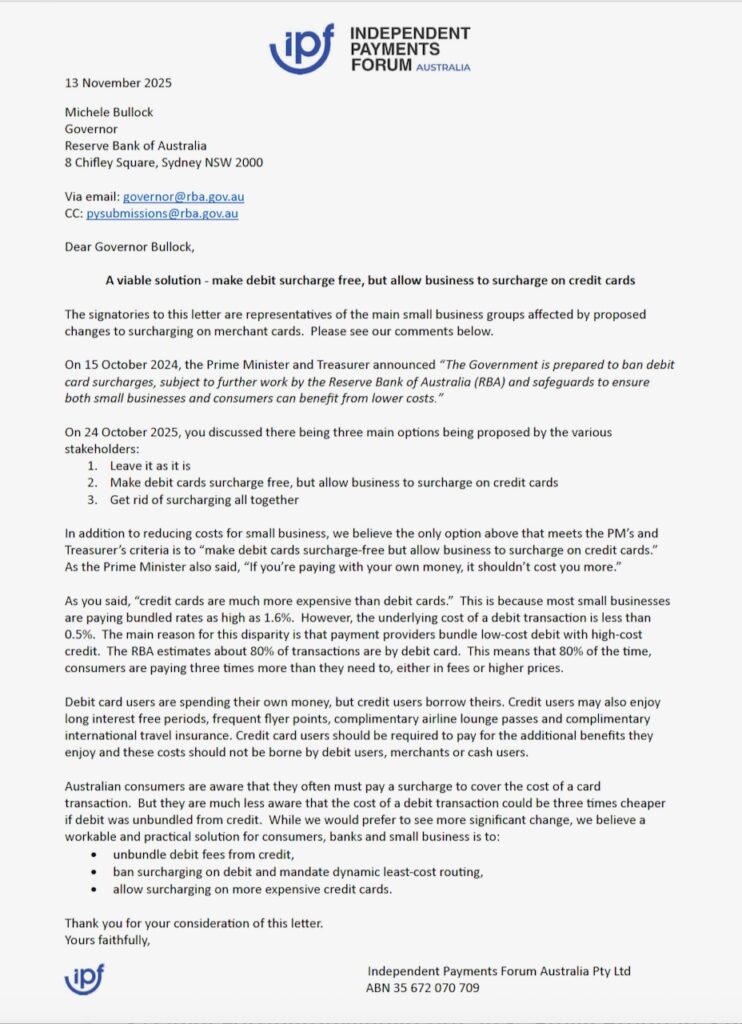
Here is their latest letter to the IPF, which had my signature presenting newsXpress members.

The letter to the RBA supports the government’s idea of making debit surcharge-free, but only if it’s done correctly. Banning all surcharges (Option 3) would be disastrous, forcing us to absorb all credit card costs or raise our prices for everyone

Small business retailers, like newsagents, are dealt with poorly by banks, the RBA, payments companies and politicians in this area. It is only continued lobbying, like the work of the IPF, that offers any hope of an outcome that’s reasonable for us.

This proposal by the IPF is a win-win if adopted by those in control.

  • For our customers: The 80% of customers who use debit cards get a surcharge-free transaction, as they should.
  • For our business: We stop losing margin by subsidising expensive credit cards. We finally get to pay the true low cost for debit and can fairly pass on the true cost for credit.

This proposal from the IPF is the only option that fixes the root cause of the problem. It brings fairness and transparency to a system that has been costing us—and our customers—too much for far too long.

What the IPF is proposing here is our best chance to fix a system that has been unfair to small businesses and our customers for too long. By standing with and supporting the IPS on this, we are pushing for a common-sense change. This solution allows us to finally offer our debit-using customers the surcharge-free experience they deserve, while ensuring our businesses aren’t left to pay for expensive credit card reward programs. It’s the only option that brings true fairness and transparency to our counters.

It does surprise me that other groups that claim to represent newsagents are not supporting the IPF.


Mark Fletcher founded newsagency software company Tower Systems and is the CEO of newsXpress, a marketing group serving innovative newsagents keen to evolve their businesses for a bright future. You can reach him on mark@newsxpress.com.au or 0418 321 338.
20 likes
Ethics

AUSTRAC and E-cigarette Commissioner call on banks to act on illicit tobacco stores with private ATMs and eftpos

AUSTRAC and and the E-cigarette Commissioner have called banks act illicit tobacco stores with private ATMs and eftpos following terrific lobbying by the Independent Payments Forum. It’s good to see engagement from government bodies on this. Here is the AUSTRAC announcement.

AUSTRAC CEO Brendan Thomas and the Illicit Tobacco and E-cigarette Commissioner (ITEC), Amber Shuhyta, have called on Australia’s banks to take immediate action to strengthen oversight of tobacco and convenience stores with private ATMs and eftpos.

Mr Thomas said non-bank ATMs and point of sales payment technologies are being used to buy illicit tobacco products and to launder the cash proceeds.

“Any bank receiving funds through these channels is at risk of dealing with illicit proceeds,” Mr Thomas said.

“We are asking banks to assess, mitigate, and, where possible, eliminate these risks.

“Where banks continue to provide services to tobacconists and convenience stores, they must closely monitor for and report suspicious matters.

He said the request is about refocussing existing AML controls to target a fast-growing criminal trade.

“This is a crime type that is generating billions of dollars in criminal proceeds, and the scale of the activity is undermining Australia’s economic integrity and community safety.”

New figures released overnight by the Australian Criminal Intelligence Commission and Australian Institute of Criminology show the cost of organised crime to Australia reached up to $82.3 billion in 2023-24, including an estimated $4 billion from illicit tobacco alone- a four-fold increase over the past three years.

AUSTRAC has also cautioned banks to be alert to displaced customers as enhanced scrutiny takes effect.

While urging stronger controls, Mr Thomas said banks must strike the right balance to avoid unintended impacts on legitimate businesses.

“There are legitimate needs for access to cash services, particularly in rural and remote communities.”

“Our shared goal is to target criminal enterprises, not legitimate economic activity.”

AUSTRAC’s administration of existing AML/CTF laws is one feature of a broader, multipronged strategy coordinated by the ITEC to shrink the illicit market, reduce criminal activity and minimise harm to community and public health.

A range of multi-agency measures are underway to disrupt the illicit tobacco market across the Australian supply and demand chain.

“Australian banks play a critical role in protecting the financial system from criminal abuse and are well placed to strengthen their AML controls in this high-risk sector.

“We are focused on disrupting the business models of criminals, making it harder for them to trade and hitting them where it hurts, in their pockets.

“I’m confident no Australian bank wants this dirty money in their business and will work with us to help shut it out.”

This statement follows a campaign by the Independent Payments Forum (IPF) and PayDay News questioning the legality of payments terminals used at these businesses. newsXpress and ALNA are the two groups in our channel supporting the excellent work of IPF.

2 likes
Ethics

Warning: read and understand the newsagency marketing group agreement before you sign it

I had a newsagent on the phone yesterday asking for help to get out of an agreement they signed a couple of months ago with a marketing group I won’t name. The newsagent says they were told they could leave if they were not happy. The agreement they signed locks them in. They’ve already been told by the head of the group that there would be legal action if they try and leave.

The agreement is clear. They are locked in for a few years with a group they are unhappy with, a group they say is not helping their business.

Before you sign an agreement with a marketing group read the contract. read it. be sure you understand it. be sure you know what you would be agreeing to if you sign it and are happy to stand by the terms of the agreement

Do not sign the agreement based on what someone says. Read it. Sign the agreement based only on what the agreement says.

This is a problem in our channel, especially for new newsagents buying their first business. They are easily dazzled by a friendly sales pitch. Beware the friendly sales pitch. You’re not signing to be their friend, you’re signing for the business they represent to help you thrive, or at least that’s what you’re hoping for.

If you are uncomfortable with the agreement, don’t sign it.

Make sure you know the minimum period you’re required to be in the group. This is your locked-in period. Read it in the contract. Are you sure you want to commit for that period of time?

If you’re not sure, don’t sign. You’re in control at this point.

Now, if the business you are buying is branded to a group and they are pressuring to sign to keep that branding and they say there is a cost to you if you don’t join the group because you have too de-brand that’s nonsense. The current owner needs to sort out the branding before they sell. Don’t be duped into thinking you must stick with the current brand if you are not sure.

Do what you think is right for you.

Now, on the brands. Take a moment to think about them. What do they stand for? How are they known by shoppers? What is their value? I don’t want spin answers from the groups. rather, I want answers from shoppers.

With any of the groups in our newsagency channel you can visit 10 different shops in the group and have 10 very different experiences. Consistency is not there.

The brand that matters is your brand, what you call, your business. It’s what you do locally that matters.

Before you sign an agreement with any newsagency marketing group, read it, understand it and only sign if you fully understand it and are completely happy with all of the terms.

The person I spoke with yesterday was in tears. They desperately want to leave the group but are scared of legal action. An ethical marketing group would help them leave to find a home in which they are more comfortable.

21 likes
Ethics

Beware consultants and others offering AI training, workshops, retreats and more

Sheesh there are some shonks out there offering workshops, retreats and consulting packages in using AI.

My advice is don’t pay anything. Instead, take a step, and then another, and another. Fall over. Learn. Get up. Take another step. Pretty soon, you’ll be running.

Where AI is at today is not a destination. We are barely at the first stop on a long journey into a future and no one today is an expert on that future.

Anyone who tells you they have the secret sauce is just selling you a bottle of their own snake oil. The real secret is there is no secret. Just the graft. Just the curiosity.

The “gurus” selling you a weekend workshop are probably only a few chapters ahead of you. The landscape is changing so fast that any manual they print is out of date by the time the ink is dry. Don’t buy their map. Draw your own. It’ll be a mess, for sure. But it’ll be yours, and it’ll lead somewhere far more interesting.

So go on, be curious. Muck around. Break things. That’s how you’ll get good, not by lining someone else’s pockets. Give it a report, a business challenge, a question on your mind, a copy of your business plan, and ask what do you think?

The more you use it, the more you learn, and the more useful it becomes.

Do all this for free.

Don’t pay for a course, a workshop or a retreat. I saw one AI retreat in Australia promoted recently costing thousands for content and context that is available for free. Nice work if you can get it.

Beware. There are people making a ton of cash because AI feels so far removed what many know and understand. Clever marketers are leveraging ignorance for their own profit. Don’t do it!

Go on, try ChatGPT or Google Gemini now for free. Once you have played with them there are other tools you can use, plenty are free, and worth it.

Footnote: yes I have written a bit here about the AI tools embedded in the Tower Systems newsagency software. That’s different. It’s built in, included, ready for immediate use without the need for training, a course, a workshop or a retreat, no need to pay extra.

13 likes
Ethics

New award rates and superannuation percentage

It’s July 1, 2025 and the new award rate is no in force.

There is no excuse for employers missing this or the increase to the percentage of pay employers must contribute to superannuation to 12%.

The Fair Work Ombudsman has all the details at their website.

Now is a good time to check on other aspects of the award and your engagement with it such as employee classifications. Ensure your people are classified correctly. Also, if you require staff to wear a uniform, this is to be provided at your cost and there is a requirement for a weekly cost re cleaning of the uniform. It’s all there in the award.

If you are an employee and you feel you may not be being paid correctly, ask your employer. If you are unhappy with the response and consider you are being underpaid, click this link to get to advice from the Fair Work Ombudsman.

If you are an employee and you think the superannuation contributions from your employer are incorrect and you have been unable to resolve this, click here to go straight to the ATO website for their recommended action.

It’s never easy to talk about pay, for everyone involved. No matter how you approach it, the matter comes down to the facts. That’s the best place to start. If it’s an award discussion, start with the facts in the award. The Retail Award is straightforward. Print it, mark it upon, speak to it when raising any concern.

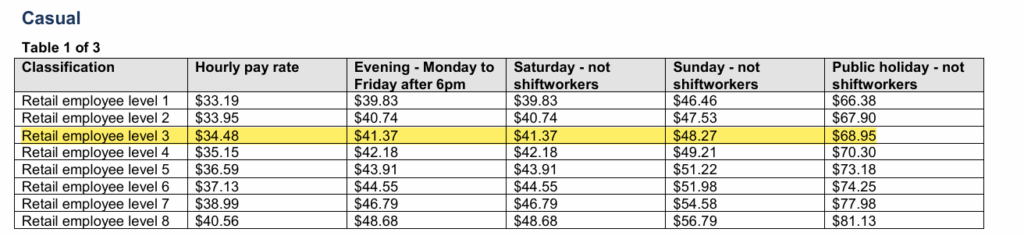
To employers who under rate employees via a lower than appropriate classification, look at the difference. Between 3 and 5, for example, it’s $2 an hour. A good employee with the right support from the business can easily cover this difference. The key to this is them understanding the needs of the business and how their actions can serve these while serving their own personal needs.

I have seen too many employees let underpayment slide in the hope it will be resolved. This is a mistake. If it’s wrong and it is not addressed, report it.

Whether we like it or not, all newsagents are bundled together in the collective Australian mind. If one underpays staff, does not pay penalty rates or fails to pay superannuation correctly, we are all judged to behave similarly. This is why I think if any of us is aware another is deliberately misbehaving, we should report them.

11 likes
Ethics

What data do you get when you buy a business? What data should you leave when you sell a business?

A retailer I know sold their business and scrubbed all historic data prior to settlement, leaving the incoming owner with no ability to make product purchases based on past sales, no ability to run the business to meet the expectations gained from reviewing the previous owner’s performance prior to agreeing to the purchase price.

They took legal action, questioning representations made to them prior to the purchase.

Since the data had been deleted at the source, the previous owner had now evidence to support their case.

Eventually, the dispute was resolved by the previous owner paying compensation to the purchaser. This followed a threat to report the matter to the ATO. Knowing a bit about the matter, I can understand why a settlement payment was quickly offered.

My advice is that you use only accurate data to represent the performance of the business in the lead up to the sale and that you leave the data there for the purchaser. 

There is nothing to fear from truth.

This is all on my mind today because of a new matter that looks like it may make its way to the courts. Deleting data can make you look guilty. If you do think you have a good reason for deleting data prior to settlement, talk to the purchaser and get their approval in writing.

Beyond the legal ramifications, deleting historical business data erode trust, a cornerstone of any successful transaction. The incoming owner, deprived of essential historical insights, is left to navigate the business blind, potentially jeopardising its future and the value they invested. This scenario underscores the critical importance of transparency and ethical conduct in business sales; what might seem like a quick fix by deleting data can lead to costly legal battles and a damaged reputation, far outweighing any perceived benefit of withholding information.

This is about a fundamental ethical obligation to provide the buyer with the necessary tools and information to succeed, especially when the purchase price is based on historical performance.

And to be honest, I can’t think of any legitimate reason for deleting historical sales data.

This advice from me will be uncomfortable for some. It shouldn’t be though. As I have noted: There is nothing to fear from truth.

12 likes
Ethics

The central billing difference between newsagency marketing groups

Some newsagency marketing / franchise groups operate central billing. The thing is, none of these central billing programs are the same. I can only speak for the newsXpress program as I am a direct or of that business.

Before I get into it though, while newsXpress is a private company, it has never distributed a profit to shareholders. Earnings are retailed and reinvested for members, like the $350,000 a year in seasonal in-store prized pack promotions and our soon to launch June national media campaign.

newsXpress created its central billing program in response to supplier requests. They were tired of late payment and failed payment.

newsXpress guarantees payments to suppliers, on time. Suppliers love this. They can bank on the results.

This unique approach by newsXpress to central billing is one reason the group offers so many suppliers who are not traditional suppliers to our channel.

Supplier businesses are businesses. Late payment costs money. Collection costs money. Being paid late damages the relationship.

13 likes
Ethics

Illegal tobacco and the newsagency channel

If you are aware of a newsagent selling illegal tobacco, report them.

Yes, it’s as black and white as that.

Any newsagent selling illegal tobacco damages the reputation of the channel, even for the majority of newsagents in our channel who do not sell tobacco.

Whether we like it or not, our shingle binds us. This is why I think we need to call out bad behaviour, like selling illegal tobacco.

With more newsagents getting back into tobacco, unfortunately, this is an issue we need to confront. The best way in my opinion is to report those we know to be selling illegal tobacco. The more they are fined the better.

You can report it to the ATO: https://www.ato.gov.au/about-ato/tax-avoidance/the-fight-against-tax-crime/our-focus/illicit-tobacco The Australian Criminal Intelligence Commission also has a hotline: https://www.acic.gov.au/contact/report-crime

If you know someone involved in importing illegal tobacco, report it here: https://www.abf.gov.au/about-us/what-we-do/borderwatch

I’ve done some searching by state / territory and here are links for reporting illegal tobacco sales:

VIC: https://www.health.vic.gov.au/tobacco-reform/making-a-report-or-complaint-tobacco-reform

NSW: https://www.health.nsw.gov.au/tobacco/Pages/let-us-know-reports-complaints.aspx

QLD: https://www.health.qld.gov.au/public-health/topics/tobacco-laws/penalties/reporting-a-possible-breach-of-smoking-laws

SA: https://www.sa.gov.au/topics/business-and-trade/licensing/tobacco/report-unlicensed-tobacco-supply

TAS: https://www.health.tas.gov.au/health-topics/smoking/selling-smoking-products/contact-us

NT: https://crimestoppersnt.com.au/ or https://pfes.nt.gov.au/reportonline

ACT: This was too hard to find.

I have heard plenty of newsagents complain about illegal tobacco recently. The question I have when I hear it is what have you done about it? Complaining to colleagues and friends does nothing. Making a formal complaint to the authorities is good action.

My advice is that you complain to your state / territory authority as well as to the ATO and to the Australian Criminal Intelligence Commission. Hitting multiple bases makes sense.

Beyond the immediate reputational damage to our channel, the sale of illegal tobacco also undermines public health efforts and fuels organised crime. By failing to report these activities, we inadvertently become complicit in a shadow economy that disregards regulations designed to protect our communities.

Taking action is about safeguarding our businesses and our channel; it’s about upholding ethical standards and contributing to a safer, more responsible retail environment for everyone.

Ultimately, reporting illegal tobacco sales is an act of self-preservation for the legitimate newsagency channel and a responsible contribution to the wider community.

If you are a newsagent selling illegal tobacco I hope you are reported and fined to the full extent of the law.

27 likes
Ethics

ACM’s Newcastle Herald digs a new low with front page transphobic ad

The apology issued by ACM Media following the publishing of the ad feels inadequate. At the very least, their ad process is broken. At worst, they knew what they were doing and were happy to sell their space.

In my opinion, this ad is wilfully ignorant, offensive and appalling. If I had this newspaper in my shop I’d misplace the entire delivery until returns time. The ad fails the company’s own published values, which include:

Kind – Being considerate, well-intentioned and thoughtful to others

  • We are considerate and well-intentioned toward colleagues, clients, customers and communities

  • We seek to create understanding and tolerance in times of discord

  • We take time to support our team members and recognise a job well done

Tolerance. They failed.

10 likes
Ethics

Payments for purchases of illegal tobacco in the frame

Payday News has published about payments processing in shops selling illegal tobacco:

Illegal tobacco stores are popping up around the country in what is fast becoming multi-billion dollar market for organised crime which appears to be serviced by multiple banks and fintechs for payments.

What are the legal obligations on acquirers, PSPs and card schemes?

An investigation by Payday News last week revealed that a large number of illegal tobacco outlets are using card payments terminals provided by banks and fintechs to sell their illegal products which, according to experts, could have serious legal implications. Some of these shops also have ATMs inside their premises for customers to access cash.

Financial Crime Compliance expert Luke Raven told PAYDAY NEWS illegal tobacco was fraught for payment processors, who often mistakenly think they aren’t captured by Anti-Money Laundering (AML) or Counter-Terrorism Financing (CTF) laws, or misunderstand the extent of their obligations.

“Many payment processing firms think that they aren’t regulated under the AML/CTF regime in Australia, and candidly, they’re wrong,” Raven said.

Retailers of tobacco products operating legally will appreciate this latest coverage.

The recent  story on the illegal tobacco by Australian Broadcasting Corporation (ABC)‘s Dan Oakes exposed the extent of illegal tobacco industry and how ubiquitous the trade has become across Australia.

4 likes
Ethics

Collins Debden pitches its diaries direct to consumers

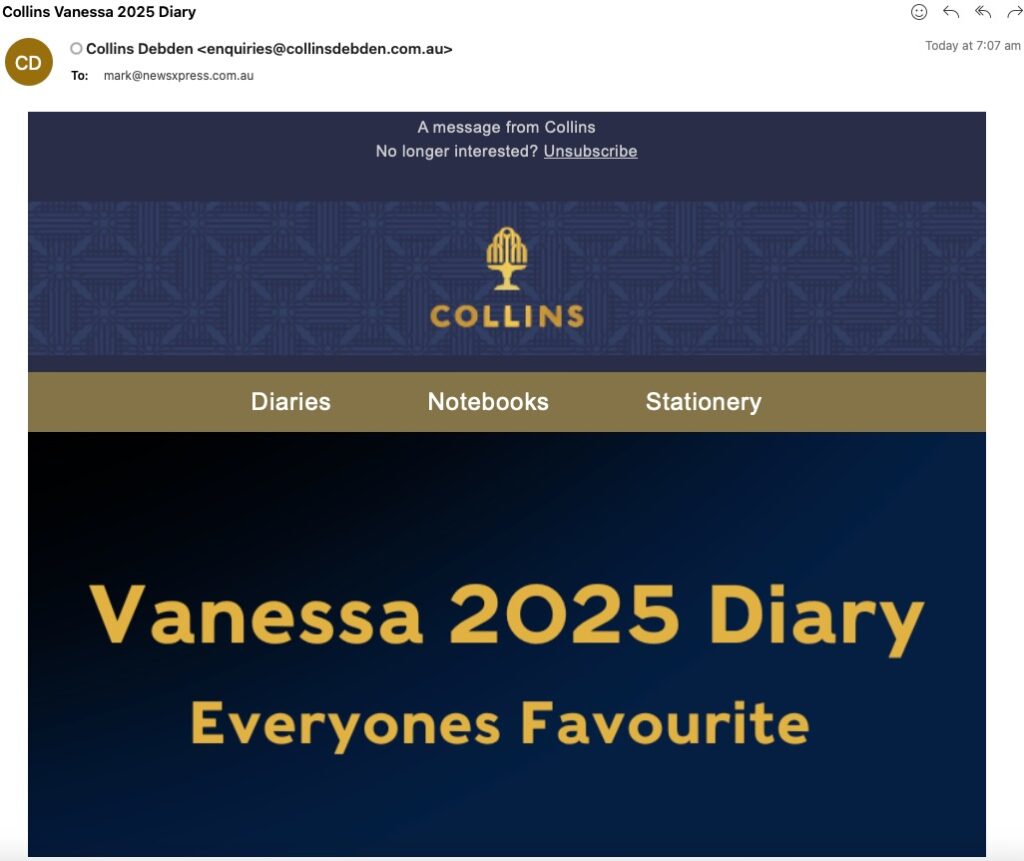
It is challenging seeing a supplier you have supported for years go out with a direct to consumer pitch. I didn’t plan to write about Collins Debden today. An email from them this morning caught my attention.

This is a Collins Debden direct to consumer pitch.

They added me to their marketing database, without my permission. Their email includes a compelling offer:

They end with a offer of social media connection. If only they were this engaged with small business retailers of their products.

I am surprised that they are promoting direct to consumers when they are so far behind with shipping to retailers. Their fulfilment processes are strained and unable to get product to shops on time. Why would an individual feel they could fulfil a single order on time, unless Collins Debden is prioritising their direct to consumer orders. I have no idea whether that is the case tho.

I am tired of suppliers going direct after years and decades of support from retailers like us to drive brand awareness and engagement. They could not go direct as they have if we had not supported as we have.

A supplier going direct demonstrates disrespect for their retail partners. Them doing this while they are party to delays in supply to retailers is appalling. It is a failure of social responsibility on their part.

Thinking about this issue of a supplier going direct more generally …

There are ethical considerations to consider when a long-term supplier decides to go direct-to-consumer.

  • Fairness and Trust: The supplier’s decision may impact local retail businesses, potentially leading to lost sales or revenue. A good supplier will be on the front foot and engage in open communication on how to mitigate any negative effects. A bad supplier will make the move and not discuss it with retailers.
  • Customer Relationships: Customers may be confused or disappointed by the change. We need to be transparent and communicate clearly with them to maintain trust and loyalty to our business. We need to tell them what has been done to us.
  • Competition: The supplier is likely now a direct competitor, impacting your market position. Consider how you can differentiate your business and offer unique value to your customers. Look for alternative products that will serve your customers.

Ultimately, the ethical approach involves maintaining open communication, acting with integrity, and prioritising the needs of your customers.

15 likes
Diaries

Collins Debden 2025 diary supply challenges are hurting sales

We are missing out of revenue from the certain sale of Collins Debden diaries as a result of supply challenges within the Collins Debden business. I have heard from plenty of newsagents in the same situation.

Approaches to the company over the last two months have resulted in what I’d describe as spin. They have not resulted in any stock being delivered, which is frustrating since Amazon Australia appears unaffected by the supply challenges.

That Amazon has stock of what newsagents could be selling right now opens the question of whether the supply delay is part of a recalibration of the go-to-market strategy at Collins Debden. I this is a reasonable question to have when you see a major competitor of stock while yuou have no indication of when your stock will arrive.

While some newsagents have covered diary sales by accessing stock elsewhere, most cannot since the typical diary shopper is brand loyal. That brand loyalty will see them buy wherever they can find the Collins Debden diary they want. This is where Amazon having stock plays out negatively for newsagents. I first heard about Amazon being able to supply from a customer who was frustrated that we did not have stock.

With newsagents aware of cost to their business from the lack of supply by Collins Debden, I anticipate there will be claims against the company for lost sales as well as claims for financial support to move diaries when they do finally arrive. In my opinion, the company would do well to thoughtfully consider how it supports local small business retailers who have been without stock now for close to two months while a major competitor, Amazon, has had stock.

How Collins Debden handles the situation, outside of fixing the supply issues, will speak to the interest the company has in its local small business retailer network. I know plenty of retailers will be watching the situation. I wonder, too, whether there are any matters for regulators here. For example, if there is evidence of preferencing a big retailer (Amazon) over local small business retailers, could that be captured in regulations supporting small businesses.

Like all newsagents who regularly stock Collins Debden diaries, the best solution would have been on time supply and the second best solutions would have been diaries supplied a few weeks late. As of this morning, we are considerably beyond that, with the situation made worse by inadequate communication from the company.

18 likes
Diaries

What can you do if your marketing group contract auto-renews or you are bound by a long lock-out period?

Following my last post (Monday this week), Does your marketing group contract auto-renew? Does it include a lock-out period?, I outline below options you may consider if you find yourself in a marketing group contract you want to leave.

I am not a lawyer. This is not legal advice. In my opinion, a marketing group contract should be so simple straightforward and fair that it does hot need a lawyer to interpret or understand.

If your marketing group contract or agreement is complex and not easy to understand that’s a warning sign right there.

CONTRACT AUTO-RENEWAL.

If you have found your contract has auto-renewed, think about whether it was clear it would and whether the newsagency marketing group contracted you prior to the auto-renewal trigger advising you that auto-renewal was imminent. The ACCC is on record as saying that auto-renewal should be clear and that you should be contacted prior to auto-renewal with enough time for you to say no thanks.

Three newsagents in the last week have told me their newsagency marketing group contracts were auto-renewed without advance warning from the marketing group that it was going to happen. I think any independent party with authority considering this would say renewal action was unfair and that the newsagent could opt to leave the group now.

RESTRAINT OF TRADE – POST CONTRACT LOCK OUT PERIOD.

Some newsagency marketing agreements seek to deny the newsagent the right to join another marketing group for a period of time after the end of the agreement. I have heard marketing groups with such a restraining clause claim that it is to protect their intellectual property shared with the business while they were in the group. The question I have is what intellectual property?

In situations where I have seen newsagents threatened by the group they are leaving, or the lawyers for the group, I have not been able to discover any intellectual property worth protecting.

In a recent report, the ACCC highlighted that restraints which go beyond what is reasonably necessary to protect a franchisor’s legitimate interests are likely to be unfair. For the purposes of this discussion, a franchisor would be the newsagency marketing group.

NEW REGULATIONS.

In November 2023, reforms passed by parliament make unfair contract terms illegal, attracting substantial penalties under the Competition and Consumer Act 2010 and the ASIC Act 2001, with each unfair term forming a separate contravention.

I think it is possible that a newsagent with an agreement that auto-renews and / or with an end of contract lock-out restraint period barring them from joining any other group could challenge the validity of the contract.

While I am not a lawyer and this is not legal advice, if I found myself in this situation I would do several things, all at once:

  1. Write to the franchisor / marketing group explaining my opinion that the contract is unfair and seeking immediate termination of the contract without penalty and without any restraint period. And, if the letter I would request that all correspondence is in writing and only in writing.
  2. Contact my local state government level small business ombudsman seeking their help in resolving the matter.
  3. Seek assistance from Australian Small Business and Family Enterprise Ombudsman on the contract.
  4. Complain to the Australian Financial Complaints Authority (AFCA). They small businesses with a free and independent dispute resolution scheme to assist with resolving financial complaints.
  5. Engage with ASIClodge a report of misconduct online.
  6. Write to the ACCC complaining about what I consider to be an unfair contract.
  7. Contact my local small claims authority (VCAT, QCAT, NCAT, TASCAT, SAT etc) to see if they would accept a case seeking to declare the contract invalid and agreeing my my immediate exit from the group.

My point here is that there are options for you, actions you can take that do not require a lawyer, actions that could free you from a contract you no longer want for your business.

I have seen newsagents consider taking steps to get out of a contract only to give up, saying it is too hard. I have also seen newsagents take a couple of steps and be permitted to exit a group as long as they don’t tell anyone.

If you are in a marketing group for your newsagency and want to leave but have been told you cannot or been told that you have a lock-out restraint period, it is possible one or more of the steps listed above could help you out. Doing nothing achieves nothing for your business.

The difference between being in a group doing little for your business and a group doing plenty could be tens of thousands of dollars in net profit in a year.

A good newsagency marketing group is profitable for the newsagency. Belonging just to belong to something is not commercially astute.

I am not going to list marketing group contracts here that I consider to be unfair in part because I have seen some groups with different contracts for different people, which in itself is odd and somewhat concerning. One group has recently become more threatening against newsagents who want to leave, causing considerable distress for the newsagents impacted.

One final point: everything I have written here could relate to some card company contracts I have seen.

Before you sign any agreement, read it, be sure you understand it and ask someone you trust for their opinion.

19 likes
Ethics

Does your marketing group contract auto-renew? Does it include a lock-out period?

If you are in a newsagency marketing group, get out the contract you signed and read what it says about termination.

Be sure you understand the term of the contract, whether you have to give notice and if so what length of notice is required and whether there is a period after the end of the contract in which you are not permitted to join another group.

If you are not sure about these things, seek professional advice. Indeed, you should have sought advice prior to signing the contract. It is never too late to seek advice.

TERM.

Newsagency marketing group contracts vary from one year to six years from what I have seen. Personally, I think anything more than one year is too long. Aren’t you better off staying with a group because of the value gain from it rather than because they have legally bound you in a contract? Shouldn’t groups want you to stay because you want to stay.

If they really trust what they offer and the benefits they deliver for you, why lock you in?

Oh, and I do understand the need for an initial term when you first join, to learn from each other, to unlock value for each other.

NOTICE PERIOD.

Some contracts require you to give notice months ahead of the contract renewal period and your failure to do this locks you in for, sometimes, another long period. In my opinion, a notice period of two months is reasonable and anything more is unfair for the small business retailer.

AUTO RENEWAL.

I think auto renewals in a contract are a gotcha, especially if the auto renewal period is long, like a year or more as is the case for some newsagency marketing group contracts I have seen.

I suspect businesses put auto renewal and a long (like a year or more) lock in period in contracts because they know people will not realise they need to give notice to not renew. They are businesses. It’s all about their revenue.

LOCK OUT PERIOD.

Another thing I have seen in newsagency marketing group contracts is a post contract termination lock out period. I have seen them make this case to protect their intellectual property, which I think is a joke. What intellectual property? Okay in the first year maybe, but what after that time? None of the newsagency marketing groups has a system with training, regulation, branding requirements and more like you see in a McDonalds.

If you are happy with your newsagency marketing group contract, this post is not for you.

If you are unhappy, please dig out your contract and look at your options.

If you have been given a newsagency marketing group contract to sign, please read it carefully. Some have worse provisions than the few I have mentioned here, provisions that are very expensive – like demanding you access some products / services only from the supplier they dictate. I saw one newsagent recently pay thousands of dollars more for something than they would have paid had they not been in that group.

Buyer beware is the point here. Do your homework. be sure you fully understand the contract. Be sure you are happy with all terms prior to signing.

Not all newsagency marketing groups are the same.

I know of at least twenty newsagents currently in groups they want to leave but cannot. Some have received legal letters threatening against leaving and others have received less formal yet equally distressing communication. In most cases, that communication was the first time i a year their business received direct communication about their business from the group to which they belong. These newsagents would leave in a heartbeat if they did not feel trapped. None of them want a legal fight, and I suspect some in the marketing groups know this, and use it to their advantage, and the disadvantage of their members.

If you are in a newsagency marketing group, get out the contract you signed and read what it says about termination.

18 likes
Ethics

2025 Australian Firefighters Calendar demands unreasonable on retailers

The supplier of the 2025 Australian Firefighters Calendars has made this demand of retailers, via a major wholesaler, GNS:

To move forward, I will need written guarantees by the directors of your company that all GNS customers will not sell my calendars online. I will not supply GNS unless I have directors’ guarantees that GNS customers will not sell my calendars below my listed price until January 1st, 2025. I have attached a supplier form for you to sign.

To their credit, GNS responded well:

At GNS, we believe in upholding the law and ensuring our customers’ freedom to conduct business as they see fit. As such, we are not willing to impose any restrictions on how you go to market with your products. Unfortunately, this means we will not be receiving any stock of the Firemen calendars.

What makes the move about the 2025 Australian Firefighters Calendars interesting is that these calendars are widely available online. A quick search shows them as available online in Australia via Amazon, Calendar Club, eBay, Just Calendars, Mega Office Supplies and more. It is even listed on the catch.com.au website.

I can’t figure out why the supplier would demand the directors of GNS to agree that retailers they supply will not sell the calendars online.

Of course, the directors of GNS can’t impose such a restriction on their retailers. Their response is good.

The move makes the 2025 Australian Firefighters Calendars less appealing in my view. No matter, there are plenty more Australian designed and made calendars supporting worthy causes available for newsagents and calendar retailers to stock. That’s what we are doing: focussing on calendars we can sell in-store and online, calendars where the supplier does not place restrictive requirements on how we run our business.

The 2025 Silo Art Calendar is a good example of a calendar well worth stocking. It raises money for a good cause, shines a light on Australian towns and, best of all, features Australian art. This is a calendar we sell plenty of in-store as well as online. People love posting it as a gift to friends overseas. We have offered this calendar for years. It’s been a huge hit.

If you are looking for calendars to stock for 2025, look at Bartel, Browntrout. Waterlyn and other local companies that have terrific calendars available.

It would be good to know if sales of the 2025 Australian Firefighters Calendars are impacted by the restrictive conditions.

18 likes
Calendars

News Corp and Nine Media seem to care little about print newspaper customers

Every week I hear another story of problems with newspaper delivery to retailers: late deliveries, missed deliveries and more.

The most recent issue relates to a regional Victorian town where the local retail newsagent no longer receives newspapers in time for when they open at 7am. The delivery contractor delivers papers to another retailer two minutes away from the newsagent, then does home deliveries and, finally, to the local newsagent.

Often, deliveries to the newsagent are short, sometimes less than half what they can sell.

Contact from the retail newsagent to News Corp and Nine Media has achieved no resolution. It appears they have either no interest in resolution or no ability to direct the delivery contractor to deliver the papers when they deliver to the cafe two minutes away.

The situation is ridiculous, petty.

Most newspaper delivery contractors I know of do a terrific job and provide excellent service to retail newsagents. Not this one though. Some decisions seem targeted.

I wonder if the disinterest of the publishers has anything to do with the retail newsagent handing their run back a year or so ago. If that is the case, it’s petty. It that is not the case, the newspaper publishers have a broken system that they appear unwilling or unable to fix. Either way, they appear uninterested in the issue and its resolution.

In the meantime, local newspaper readers miss out. Maybe that is what the publishers want. Who knows?

This specific situation does seem to have an easy resolution, if the newspaper publishers want the resolution. The delivery contractor could be directed to deliver to the two sub agents – a cafe and the retail newsagent – at the same time, as they are two minutes from each other.

Years ago, newspaper publishers were demanding of newsagents in terms of delivery times and accuracy. Threats were made. newsagents complied rather than risk losing their business. Today, it’s different. The newspaper contractor in this story has demonstrated no interest in resolving the delivery time, quantity and contact issues – it’s not possible to contact them during the day to resolve issues.

Again, newspaper customers are those that miss out. Newsagency staff are impacted too as they are the front line dealing with customer complaints.

If only News Cop and Nine Media cared about the mental health of newsagency staff and cared about their newspaper reader customers.

21 likes
Ethics

OPINION: Newspower should research before it markets against other newsagency marketing groups

Helen Dowling, the General Manager of Newspower, sent out marketing on June 25, 2024 comparing their offer to newsagents with other groups. newsXpress is one of those other groups. I am the Managing Director of newsXpress Pty Ltd.

Newspower failed to reach out to newsXpress to check whether what they were about to claim was accurate. They should have.

I reached out to Helen Dowling and to Graeme Hand, the Chairman of Newspower. Helen responded:  It is not Newspower’s intention to provide misleading information. I would be interested in knowing from Newsxpress what you believe the misleading information is in the comparison document.

Here’s the response I sent to Helen:

Thank you for acknowledging that you did not undertake research prior to publishing your document.

  • newsXpress provides in-store visits from a business development manager.
  • newsXpress provides visual merchandising materials including posters and on-location call-outs for all major seasons.
  • newsXpress have access to a member only portal with a fully populated knowledge base and extensive business development resources.
  • newsXpress members have access to a digital collateral library and cloud based resources for easy store level customisation.
  • newsXpress members have access to a full video library of social media collateral and easy access to store level customisation.
  • newsXpress offers signage and graphic design services at no cost.
  • Rather than access to an Are Media account manager we provide a whole of magazine category problem resolution service. For free.
  • Rather than a free postage for Christmas cards offer we provide free exclusive high-quality cards for Christmas for captions not covered by card companies.
  • Each member has access to a dedicated and retail experienced business development manager.
  • newsXpress helps with Google Business, Bing, and various maps profile setup and maintenance.

These are the things we do that your marketing claims we do not do.

Your marketing fails to highlight many things we do that Newspower does not do.

Helen has not responded to my email. I am not aware of Newspower publishing a correction. If they have not done so, it is disappointing that they have allowed marketing that they know contains false and misleading information to remain out there under their name.

There are four groups serving the newsagency channel. Newspower, newsXpress, nextra and The Lucky Charm. The last two, from what I understand, operate under the franchise code of conduct. Please let me know if I’m wrong about that.

The four groups are very different from each other. Here’s what I think separates newsXpress apart:

  • It leverages the common ownership of Tower Systems (the most widely used software in the newsagency channel) and newsXpress for evidence based guidance to more profitable business decisions. Through this, it also offers half price websites.
  • It offers innovative pricing for EFTPOS, lower cost than least cost routing.
  • newsXpress offers bias-free data-based card performance analysis that typically results in an increase in card sales of 15% or more.
  • Member businesses benefit from an exclusive $1,000+ a year per store in-store marketing campaign – provided at no cost to the members.
  • newsXpress runs a national in person conference with free accommodation for 2 nights and all meals covered.
  • newsXpress helps newsagents with practical business advice, in-store support, awesome supplier deals and plenty of new traffic generating exclusive products.
  • newsXpress directly owns and runs shops as testing grounds for innovation, sharing results with members.
  • newsXpress direct imports good margin products.
  • newsXpress is the only group to have authorised account access to four different Mints for access to new coin releases.
  • newsXpress has suppliers who otherwise will not supply newsagents.

What you do in and for your business is 100% up to you.

If you could use support and want fresh ideas for attracting new shoppers, consider newsXpress. Call Michael on 0400 331 055 or email help@newsxpress.com.au to find out more.

If you join, the newsXpress team will do all they can to help you run a more profitable and enjoyable business. Email help@newsXpress.com.au or call Michael on 0400 331 055.

If you’re on LinkedIn, here’s me in case you want to research me a bit more: https://www.linkedin.com/in/mark-fletcher-tower/

Mark Fletcher
Managing Director
newsXpress Pty Ltd
www.newsxpress.com.au
ABN 61 007 009 752 3A Lynch Street Hawthorn VIC 3122
M | 0418 321 338 E | mark@newsxpress.com.au

31 likes
Ethics

News Corp continues to fail newspaper home delivery subscribers with road-block customer service

Complaints about News Corp management of newspaper home deliver subscriptions to newsagents who stopped home delivery months and years ago continue. regulars here would have seen the comments by many subscribers.

From my own experience when I signed up for a subscription to The Australian and then sought to cancel after the initial period, the News Corp process is clearly structured to frustrate to a point that people give up. That is how it felt to me.

Subscribers ought be able to go to a website and cancel their subscription with one click. News Corp does not offer this service.

You have to call them. The first response after wanting to know why you want to cancel is to offer a deal. I’ve heard of people being offered an even better deal. The call process is layered with road blocks.

This is appalling customer service from News Corp in my opinion, and in my experience. For a company so invested in shouting at Australians and trying to tell us what to think, they appear disinterested in providing a good customer experience.

It’s as if the call centre mandate is to keep a subscriber at all costs – financial and emotional.

My advice for News Corp newspaper subscribers experiencing difficulties in cancelling their subscription because of road blocks by News Corp is to complain to your local office of consumer affairs and to email the ACCC. If you are owed a refund or the company has charged more than they should have in your opinion, and if you have the time, consider a claim to a small claims tribunal, like VCAT in Victoria. The more state and federal government agencies are made aware of what is happening here the better.

12 likes
Ethics

What’s the situation with selling vape products in Australia?

This is a question I was asked yesterday when I was talking with a retailer who has vape products for sale. I directed them to the Therapeutic Goods Administration website. The TGA is the federal government agency with regulatory authority for therapeutic goods. Vaping products fall within their remit. Here’s some of what the TGA website covers on vaping products:

From 1 January 2024, the importation of disposable vapes will be prohibited, subject to very limited exceptions. The ban will apply to disposable vapes irrespective of nicotine content or therapeutic claims. It means that it will be unlawful to import disposable vapes on or after 1 January 2024, even if those vapes were ordered before 1 January 2024 and have not yet arrived in Australia.

The ban also applies to individuals who have ordered disposable vapes from overseas for therapeutic use under the personal importation scheme. A limited exception will apply to international travellers arriving in Australia to carry a small quantity of vapes for their treatment or the treatment of someone travelling with them under their care.

Disposable vapes that have been imported into Australia before 1 January 2024 may continue to be lawfully supplied in Australia subject to the following requirements:

  • disposable vapes containing nicotine that meet TGA requirements may continue to be lawfully supplied in Australia in pharmacy settings to a patient with a prescription in accordance with state and territory laws for prescription medicines,
  • disposable vapes that do not contain nicotine, or any other medicine, and do not make therapeutic claims, may be supplied by retailers generally, including vape stores, subject to state or territory law.

This will allow legitimate retailers of disposable vapes to run down their stocks prior to the Government introducing legislation in early 2024 to prevent the domestic manufacture, advertisement, supply and commercial possession of disposable vapes, to ensure comprehensive controls across all levels of the supply chain.

From 1 March 2024, the importation of all non-therapeutic vapes will be prohibited. This means that it will be unlawful to import non-therapeutic vapes on or after 1 March 2024 even if those vapes were ordered before 1 March 2024 and have not yet arrived in Australia.

In addition, the importation of all vapes under the personal importation scheme will end on 1 March 2024. From this date, patients will no longer be able to order vapes directly from overseas, even if they have a prescription.

A limited exception will allow international travellers arriving in Australia to carry a small quantity of vapes for their treatment or the treatment of someone travelling with them under their care.

Subject to state or territory law, non-therapeutic vapes imported before 1 March 2024 may still be lawfully sold by retailers generally, including vape stores, provided the vape does not contain nicotine or any other medicine, and does not make therapeutic claims.

This will allow legitimate retailers of non-therapeutic vapes not containing nicotine to run down their stocks prior to the Government introducing legislation later in 2024 to prevent the domestic manufacture, advertisement, supply and commercial possession of non-therapeutic vapes to ensure comprehensive controls on vapes across all levels of the supply chain.

The website for the Minister for health also comments on this, making the government’s position on vape products clear:

During 2024, product standards for therapeutic vapes will also be strengthened, including to limit flavours, reduce permissible nicotine concentrations and require pharmaceutical packaging. A transition period will be allowed for businesses to comply with the new requirements.

The Government will introduce legislation in 2024 to prevent domestic manufacture, advertisement, supply and commercial possession of non-therapeutic and disposable single use vapes to ensure comprehensive controls on vapes across all levels of the supply chain.

It’s clear that there is no future for vape products in retail outside of pharmacies selling therapeutic products.

5 likes
Ethics

More suppliers are going direct to consumers competing with retailers they supply, and it’s breaking long term relationships

Imagine the shock of seeing a supplier offer products they wholesale to you being offered to consumers for not much more than your wholesale price.

The shock turns to anger when it continues months later, with the supplier competing with you for Google ad positioning. They can spend more since they have more margin with which to play.

Their words of no we are not trying to take business from you and we only want to grow the marketplace don’t land as you see customers you have nurtured for years switch to them.

As I told one supplier representative, what they have done in copying our business and chasing our customers disgusts me.

All of us in business have to put our needs ahead of everyone else and that is what this supplier is doing. The thing is though, they get childishly upset when we reduce our commitment to them having found a more valuable relationship elsewhere.

Maybe it is just meh but it feels like, in these early months of 2024, that we have more suppliers going direct to consumers.

Some suppliers are getting it right. One I spoke with this week who was pitching for our business said up front that they sold direct but at a price that was 10% higher than the suggested retail price they had on their items. What I liked even more was that their products, at their suggested retail price, gave us a gross profit of 62%.

This supplier is smart to structure their retailer relationships and their own online pitch such that it’s a genuine win win for supplier and retailer.

Not enough suppliers think through how to approach selling direct.

Some don’t announce it, they sneak around thinking retailers will not notice.

Some use spin from marketing to make it sound like retailers will benefit.

Some lazily copy what they see their retailers are doing and refuse to acknowledge they have done this.

Where the move has been made poorly, ignorantly and / or selfishly, it is understandable relationships break down. Trust is challenged and retailers who do not trust a supplier will not want to do business with them.

Each of us in business has to make decisions that serve our business and those who directly rely on it first. We need to be honest in our decision-making and respectful of long term relationships – if our decision means a change, we need to be upfront rather than secretive.

In my own case, I am more invested in seeking out direct supply relationships, from manufacturer direct to us rather than through a wholesaler who control a brand in the country. I am also happier working with suppliers who have no commitment to go direct to consumers.

Disruption is here to stay. Our role as business owners is to navigate this to our advantage.

7 likes
Ethics

Byline Times in the UK is gaining traction, demonstrating the value of genuinely independent journalism

The trust matters and if you want to support the truth, buy a real paper.

7 likes
Ethics