The Tatts barrier to selling your newsagency
If you have tatts in your business and are planning to sell you will need to factor in time for tatts to go through their processes. Not only do they take time to vet and approve applicants, there is the real risk that they could say no.
It surprises me when I hear of Tatts saying no to someone approved by their bank for a business loan, the landlord for a lease, magazine companies for magazine supply and other suppliers for product supply. It’s happened before and I am sure it will happen again.
It would not surprise me to see a newsagent taking Tatts to some tribunal to challenge their process when they knock back someone the vendor newsagent feels should have been approved.
My own experience is that the Tatts process differs based on your connections. They are not transparent. They appear to use unnecessary hoops as a barrier to entry, causing you to spend time that could be better invested in helping to kick-start your new business.
How we manage our newsagencies #1: the end of shift
This week I’m going take a look at everyday management of the typical newsagency business – to open discussion among people here about what they do in the area of I cover and to help others to look at their own processes.
Today, I am starting with the end of shift.
The end of shift is vital for tracking cash meeting XchangeIT data compliance and being disciplined in how you run your business. I’m not talking here about closing up for the date. No, this discussion is about the balancing of the register(s) and managing your record keeping.
Every newsagent needs a structured end of shift process. Maybe I am biased but the approach I recommend is that you do the end of shift in your newsagency software.
In my own businesses it is structured yet simple. We count back the float in each cash drawer, pool the cash, count the denominations, enter that into the software and the software then reveals whether we have balanced. depending on the difference determines what happens next. If we are less than $5.00 we move on. If we’re out by more, we have to find it.
Once we have balanced the cash, the software does the rest – checking data, printing banking sheets, handling the XchangeIT sales data send and comparing the day’s trading with the recent average for that day of the week as well as performing other checks such as fast sellers and letting me low y text message and email the trading results for the day.
All this is done behind the scenes. It keeps the process for the staff simple – get the cash right and the rest is taken care of for you.
I don’t write up any books or journals. I don’t enter any data into a spreadsheet.
The end of shift is taped so I can check that if I want at any time.
From closing he door to having the cash bagged with the end of shift reports ready for the safe usually takes between five and ten minutes depending on the day of the week and whether there is any cash discrepancy.
Join the conversation.
You are not your customer
I did not expect the Fart Pen in our impulse / counter lines range to sell all that well. I was wrong. In a couple of weeks we close to selling out. On any measure that’s a good stock turn. Take-aways I’ve been reminded of from this are: I am not my customer, don’t judge, people like fun products and people don’t always buy a gift for why you think.
The most important of these take0aways is having products that make customers smile. Happy customers spend more. They are also more likely to remember the shop. It’s a delight when people tell you why they are purchasing a product like this.
Sunday newsagency marketing tip: six ways to promote your point of difference this winter
Winter can be tough for some people. It can be tough for retail too as traffic is often down. Newsagents have an opportunity to leverage the season, to make it more enjoyable for you and your customers.
Here are six suggestions to get you thinking abut winter differently:
- Reach out to retirement villages and nursing homes. Pack up key items from your shop and tele it on the road – go to those customers who can’t come to you because of the cold.
- Offer free delivery. If option one does not work for you promote a delivery service so people shut in can still get their magazine fix or get cards to sent to loved-ones. Be the retailer who goes the extra mile.
- Add to your customer service. have somewhere people can place their umbrellas and raincoats when they enter.
- Keep your shop warm. Offer hot coffee, tea or hot chocolate. Maybe have a slow cooker with some delicious home cooked vegetable soup using a recipe from a magazine you have in-store.
- Have a summer sale. In the middle of winter, at the coldest, have a blow-out sale and call it something like a SIZZLING SALE. Get people warm with great prices.
- Change your music playlist. If you’re using Pandora or some other online station or CDs, select brighter, warmer music.
If your shop is in a really cold area consider an outer door to keep the warmth in. They do this a lot in Europe and the US in Winter.
Winter is a seasoning which you can show off your point of difference and get people seeing your newsagency differently.
Sunday newsagency management tip: remove your own red tape
Business owners often call on politicians to remove red tape and make doing business easier. I think some small retail business owners including newsagents create red tape of their own, red tape that makes it harder for customers to do business with the business and red tape that makes it harder for our employees to serve our business.
Common red tape I see in newsagencies that could be eliminated and thereby help improve business includes:
- Signs like this is not a library.
- Credit card processing fees on non-agency lines where you can cover yourself in your pricing.
- A shop layout that discourages shopping.
- Slow sales processes.
- Poor back office processes with customer accounts.
- Mixed messages in signs in-store leaving shoppers unsure about offers.
What red tape, what barriers could you remove from your newsagency thereby making doing business with you easier?
Terrific Gift HQ event in Brisbane
While the organisation was poor leading up to the event and there was a glitch with getting visitors in in a timely manner, once inside retailers visiting the Gift HQ gift fair in Brisbane yesterday were treated to a good mix of products. I enjoyed getting to see some products that will be at bigger fairs in a few weeks in advance and ahead of the rush. Smaller fairs are easier to navigate and there is less stress for suppliers.
Gift HQ is running through to Monday afternoon. If you’re in Brisbane it’s a few hours well spent.
Speaking at a national Newsagency Management Workshop series
I am speaking at a half-day Newsagency Management Workshop that will be held in Adelaide, Perth, Brisbane, Sydney, Melbourne and Hobart starting in ten days.
I’ll be presenting new Newsagency of the Future material that newsagents will be able to use right away in their businesses regardless of technology and marketing rout affiliations.
Click here to download a flyer with dates, the agenda and a booking form. Attendance is free and all are welcome.
Are you selling out of newspapers earlier?
One of the challenges in this world of declining newspaper sales is tighter than ever allocations by newspaper publishers keen to keep returns to an absolute minimum. I am finding Fairfax tighter than News Corp. Most Saturdays we sell out of The Saturday Age come time between 12 noon and 2pm and only rarely can we get extras.
What is your experience?
Cheeki water bottles – a terrific local supplier
I’ve been selling Cheeki water bottles for years now, since before they were in many newsagencies. Cheeki is an Australian company that offers excellent quality and safe water bottles for home, work and on the road. years ago there was skepticism that newsagents could sell water bottles. Now we know then can, easily!
The folks at Cheeki made it easy with good merchandising solutions.
Cheeki is a real local Aussie success story – as you can see from the about page on their website.
This week I am drawing attention to several local suppliers newsagents could consider. Stocking products from these and similarly local suppliers adds credibility to our shop local pitch. To me, local products are products made and / or designed in Australia. If my newsagency was in a country area my focus would be more on products sourced even closer to home.
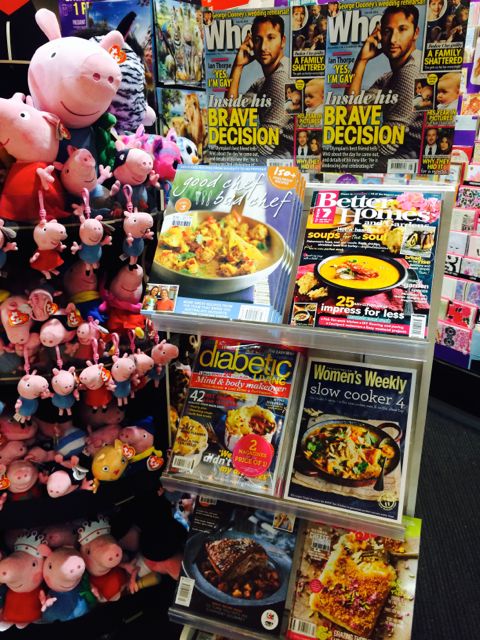
AWW Diabetes cookbook popular
The AWW Diabetes cookbook launched Thursday is popular with sting sales already. We are driving this with placement with diabetes titles more so that placement with cookbooks. It is disappointing that Bauer now releases this to supermarkets at the same time as newsagents. We used to get 6 to 8 weeks head start.
Is the Officeworks reflex paper pricing predatory pricing?
Wesfarmers owners Officeworks has an amazing deal right now on Reflex paper. In fact, the deal is so good that it is well below what newsagents can buy this paper for at wholesale. I’ve checked around and I doubt even hundreds of newsagents buying in bulk together could buy better than the Officeworks retail price.
This price of $3.20 a ream looks to me like it is below cost. It looks to me like predatory pricing.
Here is what the ACCC says about predatory pricing:
Predatory pricing occurs when a company with substantial market power or share of a market sets is prices at a sufficiently low level with the purpose of damaging or forcing a competitor to withdraw from the market.
This Reflex pricing is another attack on small business by a giant company that is half of the supermarket duopoly in Australia. We’d be letting ourselves down if we do nothing about this.
What should we do about this?
We should complain to the ACCC. Use the small business complaint form and tick the anti competitive behaviour box as this covers predatory pricing. Completing the complain form will take a couple of minutes. Making the complaint puts pressure on Wesfarmers and it puts pressure on their Reflex supplier Australian Office.
We should also complain to our local member of parliament and use this reflex pricing to pressure them to support reining in the power of Coles and Woolworths.
I plan to stop selling and using Reflex. I don’t want to carry a product that can be subject to price comparison in such an unfair way. Newsagents owned GNS has paper I can stock that is not treated this way and that’s what I’ll carry.
New Blackhawk gift cards gives us an opportunity to leverage online sales
Gift cards launched this week by Blackhawk – sold to newsagents through Touch – offer newsagents an opportunity to better connect with online and other sales. Cards for purchases from Facebook, Ticketmaster, XBOX and reloadable Visa cards are good products for us to have in-store.
Gift cards are easy gifts to include with a greeting card. Indeed, I place my Blackhawk gift card stand near greeting cards.
With no stock holding cost and minimal floorspace required the downside for newsagents is minimal.
Tapping into Mars interest
Mars has been in the news a bit over the last two weeks with talk of a manned mission and some Aussies in the running for that. This is enough of a reason to get this issue of Science Illustrated into the spotlight. Even a small opportunity like this selling one or two magazines is worth it in my view.
Is this latest magazine distributor idea all about reducing early returns?
A magazine distributor has asked XchangeIT to research implementing virtual magazine labels. Their thought is that newsagents not label magazines and instead use a hand held device to manage titles.
In a practical sense, they want you to stand in front of a title, remove it from the shelf, scan the barcode, see on the screen the ‘label’ with supply and return data and then act. With the fastest App and or hand lend device the time cost of checking a title would be four to five times longer than right now plus you’d be relying on an extra bit of hardware .
Unless I am missing something, from a newsagent perspective this thought should have been killed off quickly after it was suggested.
To me, it seems the magazine distributor could be interested in making shop floor decisions harder to make. But they will deny this.
Magazine labels today contain excellent information that enable smart newsagents to make shop floor stock management decisions.
In my software company we considered this mobile approach to returns and shop-floor title management around ten years ago when mobile data devices became more affordable. Back then we decided against it for reasons that are valid today. It would be cumbersome, difficult, slow and forcing double handling. We looked at ti again a couple of years ago and decided nothing had changed.
Here is what I wrote to XchangeIT last week about this virtual label idea:
Gavin and Jonathan have just mentioned to me about the possibility of virtual magazine labels being pursued by XchangeIT. I see no benefit for this for newsagents. They’d need technology to check magazines on the shop floor. This and the time delay in checking would frustrate them and cost considerably.
The only benefit of this would be reduced early returns and that would be bad for the cash flow of newsagencies.
Newsagents today usually only print labels for non high-volume monthlies and one shots. They do not do them for weeklies and high volume monthlies. So, the cost of labels is not high. Also, the time taken to actually label is quite low.
The label guides in-store placement. It acts as an invaluable tool in making shop floor decisions.
Australia leads the world in this area. The idea of a virtual label would deny newsagency who use it from access to a tool that is vital to active shop floor magazine management. I think it would be a waste of money for newsagents and those who serve them.
I have made similar representations on behalf of newsagents to the distributor.
If the idea of a virtual magazine label does become a reality and make its way into the IT stands for the newsagency channel, I’ll support it as I do all standards. I won’t agree with it but out of respect for newsagents I will support it. By support, I mean I will end up spending my own money on it to help newsagents.
For those who think software companies will not like this because it will reduce label purchases – I’d say you’re mistaken. Label revenue is small. From my experience the products are offered as a service. The labels can be sourced from many places.
It frustrates me that people who do not run or own or understand retail newsagencies make decisions about IT standards retail newsagents need to adhere to. These people in control of the standards are out of touch. They are not serving newsagents well. They complain that newsagents do not adhere to standards. My response is that this will continue to be the case as long as newsagents do not see any commercial benefit to them in terms of equitable magazine supply.
I wish this magazine distributor would spend more time in getting supply right. Currently, around 65% of what they supply is loss making – the stock is not even paying for the space and labour used to carry the stock. They should be investing in their end to fix this and not pursue this project of folly that has no upside for newsagents.
I wish XchangeIT would more actively represent newsagents ahead of distributors since newsagents provide the bulk of their revenue. Their ownership structure makes such a wish impossible to grant.
Locally produced soap enhances your local products pitch
b.gentle is a family run soap making business from Mt Buninyong in Victoria. I’ve sold their products in my shops for many years. Customers love their products. Them being local is a bonus. While they do sell direct, they also sell their products through many retailers including newsagents.
The b-gentle range works particularly well with older shoppers. Their products give you a good Australian success story to share in the sales pitch.
This week I am drawing attention to several local suppliers newsagents could consider. Stocking products from these and similarly local suppliers adds credibility to our shop local pitch. To me, local products are products made and / or designed in Australia. If my newsagency was in a country area my focus would be more on products sourced even closer to home.
Excellent growth in craft and hobby magazine sales
Earlier this year we nervously moved craft magazines to a lower shelf location, below weeklies. The downside is that shoppers have to reach down to select a title. The upside is that more shoppers are at this part of the magazine department than any other.
In January through June 2014 we racked up a 45% increase in craft titles sold. Once we take out popular one-shots and partworks we are still achieving 20% year on year growth. Craft and hobby titles account for 7.27% of our otal magazines sold.
The move was a success.
We can grow magazine sales by actively managing the layout of the department: by engaging in where and how we place titles.
Over the six month period our magazine sales are up 8%. This is a good result on the back of a $100,000 sales base for the same period in 2013. In the all-important weeklies, our unit sales are up 8% year on year.
Our magazine sales growth is due to active engagement with the department and the consistent promotion of our Discount Vouchers. The Discount Vouchers are driving shopper loyalty and for the weekly magazine purchase that is vitally important to us. The shoppers we lure back with the program purchase other items to then fund their magazine purchase.
New newsagency blog video
Just now a new video introducing the Newsagency Blog and its purpose has been loaded in the top right corner of the home page. This video was shot in the office yesterday.
Why I offered no goodwill and 75 cents in the dollar for stock to purchase a newsagency
I was approached recently to consider purchasing a newsagency which had been on the market for a long time. The owners were in dispute and wanted out urgently.
The figures provided were what I’d call creative. While I could see the business was losing money, a first time business buyer might have seen otherwise given how then information was presented.
The shop itself looked good, the shop fit quite new. But it was old school. It would have looked relevant in 1980 but not today in 2014.
The business had lost one magazine distributor direct account. The stationery department looked okay but tired. the card department looked the best.
With plenty of the stock old and given the business was losing money I said I was not interested. When pressed I said if I was to make an offer it wold be based on no goodwill and a payment of around 75 cents in the dollar of the wholesale cost of the stock. I said this knowing the business $50,000 in new stock and around $50,000 in replacing fittings – just to get started. So there was no point to me in rewarding the vendor for their poor management and poor decisions.
It turns out the vendor was told what I would pay – even though it was not an offer and was only mentioned in a highly conditional way.
The business has now been sold for a higher price than I would have contemplated. That tells me the purchaser has paid too much. The question on my mind is – has anyone told them they paid too much for the business? If not, they will experience sticker shock within three months of settlement.
Those of us in the newsagency channel for the long-term owe those coming into the channel honest advice.
Using local products to strengthen your local voice
These Tiny Tracks CDs are produced by a local musician and they feature his arrangements and instrumentations of international music hits – in the form of lullabies to help kids relax and sleep. They are uniquely Australian product showing off Australian entrepreneurship.
Having Tiny Tracks at the counter or in the gift department enables us to promote the local connection and thereby give the business greater credibility in its local pitch.
Mother Hen, the company behind Tiny Tracks, is a preferred supplier to nextra and newsXpress. They will supply any newsagent.
This week I am drawing attention to several local suppliers newsagents could consider. Stocking products from these and similarly local suppliers adds credibility to our shop local pitch. To me, local products are products made and / or designed in Australia. If my newsagency was in a country area my focus would be more on products sourced even closer to home.
Magazines at the new Emporium centre in Melbourne
I checked out the new Magnation location in Melbourne’s just opened Emporium centre. They are presenting their range of special interest titles in a different way. magazines have less floorspace in a Magnation store today than when the group first started out years ago. I suspect this is a reflection of occupancy cost pressure.