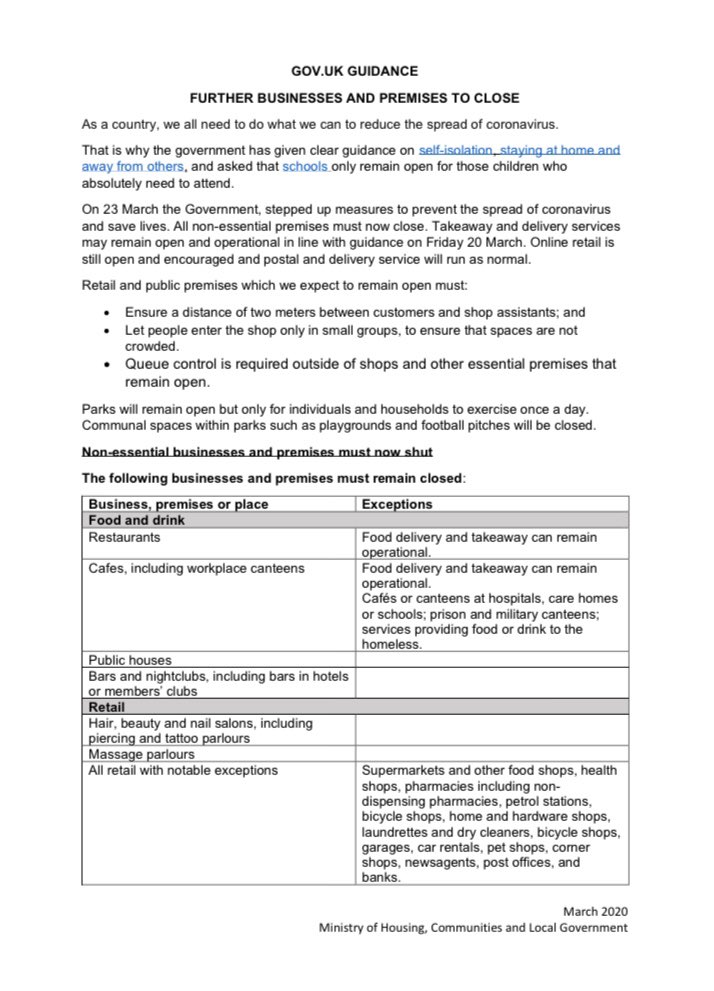
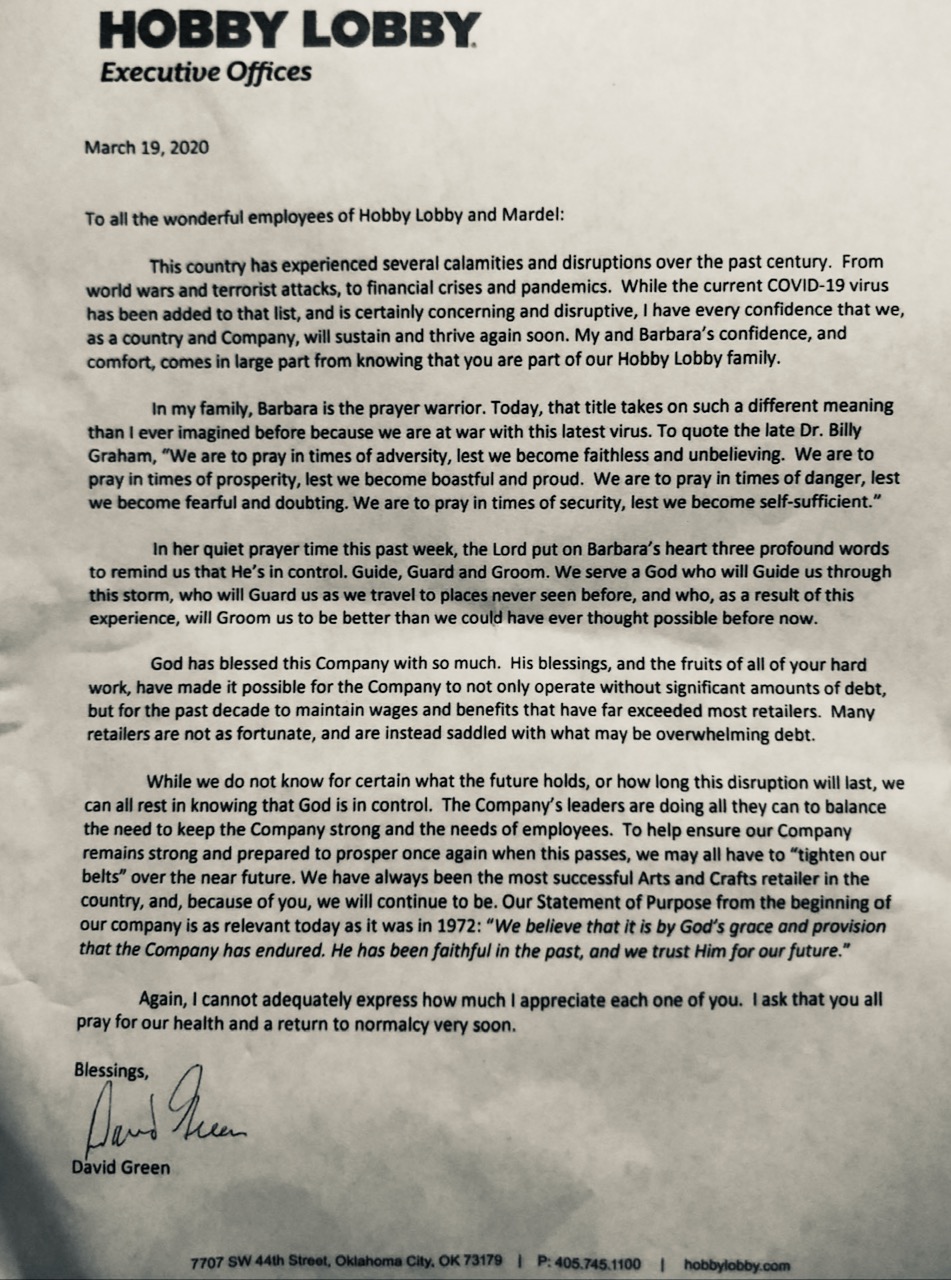
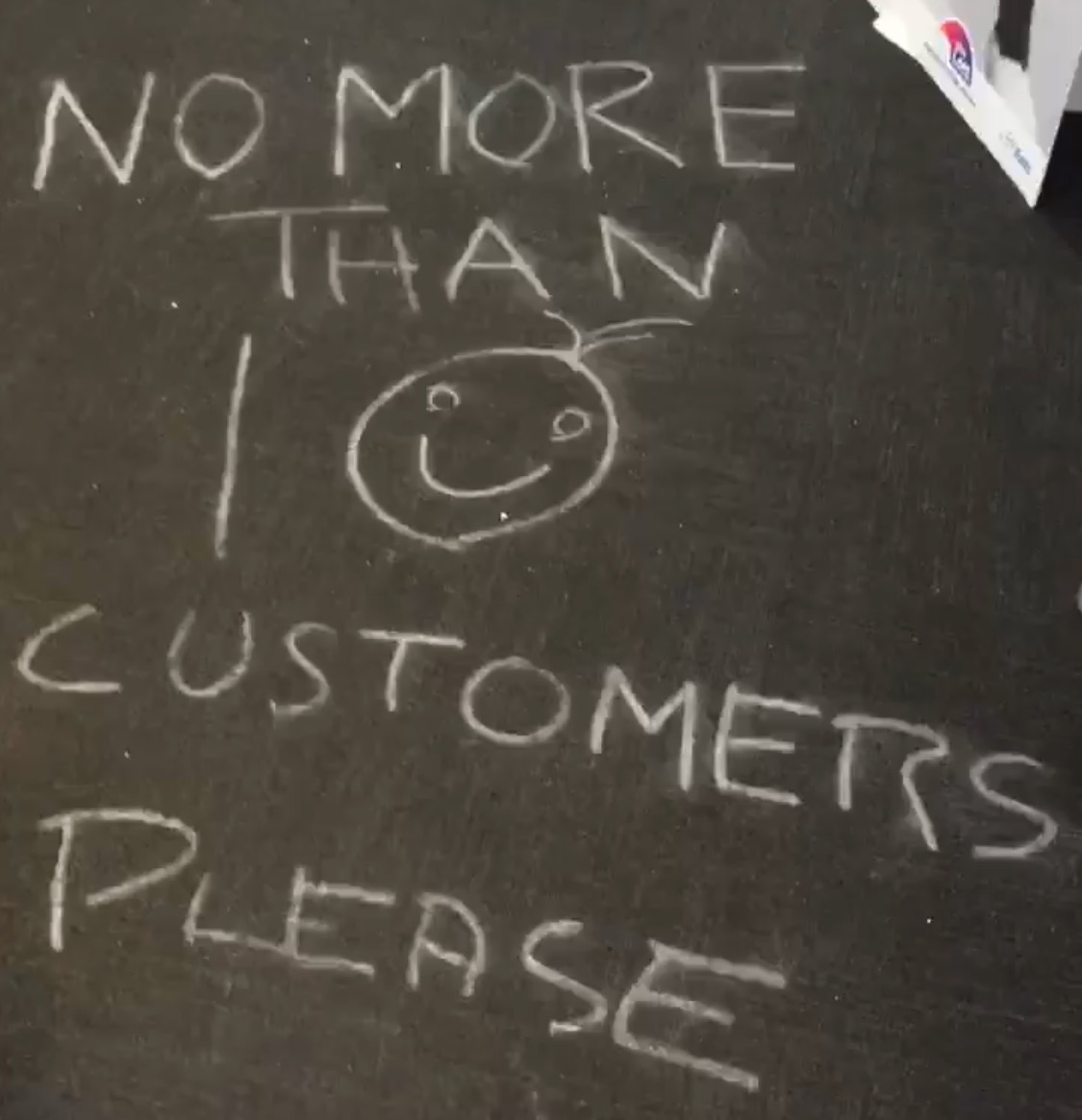
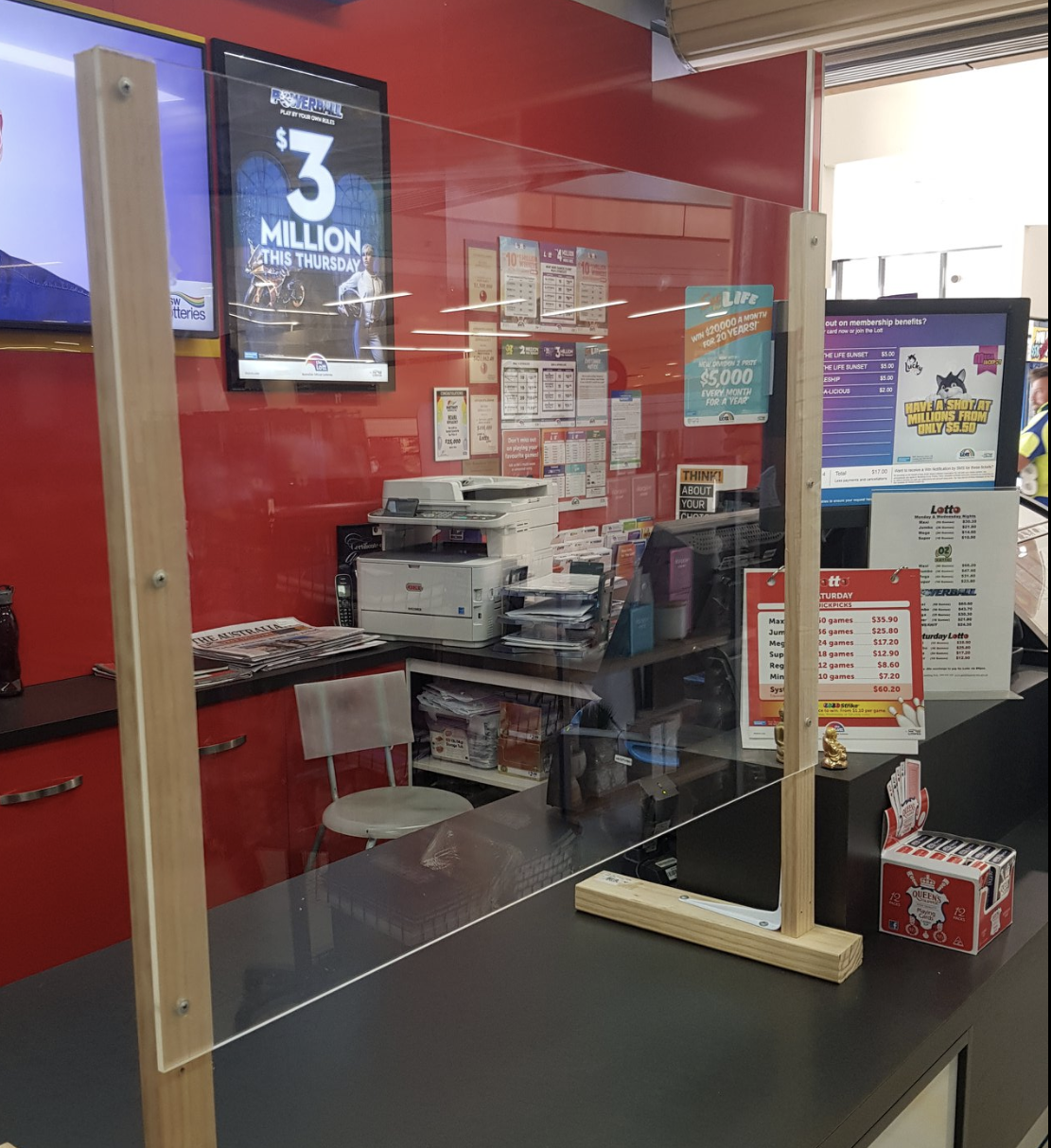
How retailers including newsagents are making their shops safer in this coronavirus world
Black Dog reached out Friday and provided some terrific resources for the times:
While they are not the only service providing resources, they are succinct and timely.
The winning ticket in Thursday’s Powerball $80M draw was purchased online. Given the usual rush to the retailer of the winning ticket, online purchases will increase.
While Tabcorp cannot control the purchase location of the winning ticket, they can control the level of support for their physical retail network. My view is that it is grossly inadequate, as it has been for years.
Their focus is on compliance and not proactive support and encouragement. The margin paid to retailers is also inadequate. Retailers stick with it out of fear for what business might look like without it and in the hope that Tabcorp will behave better.
Older customers, 70+, male and female, are the cohort most likely to ignore social distancing requirements laid out by government in their coronavirus response according to retailers.
Older customers are more likely to shop in groups, cluster with too many in a limited space, touch others in the business, want to stand still for a talk and mock moves being taken by the government to flatten the coronavirus infection curve.
I have been hearing this all week from newsagents and other retailers across the country in one on one conversations and in video conferences with groups of retailers. Retailers are frustrated, and they feel helpless to fix the problem.
One retailer talked about two grandparents coming into a small shop with two grandkids.
Another told me about an old customer who reached across the counter and patted a staff member on their arm saying it’s nothing to worry about.
Another retailer tells of two older male shoppers saying that social distancing is for sissys.
Plenty said that in their experience the older customers are less like to take the coronavirus risk seriously.
With my newsXpress group we have a daily video conference meeting and with my Tower Systems POS software retailer business customers we have a video conference every few days. It is these coronavirus related meetings to discuss business conditions and encourage each other where I have heard about the problem withholder shoppers.
How some older people are behaving is a challenge for all retailers and those who work in retail. While not the same as the health workers helping those with this illness, those who work in retail face a considerable challenge every day with their safety very much in the hands of customers and their behaviour.
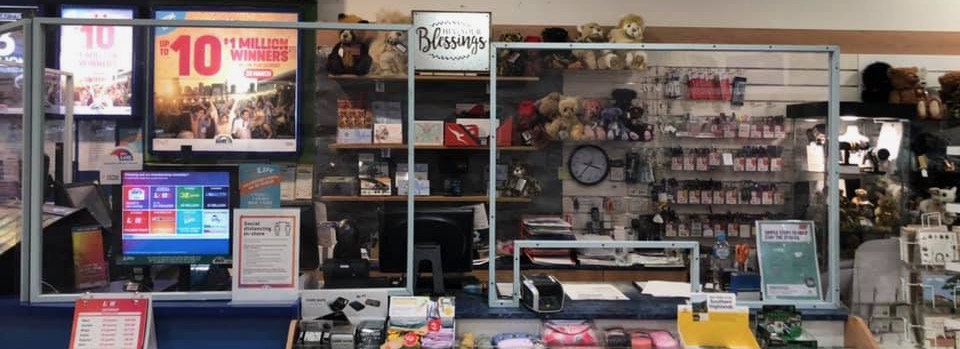
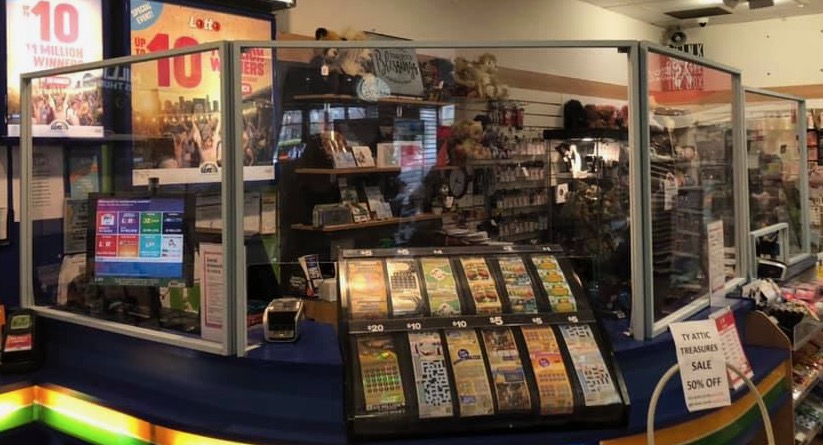
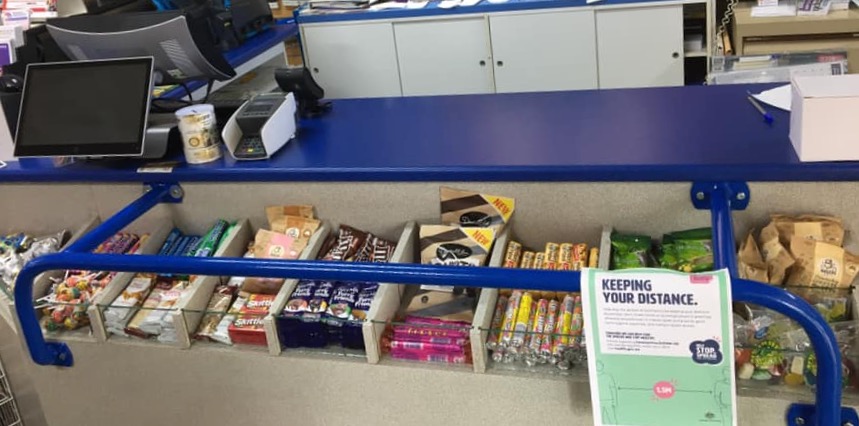
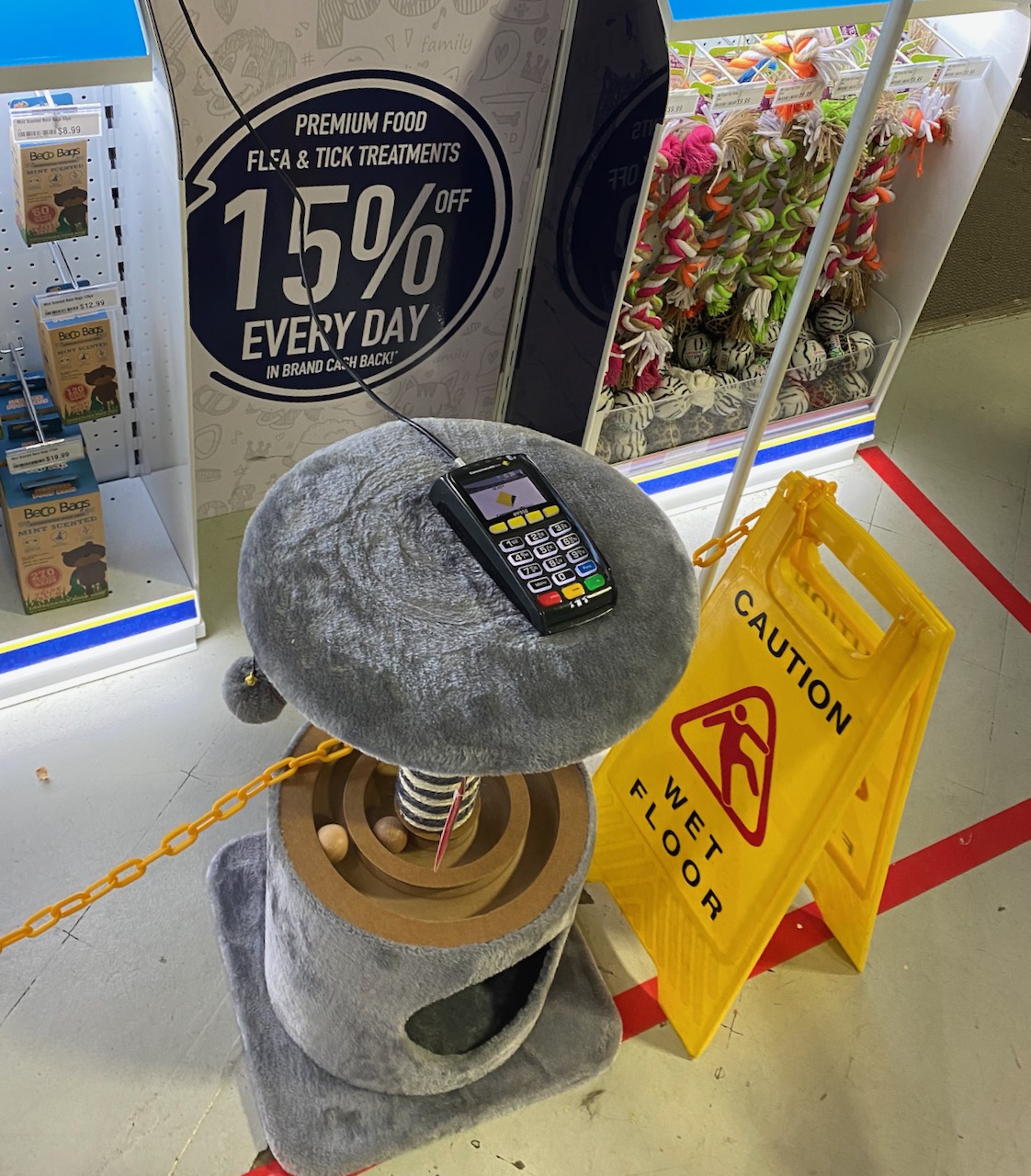
Retailers are protecting employees with gloves, hand sanitiser and good, safe, practices. They have floor and other markings to guide social distancing. Some I know are installing perspex partitions to create a better distance between staff and customers to reduce the opportunity for droplets to pass.
The challenge remains how to deal with older customers as they represent the cohort causing the most difficulties.
I think our communication needs to be clear and consistent – at the front of the store, in-store and on social media. we need to be vigilant at front of store, controlling shop entry and being firm to stop people if they present a risk because of the number in the group or because of their behaviour. We need to be prepared to ask people to leave if their in-store behaviour is inappropriate.
I appreciate some here may say this is overkill. Of course, I disagree. These are unique and challenging times. We need to provide a safe workplace for all who work in our businesses and for those who shop with us. Anyone who puts this at risk needs to leave the business.
Here is a message I put on social media this morning to address this issue:
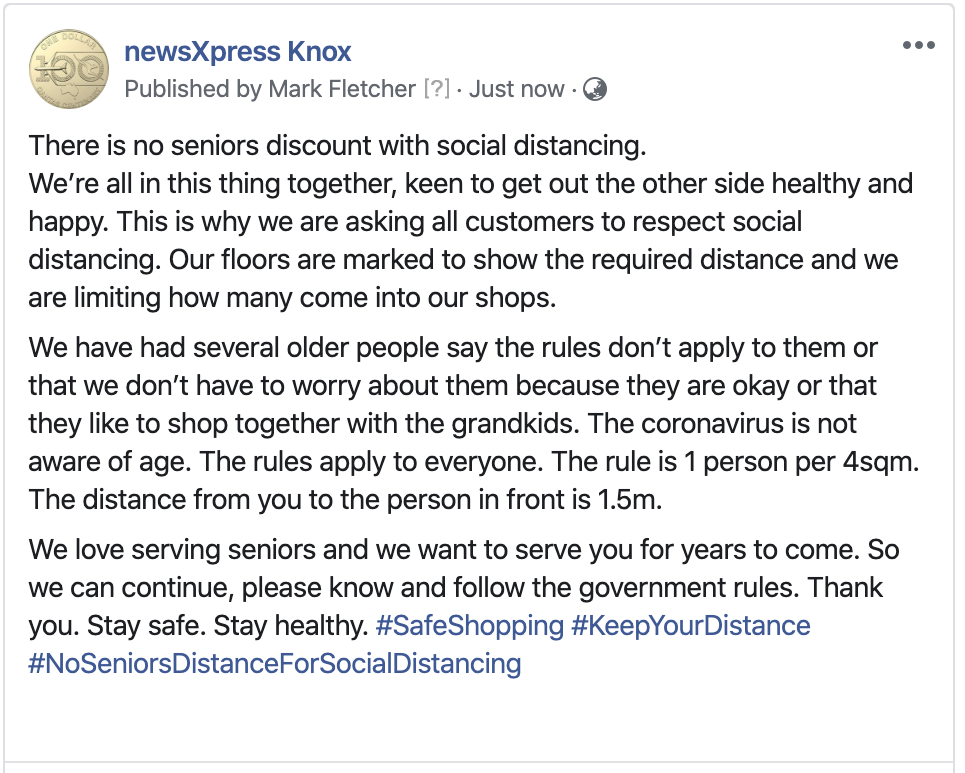
Here are some tips for your consideration should your retail business be designated an essential business in the looming lockdown. We hope they are useful:
At some point, retailers around you will be shut down for a time. If you are designated essential, the move will see affected retailers possibly upset at your favoured treatment for the newsagency channel, upset at you that you are open.
Your focus needs to be on how to adjust your business to the changing conditions. That does not mean going all out to rake in as much cash as possible. Rather, our advice is that you modestly adjust the business to serve the needs of locals. Those shop permitted to remain open could serve broader needs through this time
Look around and plan now for modest moves you could make to broaden the appeal of the business. Our advice is that you focus on categories you are already in – but with an expanded range, or products that fit with categories you already serve today.
We think stores remaining open need to make significant shop floor moves, to reflect the needs of the tougher circumstances and to demonstrate your respect for these as well as the wellbeing of shoppers and your team.
Here is the ACCC press release:
Bauer Media’s proposed acquisition of Pacific Magazines not opposed
The ACCC will not oppose Bauer Media’s proposed acquisition of Pacific Magazines (ASX:SWM), after deciding the transaction was not likely to substantially lessen competition in relevant markets.
Bauer Media and Pacific Magazines overlap in the publication of print and digital magazines and in content published on digital platforms.
The ACCC carefully assessed the impact of the merger, given the close competition between the parties’ key print magazines, Bauer’s Woman’s Day and Take 5, and Pacific Magazines’ New Idea and That’s Life!.
“The significant declines in the circulation and revenue experienced by many magazines are sustained, substantial and likely to continue, resulting in less investment in content and fewer retail promotions,” ACCC Chair Rod Sims said.
“We note that some magazine titles have already closed, and others are likely to follow, regardless of this deal.”
“We also note that the content offered by the four key magazine titles, including celebrity news, ‘real life’ stories, puzzles, and food, health and lifestyle tips, is all available from other sources.”
“Ultimately, we determined that although there is a notable level of competition between the particular print titles, the transaction was not likely to substantially lessen competition because publishers in other media, particularly online publishers, will increasingly compete with Bauer,” Mr Sims said.
The ACCC found that while many of Bauer and Pacific Magazines’ customers value the tactile nature of physical magazines, they are often not regular buyers of the magazines. Further, increasingly others see online content as a ready alternative, and this should constrain Bauer’s ability to raise prices or reduce investment on content.
Further information is available at Bauer Media Pty Limited – Pacific Magazines Pty Ltd.
Background
The ACCC commenced a review of the proposed acquisition on 23 October 2019 and raised concerns about the acquisition in December.
Bauer Media and Pacific Magazines are publishers of magazines and digital content.
Bauer Media is part of the Bauer Media Group, which is based in Hamburg, Germany. Bauer Media group is a privately owned international media company publishing over 600 magazine titles globally.
Pacific Magazines is a wholly-owned subsidiary of ASX-listed Seven West Media Limited (SWM). SWM is a national media provider across television, magazine and newspaper publishing and online platforms.
ASX-listed Seven Group Holdings Limited (SGH) has a 41 per cent shareholding in SWM. SGH is an Australian diversified operating and investment group with businesses and investments across industrial services, oil and gas and media.
Bauer and Pacific Magazines overlap in the publication of titles in:
- the category referred to as “Women’s interest” in industry documents (Bauer with Woman’s Day, The Australian Women’s Weekly and It’s Your Day, and Pacific Magazines with New Idea and New Idea Royals); and
- the Real Life category (Bauer with Take 5 and Take 5 Monthly, and Pacific Magazines with That’s Life! And That’s Life! Monthly).
The parties also overlap across other categories of magazines including Home & Garden, Celebrity, Fashion & Lifestyle, Health & Fitness, Puzzles, Food and Parenting.
Release number:
47/20
Across the country, but more so regionally and in the city, people are reaching out to newsagents to open newspaper home delivery accounts.
In retail newsagencies, newspapers are being moved from the back of the shop to the front, where they were located for decades.
Everything old is new again.
From the Minister for Planning and Public Spaces:

Small land lords time to shine
COSBOA has profoundly congratulated those small landlords around the country who have already cut their rent or in some cases stopped rent for businesses who have no income due to the COVID-19 crisis. We call upon all the small landlords around the country to do what they can for others in distress.
Peter Strong, CEO of COSBOA, stated ‘small landlords are often small business people or families who have invested in property and have rented out to others either as commercial or as residential leases. These landlords may also be experiencing the difficulties of hard times, particularly for those whose income is inextricably linked to the property they lease, such as retired people. Yet, with the announcement from the banks that there is no need for loan repayments for small businesses borrowers for the next 6 months there is an opportunity to pass this saving onto tenants.”
COSBOA knows the pain and anguish suffered by businesses who have no income yet have rent and often wages to pay. Landlords will not benefit from bankrupted business tenants. COSBOA knows that the employees of small businesses are often valued like family and they must be considered for rent relief by residential landlords as their tenant may now be on a lower income, without a job and trying to be ‘Centrelinked’ but are having trouble due to the overwhelming of the MyGov system.
Mr Strong added “it is imperative for every small landlord with a bank loan to contact their bank and get the loan repayment holiday if they are eligible. Then immediately pass that onto their tenants.’
Mr Strong added “any small landlord who takes the loan holiday and then doesn’t pass on that saving to the tenants would be a failure as a person and as a member of our society. The biggest landlords, such as Westfields, Stocklands and the Scentre Group, have shown they are the lowest members of the big business community with their callous callow response to the needs of struggling and closing small business retailers. The small landlords will be no different if they were not to pass on the saving.”
Note for tenants: Not all landlords have loans from banks and may not receive the repayment holiday and may not be able to pass on any savings. Check with your landlord and ask if they have sought to take advantage of the bank repayment hiatus.
Typically, today and tomorrow, ahead of the $80M Powerball jackpot tomorrow night, we would see and hear a ton of media coverage about a surge in ticket sales, there would be photos and videos of happy shoppers in-store buying. media reports would be excited, urging on the purchase surge.
Such images would pitch the wrong message in these days.
While we need reports of people purchasing in-store, we need to see stores setup for the required distance between shoppers, recast shop floors that are not cluttered, orderly management for the health and safety of all shoppers and retail business employees.
Lottery retailers should be pitching on social media the ease of safe shopping in-store … anything to hold back what I suspect will be a surge online, enriching Tabcorp at the cost of their retail network.
All of us in business are part of the messaging, especially as plenty of our politicians fail at clear messaging.
We are open for business, offering safe shopping for you, your neighbours and our team members.
The Sunraysia Daily has announced it is suspending print operations. Expect more news like this.
SUNRAYSIA Daily will suspend printing and all staff will be stood down due to the impact the coronavirus pandemic has had on the business.
Staff were told in a meeting on Tuesday morning.
It was proposed that Saturday’s paper would be the last edition until further notice.
Staff were told the intention was for operations to eventually resume.
The decision affects all of Elliott Newspaper Group mastheads, including Sunraysia Life, The Guardian in Swan Hill and Gannawarra Times.
Sunraysia Daily, Mildura’s only daily newspaper, is in its 100th year.
Based on up to date sales data from the week to Sunday, here is a list of the product categories that are working the best in newsagency businesses:
I urge newsagents to recast their business to focus on the changed needs. Making changes around these categories listed and other local growth categories you see demonstrates engagement, a service shoppers will respond to.
As the advice of health authorities and the respective governments across Australia and New Zealand continues to evolve, I want to keep you informed of the steps we are taking to support you during this period.
We recognise that shopping centres provide essential services including food and groceries, pharmacies and medical clinics and as such, these services will continue to trade as directed by authorities. We recognise the lock-down advice of both countries and are working with retailers on the ground in regards to closing these stores.
We acknowledge that we are in uncertain and unprecedented times and that many businesses are facing significant challenges on many fronts. To assist you, we are committed to flexibility of payment terms and recognise the varying requirements of our retail partners. We’ve already been in touch directly with many of you, otherwise please contact us so we can understand your position in more detail and work with you on your particular circumstances.
For those retailers still trading, our focus is on providing a safe place for people to shop and work, with increased cleaning and signage advising customers of safe hygiene practices, as well as the addition of extra hand sanitising units in high use areas. We’re also keeping customers updated advising of the changing trading conditions.
We continue to closely monitor the situation and will keep our retailers informed as more information comes to hand.
Thank you for your continued support.
Brett Williams
Managing Director, Retail
AMP Capital
And here is what they said…
Dear Retailers,
Firstly, I hope you, your families and your teams are well.
As you may have seen, late yesterday the Federal Government announced restrictions on indoor gatherings, including pubs and clubs. The New South Wales and Victorian Governments also announced further restrictions aimed at curbing the spread of COVID-19.
We are currently seeking clarity from each government about what these restrictions precisely mean for our outlets.
In New South Wales and Victoria, it is understood outlets in pharmacies, grocery stores, convenience stores and petrol stations will be able to continue to operate. We also believe newsagents may be classified as a “convenience store” and be entitled to continue to trade, however we are still discussing with the relevant authorities in order to have that confirmed. We will confirm this position as soon as we know more. Outlets that fall outside of these types of essential service stores will not be allowed to continue to trade.
In Queensland, South Australia, the Australian Capital Territory, Tasmania and the Northern Territory, there are currently no government-mandated restrictions on outlets trading outside of those restrictions announced by the Federal Government yesterday evening. As you’ve no doubt experienced yourself, this is a swiftly evolving issue.
We understand you will have lots of questions in relation to your business, ranging from whether you can or can’t continue to trade through to fees and charges, Site Surveys and managing Instant Scratch-Its stock.
Our team has been working across the weekend to understand the best path forward in this ever-changing environment and will continue to do so this week. We are investigating each issue as quickly as we can with the latest information available and will provide regular updates and Frequently Asked Questions (FAQs) on the Urgent Information section on Retailers Web’s homepage.
For you and your teams safety, please ensure you are following the current social distancing requirements in your outlet which is available on Retailers Web.
We will also be posting links to information about the Federal Government’s small business support package on Retailers Web.
Many thanks once again for your support at this challenging time.
Best wishes,
Antony Moore
General Manager Lotteries Retail
Here is an announcement from ALNA late tonight.
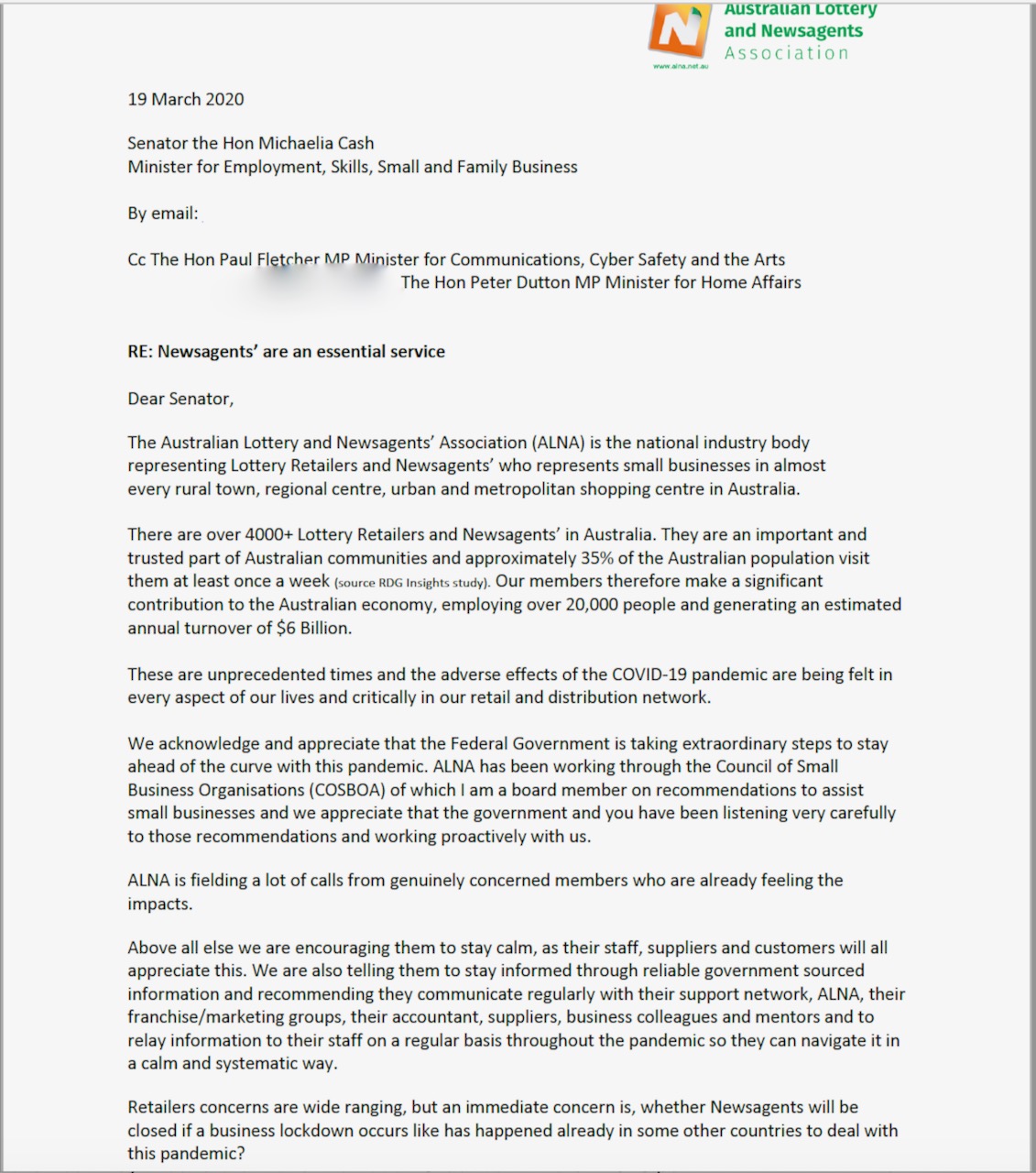
Newsagents to remain open across Australia
- Enabling accessibility of news and information for older Australian and those with limited digital options
- Establishing strict protocols regarding social distancing, cleaning and hygiene
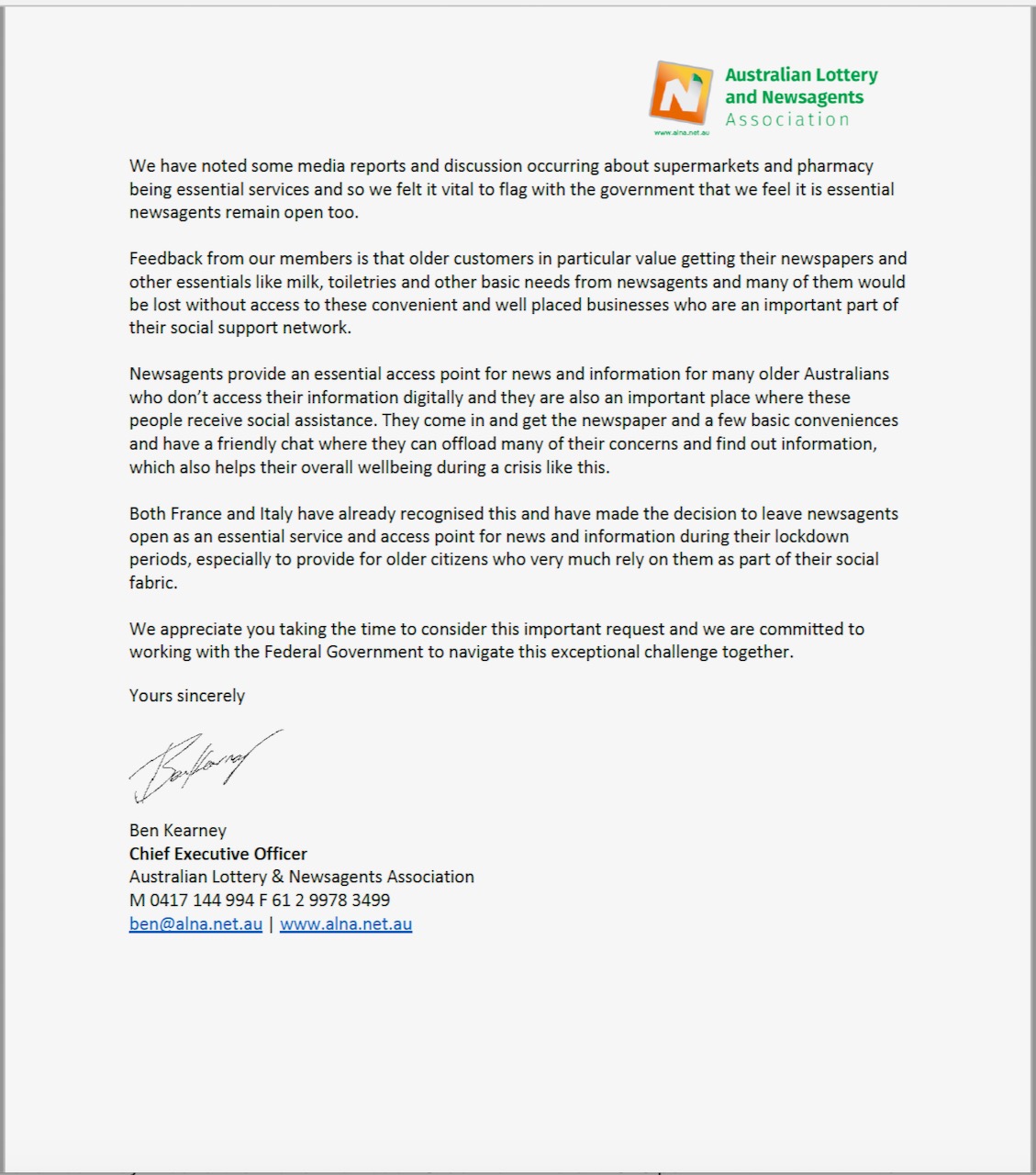
Australia, 23 March 2020, Following on from the Australian Lottery and Newsagents Association’s (ALNA) proactive letter to several Federal Cabinet ministers last week, requesting that they consider Australian newsagents to be an ‘essential service’ and remain open as they have in France and Italy, ALNA is pleased with advice and support we have received from State and Federal governments that newsagents can remain open at this time, while managing their responsibilities carefully.
ALNA was contacted today by the Deputy Prime Minister, Michael McCormack, who acknowledged the advice we had provided government regarding newsagents and their role in the Australian community. He reassured us that the government made efforts yesterday to provide greater clarity for all small businesses, including our members, around which businesses were closing.
ALNA understands how complex these issues are and we appreciate the government alleviating members concerns and providing greater clarity for all small businesses including our newsagents. We want to be a strong role model for other businesses in managing social distancing and helping to educate the public about this, all the while continuing to deliver hard copy news and some of life’s basics. In particularly supporting our older generations who rely on newsagents for their convenience and to many others who either don’t have ease of access to digital news or whose preference is for hard copy news.
Ben Kearney, CEO, Australian Lottery and Newsagents Association, stated “With strict cleaning protocols, personal hygiene and social distancing rules in place, and limiting how many customers can be in store at any given time, it’s undoubtedly not business as usual, however we are working hard to innovate our service delivery and this announcement from the Government provides certainty, for now, to our newsagents as to their continuity of trading during these challenging and unprecedented times”.
Newsagents are also in a strong position to alleviate pressure on supermarkets and local grocery stores, as many provide food and beverage items and other important household items. And with school children still either attending school or being home schooled, having access to a wide range of stationery and school supplies will be a relief for parents and carers as well.
Victoria is leading the country on mandated business closures. While the state government is yet to issue a specific list, here is what The herald Sun has published:
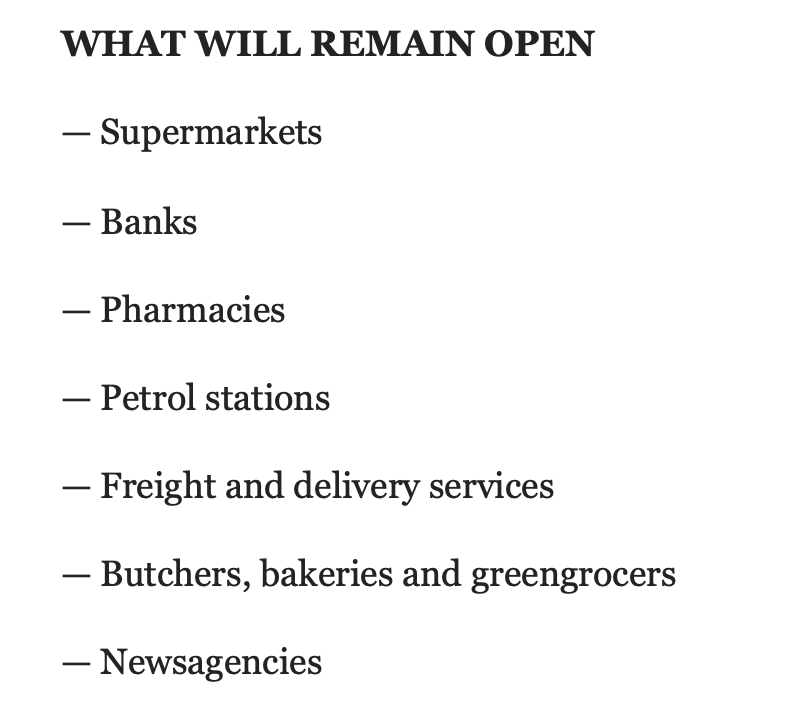
Given the objective of the shutdown, to reduce contact, businesses selling daily necessities and where people are likely to move through and purchase are preferences.
I urge newsagents to look at the post yesterday showing one way to mark our appropriate distancing on the shop floor.
Ovato has advised that a truck to Victoria has broken down. For the weeklies, it is expected that metro will still be able to make on-sale, but Country Vic won’t be on sale until Tuesday.
Ben Kearney, CEO of ALNA, has been in touch, outlining his representations recently, including today, on behalf of newsagents, seeking to have retail newsagencies permitted to open during the lockdown.
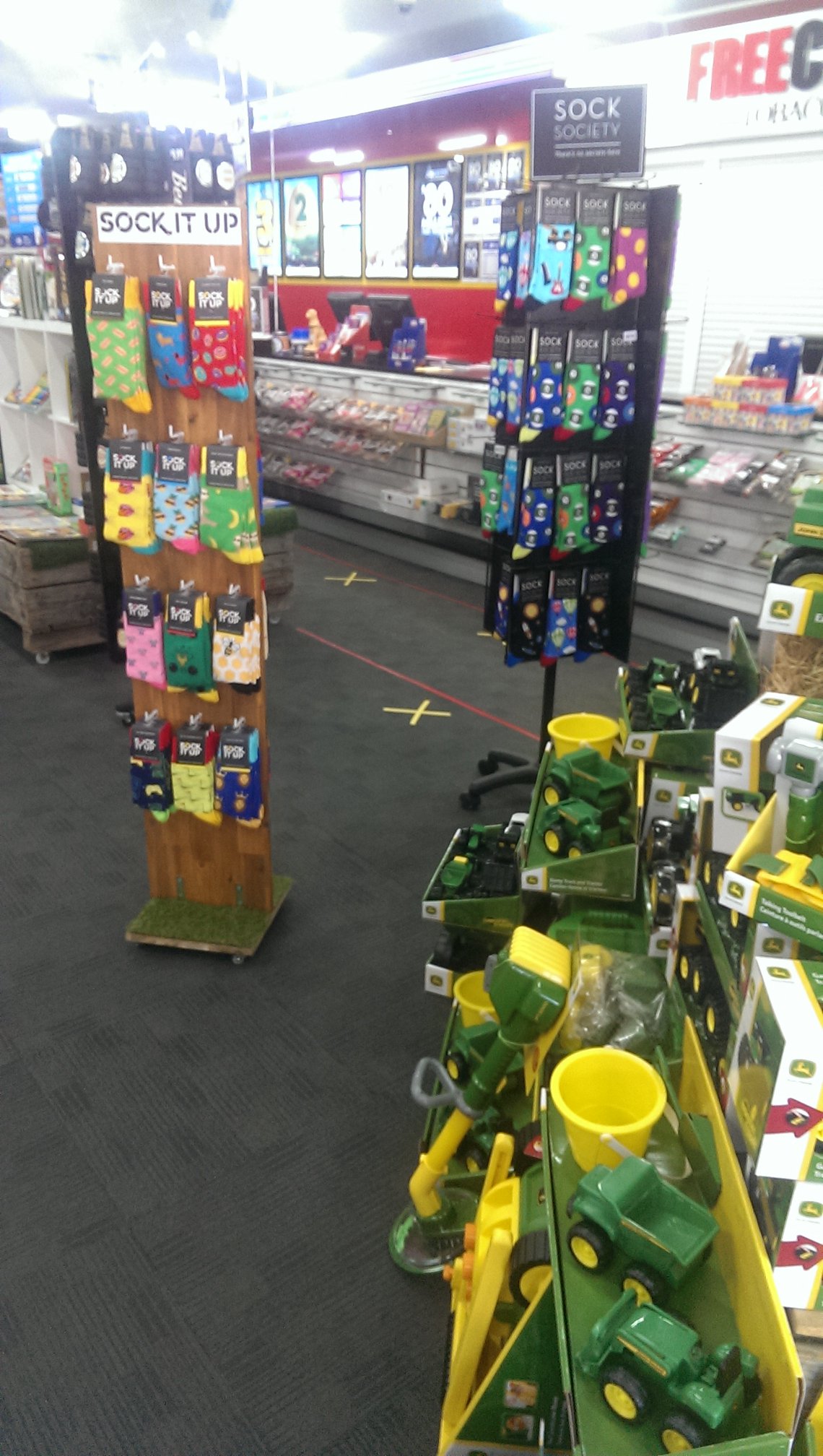
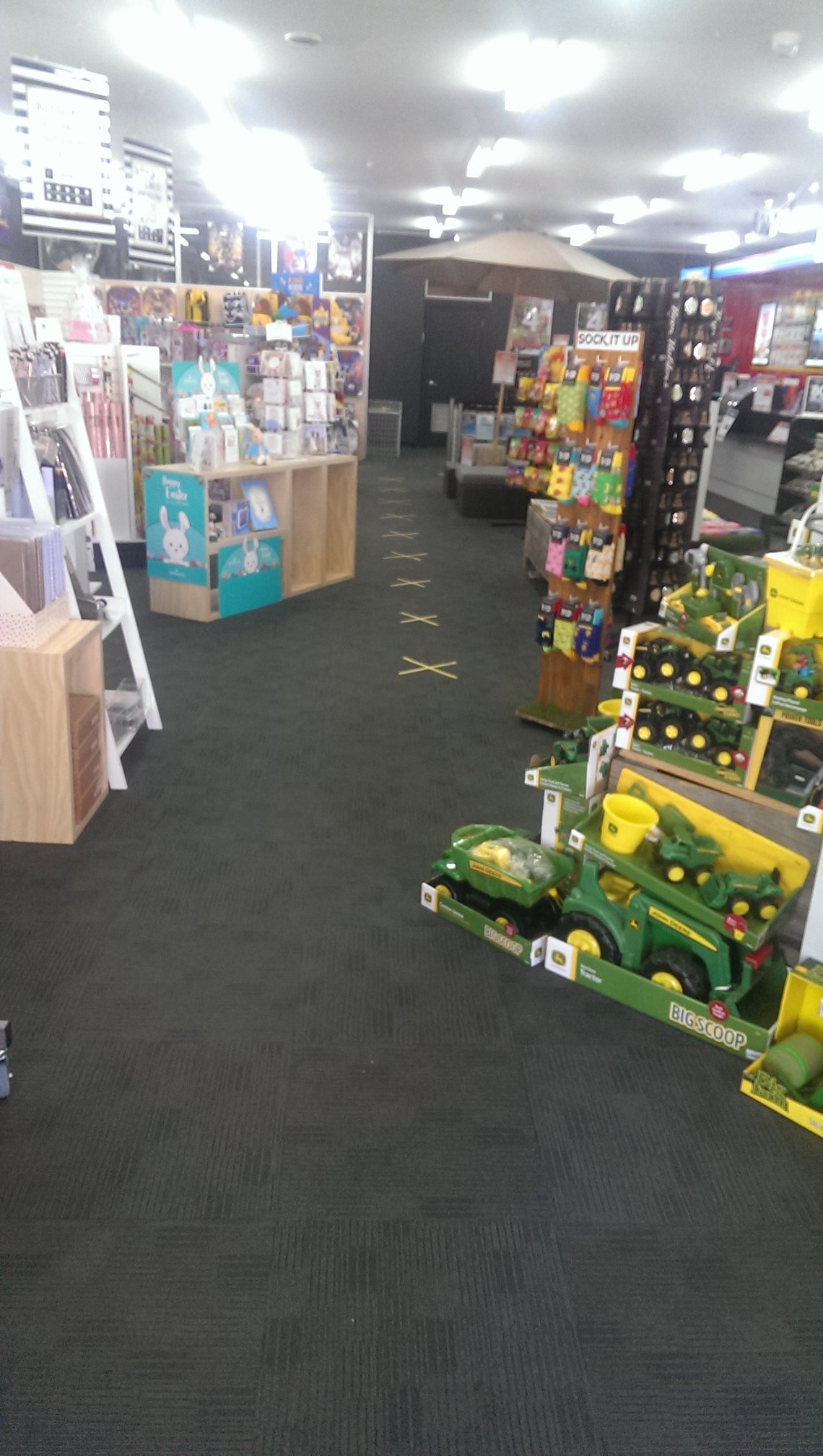
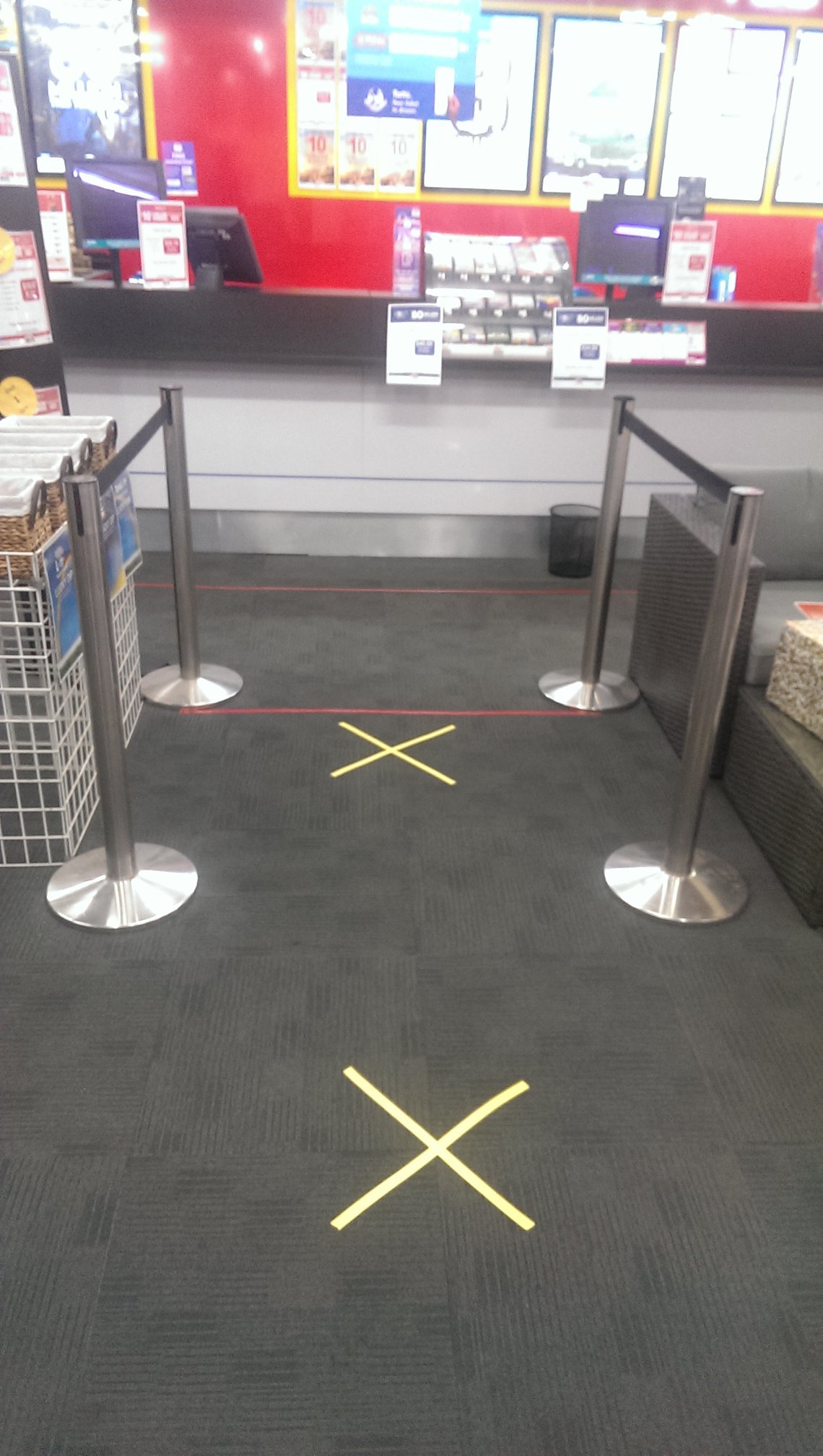
Here is what newsxpress Cobram in Victoria put in place last week. Well organised. Safe. Kudos Dean!
I wrote this note to customers of my POS software co. yesterday and thought I’d share it here as it talks to some of the opportunities we are seeing, opportunities some newsagents are already leveraging.
We are grateful for the terrific insights shared with us by many retailers across multiple retail channels and in a variety of situations. These insights have enabled us to put together the following to share with you.
In the last week we have run 8 video conferences for retailers. These have provided terrific insights. We have also participated in teleconferences with suppliers to retailers. Collating all we have heard has helped create what we share here.
COVID-19 is not impacting retail in a uniform way. The differences present opportunities that can be leveraged…
We have seen several retailers switch to cashless in the last few days. None is reporting customer pushback.
The retailers who have made significant front of store moves to serve the new needs and interests of shoppers are reporting good responses. Games and jigsaws are a good example of this.
Some retailers are having success bagging up packs and offering these as a bundle to shoppers. They make the shop faster and even facilitate curbside pickup or home drop-off.
With nursing homes all but closed to visitors, some retailers are having success delivering care packages for loved-ones who cannot visit.
These are all opportunities.
Looking back in our own software business, we have received a bunch of orders for new websites as retailers make this move. We have redirected resourced to deliver these quickly, efficiently. There is no doubt that being able to sell online has come into its own through this situation.
The other thing we are noticing is that plenty of retailers are taking the opportunity to work on their business. This is keeping our sales people busy, demonstrating our software online and bringing on new customers.
The video conferences I have been hosting with newsXpress members and Tower Systems customers have revealed some interesting and, hopefully, useful data. We are hosting these conferences daily.
Most regional and rural retailers are either up or in line with 2019 trading whereas most city retailers are down with shopping centre retailers down the most. On a video call late Thursday, of the 25 businesses, 16 were regional and rural across five states and all reported solid trade.
I have heard regional and rural retailers reporting that the better conditions are due to people with holiday homes or hobby farms and the like relocating to work from these during this work from home window.
There is also evidence of city people moving in with country located relatives.
In city high street situations there is a slight decline with offices emptying out. The shopping centres are in the most challenging situation with declines of 40% and more now common.
In the regional and rural locations stationery is selling well as are colouring books, especially adult colouring.
Across the board, popular items include jigsaws, games, crossword puzzles, magazines, basic stationery and everyday value plush.
We have been promoting send a hug to pitch cards with modest success.
Thursday, newsXpress kicked off an online brighten the room / send a hug Beanie Boo promotion offering 25% off and free shipping triggered at $50. This has driven a terrific boost in online purchases.
I think it is prudent that there are no rep visits to stores at all. It is best to keep shops for shoppers. Cash is king. I can’t see many orders being placed unless for items that will sell well in the short term. rep visits right now are a distraction.
Likewise, I think card companies need to reconsider merchandiser visits.
Retailers are not thinking beyond COVID-19. I think all bets are off for traditional promotions. Take Mother’s Day, for example, plenty of retailers have said they will not bring in additional gift stock for this and that they have cancelled later in the year seasonal orders.
Operating costs. We have had success helping some newsXpress stores to reduce rent. The most successful is a regional NSW store where their landlord has agreed a 50% reduction for at least 6 months. This was achieved using a template we developed a week ago for newsXpress members.