A blog on issues affecting Australia's newsagents, media and small business generally. More ...

help for retailers

The Global Warning: Why the “Death” of the British Newsagent is a Mirror for Australia

I’ve been writing for a long time about the widening divide in our industry. On one side, we have transformed newsagencies, dynamic retailers who are embracing high-margin “want” products, curating their stock, and achieving double-digit growth. On the other side, we have traditional newsagencies stuck in a cycle of managed decline, clinging to low-margin “agency” lines and waiting for foot traffic that isn’t coming back.

If you think this “adapt or close” reality is unique to Australia, look across the globe.

A recent BBC article, Why traditional British newsagents are on their last legs, highlights the exact same crisis unfolding in the UK.

The story has sparked debate, even drawing an open letter of protest from local print publishers who feel the national broadcaster is declaring print dead. (Print is dead, of course.) If you strip away the media politics, the core message of the BBC story is a loud, clear wake-up call for every Australian newsagent, as if they need another wake up call.

The Myth of the “Pure” Newsagent

In the BBC piece, Hetal Patel, president of the Federation of Independent Retailers, summarised the crisis:

A decline in sales of printed news and the shift to online, along with publishers reducing profit margins and wholesalers increasing carriage charges, has meant that purely dealing in news and magazines is no longer viable for independent retailers.”

Sound familiar?

For years in Australia, we’ve watched our traditional pillars erode. Magazine unit sales are slipping, newspaper unit sales continue to decline, and the distribution models from major publishers continue to financially and operationally disrespect newsagents.

The UK newsagents who are failing are the ones who remained “sentimental meeting places” or rigid “agents.” They expected the foot traffic of yesterday to pay the rising rents of today. But as one British commentator rightly pointed out to the BBC: “Newsagent struggling when nobody buys papers isn’t the shocker they think.”

The Danger of the “Agency” Mindset

The UK crisis highlights the ultimate danger of the agency business model. The agent is weak, and under compensated.

We are seeing this play out right now in Australia. With major shifts in the lottery landscape toward digital-first mandates, relying on a third party’s digital strategy to drive physical foot traffic is a losing battle.

If your primary business strategy is to stand behind a counter and hand over products where you have zero control over the margin, you aren’t a retailer. You are a clerk in a managed decline.

The British Lesson: Adapt, or Prepare to Close

The BBC article notes that the UK survivors are those who have “diversified.” But there is a massive difference between survival diversification and growth transformation.

In the UK, many struggling newsagents simply transition into generic convenience stores. They compete on thin-margin bread, milk, and chocolate, trying to go head-to-head with petrol stations and supermarket giants.

Why the British Convenience Pivot Will Ultimately Fail

I don’t want the British newsagent pivot to convenience to fail. I think it will though because they are competing with the major supermarket businesses. I’ve seen it myself across the UK. walk down the high street and you’ll see two, maybe three, supermarket small format convenience businesses, and you may see a local newsagent. The supermarket businesses have more details and a better range. The indie businesses can’t compete.

Rather than pivoting down market, British newsagents should have backed themselves and pivoted up market.

The Australian Story

Benchmark data I’ve reported here shows that the newsagencies thriving in 2026 are not the ones turning into low-margin corner shops. They are the ones transforming into destination retail boutiques.

  • They are ditching the “newsagent” shingle and giving themselves permission to be something else.
  • They are moving magazines to the side and putting “want” categories, high-end collectibles, niche stationery, boutique toys, high-value gifts, and clothing, front and centre.
  • They are achieving gross profits of 50% or more, resulting in an 11% surge in average basket value and a 9% increase in overall revenue

What We Owe the Future

The closure of traditional, multi-generational newsagents is always sad. Heritage and history are not shields against changing consumer behaviour and digital technology.

What we owe the legacy of our industry is not a stubborn refusal to change; it is the courage to pivot.

If you walk into your shop tomorrow and the first thing your customers see is a fading wall of newspapers and magazines from 1995, you are telling your community that your business is a relic.

Stop waiting for publishers, distributors, or lottery corporations to save you. They won’t.

The choices you make today will dictate whether you are a 2026 success story or a statistic. Take control, disrupt your layout, and start being a retailer.

7 likes
newsagency of the future

Learning from excellent local retail overseas: Labour and Wait

In the newsXpress retail study tour a couple of months ago we go to visit the latest Labour and Wait store, in Covent Garden. It is a masterclass in independent retail. Inspiring.

Having first visited their previous location several years ago, we remain inspired by their approach. Their unwavering commitment to functional, high-quality household, kitchen, and garden products is exemplary. These are items designed to last.

In this video on the newsXpress YouTube channel (https://youtu.be/ul18Dqu656s) I share some of the takeaways from our visit to their Dryden Street premises.

Avoiding the “Fast Retail” Trap

Labour and Wait stands out by ignoring temporary trends. Instead, they focus on well-made items with rich histories.

Many of their products are sourced directly from traditional makers across England, Europe, and America. By choosing durability over novelty, they build trust and establish a highly loyal customer base.

Minimalist Visual Merchandising

The store utilises a minimalist aesthetic that lets the products shine.

  • Purposeful Placement: From Trusco toolboxes on the floor to beautifully displayed stationery, every item has a clear purpose.
  • Sensory Appeal: Artisanal soaps and shaving creams are presented to encourage interaction.
  • No Clutter: The layout prioritises breathing room over maximum product density.

Masterful Space Management

One of the most valuable lessons for independent retailers is how Labour and Wait manages stock. Despite a vast range, the shop floor never feels cluttered.

By keeping minimal stock on the floor and utilising their storeroom effectively, they create a serene, high-end experience. This environment encourages customers to linger, browse, and ultimately spend more.

The “Counter Experience”

The checkout area is not an afterthought. Labour and Wait regularly updates a curated display right at the counter.

During our visit, this space focused on premium pet care products. It is a highly effective way to drive add-on sales and introduce customers to new niche categories.


The Retail Takeaway Quality and simplicity always win. By curation, discipline in stock control, and focusing on legacy products, independent retailers can create a destination that customers love to support.


Transform Your Retail Business

Are you ready to elevate your retail store with high-quality product categories and expert strategic advice?

newsXpress is here to help you move away from traditional models and transition into a more profitable, curated future. We provide our members with the tools, exclusive supplier access, and hands-on consulting expertise needed to thrive in today’s market.

Join the newsXpress community today. Contact us at help@newsxpress.com.au to find out how we can support your business journey.

6 likes
Newsagency management

A hard truth about magazine margins

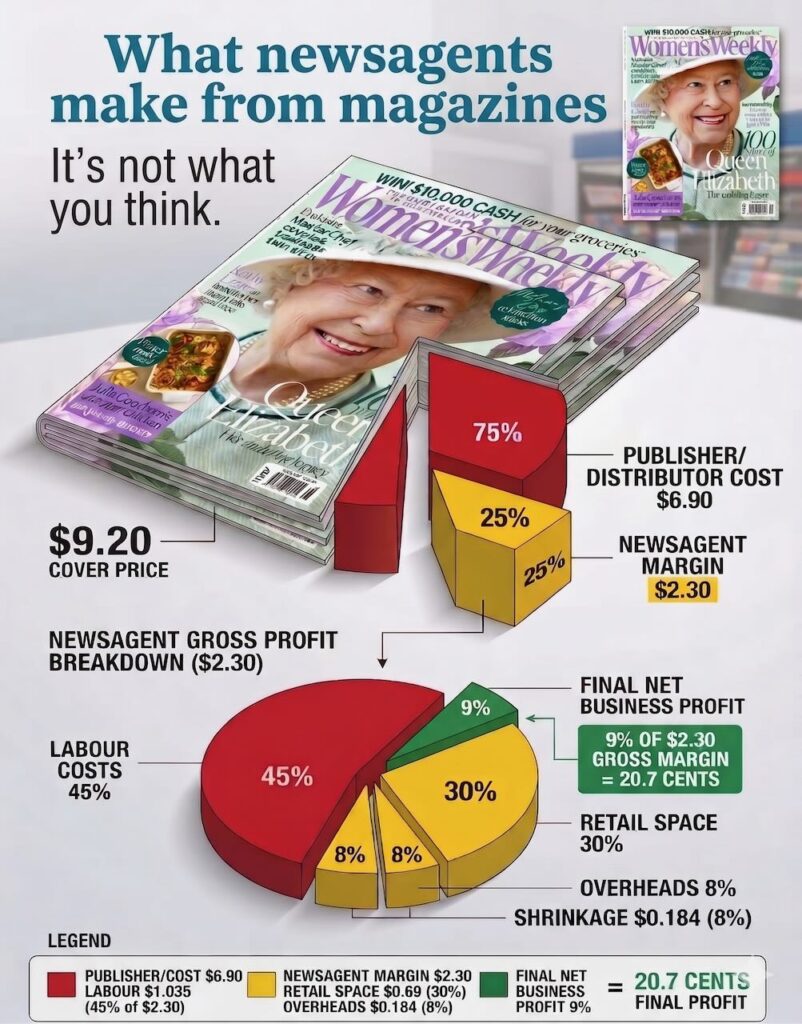
There is a persistent myth that newsagents are “raking it in” from every glossy title sold. When a customer hands over a $9.20 gold coin and change for a monthly staple like The Australian Women’s Weekly, the assumption is that the shopkeeper pockets a healthy chunk of that transaction. However, once you peel back the layers of the Publisher/distributor model, the reality for the small business owner is far more sobering.

To understand the business of magazines, you have to look at the gross margin. For us, that figure sits at 25%. From a $9.20 magazine, the newsagent receives $2.30. This is the starting point. That $2.30 must carry the entire weight of the physical retail operation before a single cent can be considered actual profit.

THE ANATOMY OF A $2.30 MARGIN
Running a brick-and-mortar store in Australia is expensive. The costs are fixed, but the income is increasingly variable. Here is how that $2.30 gross margin is eroded by the unavoidable costs of doing business:

Cost Category Allocation Amount per Copy:

  • Labour Costs (Staffing/Wages) 45% $1.03
  • Retail Space (Rent, Rates, Fit-out) 30% $0.69
  • Shrinkage (Theft, Damage, Returns) 8% $0.18
  • Operating Overheads (Power, Insurance, Comms) 8% $0.18
  • Operating Profit 9% $0.21

SURVIVAL ON 21 CENTS
After paying the staff to unpack, check, price and put out magazines and keep them tidy and take them off and count them and handle them for return, the landlord for the privilege of the floor space, and the electricity company to keep the lights on, the newsagent is left with approximately 21 cents. It is important to note that this is “Operating Profit.” This is not money in the owner’s pocket. Out of these 21 cents, the business must fund its own debt, pay interest on loans, and finally, provide an income for the owner.

Magazines are labour intensive. The supplier management process is out of date, amplifying the labour costs imposed on newsagents. When you consider the labour of  receiving stock from the Publisher/distributor, managing the display, processing the sale, and handling the returns process for unsold copies and dealing with delivery errors, the return on effort is slim. A newsagent has to sell five magazines just to clear a single dollar in operating profit.

The next time someone suggests that newsagents have it easy, show them these figures. We aren’t just selling paper; we are managing a high-volume, low-reward logistics operation. For the local newsagent, the magazine category is a service to the community, sustained by tight discipline and very thin margins.


Mark Fletcher founded newsagency software company Tower Systems and is the CEO of newsXpress, a marketing group serving innovative independent retailers who continuously evolve their businesses to be enjoyable, relevant and successful. You can reach him on mark@newsxpress.com.au or 0418 321 338.

9 likes
magazines

Is the Traditional Sales Rep Model Still Viable?

The role of the traditional sales representative is evolving. In 2026, the retail landscape demands greater efficiency from every partner. Regulars here will know this has been on my mind for a while.

Here’s a new short video from me about it: https://youtu.be/Df3umeh8M0Y

With more newsagents running their businesses under management, the value of the rep visit is considered through a different lens to if they were running the businesses day-to-day themselves. I think suppliers need to consider.

Okay, let’s get into this in the context of what I discuss in the video:

The Cost of the Traditional Model
Every representative visit carries a significant cost burden. This includes salaries, vehicles, travel expenses, and commissions. On average, a rep may only be customer-facing for half of the year. This traditional approach can be slow and expensive for suppliers.

Speed to Market
Launching a new product through physical visits can take weeks. In a digital world, this delay is a disadvantage. Many suppliers now use software and AI to reach retailers instantly. One business replaced fifteen reps with two head-office staff. After an initial adjustment, their sales exceeded previous levels.

Valuing the Retailer’s Time
Independent retailers often see multiple reps in a single day. Each visit consumes valuable time that could be spent on the shop floor. Modern retailers prefer suppliers who respect their schedule. Efficiency in the back office helps keep margins sustainable for everyone.

Digital Integration
The future of retail relies on seamless data. Manual orders and paper invoices are becoming obsolete. Retailers need automated systems for importing invoices and placing orders directly through point-of-sale software.

Looking Ahead
Suppliers must reconsider how they represent their brands. This might mean leveraging technology or finding new ways for reps to add genuine value. As retail changes, our partnerships must also adapt to remain competitive.

Efficiency is no longer optional. It is the new standard for doing business.

Now, to the reps themselves. What I am discussing here is not new. It’s not an agenda from me, either. The writing is on the all four the rep role. Consider this in your own career planning. I would if I were you.

3 likes
Newsagent suppliers

How much do newsagents really make from each newspaper they sell?

Why can’t you put newspapers right at the front of the show?

They can’t afford that prime space?

Really, at $3.50 you’d be making good money.

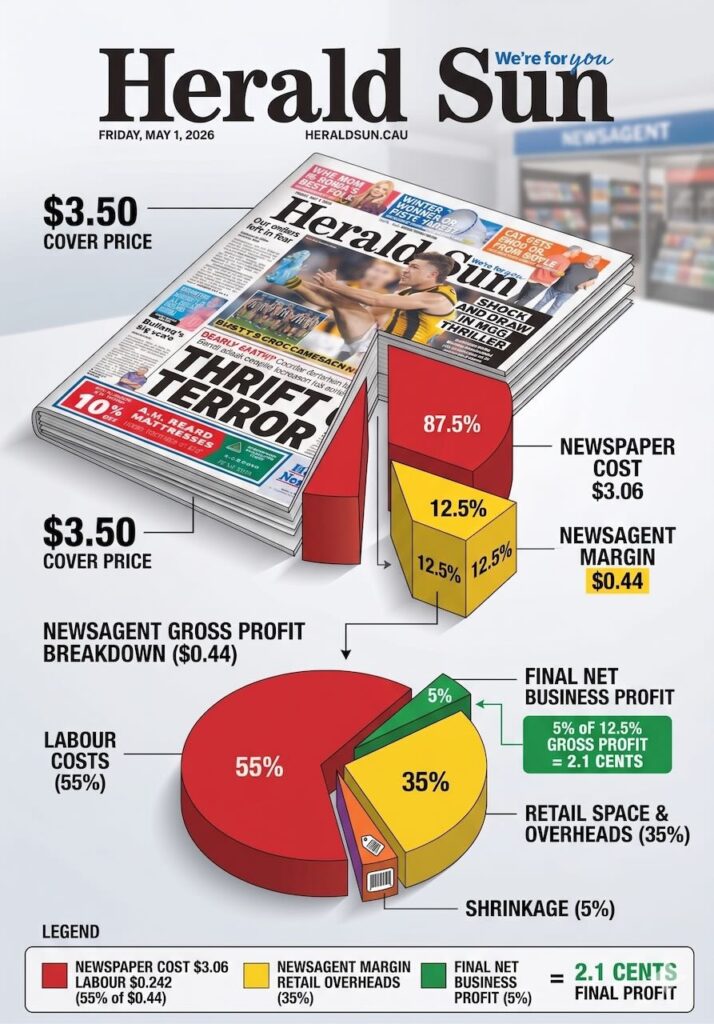
This conversation got me thinking about how I could show what I make from each newspaper sold.

It is a common sight in any Australian suburb: a customer walks in, grabs a daily paper, and walks out. To many, it looks like steady, reliable business. The reality is a tougher story of paper-thin margins and rising costs.

While many believe newsagents make good money every newspaper sold, the gross profit (GP) is generally fixed at 12.5% (or less) of the cover price. On a $3.50 newspaper, that leaves just 43.75 cents in the till.

The Real Cost of a 43.75-Cent Margin

That 12.5% is the “gross” figure, but it quickly evaporates when the operational realities of running a local business are applied.

  • Labour Costs: Every paper has to be counter, checked off, displayed, and, if unsold, processed for returns. In a high-labour-cost environment like Australia, the time spent managing these low-margin units often exceeds the profit they generate.
  • Rent and Floor Space: Newspapers take up physical space. When you calculate the rent per square metre, allocating that space to a 12.5% margin product is often a loss-making exercise compared to high-margin gifts or stationery.
  • Operational Overheads: Lighting, power, and insurance don’t get a discount just because you are selling a low-margin product. These fixed costs bite hard into the cents remaining from each sale.
  • Shrinkage and Damage: A single stolen paper or a copy damaged by rain or coffee can wipe out the profit of the next ten sales.

This “margin squeeze” is precisely why the most successful newsagents are actively decoupling from the traditional newsagency model. Relying on a product where you have no control over the price or the margin is a precarious strategy.

The future for independent retailers lies in categories where the business owner has the power to set prices, manage margins, and build a unique local brand. Whether it is high-end gifts, specialist stationery, or niche collectibles, the move is away from being a low-margin distributor and toward being a high-value destination.

The next time a customer mentions the “big money” in newspapers, it might be worth a gentle reminder: in modern retail, it is the quality of the margin, not just the volume of the foot traffic, that keeps the lights on.

This infographic represents real numbers. I used AI to date the data and a copy of Friday’s Herald Sun to create it.

You’re welcome to use this image.


Mark Fletcher founded newsagency software company Tower Systems and is the CEO of newsXpress, a marketing group serving innovative independent retailers who continuously evolve their businesses to be enjoyable, relevant and successful. You can reach him on mark@newsxpress.com.au or 0418 321 338.

9 likes
Newspapers

Why Discount Vouchers are the Ultimate Loyalty Play for Newsagents

For decades, I have seen first-hand how loyalty tools can transform a newsagency. While many retail trends come and go, the right loyalty strategy remains a bedrock of a healthy business. In my experience, newsagency businesses are the ideal environment for a discount voucher-style program.

Real Results Since 2013

I first started using discount vouchers in my own shops when they launched in February 2013. The impact was immediate. We saw measurable growth in revenue that was directly attributable to the vouchers. It wasn’t just a “feel-good” exercise; it was a clear win for the bottom line.

As the retail landscape shifted and magazine sales declined, these loyalty tools became even more critical. By allowing shoppers to accrue loyalty value from higher-margin card purchases and redeem them on magazines, we managed to drive sales in a low-margin category. This strategy has consistently delivered a better-than-average magazine sales result compared to the rest of the industry.

The Power of Flexibility

Flexibility is essential in my experience. You shouldn’t be locked into a “copycat” model. The Tower Systems newsagency POS software allows you to pull different levers to guide shopper behaviour:

  • Discount Vouchers: Offer cash off the next purchase to encourage a return visit.
  • Point Accrual: Allow customers to build value over time, which you can then convert to cash rewards.
  • Frictionless Options: Reward your locals without requiring them to sign up for anything, reducing counter wait times.
  • Digital Cards: Modern versions of the classic “clip-the-ticket” for high-frequency items.

Lessons from the Counter

Data show that you don’t need to give away the farm to see engagement. A 50-cent voucher can be just as effective as a $50.00 one at bringing a customer back through the door. I have seen this myself many times.

We also see clear patterns in how people shop. Men often redeem their rewards on the same day, while women are more likely to return about a week later to spend their voucher. Understanding these habits helps you make better management decisions.

My Advice: Don’t Overthink It

If you aren’t running a loyalty program yet, my best advice is to just start. The beauty of the Tower Systems toolkit is that where you begin is rarely where you end up. You can start with a simple voucher, learn from your shoppers, and adjust your strategy as you go.

Newsagencies are unique, and our loyalty should be too. Let’s use the flexibility of these tools to keep our businesses thriving.

5 likes
Management tip

Journals are a HUGE opportunities for retailers right now

For too long, newsagents and others have seen journals as a female purchase and stocked flowery journals that have narrow appeal.

The journal market has chan ged. have you kept up?

What I show in this video is one range from hundreds of ranges of more broadly appealing journals through which you can attract new shoppers.

Traditionally, journals have been marketed with a feminine-focused, floral, and hard-cover aesthetic. While these remain popular gifts, I argue that this limited view ignores a massive, growing demographic: younger men and non-traditional journalers. There are more people putting pen to paper today than there were even a year ago, and their tastes are shifting toward the unconventional.

I showcase a series of “naughty” and edgy journals from Brainbox Candy, first discovered at the Spring Fair in Birmingham. These products swap out the flowers for humour and raw, relatable language. By stocking items that appeal to a 12-year-old, an 18-year-old male, or even a 90-year-old with a sharp sense of humour, you create an environment where even those who don’t consider themselves “journalers” are tempted to make a purchase.

In this video, you’ll learn:

  • Why the journaling category is expanding beyond traditional demographics.
  • The importance of stocking “left-field” products to attract new customers.
  • How to use platforms like Faire to source unique, high-margin stock.
  • Why “edgy” content can be a powerful tool for retail differentiation.

Journals are selling well, if you have the right stock pitched in an appropriate way. Achieving that requires you to think outside of what has been traditional in the journal space.

By diversifying your inventory and moving beyond the “beige,” your business can capture opportunities that your competitors might be overlooking. It’s time to think outside the box and give your customers a reason to smile, and spend.

There is so much opportunity here for newsagents and other retailers in the journal space. It starts with making bold inventory purchase decisions, experimenting beyond the traditional and what may be expected of you. The investment is not big and the opportunity of success discovery wonderful.


Mark Fletcher founded newsagency software company Tower Systems and is the CEO of newsXpress, a marketing group serving innovative independent retailers who continuously evolve their businesses to be enjoyable, relevant and successful. You can reach him on mark@newsxpress.com.au or 0418 321 338.

8 likes
newsagency of the future

If you are focussed on papers, magazines, lotteries and tobacco in your newsagency, this video is for you

Sales data and data from other reputable sources tell us something about the future of papers, magazines, lotteries and tobacco products when it comes to over the counter purchase.

Here I made a video for newsagents whop are focussed on papers, magazines, lotteries and tobacco. The video referenced evidence, data.

In the video I reference sales data and data from The Lottery Corporation to support the position that these legacy categories are not a strong basis on which to business a shop with a bright future.

Evidence matters as it points to a path forward.

In the video, I break down the “four walls” of the legacy newsagency and reveals the stark reality of their decline.

In Australia, newspaper and magazine sales are dropping by double digits year-on-year. Simultaneously, the lottery landscape is shifting, with over 40% of sales now moving online, bypassing physical shopfronts entirely.

If your business plan relies solely on these “dying categories,” you aren’t just facing a slow period; you’re facing a fundamental economic shift. However, there is a path to thriving. The secret lies in the pivot.

I discuss how newsXpress helps independent retailers break free from the “agent” mindset and become proactive retailers. By leveraging a network of over 130 preferred suppliers, successful owners are transforming their floor space. We are seeing newsagencies evolve into destination hubs for boutique clothing, high-margin books, unique games, and artisan homewares.

I look at:

  • The Data Trap: Understanding the real-world decline in print media and tobacco.
  • The Digital Shift: Why online lottery sales are eroding traditional foot traffic.
  • The newsXpress Advantage: Accessing suppliers that traditional newsagents can’t reach.
  • Success Stories: How shifting to high-margin “want” categories like home and giftware creates sustainable growth.

Don’t settle for a business in decline. Learn how to look over the horizon and build a retail brand that is both profitable and relevant for the community.

I worry about those buying newsagencies because they like the structure of newspapers, magazines , lotteries and tobacco. There is no upside, no future and I say that based on the evidence.

I urge newsagents to not run a business that is tomorrow’s news story about another newsagency closing.

10 likes
Newsagency management

Levelling the Playing Field: It’s Time for Scan-Based Trading For Magazines

For years, major supermarkets have operated under a magazine distribution model that newsagents can only dream of: Scan-Based Trading (SBT). From the era of Gordon and Gotch to the current Are Direct landscape, the big players have enjoyed a system that is efficient, fair, and fiscally responsible. It is time for this same respect to be extended to the local newsagency.

The current approach disadvantages newsagents, making us less competitive as a result.

The SBT Advantage

The mechanics of scan-based trading are simple. The retailer pays the distributor only for what is actually sold. The distributor or publisher carries the cost of shrinkage, theft, and damage.

For supermarkets, this means:

  1. Guaranteed Margins: Profit isn’t eroded by shoplifting or damaged stock.
  2. Administrative Ease: No time-wasting credit claims for unsold or mangled goods.
  3. Risk Mitigation: The financial burden of “failed supply” sits with the supplier, not the shopfront.

The Newsagent Burden

In contrast, newsagents are tethered to an antiquated, high-friction model. When stock arrives damaged or fails to appear, the burden of proof rests on the small business owner. The current Are Direct claims process is cumbersome, often operating on the assumption that the newsagent is incorrect. Consequently, many newsagents simply absorb the loss rather than fight for a credit. It’s not worth it.

This isn’t just an administrative headache; it is a competitive disadvantage facilitated by the industry’s own distributors.

Debunking the “Data” Myth

The standard rebuttal from Are Direct is that newsagents lack the data accuracy of major chains. As the leader in newsagency management software, I can state clearly: this is nonsense. The technology exists, the data is accurate, and the infrastructure is ready. If Are Direct activated SBT for the newsagency channel, the drive for data precision would only strengthen. The “data issue” is a convenient shield for maintaining an unfair status quo.

A Call for Practical Support

Are Media continues to spend son “old-school” display competitions and marketing gimmicks. While these have their place, they do not address the systemic unfairness at the heart of the distribution model.

True social responsibility and support for small businesses look like:

  1. Parity: Giving a local newsagent the same trading terms as the supermarket two doors down.
  2. Efficiency: Eliminating the “guilty until proven innocent” claims culture.
  3. Respect: Acknowledging that the newsagency channel deserves a modern, low-risk trading environment.

Are Direct has the power to make this change today.

Turning on scan-based trading is a simple, fair step that would prove they value the newsagency channel as much as their big-box competitors.

Why are they committed to keeping small business newsagents less competitive?

10 likes
Ethics

The Cost of Connectivity: Why the XchangeIT Fee Should Be Ditched

It’s 2026 yet small business Aussie newsagents have to pay a tax to access data for magazines, a low margin and dying category in their businesses.

Electronic Data Interchange (EDI) is the standard for efficient supply chain management. It reduces manual entry, minimises errors, and speeds up the “store-to-shelf” process. However, for Australian newsagents, this essential tool comes with a specific burden: the XchangeIT subscription fee.

I think it’s time XchnageIT access was provided free of cost to newsagents.

An Uneven Playing Field

Most retail sectors view EDI as a cost of doing business for the supplier, not the shopfront. Large-scale competitors, including supermarkets and major petrol & convenience chains, typically do not pay a per-platform fee to receive digital invoices or send sales data.

For newsagents, this creates a frustrating financial disparity. While competitors enjoy seamless, cost-free data integration, the local newsagent must pay for the privilege of receiving data from major magazine and lottery distributors.

Why the Fee Persists

The primary argument for the fee is the maintenance of a centralised hub tailored specifically to the unique complexities of the newsagency industry, such as returns processing and magazine distributions. Yet, this raises several questions:

  • Integration vs. Accessibility: Why is the financial weight of this infrastructure placed on the small business owner rather than the large distributors who also benefit from the data?
  • Competitive Disadvantage: In a tightening retail market, does an additional overhead for digital compliance make newsagencies less competitive?
  • Industry Standards: If EDI is the global language of retail, why is its “translation” in this specific sector locked behind a paywall?

A Need for Transparency

Digital transformation should streamline a business, not act as a recurring tax. As newsagents continue to diversify into giftware, stationery, and parcel services, sectors where EDI is often provided without additional platform fees, the justification for the XchangeIT model becomes increasingly thin.

Back in the day we needed it to manage complex invoices. Today, AI can handle these invoices.

It is time for a broader industry conversation regarding who truly benefits from these data exchanges and whether the current fee structure remains equitable in today’s retail landscape.

8 likes
magazines

PAYDAY SUPER STARTS 1 JULY. HERE IS WHAT YOU NEED TO DO BEFORE THEN.

From 1 July 2026, the way you pay your employees’ superannuation changes completely. This is not a small administrative tweak. It is a fundamental shift in your payroll obligations, and if you have not started preparing, you are running out of time.

I am writing about this today because it needs to be on your radar, you need to be prepared.

What changes on 1 July

Right now you pay super quarterly. Under Payday Super, super must be paid on every payday, the same day as wages, and the contribution must be received by the employee’s super fund within 7 business days of that payday. Not 7 days after the end of the quarter. 7 business days from payday.

The super guarantee rate also lifts to 12% from 1 July 2026. Check with your accountant or payroll provider if you are uncertain what that means for your specific payroll setup.

The SBSCH closes 30 June. This affects you.

If you currently use the ATO’s Small Business Superannuation Clearing House (SBSCH), plenty of small newsagents do, you must switch before 30 June. The SBSCH cannot handle Payday Super and the ATO has confirmed it will not be updated.

The SBSCH closed to new registrations on 1 October 2025. Existing users can submit through it until 11:59 PM AEST on 30 June 2026. After that, your login is disabled. Any super payment you attempt through the SBSCH after 30 June will not be processed. You will be non-compliant from day one.

Your replacement options: integrated payroll software with a built-in SuperStream-compliant clearing house (Xero, MYOB, QuickBooks all have this), a commercial clearing house, or direct payment via your bank using SuperStream. The easiest path for most small businesses is integrated payroll software that processes super automatically as part of the pay run.

The cash flow reality

The total annual super bill does not change. What changes is the timing. Instead of four payments a year, you may be making 26 or 52 smaller ones.

For most businesses with steady revenue, this is manageable. But if your business has months where cash is tight — post-Christmas, or whatever your slow period is — you need to model this now. A payment that used to go out quarterly needs to be on hand every single payday. Run the numbers for your lowest revenue month. If the cash is not there, you need a plan.

Do not assume you will sort it out in July. By the time July arrives, the obligation is already live.

What the ATO will do if you get it wrong

The ATO has said it will take a softer approach for employers making a genuine effort to comply in the first year, July 2026 to June 2027. From July 2027, the full regime applies. Late payments attract the Super Guarantee Charge: the unpaid super, plus daily compound interest, plus an administrative uplift of up to 60% of the unpaid amount. And unlike the super itself, penalties are not tax deductible.

Three things to do right now

  1. Check whether your payroll software is Payday Super-ready. Contact your provider if you are not sure. Do not assume.
  2. If you are on the SBSCH, choose your replacement, set it up, and run a test payment before June. Do not leave this until June.
  3. Run a cash flow model for your low months. Identify the paydays where you will need the super cash on the day, and make sure you have a plan.

The ATO’s full guidance is at ato.gov.au/businesses-and-organisations/super-for-employers/payday-super. Dynamic Business covered the practical implications in April 2026 as well.

1 July is not far away.


Mark Fletcher founded newsagency software company Tower Systems and is the CEO of newsXpress, a marketing group serving innovative independent retailers who continuously evolve their businesses to be enjoyable, relevant and successful. You can reach him on mark@newsxpress.com.au or 0418 321 338.

6 likes
Newsagency management

WHY YOU CAN’T FILL THAT CASUAL ROLE (AND WHAT TO DO ABOUT IT)

I hear this from newsagency owners and other small business retailers often: They have a casual role to fill and nobody decent applies. Or someone applies, starts, and is gone within three weeks. Or the right person gets the job but six months later leaves for the supermarket down the road.

Hiring is harder than it was five years ago. The ABS reported in March 2026 that Australia’s unemployment rate is sitting at 4.3%. That is historically low. There are fewer people looking for casual retail work, and you are competing for them against businesses with bigger advertising budgets and more hours to offer.

That is the environment. You cannot change it. But you can change how you operate within it.

You are competing against supermarkets and fast food

A casual looking for weekend work can choose between your newsagency, the supermarket or fast food outlet nearby, and other big businesses with structure and, often, more hours.

You are not going to win on hours alone. You win on other things, a better working environment, less chaos, a manager who actually knows their name.

You have to deliberately create these points of difference.

Where owners go wrong

I have seen the same mistakes across many businesses I work with.

The job ad says something like “casual retail assistant, apply within.” That tells a candidate nothing useful. What days? What hours? What will they actually do? Will they be opening the shop at 5:30am? Will they handle lottery sales? Do they need to lift stock? A vague job ad gets vague candidates, or no candidates.

The induction is either non-existent or consists of following someone around for a day and hoping they absorb things by osmosis. A new casual who is confused and unsupported in the first two weeks will find somewhere less confusing. They will not tell you that. They will just stop showing up.

There are no regular check-ins. The owner is busy. The casual never raises issues because there is no space for it. Small problems compound. Six months later, they hand in notice and the owner is surprised.

What actually works

Write a job ad that describes the job. Like, for real! “Saturday and Sunday, 6am–12pm, lottery and magazine sales, some stock work, must be comfortable with early starts.” That filters in the right people and filters out the wrong ones. Post it on community Facebook groups. Put a notice on the local school or TAFE noticeboard. Ask your existing staff , referrals from people who already know what the job involves are often the best source.

Build a simple, written induction. Not a corporate manual. A one-page document that covers: what time to arrive, who to call if sick, how the register works, what the opening routine looks like, and where to find things. Two hours to create. Weeks of confusion saved.

Do a check-in weekly. Not a formal review. Just: “How is it going? Anything confusing? Anything I should know?” Most of the time the answer is nothing. But occasionally you will catch something early that would have become a resignation.

People leave managers, not businesses

I know a newsagency that has turned over three casuals in twelve months. The owner says the local labour market is impossible. The real issue is that every one of those casuals felt ignored, unclear on expectations, and invisible from the second they were hired.

The same wage, the same hours, a different manager, that person stays.

The General Retail Industry Award sets your minimum rates. Know what they are. Pay them. It costs more to advertise, interview, hire, and train someone new than it does to pay a decent casual fairly and make them feel worth keeping. Current minimums are at fairwork.gov.au.

Retention is cheaper than recruitment. In a tight labour market, that calculation matters more than it ever has.


Mark Fletcher founded newsagency software company Tower Systems and is the CEO of newsXpress, a marketing group serving innovative independent retailers who continuously evolve their businesses to be enjoyable, relevant and successful. You can reach him on mark@newsxpress.com.au or 0418 321 338.

3 likes
Management tip

YOUR LANDLORD COULD BE WRONG ABOUT THE RENT. HERE IS WHAT THE LAW SAYS.

Rent is one of the biggest costs in any retail business. It is also one of the most misunderstood. I have seen newsagents and other small business retailers accept rent increases they did not have to accept because nobody told them they had options.

That stops here.

You have legal rights. Most small business retailers don’t use them.

Every state in Australia has a retail leases act. These laws exist to protect small retail tenants. They set out what a landlord can and cannot do during a lease term, how rent reviews work, and what happens at renewal.

In April 2025, the Victorian Supreme Court confirmed that CPI-based rent caps under the Retail Leases Act 2003 (Vic) are legally enforceable. If your lease in Victoria provides for CPI-capped rent reviews, your landlord cannot demand an increase above CPI during that lease term. They cannot declare that the market has moved and expect you to pay more.

That is significant. If you are in Victoria and your landlord has been pushing increases that outrun your lease provisions, you have grounds to push back.

State by state (a brief version)

Victoria has relatively strong tenant protections. The Victorian Small Business Commission (vsbc.vic.gov.au) can assist with retail lease disputes and offers free mediation. I’ve used them, with success.

NSW has the Retail Leases Act 1994. Rent reviews are regulated and market rent determinations can be formally contested. NSW Fair Trading (fairtrading.nsw.gov.au) is a starting point.

Queensland, South Australia, and Western Australia each have their own legislation. Western Australia is the least prescriptive, retailers there may need to lean harder on what is actually written in their lease.

Know which state you are in and which act applies.

Lease term vs renewal — this distinction matters

Rent cap protections typically apply during the lease term. When the lease is up for renewal or you are negotiating a new one, the landlord can propose market rent. Market rent sounds objective. It is not. It is a figure someone made up and called market.

You can contest a market rent determination. In most states there is a formal process. An independent valuer can be brought in. If you think the number is wrong, you do not have to accept it.

Know your options before you are sitting across from the landlord’s agent in the final weeks before your lease expires. At that point you have very little time and very little power. Six months out, you have both.

What to read in your lease before your next renewal

Read the rent review clause. Find the mechanism, CPI, fixed percentage, market review, or a combination. If it says CPI and your landlord is asking for more, ask them to explain the discrepancy in writing.

Read the options clause. Options do not exercise themselves. There are usually notice periods. Miss the window and you may lose the option entirely.

Read the assignment clause. This matters if you ever want to sell. Some leases make assignment nearly impossible without landlord consent at their discretion. That affects the value of your business.

Get the right professional

Going into a lease negotiation or renewal, get a retail lease specialist lawyer involved. Not a general commercial solicitor who does a bit of everything. The difference in outcome can be worth tens of thousands of dollars over a lease term.

My view

I have watched small business retailers hand back margin to landlords they did not have to hand back. Not because the law required it. Because they were not sure of their rights, or they were worried about damaging the relationship, or they simply accepted what the landlord’s agent put in front of them.

The lease is a negotiation. Every clause in it was put there by someone for a reason,  usually the landlord’s. You are allowed to push back.

Know what is in your lease. Know what the law says. Find out before your next renewal. Not after.


Mark Fletcher founded newsagency software company Tower Systems and is the CEO of newsXpress, a marketing group serving innovative independent retailers who continuously evolve their businesses to be enjoyable, relevant and successful. You can reach him on mark@newsxpress.com.au or 0418 321 338.

7 likes
Newsagency management

ARE YOU RUNNING ON EMPTY? THE BURNOUT BEING FELT BY TOO MANY NEWSAGENCY OWNERS

I want to talk about something small business retailers don’t talk about. Not supplier margins. Not lottery digitalisation. Not AI. Something that sits underneath all of those things and quietly makes every one of them harder to deal with.

Burnout.

It is happening to newsagency owners and other small business retailers right now. Flying Solo reported in March 2026 that workplace distress has become the norm in Australia, with small business owners under intense and sustained pressure. The Nightly covered it in December 2025 too – a leading burnout specialist told them Aussie workers are “absolutely cooked.” That reporting was about employees. The situation for owners is worse, as there is no one above you to notice.

The pressure I write about here is a direct burnout accelerant

Think about what I have been documenting on this blog over the past year: AI adoption, The lottery digital shift, Supplier consolidation, Margin squeeze from card surcharge reform. Every one of those things lands on the business owner. You have to understand it, decide on it, implement it, and train your team on it, usually without a support team, without an HR department, and without the option of waiting until next quarter.

That is a lot of mental load stacked on top of the ordinary work of running a shop: rosters, he invoices, customers who argue, the casual who doesn’t show up on Saturday morning.

The load does not stop. Most owners do not stop either. That is the problem.

Burnout is a business risk, not a personal failing

Burnout is not a sign that you are weak or that you chose the wrong business. It is a signal that sustained pressure has outpaced your capacity to recover. And it is dangerous for your business in concrete, measurable ways.

Burned-out owners make worse decisions. They avoid opening the mail. They defer the hard conversations with staff. They miss the opportunity on the shelf that a clear-eyed version of themselves would have spotted in five minutes. They lose good people because they are too exhausted to notice a valued staff member quietly looking elsewhere. They run down the goodwill they spent years building — because they are just getting through each trading day rather than actually showing up.

A business cannot perform better than its owner’s mental state allows.

The warning signs

I am not a medical professional. But I have worked closely with retailers for a long time, and I have seen this enough times to recognise it. Watch for:

  • Not sleeping, or waking at 3am running through problems
  • Dreading the trading day – that feeling used to show up once in a while, now it is most mornings
  • Snapping at staff for things you would normally let slide
  • Avoiding the paperwork – the mail, the BAS, the invoices – because it all feels too heavy
  • Stopping things you used to do outside the business: exercise, seeing friends, even watching a game
  • Making decisions on autopilot because you do not have the energy to think them through

If you recognise more than two or three of those, pay attention.

One concrete thing to do this week

Don’t try to fix everything at once. That is not how recovery from sustained pressure works.

This week, do one thing. Take a full afternoon off, not a working lunch, not checking your phone in the car park, and go somewhere that is genuinely not work. Tell your staff. Leave it to them. The shop will not fall over in four hours.

If you are in a worse place than an afternoon off can reach, talk to someone. Beyond Blue at beyondblue.org.au has resources specifically for small business owners. Lifeline is available 24 hours on 13 11 14. Using those services is not weakness. It is risk management. You would not ignore a warning light on a machine. Do not ignore this one.

The transformation pressure is real. I document it here because it is real. None of the strategy matters if the person driving the business is running on empty.

Breathe.

Mark Fletcher founded newsagency software company Tower Systems and is the CEO of newsXpress, a marketing group serving innovative independent retailers who continuously evolve their businesses to be enjoyable, relevant and successful. You can reach him on mark@newsxpress.com.au or 0418 321 338.

8 likes
Small Business

The future of newspapers

Crikey yesterday had an interesting article by Christopher Warren: How much longer can the living dead tabloid newspaper survive — in print or digital?. Regulars here will know this is a question I have wondered about for years.

I think many Australian daily newspapers are losing money on more days of the week than they are making money. I know newsagents lose money from them due to the paltry 12.5% (or thereabouts) GP the publishers pay.

But back to the Crikey article.

A big moment broke in the history of journalism last week, when the ever-serious Financial Times asked with its usual tentativeness: “Can the traditional British tabloid survive the digital age?”

Spoiler alert: No, it can’t, and it’s not just in Britain; it looks like the format that made our media “mass” in the 20th century — the tabloid newspaper — is, finally, done.

It’s part of the bigger question about the continued struggle of daily newspapers in print, and even in digital. The “British” type of tabloids like Murdoch’s Sun or Rothermere’s Daily Mail — or News Corp’s Australian tabloid chain — have stumbled into a twilight, zombie world. They’re only part-alive. They’re still printing (some), yet culturally, politically, they’re wholly dead.

Locally, this past weekend saw another blow to the survival of print, with the report that Racing NSW was pulling its $1.5 million placement of form guides from The Sydney Morning Herald. Absolutely “a commercial decision on value received”, the AFR reported, and nothing to do with the paper’s reporting of a NSW auditor-general’s look at the organisation’s management of taxpayer-funded projects.

It’s a good article, well worth reading.

The “tabloid sensibility” remains alive through aggressive campaigns and provocative content. However, the business model is failing. High prices and AI-generated content have further alienated audiences.

You only have to look at what the publishers have done to understand their disinterest in the long term of newspapers.

They have ripped newspaper home delivery from newsagents, corporatised it and backed it with poor customer service. Subscribing is easy, cancelling is hard.

The products themselves are thin, loaded with content that is stale by the time it arrives in the shop to be sold. I just don’t get why someone pays money for old content and clearly biased content.

Smart newsagents have newspapers at the back of the shop, in a low cost location.

3 likes
Newspapers