A blog on issues affecting Australia's newsagents, media and small business generally. More ...

newsagency

Buying a newsagency in 2026: the questions to ask and the data to demand

A newsagency can be a good business to buy. Some buyers want a simple, traditional operation. Others see a shop the current owner never evolved and want to create something fresh in it. Know which buyer you are before you look at a single listing, because the business you should buy depends on it.

Thinking about this, a question I am often asked is: what should I ask for when looking at a newsagency? The question itself shows how green many prospective buyers are. So before anything else, get your head around the newsagency business of today. Not the agency-focused model of the past. The businesses worth buying in 2026 make their money from gifts, cards, collectibles and other categories the owner chose, not from commissions someone else controls.

Then get into due diligence. Here is the data I suggest you request from the vendor or their representative:

  • The accountant’s P&L for the last two years. The real P&L, not a spreadsheet created for the sale.
  • A list of add-backs used to calculate the profit figure behind the asking price.
  • Tax returns for the same two years, to cross-check the P&L where the business structure allows.
  • Sales data reports from the POS software for the last two years. This is the key data for verifying the income claim.
  • Sales reports from the lottery terminal, for the same reason.
  • BAS forms to confirm the P&L data.
  • A full inventory list showing purchase price and date last sold for every item, plus invoices you can randomly select and verify.
  • A copy of the shop lease, and of any equipment or other leases you are expected to take on.
  • A list of all forward orders placed on behalf of the business.
  • A list of all employees: name, hourly rate, nature of employment, start date, accrued leave and accrued long service leave.

This is basic information any buyer needs to assess a business. A business for which it cannot be readily produced is not ready for sale. Walk away or wait.

Once you have the data, analyse it yourself. Get professional advice on the legals and the lease by all means, but do not outsource the decision about whether this is a good business. You are the one who will live with it.

To newsagents reading this who plan to sell one day: look at that list and ask how your business would present against it. The time to prepare your newsagency for sale is every day you are in it. I have said it here for years: every day is your payday. Run a smart, lean, profit-focused business and you get a good payday now and another when you sell, because the price you achieve will be based on what the business is making at the time, not on its potential. If a buyer has to do the turnaround, the buyer gets the reward.

I first shared a list like this more than 15 years ago. This is the latest refinement.
1 likes
buying a newsagency

Is your newsagency remarkable?

Seth Godin wrote an excellent book — Purple Cow: Transform Your Business by Being Remarkable. It was (is) an excellent book, one I highly recommend. It applies today as much as it did in 2003 when it was published. The book inspired me, and it still does. The message is simple: you’ll notice a purple cow on the side of a hill because it stands out, it’s remarkable. The question for newsagents is: is your business remarkable, does it stand out?

Start with your front window.

Not your floor plan. Not your product mix. Not your loyalty programme. Your window. It is the one thing every person who walks past your store sees, and most newsagency windows are invisible. Not ugly. Not offensive. Just invisible. Generic. Expected. Easy to walk past without registering.

Is your window remarkable?

That is a missed opportunity, and it costs nothing to fix.

A remarkable window does not require a budget. It requires a decision to stop displaying what suppliers provide and start displaying what stops people. Those are different things. A supplier poster tells passers-by what you sell. A remarkable window makes them curious about who you are.

Think about what people do not expect to see in a newsagency window. A single unexpected object on a plinth. A handwritten question that makes someone pause. A display built around a local event, a local team, a local story. Something that changes every two weeks so the people who walk past every day have a reason to glance over.

The window is not an advertising space. It is a first impression. It is the thing that decides whether someone who has never been in before thinks your store is worth trying.

Most newsagency windows say: we sell a bit of this and a bit of that. Some say we sell newspapers, magazines, and lottery. Anybody walking past already knows that. You are not telling them anything they did not know, and you are giving them no reason to stop.

A window that shows something unexpected — something that does not fit the category assumption — plants a question. What is that? What kind of shop is this? I did not know they did that. That question is the beginning of a visit.

This is the lowest-cost, highest-visibility change available to any retailer. No supplier approval required. No capital outlay. No staff training. Just a willingness to put something in the window that people do not expect to see there.

Do it this today. Change it in a week. Yes, I know that’s work. It’s worth it! See what happens to the way people look at your store as they walk past.

Remarkable does not have to start big. It just has to start.

Go for that purple cow remarkable.


Mark Fletcher is the CEO of newsXpress and founder of Tower Systems, a POS software company serving independent retailers across Australia. mark@newsxpress.com.au | 0418 321 338

3 likes
newsagency marketing

Why newsagencies are leaving Australian shopping centres

I was asked recently why we see fewer newsagencies in shopping centres in Australia. We do, and there are reasons. I made a video on this, and here is the written version for those who prefer to read.

Shopping centres are expensive places to trade. You pay for the space, you pay mandated cleaning costs for the centre, and you pay a marketing levy for promotion that may bring nothing to a newsagency. In one centre, our marketing contribution was around $45,000 a year. We got no measurable value from it. None.

Then there is the lease itself. A typical centre lease includes a permitted use clause setting out what the business can and cannot sell. I can speak from experience here. In one of my newsagencies, in a major Melbourne centre I will not name, we were permitted to sell gifts and toys. We ranged Halloween product. The landlord claimed it was outside our permitted use. We said they were toys and party goods. They responded with a legal challenge, and under that lease, fighting meant paying their legal costs as well as our own. It was not worth it. We ended up exiting the centre.

In a centre, your trade also relies on the centre performing, and that is out of your hands. Majors come and go. Lose two anchor tenants from your end of the centre and your section can be quiet for months while the landlord sorts it out. When that happens, a small business retailer does not get heard the way a national chain tenant does.

If a newsagent told me they were thinking about going into a shopping centre, my first question would be: why? What do you expect to get that a high street location cannot give you? Yes, the high street has less foot traffic. But outside a centre you control what you sell, when you open, your own marketing and your own costs. Inside, the landlord can influence all of it, and they generally want you trading under a brand, looking like a franchise. I do not believe the franchise model has a future in our channel. Cookie-cutter retail belongs to the era when magazines, papers and lotteries were strong. The most interesting newsagencies today look nothing like each other, and that is the point.

Landlords will not love this post. I have held enough centre leases to speak from genuine personal experience, and this is my opinion.

There will be some in our channel who disagree with me. I’d ask them, what’s their skin in the game? Do they have a shopping centre business? Do they own a group that favours shopping centre settings? Do they make money from shoplifts landlords require?

There are plenty of vested interests in contemplating this topic, until you’re out and not reliant on anything shopping centre related. Then, you gain perspective, I think.

If you do see a shopping centre newsagency, support them, because they need it. But the innovation in our channel is happening outside the centres, where a retailer is more free: more flexibility, more control, more of yourself in the business.

6 likes
Newsagency management

What good foot traffic in a retail newsagency actually looks like in 2026

Foot traffic is one of those metrics newsagents talk about constantly but rarely define. When someone says their traffic is down, what does that mean exactly? Fewer people through the door? Fewer transactions? Smaller baskets? The same customers buying less?

The distinction matters because the response is different in each case.

Here is what I see in the businesses that are actually performing well right now. Their traffic story is not about volume. It is about who is coming in and what they are buying.

The old model is not coming back

The newsagency of 2010 ran on high-frequency, low-value visits. A paper every morning. A scratchie. A magazine. Frequent visits, small baskets, thin margin.

That traffic is declining structurally. Newspapers are bought online or not at all. Lottery players are being pushed to apps — deliberately, by the people who run the lottery. Magazine readers have moved on. You cannot run a campaign that fixes a habit change.

The businesses I respect have stopped trying to. They are building something different.

What the better businesses are doing

The stores growing right now attract less frequent but higher-value visits. A customer who comes in three times a year to buy gifts, cards, and a collectible is worth more to the business than one who comes in five days a week for a paper and nothing else.

That requires a different shop. The product mix has to give people a reason to come in when they are not running an errand. That does not happen by stocking what your rep suggested. It happens when you look at what your customers actually respond to and build around that.

Seasonal traffic compounds

Newsagents who take seasonal execution seriously — real displays, a genuine reason to visit around Mother’s Day, Father’s Day, Christmas — see something interesting. The spike visits convert. A customer who comes in for a card and finds a gift range they like comes back.

That repeat visit did not come from advertising. It came from having something worth discovering. You earned it.

The number worth watching

Stop asking whether your traffic count is up or down. Ask whether the traffic you have is getting more valuable.

Check your average transaction value over the past year. Look at whether repeat customers are growing as a share of your total. Ask yourself whether the people coming through the door are browsing or just transacting.

If those numbers are moving the right way, the business is in better shape than the foot count suggests. If they are not, the problem is almost certainly in the product mix and presentation — not in how many people walk past the window.

Volume is a vanity metric. Value is what you actually manage.

… Mark Fletcher founded newsagency software company Tower Systems and is the CEO of newsXpress, a marketing group serving innovative independent retailers, including newsagents, who continuously evolve their businesses to be enjoyable, relevant and successful. You can reach him on mark@newsxpress.com.au or 0418 321 338.

7 likes
Newsagency management

A Sunday thought: back yourself

I spend a lot of words on this blog telling newsagents what to do. Cut this category. Chase that one. Review your card range. Watch your roster costs. Plenty of advice, week after week.

Today I want to say something different.

Back yourself.

You already know your shop better than anyone. Better than your suppliers, better than any consultant, better than me. You know which customers come in on pension day. You know which lines move and which ones sit there gathering dust while you tell yourself they will come good. You know, honestly, what you would change if you stopped putting it off.

That knowledge is worth more than you give it credit for.

I have been around this channel for decades, and the retailers I have seen thrive were rarely the ones with the best location or the deepest pockets. They were the ones who trusted their own judgement and acted on it. They tried things. Some failed. They tried something else. They did not wait for a supplier, a landlord or an industry body to save them, because nobody is coming to save any of us. That sounds bleak. It is actually liberating.

If you have been thinking about dropping a category that no longer earns its space, you are probably right. If you have been eyeing a product area that excites you, something you would enjoy selling, that enthusiasm is data too. Customers can tell when a shop owner loves what they sell. It shows in the displays, in the buying, in the conversation at the counter.

The shops growing in this channel right now do not look like the newsagencies of twenty years ago, and thank goodness for that. Every one of them got there because an owner decided their own instincts were worth acting on.

Doubt is part of running a small business. Anyone who tells you they have never lain awake over a decision is lying. But doubt is not a reason to stand still. It is the toll you pay for doing something that matters.

So here is my Sunday encouragement. Make the change you have been sitting on. Start small if you need to. Measure it. Adjust. You have survived in one of the toughest corners of retail, through structural decline, a pandemic and everything since. That is not luck. That is you.

Back yourself. You have earned the right.

8 likes
Social responsibility

To the newsagents standing still

I get it. Standing still feels comfortable. It’s what you know. You don’t have the money to do anything else. You don’t know what else to do anyway. So, you stand still, smile, take payment, wish them a good day and stand still waiting for the next customer. You do what you have to do to keep the doors open and toe lights on. And you do what suppliers tell you because you like having a plan,. But it’s all about standing still, because that’s where you’re comfortable.

The problem is the world is not standing still with you. Plenty in the newsagency channel aren’t standing still with you.

Newspaper sales fell 13% last year. Magazine revenue is contracting year on year. Lottery players are being pushed online — not by accident, but deliberately, by the people who run the lottery everywhere except WA. These are not temporary dips. They have been heading this way for years, and there is nothing on the horizon that reverses them.

A business standing still in a declining channel is not holding steady. It is losing ground at a pace that can feel like nothing, until one day the numbers make it impossible to ignore.

I have watched this play out many times. The newsagents who came through it well mostly started moving before they had to. Not a full overhaul. Not a rebrand. Just one deliberate change made while they still had cash flow and mental space to think clearly. Then another. Then another.

The ones who waited until the numbers forced their hand had a much harder time. Less room. More pressure. Fewer options on the table.

Here is what I also know. Most newsagents standing still are not standing still because they are complacent. They are standing still because nobody has shown them a credible first step that fits their situation. The advice they get is either too vague to act on or comes attached to a supplier wanting an order.

here’s the thing:

If you have floor space allocated to a category that is declining, measure what it is actually earning per square metre. Not what it used to earn. What it earned last month. If that number is low, you have a decision to make about what replaces it — and there are categories with real consumer demand that most newsagencies do not stock yet.

If you have not looked at your average transaction value in the past six months, look at it. If it is flat or falling, your existing customers are not buying more. That is a product mix problem, not a foot traffic problem.

If you do not know which 20% of your range is generating 80% of your margin, finding that out is the most valuable hour you will spend this month.
None of this costs money. It costs attention.

You do not have to change everything. But changing nothing, in a business where the core categories are structurally declining, is a decision with consequences. It just does not feel like one because the consequences arrive slowly.

If you want a conversation about where to start — specific to your store, your situation, your numbers — reach out directly. No pitch. No agenda beyond helping you find a way forward.


Mark Fletcher is the CEO of newsXpress and founder of Tower Systems, a POS software company serving independent retailers across Australia. mark@newsxpress.com.au | 0418 321 338

1 likes
newsagency of the future

What we can learn from The Lottery Corporation Investor Day in Sydney

The Lottery Corporation held an Investor Day in Sydney last week and I am grateful for insights someone who attended shared with me. Here are takeaways that could interest newsagents who sell lotteries.

1. DIRECT TARGET: CONVERTING RETAIL CUSTOMERS TO DIGITAL

The absolute biggest priority for The Lottery Corporation (TLC) is converting unregistered retail shoppers into registered digital users. They said this in Sydney and they have said publicly elsewhere. The hiring decisions announced last week also speak to this.

The Gap: TLC currently has approximately 8,600,000 active players, but only 4,300,000 are registered. That’s what they are chasing. Some retailers see these folks as their customers. TLC sees them as their customers.

The Strategy: TLC intends to identify these in-store customers, transition them into app users, and market directly to them to increase playing frequency and retention.

Retail Impact: This represents a deliberate strategy to shift the customer relationship away from the physical counter and directly onto TLC’s own digital platforms.

2. RETAIL NETWORK FRICTION & STRUCTURAL CHANGES

The balance of power is shifting, which is expected to cause what some call a “tricky period” of tension between TLC and independent retailers.

QR Codes: The introduction of new QR codes on physical tickets is seen by  newsagents as a direct mechanism for TLC to poach their foot traffic and data.

Cap on Outlets: TLC is freezing the expansion of its physical retail network. That is a huge message on where TKLKC sees retail. Growth will no longer come from opening new outlets; instead, the focus is entirely on extraction, productivity, and quality over quantity from the existing footprint.

The Margin Shift: For TLC shareholders, this migration is highly lucrative: every 1% of turnover that moves from physical retail to digital adds roughly $6,000,000 to TLC’s EBITDA.

3. GAME REFRESHES AND PRICE INCREASES

TLC is taking a more active approach to game management, price increases, and margin optimisation than previous management.

Set for Life (S4L): A major refresh is launching in September 2026. Ticket prices will increase from 60 cents to 70 cents, introducing additional cash payouts while keeping the top prize at $20,000 a month for 20 years.

Oz Lotto: This is officially under review and is expected to be the next major game overhaul.

4. THE YOUNGER COHORT PUSH

TLC is repositioning itself from a traditional lottery operator into a “digitally led entertainment business.” A key focus of this transformation is capturing younger adults. TLC plans to introduce more social features, syndicates, subscription models, and AI-driven personalised recommendations to attract younger sports-betting demographics who are hunting for “lottery-style” high odds.

To me, the big note here are the tight focus on migrating shoppers to digital – evidenced by the QR code move, new hires, freezing new outlets and absolute clarity in the business about the commercial value of the transition.

COMPLAINING IS A WASTE OF TIME.

TLC is a public company with one requirement – to drive shareholder value.

In my opinion, complaining about what they are doing will not improve the situation of any retailer, investing money in lobbying them will not deliver a lasting benefit for any retailer.

If I was representing lottery retailers or if I was a lottery retailer, my focus would be on lobbying TLC for permission to place other products in the lottery area – to support retail and provide a smoother path to the transition TLC is seeking.

The best thing a TLC lottery retailer can do is to urgently recalibrate the business to bring shoppers in for products outside of lottery products, do the bare minimum to satisfy the franchise agreement and create a business that is strong without any lottery revenue.

If you have lottery products are feel you will lose your business as they migrate lottery customers to digital, you have to act today to improve your business. Nothing else matters.

If you’re in Newspower, Nextra or The Lucky Charm, ask what they are doing about this. I say this as what I have been sharing here on this is part of what I share with newsXpress members.

10 likes
Lotteries

Newspower’s EOFY email — what it says and what it doesn’t

Newspower sent another marketing email early this week, this time with an end-of-financial-year offer. Join before 30 June and receive $1,000 in supplier credit and four weeks of Facebook advertising campaigns.

A number of newsagents forwarded it to me. As with their earlier email, it is tidy and upbeat. And as with that email, I think it is worth reading carefully.

This is my take, my opinion. Do your own research and draw your own conclusions.

The $1,000 offer

The headline is $1,000 credit with a preferred partner supplier. The email adds that this represents “value of over $2,000 profit.”

That profit claim is doing a lot of work. It assumes a margin that is not stated, on product that has not been chosen, in a store whose circumstances are unknown. There is no category example, no margin calculation and no basis given for the figure.

The terms and conditions clarify that stock must be ordered by 30 September 2026. So the credit is tied to a supplier you choose, ordered within a fixed window, for product you then need to sell.

That is not necessarily a bad deal. But “value of over $2,000 profit” is a marketing line, not a financial analysis.

The question I have about the free stock offer is: will it attract new shoppers. To do this, of course, the products need to come from retailers who do not traditionally supply newsagency businesses. This suppliers are very important to newsagents right now.

Four Facebook campaigns

The offer also includes four one-week Facebook advertising campaigns to “maximise sales of the products you choose.”

Facebook advertising can work. The question is always how well. There are no numbers here: no reach estimates, no cost-per-click benchmarks, no examples of what previous campaigns delivered.

A week-long campaign for a single product line is a small window. Whether it moves stock depends heavily on the product, the local market and the creative. None of that is addressed.

The “300 members” figure

The email states that “approximately 300 independently owned newsagents” are already on board.

That is the first time I have seen a member count from Newspower. It is useful context. It also raises a question: how many newsagents have left?

Retention is often a more honest signal of group value than recruitment numbers. The email does not mention it.

The last number I had from research a couple of years ago was 500 retailers. If it’s gone from 500 to 300, that’s a thing.

More customers, more profit, more time

The five “More” promises — customers, profit, information, time, support — are presented as outcomes of joining.

Each one is reasonable as an aspiration. None of them come with a number, a timeframe or a case study. “More customers” through community promotion sounds good. What does it look like in practice? How many members have seen measurable foot traffic increase?

“More time” through social media and business listings management is a genuine value proposition if it is executed well. But the email gives no indication of quality, consistency or how the content is tailored to individual stores.

The dedicated Business Manager

Support through a dedicated Business Manager is listed as a benefit.

This can be valuable. The key questions are how many stores each manager looks after, how often they visit or call, and what their brief is when a store is not performing.

None of that is in the email.

Low-cost joining

“Joining is quick, simple and low-cost” is the close.

What is the cost? The email does not say. For a pitch built around financial benefit, the absence of a membership fee — or at least an indication of one — is a gap worth noting.

The broader point

An EOFY deadline creates urgency. That is the point of it. But urgency is not a reason to skip due diligence.

If you are considering this offer, the questions I would ask are: What is the full membership cost? What are the terms around the supplier credit? Which suppliers are included? What do current members say?

The email is designed to get you to reply with your name and phone number. That is the first step in a sales conversation, not the end of one.

Ask the harder questions before you get there.

I own newsXpress, a business that competes with Newspower.

11 likes
newsagency marketing

Why Lottery Retailers Are Challenging the New Lottery QR Codes

I made this video this morning because I keep getting asked about it — what the QR code on lottery tickets actually means for newsagents and why so many retailers are quietly frustrated.

The short version: it is a channel shift strategy. Print a QR code on an in-store ticket, point the customer toward an app, and over time that customer stops coming to the counter at all.

Watch the video. I cover the commission economics, the foot traffic problem, and why the contract terms make the whole thing harder to swallow.

The numbers

A $126.00 entry sold over the counter earns the retailer around $15.50 in commission. The same entry sold digitally keeps that with the corporation. Their infrastructure cost is essentially fixed whether they process ten transactions or ten thousand. Every customer shifted online is pure margin gain for them.

That is not a coincidence. That is a strategy.

The foot traffic problem

Lottery customers are habit customers. They come in on the same day every week. While they are there, they buy other things. Point them toward an app and that habit breaks. The cross-sell opportunity goes with it.

The contract makes it worse

Most lottery agreements require retailers to maintain prime counter space exclusively for lottery branding — no competing products, financial penalties for non-compliance. So retailers carry the cost of that space while the supplier uses it to redirect their customers elsewhere.

What to do

I said it in my post earlier this week and I will say it again here. Do the minimum required to hold your contract. Then build your business so it does not depend on lotteries. If losing lotteries tomorrow would threaten your viability, that is the problem to solve — not whether the QR code is fair.

This is urgent, I think.

WA is the exception. The government-owned model there works differently and the retailer relationship is genuinely more cooperative. In the eastern states under private corporate frameworks, the direction of travel is clear.

If you want to talk through how to restructure your range and reduce reliance on restricted categories, contact me at 0418 321 338 or mark@newsxpress.com.au.

12 likes
Ethics

Be Careful What You Buy Right Now

I want to say something plainly to newsagents who are buying new ranges over the coming weeks, whether at trade shows or through rep visits.

Some suppliers in this channel have not caught up with what is happening. They are pitching stock sourced at last year’s prices. That stock is arriving in Australia with this year’s freight costs baked in. The margin you think you are buying is not the margin you will actually get.

FOMO is the oldest sales tool there is. A rep will tell you this range is selling hard in other stores, that you will miss the season if you do not order now. Some of that will be true. Most of it cannot be checked in the room, which is the point.

Ask for evidence before you commit. Which stores are performing with this product? What does the sell-through data look like? What happens if it sits on your shelf? Vague answers mean the pitch is not ready to become a purchase order.

Here is something worth remembering: every sales person who walks into your store has a target. Your order helps them hit it. That is their interest in the transaction. Whether the product sells through in your store is entirely your problem once the invoice is signed.

Freight costs have shifted significantly. Products sourced offshore last year are landing now at higher costs. Some suppliers have absorbed that. Others have passed it on quietly through margin compression or reduced pack values. You will not know which category you are dealing with until after the sell-through.

Buy tight. Buy what your customers are already asking for. Buy what you are confident will sell within sixty days. Do not buy on a rep’s enthusiasm, on manufactured urgency, or on the hope that your store will perform the way another store did.

Your cash flow runs your business. Guard it.


Mark Fletcher founded newsagency software company Tower Systems and is the CEO of newsXpress, a marketing group serving innovative independent retailers, including newsagents, who continuously evolve their businesses to be enjoyable, relevant and successful. You can reach him on mark@newsxpress.com.au or 0418 321 338.

6 likes
Newsagent suppliers

Why a stocktake matters more than ever for newsagents in this year, 2026

The newsagency channel is in transition. Most newsagents know this. The question is not whether to change, but how well-equipped you are to make the right changes for your specific business.

That is where a stocktake comes in — and why skipping it this year is a more costly decision than it might appear.

Accurate stock one hand data is critical to your success over the next year.

Your data is the map

If you are thinking about evolving your product mix — reducing reliance on print, building out gifts, collectibles, plush, or other higher-margin categories — you need to know exactly what you have and how it is performing. Not roughly. Not from memory. Accurately.

A stocktake gives you that. It makes the map honest.

Too many newsagents will not  do a stocktake this year, and this will hurt them.

Without accurate stock on hand data, every category decision you make is a guess. You might think a range is performing because it looks busy on the shelf. The data might tell a different story. You will not know until the numbers are clean.

AI insights are only as good as the data behind them

The  Tower Systems newsagency software surfaces AI-powered insights in the software (yes in the software – no, you don’t have to safe a report as a PDF and use AI externally, this is IN the software)  to help retailers make better decisions. Which lines to reorder. Which to cut. Where margin is quietly leaking.

Those insights depend entirely on accurate stock data. Feed the software bad data and you get bad insights. Feed it clean data and it starts to work for you in ways that genuinely change how you run the business.

A stocktake is not a software task. It is a business decision.

The transition question

Newsagencies that are successfully evolving share a common trait: they know their numbers. They know what is selling, what is not, what is tying up cash on a shelf and going nowhere.

That knowledge does not come from instinct. It comes from data. And that data starts with a stocktake.

If you are planning to shift space from magazines to gifts, you need to know what the magazines are actually contributing — not what you assume they are contributing. If you are considering a new product category, you need to understand the dead stock risk in your existing ranges first.

Accurate stock data does not make the decisions for you. But it means the decisions you make are grounded in reality.

June is the right month

With EOFY on June 30, the timing could not be better. A stocktake done now gives you clean data for your end of year reporting, a clear picture of what to carry into the new financial year, and a foundation for the category decisions ahead.

You do not have to count everything at once. Count a section a day. By June 30 you will have numbers you can trust.

The newsagency businesses that thrive through this transition will be the ones making decisions from accurate data. The stocktake is where that starts.

4 likes
Newsagency management

When business stress becomes something more serious

Some calls stay with you.

A little while ago I spoke with a newsagent who was in a lot of pain. The conversation started with a business issue, frustration about staff, worry about the value of the business they had built over many years. But it moved quickly into something deeper. The anger was intense. The distress was real. And it became clear that this was not really a conversation about business at all.

Now for clarity, this call was from someone in an independent newsagency business.

I have been around this industry for a long time. I have spoken with thousands of newsagents and small business retailers. Most are resilient, resourceful people who carry more than they let on. Running an independent retail business is genuinely hard. The commercial pressures are real, changing communities, shifting supplier relationships, rising costs, an industry that looks different today than it did ten years ago. That weight accumulates.

Sometimes it becomes too much.

In this particular conversation, I mostly listened. Not because I had nothing to say, but because the person on the other end of the phone did not need advice. They needed to be heard. After about twenty minutes, the intensity eased a little. I later reached out to a family member who I felt was better placed to help.

I am not a counsellor. I have no medical training. There is a limit to what any of us can do when someone we are not close to is struggling. But I do think there is value in talking openly about this,  because I suspect the experience I had is not unusual, and because some people reading this may recognise something of themselves or someone they know.

If you are finding things hard right now, not just commercially, but personally, please talk to someone. Your GP is a good first call. Beyond Blue (beyondblue.org.au) offers support specifically for people experiencing anxiety and depression, including a dedicated program for small business owners. The Black Dog Institute (blackdoginstitute.org.au) is another strong resource. If things feel urgent, Lifeline is available 24 hours a day on 13 11 14.

If you are worried about someone else, a fellow retailer, a supplier contact, someone in your network who seems to be struggling, trust that instinct. You do not have to fix anything. Sometimes a phone call that says “I noticed, and I care” is enough to help someone take the next step.

Listening is a good start.

4 likes
Social responsibility

Officeworks is offshoring jobs gives local newsagents and stationers an opportunity

Officeworks has told staff at its Western Sydney customer service centre that their roles are being made redundant, replaced by a call centre in Manila. Technology support roles are moving to Bengaluru. Hundreds of jobs, offshore, in three phases.

The company cited rising costs, increasing competition, and changing customer expectations. It is a rational commercial decision for a large retailer focused on keeping prices low.

It is also an opening for local newsagents and local stationers.

Act now if you want to make more from stationery. Leverage this story.

Officeworks competes in stationery. So do newsagents and local stationery businesses. The difference has always been that a newsagent and stationer can offer something Officeworks cannot — a local person, in a local shop, who knows their customers by name and can actually help.

That difference just got bigger, thanks to Officeworks.

When a customer calls Officeworks with a question, they will now reach Manila. When they walk into their local newsagency, they get a conversation with someone who lives in their community, understands their needs, and will sort out the problem on the spot.

That is not a small thing. For many customers, it will matter.

Now is the right time to lean into stationery. Not by trying to match Officeworks on price — that is not the game to play — but by doubling down on the things a big retailer cannot replicate. Local knowledge. Personal service. A curated range chosen for your specific community rather than a national planogram.

Newsagents who position themselves clearly as the local, human alternative to the big box experience will find customers who are ready to listen.

Here are 5 tips for newsagents who want to leverage the Officeworks news:

  1. Share it locally. Post about it on your business Facebook page today, now! You do not need to be negative about Officeworks — just note that your service is local, personal, and always will be. Let customers draw their own conclusions.
  2. Put stationery front of house. If your stationery range has drifted to the back of the shop, move it. Visibility signals that you take it seriously. Customers who are reconsidering where they buy stationery need to see it when they walk in.
  3. Train your team on the range. Local service is only an advantage if your staff can back it up. Make sure everyone on the floor knows your stationery offer well enough to have a genuine conversation about it with a customer.
  4. Talk to your regulars. Your existing customers are your warmest audience. A casual mention at the counter — “we’ve actually got a great stationery range if you ever need anything” — plants a seed with people who already trust you.
  5. Review your range. This is the moment to look at what you stock and whether it reflects your community. A range chosen for your specific customers will always outperform a generic one. Talk to your newsXpress business development manager or your stationery supplier about what is working in similar stores.

Officeworks made the case for you. Use it.

Footnote: for plenty of newsagents everyday stationery is a done thing. That’s okay – the opportunity here is not for you.

5 likes
Stationery

The Iran Situation Has Pushed Up the Cost of Stock. Newsagents Need to Respond.

The conflict involving Iran has pushed up fuel costs globally. Those costs flow through the supply chain quickly. Newsagents are seeing it on their invoices right now.

The most common approach from suppliers is a fuel surcharge, added as a percentage on top of the order total. From what I am seeing, these surcharges range from 5% to 20%. Some suppliers are also lifting product prices directly, separate from any surcharge. That means some newsagents are absorbing both — a higher base price and a surcharge on top of it.

That is a significant hit to margin, especially for businesses already operating on thin returns.

Some suppliers are already on their third increase.

Passing the Cost On Is Not Optional

I do not think newsagents have much choice here. Absorbing these increases is not sustainable. The business has to cover its costs to survive. That means prices need to reflect the current cost of doing business.

Raising prices is never comfortable. Customers notice. Some push back. But the alternative — holding prices while margins shrink — is a path toward serious financial stress.

The adjustment does not need to be dramatic. A modest, consistent increase across relevant product lines is usually enough to recover most of the additional cost without triggering significant customer reaction.

Transparency Matters

What I think matters most right now is being honest with customers about why prices have moved.

Most people understand that global events affect the cost of goods. Fuel prices are in the news. Supply chain pressure is not a new concept. If you explain briefly and calmly that your costs have increased due to higher fuel surcharges from suppliers, most customers will accept it.

A short note at the counter, a line on your receipts, or a post on your social media page is enough. You are not making excuses. You are being straightforward about your situation.

Having the Australia Post price increase announcements handy is a good move to legitimise your move.

What to Watch

This will not resolve quickly. The situation in the Middle East remains unsettled, and freight and fuel costs are unlikely to fall in the short term. Review your supplier invoices carefully. Track the surcharges being applied. And make sure your pricing reflects the reality of what you are paying.

Running a newsagency well means managing costs tightly and pricing honestly. Right now, both of those things require the same response.

4 likes
Newsagency management

Where is the best place to buy greeting cards in Australia?

The local newsagency near to you is likely to be the best place to buy greeting cards in Australia and here is why:

  1. Range. Typically the local newsagency will have a better range of cards for a deeper range of captions. The bigger the range the more options you have for find the card you will love giving and they will love receiving.
  2. Ease of shopping. The local newsagency will typically offer more space for comfortable shopping. You can browse easily, take your time and not get pushed by people in the aisles.
  3. Customer service. In the local newsagency, human delivered customer service is not far away. You know the owner of the shop has curated the range for local shoppers – not some office person in another state, or overseas.
  4. More likely Australian made. Local Australian newsagents are more likely to stock locally made cards. If local jobs matter to you, this is important. Locally made cards not only support local jobs, they reflect Australian words and sentiments more so than any card designed and made overseas.
  5. Local. Shop in the local newsagency and more of what you spend stays in the local community and if you live in the local community this will matter to you.
  6. Loyalty. Many local Australian newsagencies offer a loyalty program that helps you save money on cards. Ask and find out if there are loyalty options that suit you.

While you could consider buying cards from a discount shop, supermarket or big department store, it is the local newsagency where you will find more satisfaction we think and we say this as newsagents ourselves. We take pride in the cards we choose for the shop, how they are displayed and the value they offer our customers.

So, when you need a greeting card for a birthday or some other occasion, shop at a local Australian newsagency and see for yourself the difference available to you. And, if you’re not happy, let them know, so they can improve their card offer for local shoppers.

Plenty of newsagents will offer you a pen for writing on the card and even sell you a stamp to make posting the card easy.

4 likes
Uncategorized

Queensland’s Crackdown on Illegal Tobacco Is Working

For years, illegal tobacco operators undercut licensed retailers without much consequence. Newsagents watched competitors sell illicit cigarettes, loose tobacco, and unregulated vapes at prices no compliant business could match. Enforcement was patchy. The damage to legitimate retailers was real.

Queensland changed tack. The results are worth knowing about.

What Changed

From late 2024, Queensland Health gained new powers to act directly against illegal operators — and act quickly. The previous reliance on lengthy court processes gave way to on-the-spot closure orders. Legislation introduced in late 2025 went further, allowing Queensland Health to shut a store for 90 days without needing a court order at all. The state also hired 43 new enforcement officers to back the expanded operation.

The Numbers

Between November 2024 and August 2025, Queensland Health seized more than 52.4 million illicit cigarettes, 420,000 illegal vapes, and 7,500 kilograms of loose tobacco. More than 140 interim closure orders were issued and over 3,000 fines imposed.

In December 2025, a single 10-day operation, Operation Major it was called, shut down 148 stores and seized over $15.7 million worth of illegal products, including 11.8 million cigarettes, 1.7 tonnes of loose tobacco, and 87,000 vapes. One business was fined $45,000 earlier in the year for selling illicit tobacco and vapes.

Why Newsagents Should Care

Licensed newsagents carry costs that black-market operators never did, licences, display compliance, tax obligations. The Queensland enforcement model shows what happens when authorities are properly resourced and the legislation has real teeth. Less illegal product in the market means a fairer environment for retailers doing the right thing.

One Concern Worth Noting

Some retailers have raised concerns that competitors are using the complaints process as a tactic, reporting legitimate businesses to cause disruption. This appears hard to do in practice. Complaints are not anonymous. Anyone lodging a report must provide their own details. That keeps the process honest and makes bad-faith reporting a genuine risk for the person making it.

What Comes Next

Hopefully, other states are watching Queensland closely. There is growing pressure to match the approach, and calls for the Commonwealth to do more at the border to stop illegal stock entering the country.

Queensland has shown the model works. The question now is whether other states move quickly enough to follow it.

7 likes
Tobacco sales

How do we prepare for the October 1 card surcharge ban?

October 1 is not that far away. Retailers should already be implementing a plan to deal with the situation.

Know what you’ll lose. Look at what you pay in card processing fees annually. Request a clear, itemised breakdown from your bank or payment processor detailing your current cost of acceptance for debit versus credit. That’s the figure you want to cover in other ways.

There are two obvious options to deal with the RBA imposed surcharge from October 1:

  • Cut costs. Typically, this will mean labour as that’s usually the second biggest operating cost in the business. While you can cut the dollars, you risk cutting revenue too.
  • Increase prices. A small adjustment (1.0% to 1.5%) broadly based offers a good option. The thing is, if you can gently increase prices without negatively impacting sales volume, why haven’t you done this already.?

There are other options to throw into the mix:

Least Cost Routing. Ensure Least-Cost Routing  is explicitly turned on by your provider.

Look at processing alternatives. We are already seeing companies offer new deals to lock retailers in ahead of October 1. Do your research. Under the new rules, payment providers processing over $10 billion annually must publish transparent quarterly fee structures. Use this data to benchmark your current provider and negotiate a lower rate.

Work on your business.

  • Make sure it as efficient as possible.
  • Make sure all your stock is performing well – i.e. no dead stock.
  • Make sure you have and engage with a theft mitigation strategy.
  • Make sure you have what people want when they want it.

In a typical retail business, landing well on these four points can account for more than half of the net profit. What I am saying here is that by relentlessly pursuing these four things you can have a business performing such that the merchant fee situation is nowhere near as noticeable to you. Unfortunately, though, too many small business retailers will ignore these four things.

Now, it’s important to note that the surcharge ban does not currently cover American Express or Buy Now Pay Later services.

The bottom line is that October 1 is coming – are you ready for it?

7 likes
Newsagency management

Looking at the Newspower marketing email sent out yesterday.

Yesterday, Newspower sent a marketing email to newsagents. Plenty of newsagents have shown me the email. It is neat, upbeat and confident. It promises buying power, social media done for you, seasonal campaigns, digital solutions and support.

On the surface, it reads well. Look a little closer, and what I think are gaps start to show. What I share here is my opinion about what the email reveals, and what it does not. Do your own research though, draw your own conclusions.

Big claims, light proof

The email leads with “largest”, “most trusted” and “35+ years helping stores grow sales and improve performance”. Those are big claims.

There are no numbers. No current store count. No retention percentage. No satisfaction or trust metric. No average growth figure. No example showing how performance actually improved.

What does most trusted mean, what evidence supports this?

“Proven” is used as a label, but there is nothing in the text that proves anything. For a major decision like joining a group, that is a problem.

“Retail growth made easy” – really?

The theme of the email is “Retail Growth Made Easy”. Growth is presented as simple: time-saving tools, seamless online and digital solutions, “nothing for you to do but display and sell product.”

Anyone who has run a newsagency knows that is not how it works. Real growth usually comes from hard, sometimes uncomfortable, decisions about ranging, space, stock, staff and local engagement.

When a marketing pitch underplays the work required, it is selling comfort more than change.

Buying power without context

“Save up to 25% on key product lines” is a headline promise.

Up to. On key lines. Compared to what? Standard wholesale? Going direct? Another group? There is no category example, no base price, no sense of how common this saving actually is.

“Exclusive discounts and offers” sounds attractive. But exclusive could mean “different”, not “better for the retailer overall.”

If buying power is a core part of the pitch, it deserves more than a single “up to” sentence.

Digital offer reads like a commodity

The digital list is complete: social media management, Google Business Profile setup, targeted online ads, affordable website and ecommerce.

The problem is it could be any agency website for any small business in any category. There is nothing newsagent-specific. No examples. No numbers.

The Facebook posting service promises up to six posts a week across standard categories. Posts are described as designed to drive customers, but there is nothing about engagement quality, local distinctiveness, or measured sales impact.

Volume is not the same as value.

Ink and toner promise is too broad

One of the flagship programs is about ink and toner. The pitch is to “become the go-to ink and toner retailer.”

Anyone trading in this space knows it is not that simple. Big-box retailers, specialist chains and online players set tough benchmarks on price and range. The economics vary sharply by location. In many metro and inner suburban areas, chasing destination status in this category is a real risk.

The email does not mention stock risk, SKU count, location filters or exit plans. It presents a broad opportunity without the cautionary detail this category deserves. That is a significant gap.

Support sounds busy, not defined

Support is a major theme: dedicated business managers, a members-only network, educational videos, weekly virtual meetings, events, trade fairs, bulletins.

It is a long list. But it reads like a brochure. There is no sense of how often a retailer will actually hear from their business manager, what support looks like when a store is struggling, or any example of a store that was turned around and how it happened.

Activity is not the same as outcome. The email does not make that distinction.

For everyone, not quite right for anyone

The email speaks to “independent newsagents” as one group. That is the only segmentation.

No nuance for regional versus metro, high gift versus low gift, lotto-heavy versus lotto-light, centre versus high street, or operator appetite for change. No sense of who the group is not a good fit for.

Retailers are not one thing. A pitch that treats them as one thing will struggle to be genuinely useful to any of them.

Why this matters

A polished email from a marketing group is not a decision-making tool. It is an invitation to ask harder questions.

When you read something like this, look for big claims with nothing behind them, category promises that ignore obvious risks, support that is listed but not described, and comfort language that papers over the work a genuine business change actually takes.

If a group wants you to trust them with a slice of your future, the least they can do is give you enough detail to judge them on more than slogans.

The email in question is slick. The weaknesses are in what it chooses not to say.

I own newsXpress and can be reached on 0418 321 338 or at help@newsxpress.com.au.

14 likes
Newsagency management

What Has Your Newsagency Marketing Group Done for You This Month?

May is almost over. A good time to ask: what has your marketing group actually delivered?

I am Mark Fletcher, owner of newsXpress. Here is what we gave our members this month.

Ink and toner. We published a three-page analysis of the ink and toner category in Australia — opportunities, market leaders, and strategies for both city and country stores. Most newsagencies underestimate this category. The numbers suggest they should look harder.

Credit card chargebacks. Clear, step-by-step advice on handling chargebacks from online transactions. Follow it and your chances of winning a claim improve. For some stores, that is hundreds of dollars recovered.

AI tools for your team. Two resources. First, an AI Acceptable Use Policy you can hand to staff. Second, an AI Starter Guide with 19 ready-to-use prompts for saving time and cutting costs. Not sure yet? Non-members can request a shorter introductory version by email.

Winter retail ideas. Winter is close. We put together 30 ideas for gift and related retailers: 10 micro-events, 10 marketing ideas, 10 lesser-known strategies. The back page has a low-cost business plan that works for any newsagency format.

Mother’s Day sales analysis. We pulled data from 15 newsXpress stores. Members who shared figures got a detailed report with action plans specific to their numbers. Others received an anonymised version to benchmark against.

Royal Australian Mint coin program. We have been working with the Mint on an exclusive coin program launching through newsXpress stores in October. The implementation plan is already with members. It is designed to bring new customers through the door.

The question I started with matters, it speaks to value: What Has Your Newsagency Marketing Group Done for You This Month? Put another way, what have you banked from the relationship? or, is your business better off because of the relationship?

Retail is changing rapidly. Your business needs to chan ge rapidly.

There is a big difference in what the different groups offer and do for newsagents. The list I have shared here from newsXpress work this month is only part of the newsXpress story.


Everything we produce is optional. We put the resources in front of you — what you do with them is your call.

Want to do more with your store? Email help@newsxpress.com.au. Or, call me on 0418 321 338.

12 likes
newsagency marketing

2026 newsagency performance benchmarks / goals

Benchmarks are data points that let you compare your business against similar ones. What I share here today is a significant update to the last benchmark data points I shared, in 2023.

Gross Profit

For product sales only — exclude agency business revenue and costs.

  • Traditional newsagency average: 28%–32%
  • Transformed newsagency goal: 40%+

The traditional newsagency has no future.

The gap between traditional and transformed businesses keeps widening. Smart newsagents that have moved into clothing, artisan gifts, and other categories. They have products hitting gross profit margins of 50% to 65% on those lines. Businesses still leaning on legacy categories are finding that model harder to sustain each year. The 409% overall goal is a good low-point and attainable target for a business that is actively managing its mix.

Minimum Stock Turn

Stock turn is how many times you sell through your inventory in a year — current stock holding divided into total annual revenue. These are minimums. Below them, a department is not earning its keep.

  • Cards: 3 (the channel average is 1.55 — too low)
  • Gifts: 6 (tight range, fast movement)
  • Toys: 5
  • Plush: 5

Gift Revenue to Card Revenue Ratio

Minimum: 100%. Goal: 200% or more.

If cards bring in $50,000 a year, the target is $100,000 in gifts. Gift revenue is growing in businesses that have committed to it. It deserves floor space and buying attention.

Revenue Per Employee

Minimum: $250 per hour.

Labour costs have kept rising. This target matters more now than it did three years ago. Count the owner at fair market rates — a business that does not is not measuring itself honestly.

Revenue Per Square Metre

$4,500–$8,500. Where you land depends on location (country versus city), tenancy type (high street versus shopping centre), and product mix. Higher gross profit means you need less revenue per square metre to stay viable.

Revenue Mix Targets

  • Cards 25%
  • Gifts / Toys / Plush. 35%
  • Stationery 10%
  • Magazines / Newspapers 5%–8%
  • Other / Emerging. 22%–25%

Print is in terminal, structural decline. Magazine unit sales are down around 10% year on year. Newspaper unit sales in capital city stores are down as much as 13%. That floor space and buying budget needs to go somewhere more productive.

Clothing, coffee, homewares, and more are generating real money in transformed stores — some close to $100,000 annually from a single category. Build your own target here based on what is actually working.

Category Notes

  • Stationery The best stationery is that which people love, more so than the stationery they need. This type of stationery can attract a higher price, and higher margin. .
  • Magazines Niche and special interest titles are holding up far better than mainstream ones. Curate, if they let you.
  • Greeting Cards Lifestyle cards should be more than 40% of total card sales, with at least 12% year-on-year growth in this segment.
  • Counter Impulse Sensory and impulse lines should be more than 10% of toy and related sales. Engaged stores are growing this category. The product works; the question is whether you are backing it.
  • Online Revenue Online not an optional.

Floorspace Allocation

  • Cards 20%
  • Gifts / Toys / Plush 35%
  • Stationery 8%
  • Magazines / Newspapers 5%
  • New and emerging traffic lines 10%
  • Other products 12%
  • Counter / office / back room 10%

Newspapers should be is low cost space, away from the front door and counter. Keep the back room small — it does not generate revenue.

Mark-Up Goals

  • Stationery: 125%
  • Gifts: 110%
  • Plush: 110%
  • Jewellery: 300%
  • Clothing: 120%–150%

Occupancy Cost

Target: 9%–11% of total revenue (product sales plus agency commissions).

A shopping centre site will sit higher in that range than a high street one — that is expected. You control both margin and revenue. Both sides of that equation are your responsibility.

Labour Cost

Target: 9%–11% of total revenue (product sales plus agency commissions).

Use tools that handle repetitive work so your team can be on the floor. Count the owner at fair market rates. If you are not doing that, your numbers are not telling you the truth.

A Final Note

These are targets, not rules. Set your own based on your own situation. But think about it.

The stores doing well right now are run by people making decisions based on data and broader retail trends. Not on habit. Not on what suppliers suggest. On what is actually working.

8 likes
Newsagency management

Protecting Your Business: A Guide to Counterfeit Note Detection

Counterfeit currency can impact your bottom line and disrupt operations. Use these essential tips from the Reserve Bank of Australia to ensure your staff can identify genuine banknotes with confidence.

This is on my mind today because of reports of fake $50s in circulation again.

Know the Features
Australian banknotes are printed on polymer, which has a distinct feel. It should be difficult to tear and should spring back when scrunched.

  • Check the Windows: Ensure the clear window is an integral part of the banknote and not an addition.
  • Observe the Tilt: On the NGB (Next Generation Banknote) series, tilt the note to see the rolling colour effect and the moving features in the top and bottom windows.
  • Look for the Coat of Arms: Hold the banknote to the light to see the Australian Coat of Arms and the seven-pointed star.

If you encounter a suspect banknote, follow these three steps:

  • Store It: Handle the note as little as possible. Place it in a clean envelope.
  • Note It: Record how the note came into your possession, including a description of the person and any vehicle used.
  • Report It: Contact your local police immediately.

Your Rights as a Retailer
You are within your rights to refuse any banknote if you suspect it is counterfeit. Always prioritise the safety of your staff and customers; never engage in a physical dispute over a suspect note.

By staying vigilant, you protect your business and the integrity of Australia’s currency. For more detailed security features, visit the RBA Banknotes website.

Share this information with everyone in your business.

6 likes
Management tip

The Global Warning: Why the “Death” of the British Newsagent is a Mirror for Australia

I’ve been writing for a long time about the widening divide in our industry. On one side, we have transformed newsagencies, dynamic retailers who are embracing high-margin “want” products, curating their stock, and achieving double-digit growth. On the other side, we have traditional newsagencies stuck in a cycle of managed decline, clinging to low-margin “agency” lines and waiting for foot traffic that isn’t coming back.

If you think this “adapt or close” reality is unique to Australia, look across the globe.

A recent BBC article, Why traditional British newsagents are on their last legs, highlights the exact same crisis unfolding in the UK.

The story has sparked debate, even drawing an open letter of protest from local print publishers who feel the national broadcaster is declaring print dead. (Print is dead, of course.) If you strip away the media politics, the core message of the BBC story is a loud, clear wake-up call for every Australian newsagent, as if they need another wake up call.

The Myth of the “Pure” Newsagent

In the BBC piece, Hetal Patel, president of the Federation of Independent Retailers, summarised the crisis:

A decline in sales of printed news and the shift to online, along with publishers reducing profit margins and wholesalers increasing carriage charges, has meant that purely dealing in news and magazines is no longer viable for independent retailers.”

Sound familiar?

For years in Australia, we’ve watched our traditional pillars erode. Magazine unit sales are slipping, newspaper unit sales continue to decline, and the distribution models from major publishers continue to financially and operationally disrespect newsagents.

The UK newsagents who are failing are the ones who remained “sentimental meeting places” or rigid “agents.” They expected the foot traffic of yesterday to pay the rising rents of today. But as one British commentator rightly pointed out to the BBC: “Newsagent struggling when nobody buys papers isn’t the shocker they think.”

The Danger of the “Agency” Mindset

The UK crisis highlights the ultimate danger of the agency business model. The agent is weak, and under compensated.

We are seeing this play out right now in Australia. With major shifts in the lottery landscape toward digital-first mandates, relying on a third party’s digital strategy to drive physical foot traffic is a losing battle.

If your primary business strategy is to stand behind a counter and hand over products where you have zero control over the margin, you aren’t a retailer. You are a clerk in a managed decline.

The British Lesson: Adapt, or Prepare to Close

The BBC article notes that the UK survivors are those who have “diversified.” But there is a massive difference between survival diversification and growth transformation.

In the UK, many struggling newsagents simply transition into generic convenience stores. They compete on thin-margin bread, milk, and chocolate, trying to go head-to-head with petrol stations and supermarket giants.

Why the British Convenience Pivot Will Ultimately Fail

I don’t want the British newsagent pivot to convenience to fail. I think it will though because they are competing with the major supermarket businesses. I’ve seen it myself across the UK. walk down the high street and you’ll see two, maybe three, supermarket small format convenience businesses, and you may see a local newsagent. The supermarket businesses have more details and a better range. The indie businesses can’t compete.

Rather than pivoting down market, British newsagents should have backed themselves and pivoted up market.

The Australian Story

Benchmark data I’ve reported here shows that the newsagencies thriving in 2026 are not the ones turning into low-margin corner shops. They are the ones transforming into destination retail boutiques.

  • They are ditching the “newsagent” shingle and giving themselves permission to be something else.
  • They are moving magazines to the side and putting “want” categories, high-end collectibles, niche stationery, boutique toys, high-value gifts, and clothing, front and centre.
  • They are achieving gross profits of 50% or more, resulting in an 11% surge in average basket value and a 9% increase in overall revenue

What We Owe the Future

The closure of traditional, multi-generational newsagents is always sad. Heritage and history are not shields against changing consumer behaviour and digital technology.

What we owe the legacy of our industry is not a stubborn refusal to change; it is the courage to pivot.

If you walk into your shop tomorrow and the first thing your customers see is a fading wall of newspapers and magazines from 1995, you are telling your community that your business is a relic.

Stop waiting for publishers, distributors, or lottery corporations to save you. They won’t.

The choices you make today will dictate whether you are a 2026 success story or a statistic. Take control, disrupt your layout, and start being a retailer.

7 likes
newsagency of the future

Learning from excellent local retail overseas: Labour and Wait

In the newsXpress retail study tour a couple of months ago we go to visit the latest Labour and Wait store, in Covent Garden. It is a masterclass in independent retail. Inspiring.

Having first visited their previous location several years ago, we remain inspired by their approach. Their unwavering commitment to functional, high-quality household, kitchen, and garden products is exemplary. These are items designed to last.

In this video on the newsXpress YouTube channel (https://youtu.be/ul18Dqu656s) I share some of the takeaways from our visit to their Dryden Street premises.

Avoiding the “Fast Retail” Trap

Labour and Wait stands out by ignoring temporary trends. Instead, they focus on well-made items with rich histories.

Many of their products are sourced directly from traditional makers across England, Europe, and America. By choosing durability over novelty, they build trust and establish a highly loyal customer base.

Minimalist Visual Merchandising

The store utilises a minimalist aesthetic that lets the products shine.

  • Purposeful Placement: From Trusco toolboxes on the floor to beautifully displayed stationery, every item has a clear purpose.
  • Sensory Appeal: Artisanal soaps and shaving creams are presented to encourage interaction.
  • No Clutter: The layout prioritises breathing room over maximum product density.

Masterful Space Management

One of the most valuable lessons for independent retailers is how Labour and Wait manages stock. Despite a vast range, the shop floor never feels cluttered.

By keeping minimal stock on the floor and utilising their storeroom effectively, they create a serene, high-end experience. This environment encourages customers to linger, browse, and ultimately spend more.

The “Counter Experience”

The checkout area is not an afterthought. Labour and Wait regularly updates a curated display right at the counter.

During our visit, this space focused on premium pet care products. It is a highly effective way to drive add-on sales and introduce customers to new niche categories.


The Retail Takeaway Quality and simplicity always win. By curation, discipline in stock control, and focusing on legacy products, independent retailers can create a destination that customers love to support.


Transform Your Retail Business

Are you ready to elevate your retail store with high-quality product categories and expert strategic advice?

newsXpress is here to help you move away from traditional models and transition into a more profitable, curated future. We provide our members with the tools, exclusive supplier access, and hands-on consulting expertise needed to thrive in today’s market.

Join the newsXpress community today. Contact us at help@newsxpress.com.au to find out how we can support your business journey.

6 likes
Newsagency management

A hard truth about magazine margins

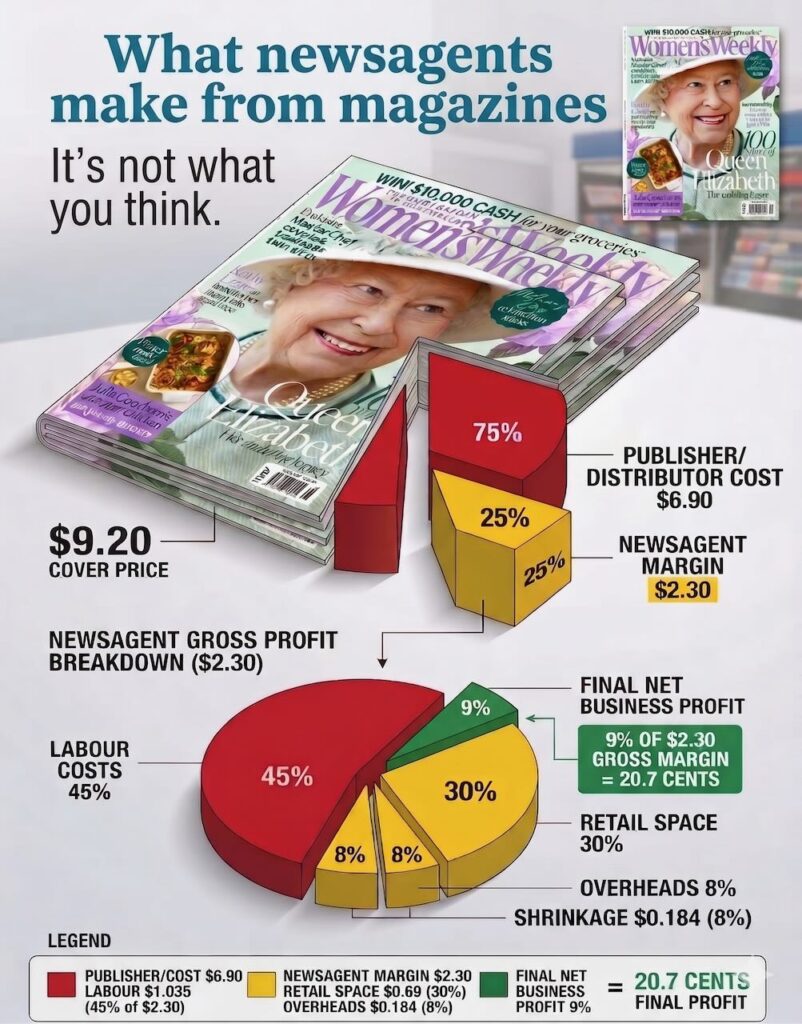
There is a persistent myth that newsagents are “raking it in” from every glossy title sold. When a customer hands over a $9.20 gold coin and change for a monthly staple like The Australian Women’s Weekly, the assumption is that the shopkeeper pockets a healthy chunk of that transaction. However, once you peel back the layers of the Publisher/distributor model, the reality for the small business owner is far more sobering.

To understand the business of magazines, you have to look at the gross margin. For us, that figure sits at 25%. From a $9.20 magazine, the newsagent receives $2.30. This is the starting point. That $2.30 must carry the entire weight of the physical retail operation before a single cent can be considered actual profit.

THE ANATOMY OF A $2.30 MARGIN
Running a brick-and-mortar store in Australia is expensive. The costs are fixed, but the income is increasingly variable. Here is how that $2.30 gross margin is eroded by the unavoidable costs of doing business:

Cost Category Allocation Amount per Copy:

  • Labour Costs (Staffing/Wages) 45% $1.03
  • Retail Space (Rent, Rates, Fit-out) 30% $0.69
  • Shrinkage (Theft, Damage, Returns) 8% $0.18
  • Operating Overheads (Power, Insurance, Comms) 8% $0.18
  • Operating Profit 9% $0.21

SURVIVAL ON 21 CENTS
After paying the staff to unpack, check, price and put out magazines and keep them tidy and take them off and count them and handle them for return, the landlord for the privilege of the floor space, and the electricity company to keep the lights on, the newsagent is left with approximately 21 cents. It is important to note that this is “Operating Profit.” This is not money in the owner’s pocket. Out of these 21 cents, the business must fund its own debt, pay interest on loans, and finally, provide an income for the owner.

Magazines are labour intensive. The supplier management process is out of date, amplifying the labour costs imposed on newsagents. When you consider the labour of  receiving stock from the Publisher/distributor, managing the display, processing the sale, and handling the returns process for unsold copies and dealing with delivery errors, the return on effort is slim. A newsagent has to sell five magazines just to clear a single dollar in operating profit.

The next time someone suggests that newsagents have it easy, show them these figures. We aren’t just selling paper; we are managing a high-volume, low-reward logistics operation. For the local newsagent, the magazine category is a service to the community, sustained by tight discipline and very thin margins.


Mark Fletcher founded newsagency software company Tower Systems and is the CEO of newsXpress, a marketing group serving innovative independent retailers who continuously evolve their businesses to be enjoyable, relevant and successful. You can reach him on mark@newsxpress.com.au or 0418 321 338.

9 likes
magazines