A blog on issues affecting Australia's newsagents, media and small business generally. More ...

retail strategy

Most newsagents are giving their best space to their worst-performing departments

This post promotes a service my business sells. Read it with that in mind, and judge it on whether the argument holds.

Here is the argument.

The typical newsagency floor was laid out for a business that no longer exists. Newspapers and magazines got the front, the window, the walk from the door to the counter, because that was what people came in for. Print bays have been shrinking for fifteen years. In most stores the space they hold has not shrunk anywhere near as fast.

Now, while you may have made some changes, most I see are not enough for a bright future.

Meanwhile cards, gifts, stationery, art and craft, collectables, plush and the newer categories are squeezed in around the edges. They earn their keep in poor positions, which is exactly why they are worth more space. A category performing from a bad spot is telling you something.

I see this constantly. Not because newsagents are careless, but because layout changes slowly. Nobody wakes up and decides to hand prime real estate to a declining category. You take out one bay, then another, then you shuffle a fixture, and five years later the shop is a compromise between what it used to be and what it is becoming.

The numbers most newsagents never see side by side

Two figures per department. The share of your selling space it occupies, and the share of your sales and gross profit it returns.

Almost nobody has these two figures next to each other. Yet the gap between them is the single most useful number in a newsagency, because it tells you where your rent is being wasted.

There is a second pattern I look for, and it is the one that worries me most.

Revenue flat, transaction count down.

I see it constantly in this channel now. Revenue holds because prices rose and because lotto and agency lines carry a dollar value. Underneath, fewer people are walking through the door. Foot traffic is the whole basis of a newsagency, and when it goes, everything built on it goes with it, usually about two years after the owner could have acted.

You cannot see this in one year of data. It shows up plainly in two.

What newsXpress is offering

A Store Opportunity Review. Send two years of sales data from your POS software and a sketch of your shop showing what is located where. That is all.

It comes back as a written report — how your two years compare on revenue, transactions, average sale, items per sale and department performance; how your space allocation stacks up against what each area actually returns; research on your local area and who is in it now; and research on the category opportunities that suit your catchment. Opportunities listed in the order I would tackle them.

Three business days. Then a follow-up consultation with the retail professional who wrote it, included.

$595 inc GST. $395 inc GST until the end of September. Prepaid to qualify you. And you know what, since I own newsXpress, if the report you receive is of no value to you whatsoever, let me know and I will refund your payment.

It is open to any local retailer, not just newsXpress members and not just newsagents. Gift shops, bookshops, jewellers and homewares stores face the same space and margin questions.

help@newsxpress.com.au.

Why I think it matters more in this channel than any other

Because newsagents are running out of runway, and space is the lever they still control.

You cannot fix print decline. You cannot negotiate lottery terms. You cannot stop a masthead closing or a distribution frequency changing. What you can do is decide what occupies the best two metres of your shop, and most newsagents are making that decision by inheritance rather than by evidence.

The stores I see doing well in 2026 are the ones that stopped waiting for the old model to stabilise and started treating themselves as retailers with a good site. The layout usually changed before the results did.

And the honest caveat

A report will not save a shop in the wrong location on the wrong lease with the wrong rent. Nothing will, and I would rather tell you that in the follow-up call than take your money and pretend otherwise.

But if the business is fundamentally sound and simply arranged for a version of itself from a decade ago, this is a cheap way to find out what to move and what to back.

Draw the sketch badly. It is the part I find most useful.

To kick this off, email help@newsxpress.com.au.

4 likes
Newsagency management

Ten years. That’s what I think this channel has left.

I’m back from our national conference in Perth. Two and a half terrific days with newsagents, newsXpress members and suppliers to the channel.

Two subjects took up most of the room. Where this channel is heading, and what AI is already doing inside shops.

Where the channel is heading

I’ll put it plainly. I think the newsagency channel, as a channel, disappears inside ten years. It gives me no pleasure to write that.


Australia sits one decision away from the closure of a capital city daily newspaper. Several of them lose money. They’re being held up partly by emotion. News Corp has always loved ink on paper. Kerry Stokes has his attachment to The West Australian. Nobody wants to be the publisher who switches the first one off. That decision is coming anyway.

Print stopped delivering news a long time ago. By the time the paper lands on the counter the story is old. Your customers already know.

Magazines tell the same story in slower motion. Deliveries went from three days a week to two, and now to one. In some places it’s a coin toss whether they turn up at all. Titles we missed used to be couriered out. Not now.

Are Media is publicly up for sale. There’s plenty of talk about a break-up, including Are Direct and possibly XchangeIT. Worth watching closely, because whoever ends up owning the distribution business owns the physical route into our shops.

Stationery keeps drifting to Officeworks. Dollarama buying The Reject Shop means a harder shove from the value end of the market.

And when we make the news, it’s a closure story. Another one bites the dust.

The answer we spent most of our time on

Most of the conference went on what to do about it. We call it decoupling.

Disconnect from being a newsagency. Stop identifying as one. Present as something completely different, ideally something local and yours, rather than another national group’s brand painted over the top of the old shop.

This is more than a cosmetic change. Once you’re not a newsagency, you can sell to people who would never have walked into one, and that’s the whole point.

Three retailers who have already done it spoke to the room. Former newsagents, all of them. They talked about de-identifying, and about how their businesses run now.

AI, live on the big screen

Nobody gave a presentation about AI. We put it on the big screen and worked on real businesses, no script, in front of the room.

One retailer is doing well with clothing and wanted to build it out. In front of everyone we looked at the mistakes being made, then at how to tell a better price and sizing story for the demographic in that town.

Another had already decided to decouple and wanted to know what else to sell. That session produced a series of opportunities needing little capital, and then a four or five page business strategy report.

We spent time on the risks too, on where AI gets things wrong. It’s useful in small business retail, but only with a human checking the work.

What I said to the suppliers in the room

This channel will lose two to three hundred newsagents this year. So think hard about what you pitch.

The smart operators want product that brings more people through the door, and a broader demographic than they have today. Product that panders to the history of the channel has no future.

If you’re not helping retailers reach further than they reach now, you’re worth less to them than the supplier who will. We’re in this together, and the ones who understand that will do well out of the next few years.

I have been called pessimistic before

A newspaper publisher once stood in front of a room and told everyone I was wrong about declining newspaper sales. Magazine publishers objected to me discussing magazine decline at all. Those calls have aged fine.

There’s no doubt in my mind that the traditional Australian newsagency has no future. A business built on lotteries, papers, magazines, stationery and greeting cards, and not much else, is already dead. The owner just doesn’t know it yet.

Now look at a shop leaning into sensory product, Pokémon and other collectibles, and good quality gifts. People walk in for completely different reasons. That business has somewhere to go.

Where we are

newsXpress has 194 members. We’ve never chased being the biggest, and we’re not your average newsagency marketing group. What we have is a group of retailers who want to move, and are moving.

Our focus is a strong back half of 2026, then 2027 and 2028.

Mark Fletcher
mark@newsxpress.com.au
0418 321 338

8 likes
newsagency of the future

Sales Rep Visits In-Store Are a Waste of Time in Most Cases I Think

How long do you give a sales rep who wants to meet to pitch a new range? I give them none. Send it to me in an email instead.

That’s not me being rude. It’s a decision I made after noticing how much time these visits were eating, and how little most of them changed what I actually stock. Twenty minutes here, forty there, add it up over a month and it’s a working day gone, mostly on ranges I was never going to take.

An email pitch has to work harder, and that’s the point. If you want my shelf space, tell me:

  • What the range actually is, in a few lines, not a slideshow. If it takes ten minutes to explain, it’ll take my customers longer to understand.
  • The evidence behind any claim you’re making, sales data, a case study, something I can check. “Retailers love it” isn’t evidence.
  • Who the target shopper is, specifically, not “everyone.”
  • How this range gets me in front of shoppers I’m not already reaching. Recycling the same faces already through my door doesn’t count.

A rep standing in my shop can talk around all four of those. An email can’t hide as easily, and it doesn’t cost me the time it takes to be polite while it happens.

Something else: a lot of rep visits are social, on purpose.

Reps and the companies behind them know retailers often buy from people they like, and that this counts for more in the decision than it should. A friendly half hour costs them nothing and buys a lot of goodwill, goodwill that shows up later as shelf space the product hasn’t earned.

So the question worth asking yourself: how much time do you actually spend with sales reps in an average month? And when did you last sit down and work out whether that time is buying you better ranges and more sales, or just buying the rep goodwill at your expense?

If you haven’t audited it, that’s the exercise. Not every visit is wasted, some earn their keep, but you won’t know which until you actually look.

5 likes
Newsagency management

Your Google Business Profile in 2026: what’s changed, what’s still true, and one thing to fix

This advice first went to newsXpress members 3 years ago. It went to ALNA members after that. I’m sharing an updated version here to reach more newsagents, because I went back and checked it against Google’s own current guidelines and against what’s actually changed since it was written. Most of it holds up. One part of it doesn’t, and it’s worth fixing today.

It’s still free. It still takes a few minutes, not a consultant. And local search still converts better than almost anything else you can do with your time.

Why this is still worth doing

Roughly 46% of all Google searches carry local intent, and some 2026 estimates put that closer to 50%. Of the people who run a “near me” style search, 76% visit a business within 24 hours, and 28% of local searches end in a purchase. Local search is mobile-heavy too: around 70% of these searches happen on a phone. A complete, active Google Business Profile is how you show up in that moment.

One thing to fix: your categories

Here’s the part of the original advice that needs correcting. It said to select as many categories as apply to your business, on the basis that retailers too often pick just one. Google’s own current guidelines say the opposite: choose the fewest categories it takes to describe your core business, as specifically as possible, and don’t add categories just to cover more search terms.

Categories aren’t a keyword list. They’re meant to answer “what IS this business,” not “what does it sell.”

If your profile has picked up five or six categories over the years to catch every possible search, it’s worth trimming back to the two or three that most specifically describe what you are. A newsagency that also sells gifts and cards is still a newsagency, just with specific, accurate secondary categories, not a business wearing every hat in the shop.

What’s changed since this was first written

Posting no longer requires a third-party tool. Google Business Profile now has scheduling and recurring posts built directly into the posting screen: set a post once, choose “weekly” or a custom pattern, and Google keeps publishing it for you. Tools like Loomly, Sendible or OneUp still work fine if you’re already using them, but they’re no longer the only way to plan ahead.

The business description limit is 750 characters, not 750 words. Google displays roughly the first 250 characters before a customer has to tap “read more,” so put the important information first. Google’s guidelines also ask that the description itself not read like an advertisement: no “everything on sale” or price call-outs. Save the sales pitch for your posts, and use the description to say plainly what you are and what you offer.

Posts can technically run up to about 1,500 characters, but the data on what actually gets read and clicked favours something much shorter, well under 300 characters, closer to a tight paragraph than a full page. If you’ve been writing longer posts, trimming them will likely help rather than hurt.

What hasn’t changed

Posts still archive after six months, same as when this advice was first written, and profiles with something posted in the last week or so are the ones that show up looking active. That’s the real reason to keep posting weekly rather than setting and forgetting. Hashtags still do nothing on Google posts, so don’t bother. And the core advice against handing this over to a marketer or a friend still stands: you know your shop and your customers, and that’s worth more here than someone else’s template.

New this year: Gemini can now help run your profile

The one genuinely new development since last year is that Google connected Gemini directly to Business Profile, for single-location owners, from June 2026. Once connected, you can ask it things in plain language: how did my business do this month, help me respond to this review, or post something about our new stock this week. It can draft, and you can edit before anything goes live.

This doesn’t change the advice about doing this yourself rather than outsourcing it. Gemini is a tool you point at your own knowledge of your shop, not a replacement for it. It’s worth trying, particularly for retailers who found the interface itself the biggest barrier to getting started.

The short version

Set up or claim your profile if you haven’t. Pick the fewest, most specific categories that describe your business, not the most. Write a plain, accurate 750-character description with the important part up front. Post about one product a week, with a photo, in a couple of short sentences rather than a couple of paragraphs. Keep doing it yourself.

It still costs nothing, and it’s still one of the highest-return things a small retailer can do this year.

5 likes
Newsagency management

Collins Debden has a journal range that works for the male journalling opportunity

I’ve been talking a while about the male journalling opportunity: young guys 15 through 35 who are journalling more now than ever.

Anyway, here is a new video from me about a terrific range from Collins Debden: https://youtu.be/aP4dyCswFGU

Now, if the opportunity of selling journals to young guys is new to you, here’s more context:

Journaling has shed its old image. It’s now widely treated as part of a healthy lifestyle, and one of the fastest-growing groups taking it up is younger men, roughly aged **18 to 35**.

AFL footballers are journaling and talking about it openly. Olympians describe it as part of how they manage performance. Outside sport, plenty of people talk about journaling as a mental health tool and a way to build a steady daily routine. Whatever’s driving it, the trend is real, and it’s showing up in what customers are asking for at the counter.

## Why structure matters for a first-time journaller

Handed a blank notebook, most people freeze after the first page. What gets someone journaling regularly isn’t a nicer cover. It’s a bit of structure to work from until the habit sticks.

Collins Debden has built a range around exactly that idea, called Jumble. It includes titles such as Routines, Doze, Passion, Flex, Thankful and Believe, each built around a single clear theme.

Take the Passion journal as an example. Once the marketing slip comes off, the layout does the work. There’s space to sum up the week in one word, simple prompts with small icons to circle covering how the week felt, the hurdles overcome, the ways people supported each other, and a favourite memory, then open space for free notes alongside.

Routines follows the same logic from a different angle. It asks for a main goal for the week, the steps to reach it, weekly habits to track, and a quick read on mood and energy. Both journals, like the rest of the range, come with a sticker sheet.

A little scaffolding at the start makes it far more likely the habit sticks, and that’s really the whole idea behind the range.

## Why this is worth stocking

Collins Debden is an established international publisher of diaries and journals, and the Jumble range is a solid place to start for any retailer looking to serve the male journaling market. It gives a first-time journaller somewhere obvious to begin, rather than a blank book and good intentions.

It’s also worth talking about on social media. Local men’s sheds, mental health groups and community organisations are exactly the kind of audience who’ll want to know these journals are stocked nearby, and a short post is often enough to put your shop on their radar.

To find out more about opportunities like this, get in touch with the team at help@newsxpress.com.au.

6 likes
Newsagency opportunities

Why newsagents can’t afford to run old software anymore

Software security has changed more in the last eighteen months than in the previous five years, and small retailers, like newsagents, are squarely in the firing line.

Newsagents handle sensitive data: EFTPOS transactions, lottery and gift card sales, loyalty accounts, customer details. Running old software is a commercial risk to your business and to the people who shop with you.

What’s changed

Cyber criminals have worked out that small businesses are easier targets than large ones, and just as valuable.

According to the Australian Signals Directorate’s Annual Cyber Threat Report for 2024–25, the average cost of a cyber incident to a small business rose 14% to $56,600. The ACSC’s cyber security hotline took more than 42,500 calls that year, up 16% on the year before, and the agency issued over 1,700 warnings about malicious activity targeting Australian organisations, an 83% jump. Read the full report.

Payment security rules have tightened. PCI DSS 4.0, the standard that governs how businesses handle card payments, made a set of new requirements mandatory from April 2025, including multi-factor authentication for anyone accessing systems that touch card data. If your POS provider hasn’t talked to you about this, it’s worth asking.

Attackers are going after software supply chains too. Industry research on retail breaches found close to a third involved a compromised third-party vendor rather than a direct attack on the retailer, nearly double the rate from the year before. A weakness in a POS provider, a payments processor, or an IT support company can expose every retailer connected to them.

And a lot of small business software is older than it should be. Security researchers still find point-of-sale systems running operating systems that stopped receiving security patches years ago, because “it still works” felt like a good enough reason to leave it alone. Unsupported software is an open door. Nobody is watching for weaknesses in a system the vendor stopped maintaining, and attackers know it.

The businesses ransomware groups target most aren’t the ones with the least valuable data. They’re the ones with the least resistance.

Why this matters more for newsagents specifically

Most newsagents have grown beyond newspapers and magazines. Gift cards, loyalty programs, mobile recharge, lottery accounts and card payments all run through the same till, and all of it depends on software that’s connected to the internet, connected to your bank, and often connected to a support provider with remote access to your systems. That’s real exposure. It’s a profile attackers look for: valuable transactions, limited in-house IT support, and a temptation to delay updates because the shop is busy and the software “still works fine.”

What keeping software up to date means

Keeping software current is more than clicking “update” when a pop-up appears. A few questions worth putting to your POS provider or IT support:

  • Is your point-of-sale software still actively supported, with regular security patches, or is it running on an older version the vendor no longer maintains?
  • Is multi-factor authentication switched on for anyone who can access your systems remotely, including your support provider?
  • How quickly does your provider apply security patches after they’re released, and do they tell you when they do?
  • Are your backups tested, and stored somewhere separate from your main system, so a ransomware attack on your till doesn’t take your records with it?

A short checklist for your shop

None of this requires becoming a cyber security expert. A few habits make most of the difference:

  • Turn on multi-factor authentication on every account that offers it, not just your bank login.
  • Keep the operating system and browser on any device connected to your POS current.
  • Treat unexpected “urgent” emails about supplier invoices or EFTPOS settings with suspicion, and verify by phone before acting.
  • Back up your data regularly, and keep at least one copy separate from your main system.

Treat your POS software the way you’d treat your shop’s front door: locked, current, and not something you put off dealing with because business is busy. The retailers who get hit hardest are usually the ones who assumed it wouldn’t happen to a shop their size.

Now, here are some valuable sources:

8 likes
Newsagency management

The sale that walked out the door

A customer walks into a local shop looking for NeeDoh, one of the best-known names in sensory play. Out of stock. The assistant holds up a generic off-brand substitute when asked of they have NeeDoh.

No but, we have these off-brand products.

Right next to that substitute, on the same shelf, sits a full range of Crazy Aaron’s Putty, a premium brand that does exactly what Nee-Doh does. They don’t point it out. The don’t ask what the customer actually wants, or offers to let them try it.

If you’d rather head about this, here’s a video that I made today reflecting on the experience.

The shopper turns and leaves with nothing

The shop has lost a sale it didn’t need to lose.

Why how we engage matters

Shoppers rarely walk into a local store for one planned purchase. They browse, and they react to whatever catches the eye. People buy sensory and novelty lines for all sorts of reasons: arthritis relief, sensory needs, or just something to fidget with at a desk.

That’s exactly why these products deserve better than a spot near the counter as an afterthought. Stock the brands people recognise, know the range, and be able to talk about it like you mean it. That’s what turns a browser into a buyer.

What went wrong

A team that doesn’t know its stock, its trends, or its alternatives well enough to mention them naturally will lose sales like this one and never notice it happened.

An out-of-stock answer with no real alternative can be enough to lose a customer for good, along with every repeat visit and word-of-mouth recommendation that would have followed.

Independent retailers compete on service. Every interaction either builds the relationship or ends it, and there’s rarely a moment in between.

What good service looks like instead

It doesn’t take much to turn this around: a mention of the putty on the same shelf, a question about what the customer actually needs it for, an offer to try before they buy, or just a heads-up that new stock is on its way.

The takeaway

Train every team member to treat a stock shortage as a chance to offer something else, not a dead end.

Independent retailers can’t compete with the majors on price, but they can out-curate and out-serve them, provided staff know the range well enough to make a recommendation without having to think about it.

6 likes
retail

5 ways your newsagency can profitably deal with the award wage increase, a rent increase and the surcharge ban

Award wages went up 4.75% on 1 July. Rent is tracking 4–5% higher for most. From 1 October, the RBA surcharge ban means card fees you were recovering from customers need to be absorbed or built into prices. The combined hit is around 1.5% of turnover for a typical newsagency — real money when margins are already thin.

Here are five ways to recover some of it, using tools already in  newsagency software.

1. Reprice the stock you control

Magazines and newspapers are priced for you. Stationery, gifts, art supplies and general merchandise are not. If you have not looked at those prices recently, there is a reasonable chance you are undercharging.

A smart stock manager lets you update prices across a category in one pass, in bulk, accurately, safely. Some newsagencies mark up stationery at 100%; others run 125% and see no drop in sales. Worth checking where you sit.

A small increase of 1% across what you control might get you nicely into positive ground.

2. Stop entering invoices by hand

Five to ten hours a week on manual invoice entry is a full day of wages, every week, on admin. AI invoice arrivals imports supplier invoices directly — no typing, fewer errors, no chasing up mistakes.

Those hours go back to the counter or to something that actually earns revenue.

3. Clear dead stock

Stock that has not sold in six months typically accounts for 10–15% of total inventory value. It is taking up shelf space, paying rent per square metre, and returning nothing.

The software flags these lines. Get them out through clearance, supplier return or bundling, and the capital goes back into stock that moves.

4. Find your stockouts

Missed sales are invisible unless you look for them. The insights dashboard makes them visible: it shows the dollar value of sales lost because a product was not in stock when a customer wanted it.

Match that with automated reordering and the lines that drive your sales stay on the shelf.

5. Use theft detection tools

Theft typically accounts for 3% – 5% of newsagency turnover. Most of the volume is customer theft; the highest individual losses tend to be internal.

The audit log and early detection tools in the software catch discrepancies well before a stocktake would. Earlier detection means a smaller problem to deal with.


Contact the Tower Systems team at sales@towersystems.com.au.

5 likes
Newsagency management

“Support local” is a guilt trip, and it’s not working – are you wasting your time on it?

Walk down any street or go on social media and you’ll see the signs in the windows our read the words.

Support local. Shop small. Keep it in the community.

We say it to each other too and we say it to shoppers every chance we get.

It doesn’t work. It never has. I think a lot of us know that and keep doing it anyway, because it feels like we’re doing something.

The problem is what “support local” actually asks. It asks the customer to do you a favour. It puts your need in the middle of it, not theirs. Shop here because I need you to, because if you don’t I might not make it. Nobody wakes up wanting to prop up a struggling business. They wake up wanting a good card, a gift that works, a quick errand done well. You’re asking them to pay in guilt, and people don’t like paying in guilt.

It’s worse than just useless I think. It quietly tells the shopper you might be in trouble. It casts you as the underdog who needs a hand. That’s not a reason to come in. If anything it’s a reason to wonder how long you’ll be around. Are you looking for a pity party?

What does pull people in? The boring answer, and the true one. Being good at it.

Have the thing they actually came for. Know their name, and remember what they bought last time. Be quick when they’re in a rush and happy to chat when they’re not. Make the place a pleasure to walk into instead of a duty. People go back to shops that are good to them. They don’t go back out of pity. The few who come in once because they felt they should don’t come a second time.

Give them a reason that’s about them, not you. A range that’s worth the trip. Staff who know their stock cold. A shop that feels like a place rather than just a spot to hand over money. Do that and you never have to ask anyone to support local. They shop with you because you’re the better option, and they tell their mates, because people talk about a shop they love and nobody talks about a charity case they helped out.

Now the bit we don’t say out loud.

Plenty of the retailers shouting loudest about supporting local don’t do it themselves. Coffee from the drive-through chain. Printing ordered online because it was a few dollars cheaper. The weekly shop at one of the big two. Shopfittings, uniforms, the lot, bought from whoever came up first in a search, none of it from anyone nearby.

Walk into some of these shops and ask where they bank, where they buy their own gear, where they had lunch. The answer tells you the whole story. They want a loyalty they won’t hand over themselves.

Customers pick up on that. Maybe not in words, but they feel it. A shopkeeper who actually lives the line is convincing without a poster, because the whole shop runs on it. One who preaches it on the door and breaks it everywhere else is just another sign in a window.

So before you print the next poster, have a look at your own card statement. If you want a town where people choose the independent option, be that customer first. Spend up and down your own street. Use the local tradie, the local supplier, the cafe round the corner. Not out of guilt. Because it’s the world you keep saying you want, and you can’t ask anyone else to build it while your own money’s going somewhere else.

Be worth shopping at, and back the others having a go at the same thing. That’s the only version of supporting local I’ve ever seen actually work.

2 likes
Newsagency management

New Year New You: Stop Watching a category decline that you built your shop on

Watching a category shrink is a slow kind of frustration. Not overnight. Gradually, a few titles at a time. Fewer customers asking. Numbers that used to feel unremarkable now feel like something worth explaining at the end of the month.

For most newsagents, that category is magazines. For some, newspapers. For others, lottery products, as customers move to buying online. The specifics differ. The feeling is familiar.

The question is not whether the decline is real. It is what happens to the floor space, the margin budget, and the foot traffic that category used to carry.

The instinct is to hold on

Magazines once drove daily foot traffic. Newspapers brought customers in before 8am. These were not minor parts of the business — they shaped the layout, the staffing, the rhythm of the day.

Protecting what built the shop makes sense. But holding floor space for a shrinking category has a real cost. Every metre could be working harder.

What is actually working in newsagency businesses right now

Greeting cards are probably the best example. Customers still want to buy them in person, and a well-curated section with decent replenishment consistently performs. The category does not get talked about much but it delivers.

Gifts and homewares have become a genuine revenue contributor for many stores, particularly where the range is local, seasonal, or hard to find online. Not generic gifts — product the owner chose because they know the customer walking through the door.

Stationery (smart stationery especially), arts and crafts, and activity products have a much bigger audience than they did five years ago. That shift is still underexploited in a lot of stores.

Advice on making the shift

Rebalancing a shop is not a quick fix. It means rethinking the floor plan, finding new suppliers, and testing product lines that may not work before you land on ones that do.

The first move is usually to reclaim the space rather than fill it. Look at which sections are underperforming per square metre. Reducing a magazine section from 12 bays to eight can free up real floor without dropping the category.

After that, test small. A limited range, careful sell-through tracking, then let the numbers guide the next order. Filling space with volume before knowing what the customer actually wants is an expensive habit that is easy to fall into.

If your POS system is not clearly showing you what is turning and what is sitting, that is worth fixing before any buying decisions. The data is there — it just needs to be used.

And talk to other newsagents. The community shares information more openly than most retail sectors. What is working two towns over may be exactly what is missing from your range.

If you;re in a marketing group, start there – they should be all over this and giving you actionable practical help. Are they?

The shops struggling did not decline because the category did

They delayed the response. The ones doing well moved earlier, tested more, and were willing to look different from what they used to be.

A newsagency does not have to be defined by what it sold in 2005. The customers are still there. The question is whether the shop gives them a reason to walk in.


Mark Fletcher founded newsagency software company Tower Systems and is the CEO of newsXpress, a marketing group serving innovative independent retailers, including newsagents, who continuously evolve their businesses to be enjoyable, relevant and successful. You can reach him on mark@newsxpress.com.au or 0418 321 338.

3 likes
Newsagency management

Not another boring EOFY post

No. Not from me.

You already know the required stuff. Run the stock listing, take the backup, ring the accountant. You’ve read that post a hundred times and you’ll read it a hundred more this week. I’m not adding to the pile.

What interests me today is the other list. The one you never write down. The jobs you keep meaning to get to and keep finding a reason not to. New financial year tomorrow, so it’s as good a night as any to stop dodging them.

Start with the dead stock. You know exactly what it is. You walk past it every day and your eye slides straight over it, because you stopped seeing it months ago. It’s been sitting there a year doing nothing. Mark it down hard, bundle it, give it away if that’s what it takes, but get it off the floor and put something that actually sells where it was.

Then have an honest look at your hours. Are you open at times nobody comes in, just because you always have been? In there from eight when the first real customer turns up at half nine? Trading Sundays for a figure that doesn’t cover the cost of being there? You can reorder stock. You can’t reorder the hours of your life, so spend them where they count.

The roster is the same question, and it’s a harder one because it’s about people you like. Are you rostering for the trade or for habit? Two on when one would cope? Be fair and be kind about it, but be straight with yourself about what each shift brings in.

Put your prices up. There, I’ve said it. You’ve been frightened of it for years, sure the customer will walk. Most won’t even notice. The few who do were never the ones keeping the lights on. You were never the cheap option and you were never going to win that fight, so stop pricing like you’re in it.

And bring in something mad, new. Something fresh, something with no business being in a newsagency, something that stops a regular in their tracks to ask what on earth it’s doing there. Back a hunch. Take the punt you’d usually talk yourself out of. Worst case, you mark it down next EOFY with the rest of the dead stock. At least you’ll know.

None of this is on the required list. That’s the whole point. Get one of these done and next year is genuinely better than this one, not just compliant.

So before you flip the calendar, pick one. Just the one. Be ruthless about it. Start the next when that’s sorted.

Happy new financial year.

6 likes
newsagency of the future

One sale, or three hundred newspapers

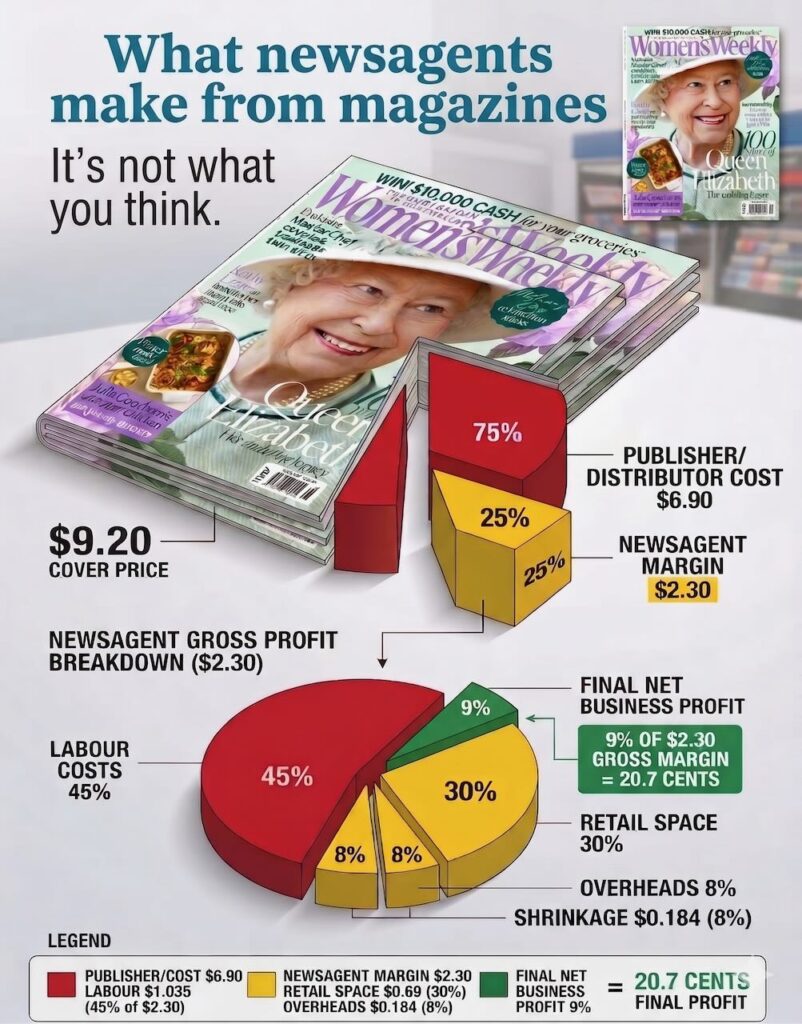
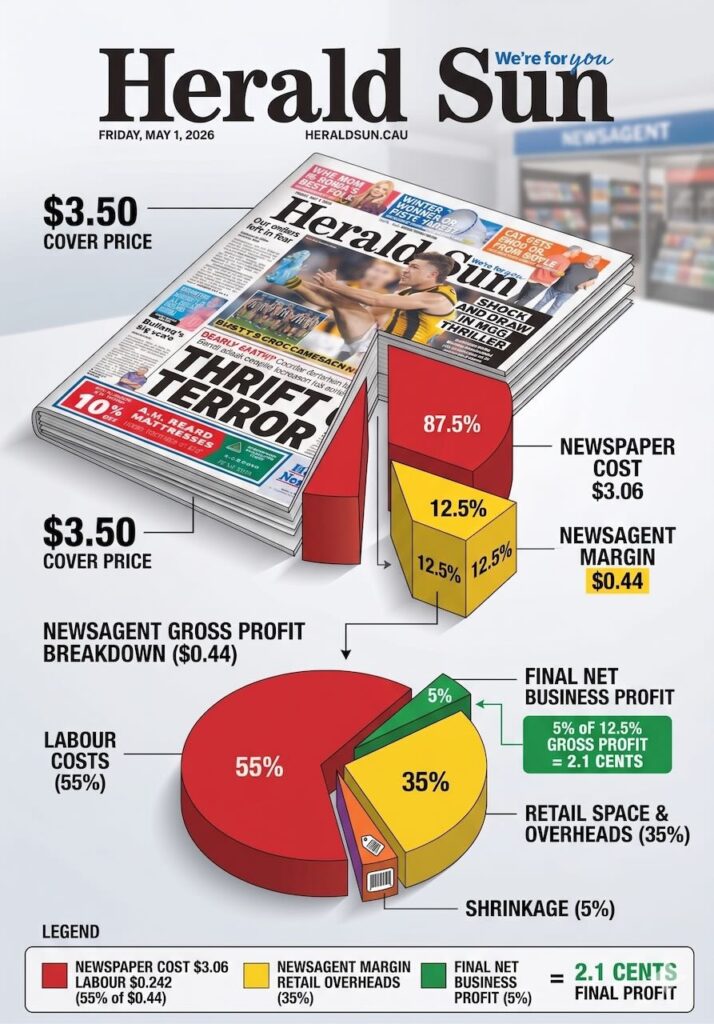
Sell a newspaper for $3.50 and you make about 12.5 per cent. That’s 44 cents in your hand. Sell a $250 item at 55 per cent and you make $137.50.

Do the division. One $250 sale is worth more than three hundred newspapers. You could sell a paper to every adult who walks past for a week and still not match what one good sale puts in the till.

We all know this. So why do we keep leaning on the 44 cents?

Because the paper is easy. The customer comes in, knows what they want, pays, leaves. No risk, no money tied up, nothing riding on your judgement. It feels like business because it’s busy. But busy isn’t the same as making money, and the newspaper proves that every single day.

The $250 sale is hard, and it’s hard in two ways we don’t talk about honestly.

You have to find the item first. That means backing your own read on a range, spending real money on stock that might just sit there, giving it decent space and light, and waiting. Some of it won’t work. You’ll buy the wrong thing now and then. That’s the price of playing in the part of the shop where the money actually is. The paper never asks any of that of you, which is exactly why it pays you 44 cents.

Then you have to find the shopper. And here’s the bit that stings. That shopper is already in your shop. They come in for the paper, or the lotto, or a birthday card. You see them twice a week. You know their name. It has just never crossed your mind that they’d spend $250 with you, because somewhere along the line you filed them as a paper buyer and left them there.

They’ve filed you too. Years of selling them a paper has taught them what you’re for. They don’t look at your good stock because they don’t think of you as the shop that sells it. So they buy the $250 thing somewhere else, from someone who bothered to see more in them than a paper sale.

That’s the real work. Not just buying the right product. Looking again at the people who are already in front of you, and shifting what they think you’re for.

The maths was never the hard part. The habit is.

Now, what is the gift item you sold was worth $1,500? yes, there are ‘newsagents’ doing this.


Mark Fletcher founded newsagency software company Tower Systems and is the CEO of newsXpress, a marketing group serving innovative independent retailers, including newsagents, who continuously evolve their businesses to be enjoyable, relevant and successful. You can reach him on mark@newsxpress.com.au or 0418 321 338.

8 likes
Newsagency management

Why men’s journals are worth space in your newsagency right now

Young men aged 18 to 40 are buying journals in growing numbers. Not diaries. Structured, guided journals built around habits, daily prompts, and goal-setting pages. They found the category through Stoicism podcasts, productivity YouTube channels, and communities built around self-discipline and mental health. Projects like Better health, Blokes Talk, men’s Shep and more speak top it. Local churches too.

Structured and guided formats now account for 54% of planner sales globally. Gen Z is 35 to 40% of that buyer base — well above where the industry expected them to be. The broader men’s wellness market is forecast to nearly double by 2030. Journaling is a small corner of it, which is exactly what makes it worth trialling. Low cost to test, no specialist range needed.

For a newsagency, there are two buying occasions worth understanding. The self-purchaser is deliberate. He checks paper weight, flips through the layout, and walks past a cheaper option that does not feel right. Matte black, charcoal, leather. Words like “focus”, “discipline”, “morning ritual”. He will pay $45 for a journal that suits him and ignore a $15 one that does not. Get the range right once and he comes back.

The gift buyer does not know the category but wants something that looks considered. A journal and pen together with a simple “Gift for him” sign does the job. She does not need to know anything else.

A small display near the counter — four to six SKUs, one pen, one leather sleeve, clean signage — is enough to find out whether it works in your store.

newsXpress provided its members a full brief on this category a while back, and it goes considerably further than what I have covered here. Merchandising detail, display headers, bundle pricing, paper specifications, what to avoid stocking and why. Built on market data and retail behaviour research. Not a supplier recommendation.

Finding new shoppers is the problem most independents are trying to solve. Categories like this one — real demand, accessible to trial, underserved by most newsagencies — are where that starts. The traditional product mix is not going to bring in people who have never had a reason to walk through the door.

If you are a newsXpress member, the full brief is in your member resources. If you are not a member and this is the kind of support you have been looking for, it is worth a conversation.

And, for what it’s worth, I know of a local retailer playing in this narrow segment and achieving $15,000+ a year in direct sales and more than double that if you consider what is added to the basket during the destination purchase.

It all comes down to whether you do want to attract new shoppers, or whether you are happy with things the way they are.

… Mark Fletcher is the CEO of newsXpress and founder of Tower Systems, a POS software company serving independent retailers across Australia. mark@newsxpress.com.au | 0418 321 338
6 likes
Newsagency opportunities

The price increase you most likely haven’t tried yet

If you are like a ship I visited a few days ago, you are likely sitting on hundreds of well-selling products right now where a 50 cent or one dollar increase would go completely unnoticed by customers but would add real dollars to the bottom line by the end of the year. Not a dramatic margin overhaul — just a quiet, deliberate look at what you’re charging versus what the product is actually worth to the person buying it. That gap exists in almost every shop. The retailers who go looking for it find it.

When did you last put a price up just to see what happened?

Not because a supplier raised their cost. Not because the margin report flagged something. Just because you thought a product might be worth more than what you’re charging for it.

Most newsagents never do this. Prices move when costs move. Margin percentage drifts down without anyone noticing, and the business quietly earns less than it should for years.

The products worth testing are the ones customers want rather than need. A card for a specific occasion. A gift that’s genuinely hard to find locally. A collectible that’s selling faster than you can reorder it. For those products, shoppers will often pay more than the current price suggests — you just haven’t asked yet.

Put one price up. Watch it for a couple of weeks. If it keeps selling at the same rate, you’ve found margin you were leaving behind. If it slows, adjust it. Neither outcome is a problem. One earns you more money. The other tells you something useful about your customers.

The retailers doing this well aren’t testing everything at once. That’s not experimenting, that’s chaos. They pick lines with strong, consistent demand and move carefully. Over time those small experiments add up to a margin position that looks nothing like where they started — without a supplier negotiation or a ranging overhaul in sight.

Your POS data already shows you which products are moving consistently. Start there. Pick something with steady demand, nudge the price, and watch what the data shows over the next few weeks.

The worst that happens is you learn something. The best is that you find margin that’s been sitting there the whole time, waiting for you to notice.

6 likes
Newsagency management

Selling your lottery business and keeping your shop might be a smart move

More newsagents outside of Western Australia are selling their lottery business. Not because they’re struggling — because they’re thinking ahead. I am seeing this move more and I guess others are too.

Some do it while winding down. The lottery licence has value, selling it separately makes the exit numbers work better than a whole-of-business sale. That’s been happening for years.

What’s newer is the transformation sale. Retailers actively rebuilding what their shop is and who it serves are looking at their lottery setup and seeing floor space, staff time, and capital locked into a product they no longer control.

The Lottery Corporation’s direction isn’t hard to read. Digital. Direct. Their money is going into moving lottery players onto their own platform. Every campaign pushing customers to the app reduces the long-term value of a retail licence. Newsagents paying attention are moving before the market moves for them.

Selling in that context isn’t giving up ground. It’s freeing it up.

The footprint a lottery terminal takes matters when you’re rebuilding a shop around gifts, collectibles, or homewares. That space earns more doing something else. The capital from the sale funds the change. The staff hours no longer absorbed by lottery transactions go somewhere that actually builds the business.

Buyers are around. Supermarkets adding a service draw. Chemists expanding their convenience offer. Standalone operators shifting the whole thing to a kiosk. For those buyers the licence fits traffic they already have. For the newsagent selling, it’s a clean separation.

This isn’t the right move for every retailer. If lottery is still generating foot traffic that converts into other purchases, the calculation is different. But look honestly at what lottery customers buy beyond their ticket. In a lot of shops the answer is not much.

The Aussie newsagency channel is mid-transition – well, for most retailers at least.

The retailers shaping what comes next are making deliberate decisions about what stays in the business and what doesn’t. Lottery deserves that same deliberate look — not held onto by habit just because it’s always been there.

I haven’t had lotteries in my newsagency businesses for 14 years now. It’s not necessary for success. What I love about not having it, having had it for years, is to not have to deal with what I personally found to be a bullying partner who thought they knew about newsagency retail, when they didn’t.

8 likes
Lotteries

Is your newsagency remarkable?

Seth Godin wrote an excellent book — Purple Cow: Transform Your Business by Being Remarkable. It was (is) an excellent book, one I highly recommend. It applies today as much as it did in 2003 when it was published. The book inspired me, and it still does. The message is simple: you’ll notice a purple cow on the side of a hill because it stands out, it’s remarkable. The question for newsagents is: is your business remarkable, does it stand out?

Start with your front window.

Not your floor plan. Not your product mix. Not your loyalty programme. Your window. It is the one thing every person who walks past your store sees, and most newsagency windows are invisible. Not ugly. Not offensive. Just invisible. Generic. Expected. Easy to walk past without registering.

Is your window remarkable?

That is a missed opportunity, and it costs nothing to fix.

A remarkable window does not require a budget. It requires a decision to stop displaying what suppliers provide and start displaying what stops people. Those are different things. A supplier poster tells passers-by what you sell. A remarkable window makes them curious about who you are.

Think about what people do not expect to see in a newsagency window. A single unexpected object on a plinth. A handwritten question that makes someone pause. A display built around a local event, a local team, a local story. Something that changes every two weeks so the people who walk past every day have a reason to glance over.

The window is not an advertising space. It is a first impression. It is the thing that decides whether someone who has never been in before thinks your store is worth trying.

Most newsagency windows say: we sell a bit of this and a bit of that. Some say we sell newspapers, magazines, and lottery. Anybody walking past already knows that. You are not telling them anything they did not know, and you are giving them no reason to stop.

A window that shows something unexpected — something that does not fit the category assumption — plants a question. What is that? What kind of shop is this? I did not know they did that. That question is the beginning of a visit.

This is the lowest-cost, highest-visibility change available to any retailer. No supplier approval required. No capital outlay. No staff training. Just a willingness to put something in the window that people do not expect to see there.

Do it this today. Change it in a week. Yes, I know that’s work. It’s worth it! See what happens to the way people look at your store as they walk past.

Remarkable does not have to start big. It just has to start.

Go for that purple cow remarkable.


Mark Fletcher is the CEO of newsXpress and founder of Tower Systems, a POS software company serving independent retailers across Australia. mark@newsxpress.com.au | 0418 321 338
5 likes
newsagency marketing

What good foot traffic in a retail newsagency actually looks like in 2026

Foot traffic is one of those metrics newsagents talk about constantly but rarely define. When someone says their traffic is down, what does that mean exactly? Fewer people through the door? Fewer transactions? Smaller baskets? The same customers buying less?

The distinction matters because the response is different in each case.

Here is what I see in the businesses that are actually performing well right now. Their traffic story is not about volume. It is about who is coming in and what they are buying.

The old model is not coming back

The newsagency of 2010 ran on high-frequency, low-value visits. A paper every morning. A scratchie. A magazine. Frequent visits, small baskets, thin margin.

That traffic is declining structurally. Newspapers are bought online or not at all. Lottery players are being pushed to apps — deliberately, by the people who run the lottery. Magazine readers have moved on. You cannot run a campaign that fixes a habit change.

The businesses I respect have stopped trying to. They are building something different.

What the better businesses are doing

The stores growing right now attract less frequent but higher-value visits. A customer who comes in three times a year to buy gifts, cards, and a collectible is worth more to the business than one who comes in five days a week for a paper and nothing else.

That requires a different shop. The product mix has to give people a reason to come in when they are not running an errand. That does not happen by stocking what your rep suggested. It happens when you look at what your customers actually respond to and build around that.

Seasonal traffic compounds

Newsagents who take seasonal execution seriously — real displays, a genuine reason to visit around Mother’s Day, Father’s Day, Christmas — see something interesting. The spike visits convert. A customer who comes in for a card and finds a gift range they like comes back.

That repeat visit did not come from advertising. It came from having something worth discovering. You earned it.

The number worth watching

Stop asking whether your traffic count is up or down. Ask whether the traffic you have is getting more valuable.

Check your average transaction value over the past year. Look at whether repeat customers are growing as a share of your total. Ask yourself whether the people coming through the door are browsing or just transacting.

If those numbers are moving the right way, the business is in better shape than the foot count suggests. If they are not, the problem is almost certainly in the product mix and presentation — not in how many people walk past the window.

Volume is a vanity metric. Value is what you actually manage.

… Mark Fletcher founded newsagency software company Tower Systems and is the CEO of newsXpress, a marketing group serving innovative independent retailers, including newsagents, who continuously evolve their businesses to be enjoyable, relevant and successful. You can reach him on mark@newsxpress.com.au or 0418 321 338.

7 likes
Newsagency management

To the newsagents standing still

I get it. Standing still feels comfortable. It’s what you know. You don’t have the money to do anything else. You don’t know what else to do anyway. So, you stand still, smile, take payment, wish them a good day and stand still waiting for the next customer. You do what you have to do to keep the doors open and toe lights on. And you do what suppliers tell you because you like having a plan,. But it’s all about standing still, because that’s where you’re comfortable.

The problem is the world is not standing still with you. Plenty in the newsagency channel aren’t standing still with you.

Newspaper sales fell 13% last year. Magazine revenue is contracting year on year. Lottery players are being pushed online — not by accident, but deliberately, by the people who run the lottery everywhere except WA. These are not temporary dips. They have been heading this way for years, and there is nothing on the horizon that reverses them.

A business standing still in a declining channel is not holding steady. It is losing ground at a pace that can feel like nothing, until one day the numbers make it impossible to ignore.

I have watched this play out many times. The newsagents who came through it well mostly started moving before they had to. Not a full overhaul. Not a rebrand. Just one deliberate change made while they still had cash flow and mental space to think clearly. Then another. Then another.

The ones who waited until the numbers forced their hand had a much harder time. Less room. More pressure. Fewer options on the table.

Here is what I also know. Most newsagents standing still are not standing still because they are complacent. They are standing still because nobody has shown them a credible first step that fits their situation. The advice they get is either too vague to act on or comes attached to a supplier wanting an order.

here’s the thing:

If you have floor space allocated to a category that is declining, measure what it is actually earning per square metre. Not what it used to earn. What it earned last month. If that number is low, you have a decision to make about what replaces it — and there are categories with real consumer demand that most newsagencies do not stock yet.

If you have not looked at your average transaction value in the past six months, look at it. If it is flat or falling, your existing customers are not buying more. That is a product mix problem, not a foot traffic problem.

If you do not know which 20% of your range is generating 80% of your margin, finding that out is the most valuable hour you will spend this month.
None of this costs money. It costs attention.

You do not have to change everything. But changing nothing, in a business where the core categories are structurally declining, is a decision with consequences. It just does not feel like one because the consequences arrive slowly.

If you want a conversation about where to start — specific to your store, your situation, your numbers — reach out directly. No pitch. No agenda beyond helping you find a way forward.


Mark Fletcher is the CEO of newsXpress and founder of Tower Systems, a POS software company serving independent retailers across Australia. mark@newsxpress.com.au | 0418 321 338

1 likes
newsagency of the future

Queensland’s Crackdown on Illegal Tobacco Is Working

For years, illegal tobacco operators undercut licensed retailers without much consequence. Newsagents watched competitors sell illicit cigarettes, loose tobacco, and unregulated vapes at prices no compliant business could match. Enforcement was patchy. The damage to legitimate retailers was real.

Queensland changed tack. The results are worth knowing about.

What Changed

From late 2024, Queensland Health gained new powers to act directly against illegal operators — and act quickly. The previous reliance on lengthy court processes gave way to on-the-spot closure orders. Legislation introduced in late 2025 went further, allowing Queensland Health to shut a store for 90 days without needing a court order at all. The state also hired 43 new enforcement officers to back the expanded operation.

The Numbers

Between November 2024 and August 2025, Queensland Health seized more than 52.4 million illicit cigarettes, 420,000 illegal vapes, and 7,500 kilograms of loose tobacco. More than 140 interim closure orders were issued and over 3,000 fines imposed.

In December 2025, a single 10-day operation, Operation Major it was called, shut down 148 stores and seized over $15.7 million worth of illegal products, including 11.8 million cigarettes, 1.7 tonnes of loose tobacco, and 87,000 vapes. One business was fined $45,000 earlier in the year for selling illicit tobacco and vapes.

Why Newsagents Should Care

Licensed newsagents carry costs that black-market operators never did, licences, display compliance, tax obligations. The Queensland enforcement model shows what happens when authorities are properly resourced and the legislation has real teeth. Less illegal product in the market means a fairer environment for retailers doing the right thing.

One Concern Worth Noting

Some retailers have raised concerns that competitors are using the complaints process as a tactic, reporting legitimate businesses to cause disruption. This appears hard to do in practice. Complaints are not anonymous. Anyone lodging a report must provide their own details. That keeps the process honest and makes bad-faith reporting a genuine risk for the person making it.

What Comes Next

Hopefully, other states are watching Queensland closely. There is growing pressure to match the approach, and calls for the Commonwealth to do more at the border to stop illegal stock entering the country.

Queensland has shown the model works. The question now is whether other states move quickly enough to follow it.

7 likes
Tobacco sales

How do we prepare for the October 1 card surcharge ban?

October 1 is not that far away. Retailers should already be implementing a plan to deal with the situation.

Know what you’ll lose. Look at what you pay in card processing fees annually. Request a clear, itemised breakdown from your bank or payment processor detailing your current cost of acceptance for debit versus credit. That’s the figure you want to cover in other ways.

There are two obvious options to deal with the RBA imposed surcharge from October 1:

  • Cut costs. Typically, this will mean labour as that’s usually the second biggest operating cost in the business. While you can cut the dollars, you risk cutting revenue too.
  • Increase prices. A small adjustment (1.0% to 1.5%) broadly based offers a good option. The thing is, if you can gently increase prices without negatively impacting sales volume, why haven’t you done this already.?

There are other options to throw into the mix:

Least Cost Routing. Ensure Least-Cost Routing  is explicitly turned on by your provider.

Look at processing alternatives. We are already seeing companies offer new deals to lock retailers in ahead of October 1. Do your research. Under the new rules, payment providers processing over $10 billion annually must publish transparent quarterly fee structures. Use this data to benchmark your current provider and negotiate a lower rate.

Work on your business.

  • Make sure it as efficient as possible.
  • Make sure all your stock is performing well – i.e. no dead stock.
  • Make sure you have and engage with a theft mitigation strategy.
  • Make sure you have what people want when they want it.

In a typical retail business, landing well on these four points can account for more than half of the net profit. What I am saying here is that by relentlessly pursuing these four things you can have a business performing such that the merchant fee situation is nowhere near as noticeable to you. Unfortunately, though, too many small business retailers will ignore these four things.

Now, it’s important to note that the surcharge ban does not currently cover American Express or Buy Now Pay Later services.

The bottom line is that October 1 is coming – are you ready for it?

7 likes
Newsagency management

2026 newsagency performance benchmarks / goals

Benchmarks are data points that let you compare your business against similar ones. What I share here today is a significant update to the last benchmark data points I shared, in 2023.

Gross Profit

For product sales only — exclude agency business revenue and costs.

  • Traditional newsagency average: 28%–32%
  • Transformed newsagency goal: 40%+

The traditional newsagency has no future.

The gap between traditional and transformed businesses keeps widening. Smart newsagents that have moved into clothing, artisan gifts, and other categories. They have products hitting gross profit margins of 50% to 65% on those lines. Businesses still leaning on legacy categories are finding that model harder to sustain each year. The 409% overall goal is a good low-point and attainable target for a business that is actively managing its mix.

Minimum Stock Turn

Stock turn is how many times you sell through your inventory in a year — current stock holding divided into total annual revenue. These are minimums. Below them, a department is not earning its keep.

  • Cards: 3 (the channel average is 1.55 — too low)
  • Gifts: 6 (tight range, fast movement)
  • Toys: 5
  • Plush: 5

Gift Revenue to Card Revenue Ratio

Minimum: 100%. Goal: 200% or more.

If cards bring in $50,000 a year, the target is $100,000 in gifts. Gift revenue is growing in businesses that have committed to it. It deserves floor space and buying attention.

Revenue Per Employee

Minimum: $250 per hour.

Labour costs have kept rising. This target matters more now than it did three years ago. Count the owner at fair market rates — a business that does not is not measuring itself honestly.

Revenue Per Square Metre

$4,500–$8,500. Where you land depends on location (country versus city), tenancy type (high street versus shopping centre), and product mix. Higher gross profit means you need less revenue per square metre to stay viable.

Revenue Mix Targets

  • Cards 25%
  • Gifts / Toys / Plush. 35%
  • Stationery 10%
  • Magazines / Newspapers 5%–8%
  • Other / Emerging. 22%–25%

Print is in terminal, structural decline. Magazine unit sales are down around 10% year on year. Newspaper unit sales in capital city stores are down as much as 13%. That floor space and buying budget needs to go somewhere more productive.

Clothing, coffee, homewares, and more are generating real money in transformed stores — some close to $100,000 annually from a single category. Build your own target here based on what is actually working.

Category Notes

  • Stationery The best stationery is that which people love, more so than the stationery they need. This type of stationery can attract a higher price, and higher margin. .
  • Magazines Niche and special interest titles are holding up far better than mainstream ones. Curate, if they let you.
  • Greeting Cards Lifestyle cards should be more than 40% of total card sales, with at least 12% year-on-year growth in this segment.
  • Counter Impulse Sensory and impulse lines should be more than 10% of toy and related sales. Engaged stores are growing this category. The product works; the question is whether you are backing it.
  • Online Revenue Online not an optional.

Floorspace Allocation

  • Cards 20%
  • Gifts / Toys / Plush 35%
  • Stationery 8%
  • Magazines / Newspapers 5%
  • New and emerging traffic lines 10%
  • Other products 12%
  • Counter / office / back room 10%

Newspapers should be is low cost space, away from the front door and counter. Keep the back room small — it does not generate revenue.

Mark-Up Goals

  • Stationery: 125%
  • Gifts: 110%
  • Plush: 110%
  • Jewellery: 300%
  • Clothing: 120%–150%

Occupancy Cost

Target: 9%–11% of total revenue (product sales plus agency commissions).

A shopping centre site will sit higher in that range than a high street one — that is expected. You control both margin and revenue. Both sides of that equation are your responsibility.

Labour Cost

Target: 9%–11% of total revenue (product sales plus agency commissions).

Use tools that handle repetitive work so your team can be on the floor. Count the owner at fair market rates. If you are not doing that, your numbers are not telling you the truth.

A Final Note

These are targets, not rules. Set your own based on your own situation. But think about it.

The stores doing well right now are run by people making decisions based on data and broader retail trends. Not on habit. Not on what suppliers suggest. On what is actually working.

8 likes
Newsagency management