A blog on issues affecting Australia's newsagents, media and small business generally. More ...

Newsagency Benchmark Report: My Take on November 2025 Sales Trends

I’m pleased to share the latest newsagency sales benchmark results for the Australian newsagency channel, covering performance up to the end of November 2025. For two and a half decades, my approach has always been to analyse data without emotion, sticking strictly to the facts to give you a clear picture of the state of our channel.

This latest report draws on data from a diverse mix of independent shops and businesses across various banners, allowing us to provide a genuinely representative analysis of key trends in turnover, unit sales, and category growth. This evidence-based approach is, in my view, the most reliable way to help newsagents navigate the significant changes occurring in our industry.

Key Insights from the Data

I was particularly pleased to see greeting card sales show a solid performance heading into the busy season. Unit sales are up approximately 8%, which has translated into strong revenue growth of between 12% and 15%. Crucially, Christmas card sales are showing specific strength, jumping 15–20% year-on-year.

We are also witnessing a positive moment in the magazine category. Unit sales are up 1–2%, a shift driven largely by special interest titles, crosswords, and motoring publications, proving that targeted content still holds real value for your customers.

Looking at general retail, the growth in higher-value items continues to impress. Plush items and toys are seeing significant sales increases, up over 20%, and books and giftware continue to perform well for stores stocking these ranges.

The Successful Business Transition

While traditional categories like newspapers and stationery continue to experience declines, this highlights the successful business transition that many of you are undertaking. We have found that while overall transaction counts have decreased by around 5%, the average sale value has risen a substantial 15–25%.

This is a powerful indication that stores are successfully moving away from a high-volume, low-margin model—historically defined by lottery and newspapers—towards a higher-value, retail-focused business.

Refining Your Strategy for 2026

Ultimately, these figures clearly demonstrate that while the newsagency model is evolving, significant opportunities remain for those willing to adapt. By shifting your focus towards high-margin categories and closely monitoring your local customer demand, you can effectively mitigate the decline in legacy products.

I strongly encourage every newsagency owner to review their own data using tools like the Tower software’s monthly sales comparison report. By analysing these figures alongside the benchmarks, you can identify opportunities to pivot your product mix and position your business for a successful 2026.

If you have any questions about interpreting these figures or would like to discuss how your business compares, please feel free to reach out to the newsXpress team, or contact me directly at mark@newsxpress.com.au. Let’s succeed together.

newsXpress is a marketing group that supports small local independent retailers to thrive. Find out more at help@newsxpress.com.au.

8 likes
newsagency of the future

Shop for your Christmas cards at your local newsagency and here’s why

Here my 5 top reasons to shop for Christmas cards at your local newsagency:

  1. Aussie made. You’re more likely to find Aussie made Christmas cards in a newsagency.
  2. Aussie designed. You’re more likely to find Aussie designed Christmas cards. You know, there are some card companies that pitch Aussie designed when they take an overseas design and make a small change and claim Australian designed!
  3. Best range of Christmas cards. Your local newsagency likely has a better range than pretty much any other retailer.
  4. Local charity support. Plenty of card purchases in local Aussie newsagencies support local charities.
  5. It all stays local. Local businesses are locally owned, meaning what you pay is more likely to stay local and benefit local.

So, ignore big retailers with their cheap, generic and likely printed overseas Christmas cards. Go local because you’re local and local is important.

Shopping local fuels the local economic engine. When you purchase a card from a local newsagent, you are stimulating the local economy in a powerful way. Money spent locally stays locally. It helps pay the wages of the staff members you see behind the counter, people who are often your neighbours, friends, or local students getting their start in the workforce. By keeping money within the community, you are helping to foster a vibrant business environment and preserving the unique character of our neighbourhood.

Take a look at the back of the cards. See where they are made. Many local newsagencies proudly champion Australian-made products. When you choose an Australian-made card, you’re putting Aussies to work. You are supporting the talented card designers, writers, printers, and the card finishers. 

Newsagents offer a curated selection that you won’t find in the generic aisles of a supermarket. From funny to heartfelt, and from traditional to modern, our range is selected with our specific community in mind. Plus, we are known for convenience. 

Your local newsagency is a vital business that relies on the support of locals like you to survive and thrive. When you choose to shop here, you are contributing to the cultural heritage of your town. You are ensuring that small, family-run businesses remain a fixture of our streets.

The choice you make to shop with us is one for which everyone who relies on this business is deeply grateful. So, this Christmas, let’s spread some cheer and shop local. When you shop local, you’re making a difference, because we’re making a difference.

8 likes
Greeting Cards

Don’t fall for this lazy marketing trap from a supplier dangling a bag of cash

A big supplier dumps hundreds of thousands of dollars on a small retailer to win their business across a few shops and lock them in long-term.

The retailer gets the cash, which is their prime focus. There is no consideration as to whether the products they are locked in to taking are best for their situation, no thought about the money they will make over the contract period. The decision was about the ‘free’ cash today.

When a supplier uses their cash to buy real estate in an independent retail store, they are effectively saying, “Our product is not strong enough to hold this shelf on its own against the competition, so we are going to pay to have the competition removed.”

This is lazy marketing. It prioritises the supplier’s desire for guaranteed volume over the retailer’s need for agility. Independent retailers survive by being different, by pivoting quickly to trends, and by offering what the big box stores can’t.

When you lock a small business into a long-term supply contract, you strip them of their agility. You homogenise their offering. You turn a local indie retailer into a static franchise outlet for your brand, often without them realising it until it’s too late.

It hurts the ecosystem. This “checkbook strategy” stifles what keeps local retail alive: innovation. When shelf space is sold to the highest bidder rather than the best product, smaller local makers, who often drive actual trends, are locked out.

The retailer loses access to better-selling, higher-margin products. The customer loses access to variety. The only winner is the big supplier who secured five years of guaranteed revenue without having to actually compete.

Now, to suppliers doing this: If you believe in your product, let it fight for its place on the shelf. Win the retailer’s loyalty through turnover, margin, and service, not by handcuffing them with a contract they signed when you dangled a bag of cash.

Stop buying market share. Start earning it.

To newsagents: that bag of cash does not have the value you may think it has. The best value you can achieve for your business and those who rel;y on it is from products that sell, turning faster than usual and delivering a grown profit % that is best-practice.

10 likes
Ethics

Mumbrella shines a light on magazines, Are Media and newsagents

I am grateful to Mumbrella and James Manning for the opportunity to talk magazines, newsagents and Are Media. What a buyer needs to know about Are Media and the future of magazines canvasses these topics and more. I am particularly grateful for the opportunity to explore why we are seeing some newsagencies close.

The best person to speak about what any new owner of Are Media would need to grasp is Mark Fletcher. The industry blogger, retail newsagent, owner of marketing group newsXpress and retail software developer understands as much as anybody about the place magazines occupy in Australia.

Fletcher said that his former retail software business, where he still consults, has about 1,900 newsagents as customers. Although he couldn’t put a figure on the number of newsagency closures, he did say the rate of closures had increased in 2025.

“When a newsagent can’t sell their business they will often just close it,” he told Mumbrella.

Fletcher has long been an advocate for newsagents to be less reliant on newspapers and magazines. While they still bring valuable foot traffic, newsagents need other attractions.

“If you look at a newsagency that is relying on newspapers, magazines, stationery and lotteries as a big chunk of their income, those businesses are dead, they have no future.”

Fletcher has always been prepared to share learnings from the newsagencies he has owned over the years.

In addition to detailing how his newsagency at Malvern in suburban Melbourne performs, he collates industry data from a number of other retailers.

“Depending on where a retailer is, newspaper unit sales are down about 11% year-on-year. Magazines are having a good year, special interest titles are up 10 or 12%. The weeklies and the major monthlies are down, but we expect that.”

In his own agency, Fletcher reported magazine turnover of $400,000 a year in magazines. “It’s a very strong area for magazines.”

Many newsagents are putting magazines at the back of the shop because they only offer a 25% margin. Fletcher noted that doesn’t help their sales.

“Retailers that are closing are the traditional ones – places that have not transformed their businesses.”

Fletcher says these are newsagents who have not combined traditional newspaper and magazine sales with a broad range of products that offer better margins.

“The biggest categories of growth right now are coffee, books and games of all things — not things like Monopoly — but unusual games which are really having a moment in the sun.”

I am also grateful we got to talk about opportunities we could explore with a new owner of Are Media.

Culling Are Media titles, giving better retail margins

Fletcher said he understands why Are Media keeps a broad range of titles.

“But I would think that somebody acquiring the business would look across that portfolio and ask, is there a rationalisation we can go through here that creates a more efficient mix of products?

“Newsagents make 25% gross profit from every magazine title, but pretty much anything else in their business outside of lotteries has a 50% margin. Any new Are Media owner would have to look at the magazine commission structure.

“At present newsagents can’t control what they get. If you trusted a retailer enough to give them control over what titles they got and the quantity they got, you would see sales increases.”

Too often news outlets, I’m looking at you ABC news, Nine Media and News Corp, fail at basic journalism when writing about newsagents. James Manning did a terrific job here exploring the reality newsagents and print media folks face and talking through opportunities that could benefit all.

The reality is: engagement with print has changed and continues to change. Why people buy newspapers and magazines has changed. Whereas in the past people would buy newspapers and weeklies as their first source of news (hard and soft), today, such purchases are more likely to pass the time since the first source was available in their hands long before the print product started running off the presses.

Now, special interest magazines have never carried news as such, or at least news associated with urgency or timeliness. I think this is one reason sales remain strong for them. The other reason, of course, is that people are buying what they love and in engagement with special interest categories is rooted in passion.

I hope Are Media finds a good home that respects the committed and talented people in the business. If I was the new owner, that’s where I’d start – with the people, exploring with them new opportunities that leverage their expertise.

Now if you’re a newsagent and reading this – first up on getting this far. Second, don’t give up on magazines, don’t act to kill them off. rather, leverage what;s working and the success of others to find ways for magazines to be more valuable to your business.

17 likes
magazines

$1 a month for the Herald Sun digital subscription

$1 a month for the first 2 months for the Herald Sun. Then, $17 charged monthly for 3 months, after which it automatically renews to $34 monthly.

Compare the $1 a month to the cost of the dying print product. You can see their focus is on digital scrscribers.

Now, if you;re enticed by the $1 a month, in my experience, cancelling a News Corp subscription is time consuming with plenty of barriers to jump. So, beware!

3 likes
Newspapers

Advice for newsagents considering websites for their businesses

In my work with Tower Systems, I am often asked this question by small business retailers: What’s the best website platform for a small retail business Wix, Shopify, Woo Commerce or Squarespace?

I  years of experience using websites in my shops and advising Tower customers about  websites using Shopify, Magento, Big Commerce and WooCommerce. Recently, I’ve had more questions asking to compare Wix, Shopify, Woo Commerce or Squarespace.

Below are my thoughts, which I wrote this morning for the Tower Systems POS software blog. This advice is relevant to newsagents considering a website for their business. Now, here is the advice:

The advice we provide in this article is based on our years of experience serving thousands of small business retailers.

The best e-commerce platform for your business will depend on your technical experience, your budget, your position in your online journey and the goals you have for your website. Each of these platforms offers different benefits. from the outset, though, in our experience, Shopify is the best solution for easy of use, ease of change without technical skills, the ability to scale and ease of winning shoppers from the already considerable Shopify customer ecosystem.

Wix offers easy drag and drop, which can see like a big time saver for the novice. In reality, Wix websites can often become messy, overloaded. It can be a good platform to figure out what you want but our experience is that it’s not ideal once you are up and running and building your online business. We think it’s unlikely you’ll find hero websites for small business retailers based on Wix. If you need a site up in an hour and want total freedom to drag things around the screen, Wix could be a good choice today.

WooCommerce is a plugin for WordPress. It’s made for use by technically skilled people. You do the work, and once you;’ve done that you will tend to have to do more work. This tech work can distract you from running your retail business. Woo is terrifically flexible, which comes as a labour cost for you or for the web developer you hire. If you already have a WordPress site and want to avoid monthly subscription fees, this offers the most freedom, provided you have the technical skills and truckloads of time to manage it.

Squarespace is offers beautiful looking websites with an easy to use back end for adjustment. It’s heavily image-focused. You can’t “break” a Squarespace site as easily as a Wix site because the editor forces you to stay within a grid. Squarspace lacks some of the finesse of Shopiufy for businesses that need more, especially when it comes to shipping flexibility. fI selling “the vibe” is as important as selling the product, Squarespace might be your answer.

Shopify is the best solution for local small business retailers in our experience. Shopify themes make it easy for you to change the look and feel of your website without hiring a web developer. Shopify integrates with terrific local shipping options (Sendle, My Post Business etc) and Shopify validates Australian addresses incredibly well at checkout, which saves you money on “return to sender” errors. It is the industry standard for a reason. If your goal is to grow, Shopify handles the “boring” stuff (hosting, security, checkout compliance) better than anyone in our experience.

We have years of experience using Shopify ourselves – when we offer advice to retailers on e-commerce, it comes from a place of personal experience as well as extensive technical experience and years building Shopify websites for so many different retailers.

Now, we’re not saying Wix, Squarespace and WooCommerce are bad. What you choose for your business needs to be what you want/need.

What we are saying is do your research – choose the ecommerce platform that serves your technical skills, budget, business plans and how you see your business living online.

Low cost websites may be low cost because of the work you have to do to manage and modify them.

Fast to setup websites may be fast because they don’t go as deep within your business.

Key to success is you knowing what it is that you want / need for yourself and for your business. Saying you want a website is not enough. What do you want from it?

Take your time. Figure out what you need, want and can afford. Look at examples of websites for your type of business. Consider web developers local to you, people who understand your business, people you can speak with. Ask why they recommend what they recommend.

We recommend Shopify for speed to launch, ease of change, non technical back end management, ease of scale, wonderful integrations and access to a huge ecosystem of shoppers. It’s what we use and what many of our local small business retail customers use.

Web development is unregulated. Be careful. There are some who know the words to say to dazzle less technically literate folks into spending money with them only to never deliver what the business wants / needs. Get any promises in writing – including delivery timing and website functionality.

Be sure you know the business you are dealing with. Often, we developers are not local as they may pitch.

Do your due diligence before you sign any contract or pay any money. We’ll say again: take your time.

This decision rests entirely on your business’s ultimate ambition. If you view your online store as a serious, scalable retail channel, one that you need to easily manage alongside your physical operations, integrates effortlessly with local logistics, and provides a reliable, secure foundation that won’t require a developer every time you want to make a change, then Shopify is our recommended investment.

While Wix and Squarespace offer beautiful simplicity for the start-up, and WooCommerce offers technical control, Shopify is purpose-built for the commercial rigor of a growing retail business, offering the best balance of ease-of-use, power, and a vast ecosystem of apps and support designed to help Australian retailers move more stock with less technical overhead.

Shopify is a good small business e-commerce solution, which can grow as you grow. We had one customer using Shopify go from $50,000 in their launch year to $2.5 million by year four. The growth came from their smart business decisions. Shopify made it easy to manage the growth.

If you are considering a website for your retail business, consider Tower Systems. Call 1300 662 957 in Australia or 0800 444 367 in New Zealand. Or, email sales@towersystems.com.au. If we feel we are not right for you, we will say so.

4 likes
Newsagency management

If your social media content is not delivering new shoppers, it’s time to fix your content

There is no shortage of people and organisations offering to manage your social media content. It can feel like an easy decision to say yes, and give them the keys to generating shopper traffic for you. They promise consistency and visibility with zero effort from you.

It sounds like a lifeline. In reality, it’s a waste of time.

Here is the hard truth about social media marketing for local businesses: being in someone’s news feed has no value unless they value your content.

Generic, canned posts, the kind that could belong to any shop, anywhere, are “noise.” People scroll right past it.

The “Big Business” Trap We often look at huge national chains and see their generic marketing. It seems to work for them, so why not us?

But big business marketing is designed to make hundreds of stores look exactly the same. That is the opposite of your strength. No two independent newsagents in Australia are the same. Your shop has its own personality, its own community, and its own vibe.

Standardised posts strip away the very thing that makes you special.

Posting a generic photo pitching a magazine, lottery game or an item of stationery is a loser move.

These product categories only become valuable content when you post about them in a way that is unique, useful, or entertaining. You need to inject your perspective into what you sell.

  • Don’t just post a picture of a new cookbook; share your attempt at making a recipe from it (even if it failed!).
  • Don’t just post a picture of a card; make your post personal.

The best social media posts for your business come from you, about your business. To stop people from scrolling, your posts need to be:

  • Personal: Show the faces behind the counter.
  • Knowledgeable: Share tips or insights about your products that only you know.
  • Local: Inform your followers about community events or local news.
  • Fun: Don’t be afraid to be entertaining or self-deprecating.

I understand time is short. You might feel you aren’t “creative” enough to invest time in social media.

There is no shortcut for better social media posts. You must do the work. You must put in the time to make it work for you.

There are plenty of old assumptions made about the local Aussie newsagency. How you engage on social media is vital to changing how people see your business in the modern era. Take this as a challenge and an opportunity to find your voice.

If someone else or some other organisation, like your marketing group controls your social media posts, stop. Take control. It’s your business.

Footnote: I have looked. today at more than 50 Facebook pages for newsagencies across different banners as well as independent. The majority are wasting their Facebook engagement and I suspect this is resulting in no net new traffic being attracted. What a waste.


Mark Fletcher founded newsagency software company Tower Systems and is the CEO of newsXpress, a marketing group serving innovative newsagents keen to evolve their businesses for a bright future. You can reach him on mark@newsxpress.com.au or 0418 321 338.
6 likes
marketing tip

Charity boxed Christmas card sales up in 2025

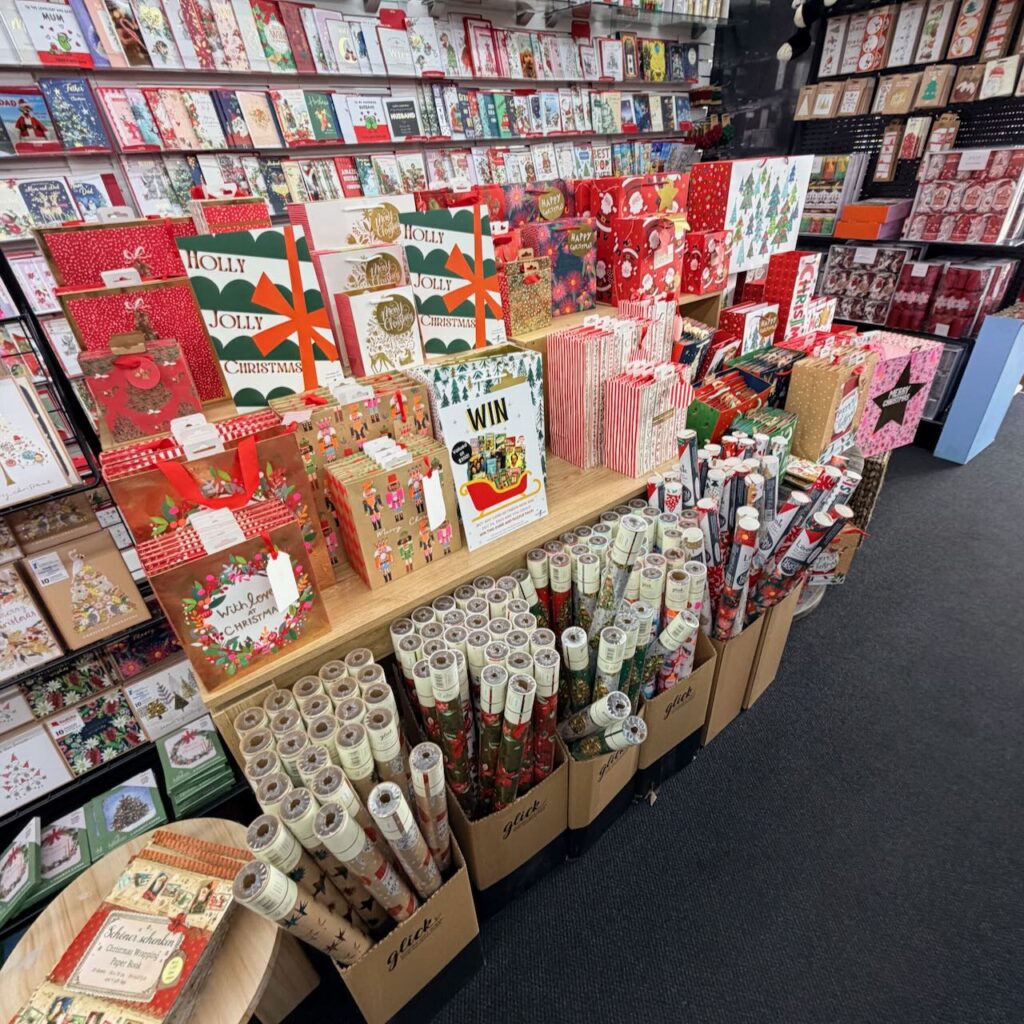
I am seeing terrific growth in charity boxed Christmas cards already this year. Retailers who have ranged well and leant into the charity aspect of these products should be up by double-digits over 2024.

For plenty of shoppers, the charity being supported is more important than card design. I see this especially in online sales. Shoppers are actively seeking ways to ensure their spending makes a positive impact. By featuring charity-supporting card boxes, you instantly elevate your store’s appeal. That’s supported in the sales data.

I’ve seen people buy 8, 10 and 12 boxes supporting a single charity. Some only buy 2 boxes – often of the same charity too. People buy by charity usually because on a personal connection. It’s wonderful hearing the stories.

The Christmas customer embraces the opportunity of positive impact when it presents. With charity boxed Christmas cards, the message is simple:

  • Every box sold contributes funds directly to vital causes. This emotional connection makes the purchase inherently more valuable to the consumer than a standard card box.

  • You appeal to the desire for corporate and personal generosity during the season of goodwill, attracting a broader customer base interested in ethical and meaningful purchases.

Range of support is key.

In my businesses, we offer collections that support incredible work across:

  • Health & Research: Including foundations focused on cancer, dementia, breast cancer, prostate health, and mental wellness (e.g., Beyond Blue, Peter MacCallum Cancer Centre Foundation, NBCF, etc.).

  • Vulnerable Populations: Dedicated to supporting children, young people, and families in need (e.g., Kids Helpline, Starlight Children’s Foundation, Make-A-Wish, etc.).

This diverse support network turns your card display into a powerful platform for community contribution.

This all supports the reputation we nurture. Stocking charity cards is a strong demonstration of your business’s commitment to Corporate Social Responsibility (CSR).

  • It reflects well on your brand, signalling a shared value system with your customers.

  • Many charity collections feature beautiful, high-quality designs, including those with Australian themes and sustainable printing, ensuring you don’t compromise on product excellence.

My advice is: make your card section a destination for shoppers who want to share cheer while simultaneously making a difference. The choice to stock charity boxed Christmas cards is a simple yet powerful strategy to boost sales, enhance customer loyalty, and align your business with the true spirit of giving.

Now, for clarity and transparency, in one of my businesses we will will do tens of thousands of dollars in charity boxed Christmas cards this year.


Mark Fletcher founded newsagency software company Tower Systems and is the CEO of newsXpress, a marketing group serving innovative newsagents keen to evolve their businesses for a bright future. You can reach him on mark@newsxpress.com.au or 0418 321 338.
7 likes
Greeting Cards

The lobbying on payments equity for small business retailers continues

The Independent Payments Forum, a lobby organisation representing many small business groups including ALNA members and newsXpress members from our channel, continues to lobby for more equitable payments arrangements.

The core issue being dealt with here is that payment providers “bundle” low-cost debit card fees with high-cost credit card fees

  • The high cost: Many of us are stuck paying a single bundled rate as high as 1.6% for all card transactions.
  • The reality: The actual cost of a debit transaction is tiny—less than 0.5%.
  • The imbalance: The RBA estimates about 80% of transactions are now by debit card.

This means that for 8 out of 10 sales, we (and our customers) are paying a fee that is more than three times higher than it should be.

The current situation places an unfair burden on small businesses for the profit of the banks, because those in power for decades have not cared enough to support fairness for small businesses. We either matter to them, or not.

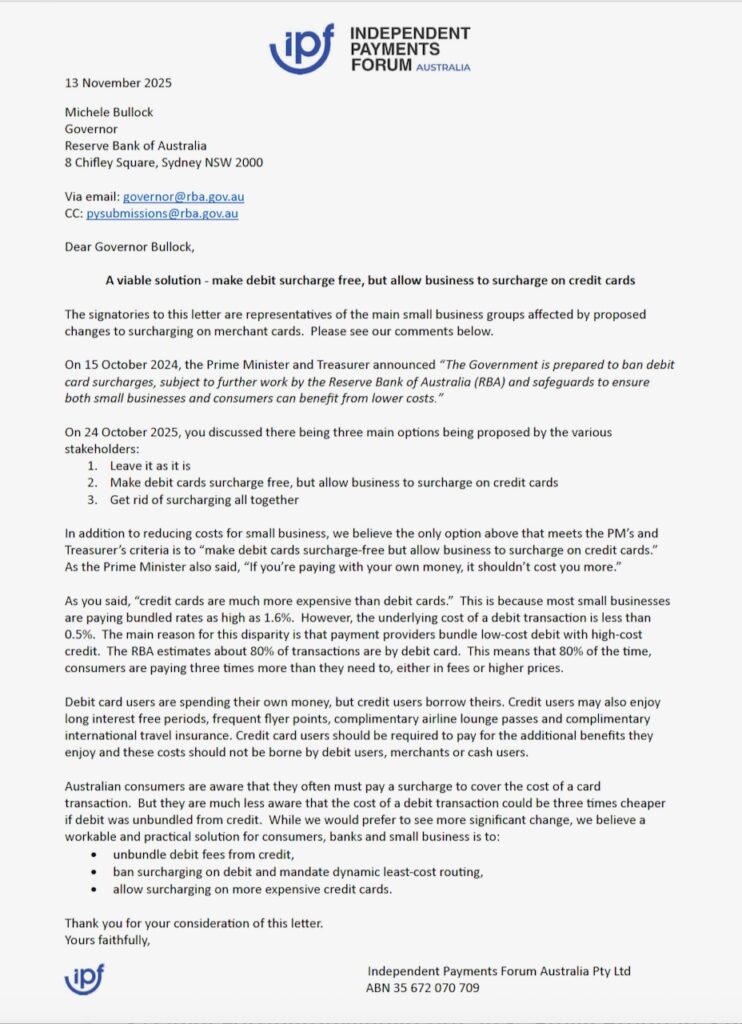
Here is their latest letter to the IPF, which had my signature presenting newsXpress members.

The letter to the RBA supports the government’s idea of making debit surcharge-free, but only if it’s done correctly. Banning all surcharges (Option 3) would be disastrous, forcing us to absorb all credit card costs or raise our prices for everyone

Small business retailers, like newsagents, are dealt with poorly by banks, the RBA, payments companies and politicians in this area. It is only continued lobbying, like the work of the IPF, that offers any hope of an outcome that’s reasonable for us.

This proposal by the IPF is a win-win if adopted by those in control.

  • For our customers: The 80% of customers who use debit cards get a surcharge-free transaction, as they should.
  • For our business: We stop losing margin by subsidising expensive credit cards. We finally get to pay the true low cost for debit and can fairly pass on the true cost for credit.

This proposal from the IPF is the only option that fixes the root cause of the problem. It brings fairness and transparency to a system that has been costing us—and our customers—too much for far too long.

What the IPF is proposing here is our best chance to fix a system that has been unfair to small businesses and our customers for too long. By standing with and supporting the IPS on this, we are pushing for a common-sense change. This solution allows us to finally offer our debit-using customers the surcharge-free experience they deserve, while ensuring our businesses aren’t left to pay for expensive credit card reward programs. It’s the only option that brings true fairness and transparency to our counters.

It does surprise me that other groups that claim to represent newsagents are not supporting the IPF.


Mark Fletcher founded newsagency software company Tower Systems and is the CEO of newsXpress, a marketing group serving innovative newsagents keen to evolve their businesses for a bright future. You can reach him on mark@newsxpress.com.au or 0418 321 338.
20 likes
Ethics

Retail advice: 10 ways to reduce employee stress in your business

You can tell if people working in a shop feel stressed. It can feel unpleasant. I know I have walked out of a shop without purchasing in such a situation.

No-one likes a stressful workplace, and while we can’t control everything, there are things we can put in place to reduce opportunities for stress.

I’m no psychologist. These suggestions are based on what I have seen work in local retail business settings.

  1. People above business. Put the needs of the people in your business above the needs of the business itself.
  2. Rest and meal breaks. Ensure they are always taken away from the shop floor or the usual workplace.
  3. Keep the workplace ventilated with safe air and ensure people have easy access to water where they work.
  4. Demonstrate trust and appreciation, and give people the opportunity to make decisions within their role.
  5. Suggest a walk. If you see someone having a challenging day, offer an opportunity for a walk outside to clear their head.
  6. Provide coffee, tea, filtered water and a stash of biscuits and some other snacks. Keep it clean and welcoming.
  7. Seek out opinions. Ask employees for their suggestions. Listen to them and actively consider them.
  8. Turn off. Don’t contact employees once they clock off unless it’s a genuine emergency.
  9. Embrace ways to appreciate people. It may be a fresh cake for the kitchen, lunch or movie tickets. The gesture doesn’t need to be big.
  10. Check in. Ask people if they feel stressed and, if they do, ask what they would like done about that.
  11. Do more than minimum. Yes, this is idea 11, a reminder to do more than the minimum required.

These are all common-sense ideas. Over time, however, we can neglect them and follow less employee-friendly practices and therefore increase the stress that employees experience.

The more freedom people working in your business feel they have the more they are likely to contribute and their endeavours can be key to helping the business achieve beyond what you expected for the business.

It all starts with the settings you have in place, your own behaviour, the freedom you set for people to be themselves.

A happy workplace is a productive workplace and, likely, a more profitable workplace.

Now, if you’re not sure where to start, ask those working in your business: how for you feel? is this a stressful workplace? how could we make this a more enjoyable place for you to work? Or, come up with your own questions.


Mark Fletcher founded newsagency software company Tower Systems and is the CEO of newsXpress, a marketing group serving innovative newsagents keen to evolve their businesses for a bright future. You can reach him on mark@newsxpress.com.au or 0418 321 338.
11 likes
Management tip

A step by step demonstration of AI tools available in newsagency software right now

There is plenty of smoke and mirrors being engaged in relation to AI and POS software right now. I a proud to note that Tower Systems has led in the area of AI when it comes to newsagency software, starting years ago and continue to evolve, apace, today. yesterday, for Tower I hosted a stop-by-step demonstration of each AI function in the software today, along with a discussion of some of what’s best. here’s a video of that session: https://youtu.be/xyoQtM90KGk

I wanted to offer a show don’t tell session, a practical demonstration using real data, so retailers, including newsagents, could see exactly the AI tools they could use in the Tower systems POS software, including newsagency software, today.

This video from Tower Systems covers exciting AI / POS software developments like:

✅ Natural Language Querying: Imagine asking your POS system questions about your business in plain English, like “What are my top 5 selling products?” or “Which customers generate the most revenue?” This video introduces the upcoming MCP integration, which will make this a reality.

✅ Automated Invoice Importing: Learn how you can effortlessly import supplier invoices in PDF format directly into your software, drastically reducing manual data entry and errors.

✅ Smarter Inventory Management: Discover how the system can intelligently manage stock, including breaking down bulk purchases (e.g., a bucket of scissors) into individual saleable units.

✅ Enhanced Reporting: Gain insights into what products you’re missing out on selling due to stockouts, what’s performing exceptionally well, and optimal product placement for increased sales.

This video is good to watch for any small business retailer looking to leverage AI to save time, make better decisions, and boost profitability.

If you are talking to a software company about using their software and they claim it down domewiting with AI, ask them to show you.  Any salesperson can make a claim, only those with the goods can back the claim with a live demonstration. There is no other newsagency software that today can match what is demonstrated in this video.

Now, more broadly on AI, if you think it’s not for you, that your business does not need it or that you are not techie enough to learn how to leverage it, you’d be wrong on all three fronts.

Every business needs the competitive advantage benefits of AI. You can control how much or how little of AI you use and, through choices you make, you can control the value you derive from its use.

You don’t need to be a tech nerd to learn and use AI. Access is not age restricted.

If you’re not sure, watch the video. It’s free to access. See the time saving opportunities. Listen to some smart questions from some retailers who joined in.

<small>Mark Fletcher founded newsagency software company Tower Systems and is the CEO of newsXpress, a marketing group serving innovative newsagents keen to evolve their businesses for a bright future. You can reach him on mark@newsxpress.com.au or 0418 321 338.</small> 

9 likes
newsagent software

AUSTRAC and E-cigarette Commissioner call on banks to act on illicit tobacco stores with private ATMs and eftpos

AUSTRAC and and the E-cigarette Commissioner have called banks act illicit tobacco stores with private ATMs and eftpos following terrific lobbying by the Independent Payments Forum. It’s good to see engagement from government bodies on this. Here is the AUSTRAC announcement.

AUSTRAC CEO Brendan Thomas and the Illicit Tobacco and E-cigarette Commissioner (ITEC), Amber Shuhyta, have called on Australia’s banks to take immediate action to strengthen oversight of tobacco and convenience stores with private ATMs and eftpos.

Mr Thomas said non-bank ATMs and point of sales payment technologies are being used to buy illicit tobacco products and to launder the cash proceeds.

“Any bank receiving funds through these channels is at risk of dealing with illicit proceeds,” Mr Thomas said.

“We are asking banks to assess, mitigate, and, where possible, eliminate these risks.

“Where banks continue to provide services to tobacconists and convenience stores, they must closely monitor for and report suspicious matters.

He said the request is about refocussing existing AML controls to target a fast-growing criminal trade.

“This is a crime type that is generating billions of dollars in criminal proceeds, and the scale of the activity is undermining Australia’s economic integrity and community safety.”

New figures released overnight by the Australian Criminal Intelligence Commission and Australian Institute of Criminology show the cost of organised crime to Australia reached up to $82.3 billion in 2023-24, including an estimated $4 billion from illicit tobacco alone- a four-fold increase over the past three years.

AUSTRAC has also cautioned banks to be alert to displaced customers as enhanced scrutiny takes effect.

While urging stronger controls, Mr Thomas said banks must strike the right balance to avoid unintended impacts on legitimate businesses.

“There are legitimate needs for access to cash services, particularly in rural and remote communities.”

“Our shared goal is to target criminal enterprises, not legitimate economic activity.”

AUSTRAC’s administration of existing AML/CTF laws is one feature of a broader, multipronged strategy coordinated by the ITEC to shrink the illicit market, reduce criminal activity and minimise harm to community and public health.

A range of multi-agency measures are underway to disrupt the illicit tobacco market across the Australian supply and demand chain.

“Australian banks play a critical role in protecting the financial system from criminal abuse and are well placed to strengthen their AML controls in this high-risk sector.

“We are focused on disrupting the business models of criminals, making it harder for them to trade and hitting them where it hurts, in their pockets.

“I’m confident no Australian bank wants this dirty money in their business and will work with us to help shut it out.”

This statement follows a campaign by the Independent Payments Forum (IPF) and PayDay News questioning the legality of payments terminals used at these businesses. newsXpress and ALNA are the two groups in our channel supporting the excellent work of IPF.

2 likes
Ethics

Strong start to diary sales in Australian newsagencies this year

I am seeing a strong start to diary sales in Australian newsagencies this year compared to recent years. This is terrific news for newsagents and their diary suppliers.

While some of the strong start of diary sales in Australian newsagencies can be attributed to Collins not repeating last year’s distribution mess this year, I think it also has to do with strong shopper demand for tactile engagement. Despite the prevalence of digital tools, many still value the tactile experience of handwriting notes and plans. The use of a physical planner is often seen as a way to reduce screen time.

Journal sales are way up this year – again because people love tactile engagement for not taking and journaling. There is a significant demand for premium, aesthetic, and niche stationery.

We are seeing people buy two and more diaries: for home, work, and more.

The diary customers we are seeing cover a range of shopper segments: students, professionals, office people, families, FIFO workers. People are buying them for different reasons too, beyond the everyday of noting appointments – time-blocking, goal-setting, personal well-being journaling.

Diaries play into a trend we are seeing around personal actions designed to support better mental health. Younger males are strong in this area from what we are seeing and from what we hear from retailers overseas.

To leverage the diary opportunity we have a broad range from the practical / functional through to the attractive and inspirational. We have tried to offer a range with broad appeal.

Thinking about the growth in the sale of journals to young males (18 – 35), here are some thoughts on creating a diary story to appeal to them:

For this demographic, a planner is often less about “pretty stationery” and more about what they’d consider personal mastery, performance, and strategic thinking.

  • Goal clarity & achievement: We see influencers talking to this young male cohort online about goal setting and the role it plays in personal development.
  • Reduced stress/regulated emotion: Plenty of influencers online (TikTok, Instagram and YouTube) promote journaling for its ability to calm moods and clarify steps toward goals.
  • Improved focus (deep work): The time-blocking concept aligns with the goal of to prioritising high-value tasks and engage in “deep work,” which the same influencers often say is critical for personal success.
  • A need for structure: This group diary users looks for a systematic, science-backed approach to eliminate guesswork and maximise efficiency.

How we sell to this diary cohort is different to how we might sell to a female 35+. We need to think about this when displaying diaries in-store – where we place them and how we present needs to be different, otherwise they may miss the opportunity.

It’s terrific seeing diary sales so strong this year in Australian newsagencies.

6 likes
Diaries

UK newsagents targeted in protest attack

Better Retailing is exclusively reporting on attacks in newsagencies against certain newspapers.

A planned protest campaign targeting newsstands by activist group ‘Media Revolution’ has newsagents and major retailers on alert.

Described as ‘Media Liberation Day’, the group urged people to disrupt the sale of national newspapers in stores on 5 November by covering up their front pages.

Organiser Liz Pendleton told other activists: “We’ve got this direct action you can get involved with straight away You can print out these cover stories and you can put them on top of newspapers in newsagents and supermarkets to call out malignant media.”

It reminds me of the shopper we had who offended by the birthday card with a small balloon penis on the front – they would come in and cut the penis off all the cards.

While I have sympathy for those concerned about the concentration of news media ownership, protests like this against small business retailers are unfair.

1 likes
Newsagency challenges

At what point are newspapers not profitable

Talking to a newsagent yesterday, more days than not they sell 2 copies of a daily newspaper. Allowing for labour, retail space and other costs, you have to wonder why bother with this level of loss making.

The numbers for retailers will vary based on retail occupancy cost. The question for everyone days to be: at what point is a newspaper not worth caring in the shop?

This is a critical strategic question that newsagents are grappling with.

The core economic challenge of low-velocity staples, like newspapers

The scenario outlined is a classic example of a product line’s viability erosion. When a product is sold, its profitability isn’t just the sticker price minus the wholesale cost. A more accurate calculation involves:

  1. Direct costs: The wholesale price of the newspaper.
  2. Allocated overhead:
    • Occupancy cost: The retail space is a business’s most valuable asset. That newspaper stand or shelf space occupies square footage that has a specific cost per day. If it’s in a prime location (like the front of the store), its opportunity cost is even higher.
    • Labour costs: This is often overlooked. It includes the time spent receiving the delivery, setting up the display, handling the transaction, and, critically for newspapers, managing the complex and time-consuming returns process for unsold copies.
    • Capital cost: The money used to purchase the stock (even for just a day) is capital that could be used elsewhere.

When sales volumes drop to such low levels, the gross profit from those two sales (which is typically minimal on newspapers) is almost certainly eclipsed by the daily allocated costs. This turns a traditional staple product into a consistent financial drain.

The strategic question: why bother?

If it’s a clear loss-maker, the decision to continue stocking the product moves from a purely financial one to a strategic one. Retailers often continue for several complex, and increasingly debatable, reasons:

  • As a “Destination Driver”: The primary historical justification. The newspaper was a “destination” product, an item that drove guaranteed daily foot traffic. The business model relied on this customer coming in for their paper and also purchasing a high-margin greeting card, a magazine, or a lottery ticket. The newspaper was a loss-leader that generated profitable, ancillary sales.
  • Customer habit and loyalty: A small-business retailer, especially one embedded in a local community, builds long-term relationships. There may be a small cohort of elderly or long-time customers who expect the paper. The retailer may choose to absorb the loss simply to retain the loyalty of these patrons, fearing that if they go elsewhere for their paper, they will also move their other, more profitable purchases.
  • Brand identity: For a business named “XYZ Newsagency,” there is a powerful brand-identity component. Removing newspapers can feel like a fundamental betrayal of the business’s name and purpose.

The tipping point: when is it not worth carrying?

This is the central question, and the answer is different for every retailer. The decision to delete a product line like newspapers is reached when the strategic justifications no longer outweigh the financial losses.

This tipping point often arrives when:

  1. The opportunity cost is quantified: The retailer calculates that the same physical space could be dedicated to a product with a better sales velocity and a higher margin (e.g., gifts, collectibles, coffee, and more), and the potential profit from that new line is greater than the total profit from the customers who buy the newspaper.
  2. The “Destination Driver” Fails: The retailer observes that the newspaper customer is no longer buying those ancillary products. They are simply buying the low-margin paper and leaving. At this point, the product is no longer driving traffic; it is simply serving traffic at a loss.
  3. Labour costs become untenable: The time spent managing the administrative burden of returns and distribution becomes so significant that it physically pulls staff away from more profitable activities, such as customer service, merchandising, or managing online sales.
  4. The customer base dwindles: Eventually, the small number of loyal customers who demand the product either moves away, stops purchasing, or transitions to digital, at which point the retailer is absorbing a loss for almost no tangible benefit.

The question for each retailer is no longer How do I sell more newspapers? but How much am I paying to keep this product line, and is the benefit it provides in foot traffic and loyalty still worth that price?

In more newsagencies than not these days newspapers are loss-making for the retailer.


Mark Fletcher founded newsagency software company Tower Systems and is the CEO of newsXpress, a marketing group serving innovative newsagents keen to evolve their businesses for a bright future. You can reach him on mark@newsxpress.com.au or 0418 321 338.
13 likes
newsagency of the future

80 Years On: Remembering the Second World War

I’m grateful that newsXpress stores will be offering access to coins to commemorate the eightieth anniversary of the end of the Second World War. The coin’s reverse features a remembrance wreath, which comprises eight red poppies to represent the eight decades that have passed since the end of the war.

Produced by the Royal Australian Mint, the demand for these coins is high if calls and emails already are anything to go by.

The new shopper traffic generated by each coin release is excellent, and coin shoppers are efficient, often purchasing other items.

5 likes
newsagency marketing

Why Coles’ Big AI News is Great for Independent Retailers (Like You)

You might have seen the news this week that Coles is rolling out an enterprise-wide partnership with OpenAI. When I saw that story, my first thought wasn’t about the competition. It was: “This is fantastic news.”

This move by a retail giant validates what Tower Systems has been focused on for some time, for newsagents and the other small business retailers it serves: AI isn’t just a gimmick for the big end of town; it’s a genuine “competitive game-changer” for independent, local retailers.

It’s levelling the playing field. And the best part? You don’t have to wait. While Coles is just announcing their plans, local, independent retailers are already using powerful AI tools every single day. I made a video this morning about this:

For a long time now, Tower has been embedding AI tools from OpenAI, Google Gemini, and others directly into its point-of-sale software. It’s not about “future tech”; it’s about practical tools that solve real problems for small business owners.

In the video, I discuss how our customers are already using AI to:

  • Save hours of admin by automatically analysing and importing virtually any supplier invoice, with no special setup required.
  • Market smarter by generating unique product descriptions and blog posts that speak in their business’s authentic voice.
  • Boost profitability with plain-English reports that identify what’s not selling, what’s overstocked, and even potential theft, long before it becomes a major issue.
  • Prevent lost sales by getting alerts on popular items you’re about to run out of.

As I mention in the video, I rely on these and more AI tools in my own retail shop – to save time, make better-informed decisions, and run a smarter, more efficient shop.

This technology is here, it’s accessible, and it’s already making a fundamental difference for local businesses. The Coles announcement is a great signal for the entire retail sector and all who serve it that AI is no longer an option, AI is an essential part of modern retail.

Watch the video to see my full breakdown of what this means for local small business retail and how you can leverage this power in your own independent business today.

As you can probably tell, I’m excited about AI. It makes accessible to small business retailers opportunities for more effectively competing – as plenty are already finding. It’s a terrific opportunity for efficiency and growth.

And, when you’re researching AI, get to the facts. Some software companies say they have AI tools, when they don’t. It’s important you see for yourself what’s available today as this matters.


Mark Fletcher founded newsagency software company Tower Systems and is the CEO of newsXpress, a marketing group serving innovative newsagents keen to evolve their businesses for a bright future. newsXpress has an established package if advice and support for newsagents when it comes to AI. You can reach him on mark@newsxpress.com.au or 0418 321 338.
15 likes
Newsagency management

If you listen to retail advice from supplier reps, this post is for you

A supplier rep told retailers they visited how awesome a new product they were pitching was. There said other retailers had found it successful. retailers bought up. The product failed. The rep doubled down, suggesting that the retailers failed and not the product.

Retailers listened to the rep because of the origin story they always pitched on the first meeting – years of local small business retail experience.

I get it, supplier reps have one job to do to sell the products they represent. The thing is they will fail if they sell products that fail.

The rep in the story above did have retail experience, from more than twenty years earlier, for a couple of years when they were in high school. The way they told the story is sounded more recent, and more significant than part time counter sales.

Unless someone has current retail experience relevant to you, be skeptical about their advice. Do your research. Check their claims. get any promises in writing. And, if you encounter a rep giving bad advice, discretely tell fellow retailers so they don’t get caught.

Thoughtful Verification: Key Steps for Supplier Due Diligence

  1. Seek Peer Confirmation: Ask the representative for the names of a few other retailers who have been successfully selling the product for some time and have placed multiple restock orders.
  2. Request Performance Clarity: Request documented figures for the typical sell-through rate experienced by new customers in their first few months. This turns success stories into a predictable, quantifiable expectation.
  3. Establish a Protective Agreement: For a new product, formally agree upon a buy-back or stock credit option for a portion of initial inventory if the item does not move as projected within the first six months.
  4. Confirm Commitments: Ensure that any agreed-upon details, including promised support or performance metrics, are confirmed in writing (an email is sufficient) to provide clarity and mutual understanding.

Now I know what I’ve written here is vague. That’s deliberate. I am not in the mood for a legal letter or worse. It’s happened before. I have a theory, those misbehaving tend to be quick to fire legal shots.

5 likes
Newsagency management

I Was Wrong. We Sold Out. The Humbling Reminder That We Are Not Our Customer.

I have a confession to make.

I feel a bit foolish, and that’s not always a comfortable feeling. But this time, I’m glad I do. It means I had a wonderful reminder I probably should have remembered sooner.

For the last couple of years, we’ve been refining our product mix across at our www.mintcoinshop.com.au website that’s connected to one of my shops. We’ve developed a good sense of who our customers are and what they like. Or at least, we thought we did. We’d been intentionally saying ‘no’ to certain products, especially coin designs that seemed a bit… “out there.”

This policy was put to the test recently when we saw a new range of Halloween coins from Europe.

My immediate reaction was a hard ‘no’.

I looked at them and thought they were gimmicky. They felt “risqué” for our brand. I was convinced they would never appeal to our core audience of serious coin collectors. My internal narrative was all about protecting our reputation, maintaining our curated standard, and not wasting money on stock that wouldn’t move.

This was my bias, fully at work, masquerading as ‘good business strategy.’

I was just about to send the ‘pass’ email to the supplier when I remembered a classic retail truth hit me: We are not our customer.

My personal taste is irrelevant. My assumptions about what a ‘serious collector’ enjoys are just that, assumptions. Who am I to say that someone who appreciates a rare proof coin doesn’t also have a sense of humour and a love for Halloween?

So, we changed course. We took the risk. We ordered some of each design.

Last night, with a healthy dose of skepticism, I drafted a simple marketing email. I sent it out at 10 PM, figuring we’d see what happened by morning. (I even used what I call “deflection framing” in the copy, which is a whole other story, but it was my way of subtly bracing for a non-response).

This morning at 7 AM I checked the results.

We were completely sold out. Every single coin.

I’m thrilled, of course. But I’m also kicking myself. I’m glad we took the risk, but I feel foolish for not taking it sooner. How many other opportunities have we missed over the last two years because our personal preferences got in the way?

It’s a powerful lesson in the dangers of “managing for average.” So many businesses I see manage for average, they manage for results they can be sure of – often denying their business the opportunity of even better results, with a risk for sure, but with that risk comes education and that’s the cornerstone of growth.

It’s easy to get comfortable. It’s easy and safe to keep doing what we’ve always done. If we do, we’ll probably keep hitting our targets. We’ll do fine.

Fine is the enemy of better.

Chasing “safe” means we might miss reaching for something exceptional. Our comfort zone is a place where new opportunities rarely grow. This little experiment proved that the real risk isn’t trying something we think won’t work; the real risk is letting our biases stop us from finding out for sure.

I’m sharing this because it’s a reminder I needed. That feeling of being wrong, of being foolish, is a sign of growth. It means you’re pushing past your assumptions.

It leaves me with one big question for myself, and for you: What are you saying ‘no’ to right now, simply because you don’t get it or don’t like it?

That might be the very thing you should try next.

Final note: Right now, for newsagency businesses, that I have written about here matters. We are at a moment in time where we must play outside our small sandpit, where we must take risks in order to attract new shoppers. This is urgent for each of our businesses and vital for the channel and all who rely on the channel. I can’t stress this enough and the urgency with which we must act.


Mark Fletcher founded newsagency software company Tower Systems and is the CEO of newsXpress, a marketing group serving innovative newsagents keen to evolve their businesses for a bright future. You can reach him on mark@newsxpress.com.au or 0418 321 338.
14 likes
newsagency of the future

Opinion: NewsQuake from NLNA is rooted in the past

I’ve been asked my opinion about the NewsQuake services launch by NLNA this week. Well, here it is, and it is my opinion. If you’re interested in newsQuake, do your own research, make up your own mind.

NewsQuake pitches parcel pick up, money transfer and bill payment services to newsagents.

These services have been available to and through newsagents for many years.

They are agency services, meaning newsagents receive a commission or service fee that is fractional in terms of the transactional value to the shopper.

The pitch to newsagents is that offering the services drives new traffic. While that may be true, looking at newsagent basket data for decades, I see no evidence that agency business translates into meaningful retail product sales.

There are reasons people paying a bill, picking up a parcel or sending money don’t buy other products in the shop visit:

  1. The visit is a destination visit, for purpose, anything else is a distraction.
  2. The visit is annoying, so they are not of a mindset for a happy product purchase: they are sending money to someone who is not good at saving, they are paying a bill they are not happy with, they are guilt ridden over the online purchase they are there to pickup.
  3. They don’t see you as a shop. Rather, you are a depot, and that’s how they think of you.
  4. The visit is a counter visit, they have no reason to look at the body of the shop.
  5. Your headspace in dealing with them is that of an agent who is aware their value to you today is a few cents and not one of a retailer serving a customer who could spend $350.00 on beautiful gifts.

The other experience with agency business those of us who have offered them in the past is that your agency customer is likely more demanding in terms of attention and transaction time than you are compensated through commission.

Those of us who did Bill Express all those years ago will have stories of customers arguing with you about a bill they are paying, for which you receive a few cents, wanting you to fix a billing issue and not accepting that you cant – all the while a customer with a $250.00 gift purchase is waiting to pay you.

There is a disconnect between the agency shopper and the retail shopper.

I think it’s worth thinking about who makes money out of each bill payment, parcel pickup and money transfer transaction. In each case I suspect there are at least three businesses making margin on the transaction. In my experience from offering these services in the pack and unpacking where margin dollars fell, the retailer always made the smallest margin while carrying the highest labour cost. I can’t speak to this being the case with NewsQuake.

The News Corp. news story about NewsQuake was nice. News Corp. is a commercial partner of NewsQuake though. That was reflected in the puff piece. I smiled at a dinosaur of a company promoting this dinosaur group of services.

Good on NLNA for trying something. My suggestion to them tis to come up with ideas that are actually relevant for newsagents in 2025 and beyond. It’s not NewsQuake in my opinion.

The future of each Australian newsagency business can be found in trading outside the traditional shingle, away from agency products. Your future is in you being an innovative and proactive retailer. This is something I covered at length in my Lotterywest presentation: https://www.youtube.com/watch?v=7ELmh8Grzd8

24 likes
newsagency of the future

Has the pace of decline of over the counter newspaper sales increased in 2025?

The data I’ve seen from a range of Australian newsagencies suggests the answer is an unequivocal yes: the pace of decline of over the counter newspaper sales increased in 2025. While the dataset is small, it points to an accelerated decline in 2025, a trend that should be an urgent wake-up call for every newsagent. And, it’s not as if this is the first such wake-up call for Aussie newsagents.

Looking at data from several capital city newsagencies, unit sales of newspapers are down a staggering 13% year-on-year so far in 2025. That is a significant increase in the rate of decline compared to previous years.

Data Don’t Lie: Newspapers vs. Magazines

(Note: data data is technically the plural of the Latin word datum)

To understand how serious the situation is, we need to compare it to other categories. In the same businesses I’ve analysed, magazine unit sales have declined at the same pace or even slower than in previous years.

In one newsagency, while newspaper sales have declines by 13.5% this year, magazine unit sales are down  7.9%. If I remove sales spikes from that data, the magazine decline drops to under 7%. The gap between the newspaper crisis and the magazine slowdown is stark.

The situation for international newspapers is even more dire, with a decline of over 50%. While this could be a data categorisation issue, it more likely signals that these titles are in the most serious trouble of all.

From Profit Centre to Community Service

For generations, newspapers drove our businesses. They created valuable, reliable foot traffic. Today, that is no longer the case.

The gross profit contribution from newspapers now rarely covers the labour, space, and administrative costs of carrying them. For many, it has become a community service rather than a commercial imperative. Any newsagent still relying on newspapers for either their business purpose or their revenue needs to urgently reconsider that position.

Your Action Plan: Making Business-First Decisions

While offering newspapers may feel like a community obligation, we are businesspeople who must make commercial decisions. The newspaper publishers are theirs, you can see it in the products they give us to sell, where genuine news can often be hard to find.

It’s time to reflect this new reality in your own business.

  1. Relocate Your Newspapers: Move newspapers to a low-cost position in the shop, away from the prime real estate at the front door and counter.
  2. Minimise Your Costs: Streamline every process for managing newspapers. Handle returns, ordering, and merchandising in the most time-efficient and least costly way possible.
  3. Stop External Promotion: Cease any active promotion of newspapers outside your business. Your marketing dollars and efforts are better spent elsewhere.
  4. Re-evaluate Your Signage: Reconsider any “Newspaper” brand signs on your shopfront. They may be creating customer expectations that no longer align with the future of your business.
  5. Set Your Exit Point: For every title, determine the point at which it is no longer viable for you to carry it. Be prepared to make that call.

The Writing is on the Wall

It is only a matter of time before a major Australian capital city daily stops being published seven days a week. We’ve seen this movie before. Back in 2009, the Seattle Post-Intelligencer moved to a digital-only model. While the move was challenging, the title survived and exists today: SeattlePI.

The print medium is challenged, but the shift is bigger than that. How, when, and why we consume content, including news, has fundamentally changed. Our businesses, originally created for the distribution of news, are at the heart of these changes.

Newspapers are far less important to our businesses than ever before. It’s time our business decisions reflected that.

Our future is not news.

Our future, your future, is 100% yours to set, without the boundaries of legacy media. But that’s a topic for another day, including a discussion around what to call your business. Watch out, I’ll have something more on this very soon.


Mark Fletcher founded newsagency software company Tower Systems and is the CEO of newsXpress, a marketing group serving innovative newsagents keen to evolve their businesses for a bright future. You can reach him on mark@newsxpress.com.au or 0418 321 338.
19 likes
newsagency of the future

Have you ever done a Sunday reset in your newsagency?

The goal of a Sunday reset is to make a noticeable difference to the shop for you and your customers.

It’s easy to become ‘shop blind’ to your own retail space, walking past the same displays day after day. This routine can make your business feel stale to both you and your regulars. The goal of a Sunday reset is to shatter that stagnation and make a noticeable, energy-boosting difference for everyone. The key to success is you not overthinking it; this is about decisive action, not perfect planning. Give yourself no more than 2 hours.

Follow these easy steps:

  1. Declutter. Be ruthless. Chuck out what you know for sure is not selling and will never sell. Holding onto it costs you valuable space. Throw away anything at the counter that’s not used or of value there. Remove all products currently at the counter. Take down main product displays and placements in the first 2 metres inside the shop.
  2. Rebuild. Rebuild with fresh eyes. This is your chance to experiment. Put products at the counter people will understand and can easily grab. Include some high-margin products you think people would never buy at the counter. Create product displays and placements in the first 2 metres featuring items you would never normally put at the front of the shop.
  3. Talk about it. Jump on your business social media pages and brag about what you’ve done. Post before-and-after photos to highlight the change.
  4. Create a “Discovery Zone”. Designate one small, high-traffic area, a single shelf, a small table by the entrance, or the corner of your counter, as your dedicated “Discovery Zone”. Commit to changing only this spot every single week, no matter what. Feature a single product, a small collection of related items, or something completely unexpected. This trains your regular customers to look there first for what’s new, creating a sense of anticipation and ensuring your shop always has a fresh point of interest, even on weeks when you don’t have time for a full reset.

Do things you’d not do in your business, even things you are unsure of – for it’s this type of exp[erimentation where you can find fresh success.

What you want is shoppers entering the shop to notice that it’s different and to comment on it. This alone is a win for you since they are connecting change with your shop, it means they notice you.

You should feel good about a Sunday reset. Its good work to do on your business.

5 likes
Newsagency management

Best practice invoices make life easy for newsagents

Check out how easy it is to load an invoice from Hunter Leisure into newsagency software:

Hunter is managing fulfilment for Ty products (Beanie Boos) in Australia now.

For suppliers: what makes the Hunter Leisure invoice so good is the clear labelling and inclusion of product barcodes. This example from Hunter is gold standard.

For retailers: this import uses the AI import tools in the Tower Systems newsagency software. More than 1,800 newsagents have access to this software. the AI tools are proving to be a game-changer: saving time, reducing mistakes and facilitating money making business decisions.

I am using AI tools everyday in my own shop, as I mention here:

I get that for some, AI feels too hard to understand. It’s not. AI tools embedded in POS software are helping local independent retailers every day. If you are not using them, you are not competitive.

I’m serious.

I know of newsagents who have cut labour costs by $175.00 a week by using the AI tools. That’s a $9,100.00 saving a year. And that’s for one of many AI tools in the software.

If you want a profitable retail business, using AI tools is essential.

In the Tower Systems newsagency software, newsagents can use AT tools to:

  1. Import supplier invoices without needing EDI files.
  2. Compare prices with retailers nearby.
  3. Generate blog posts that drive traffic to the business website.
  4. Generate product descriptions quickly that help your products be found.
  5. Receive a text summary of trading for the day with meaningful local data insights beyond what POS software usually reports.
  6. Be told if theft may be an issue in the business.
  7. See revenue you’re missing thanks to AI driven inventory watch tools.
  8. See what product pairings could drive additional revenue from impulse purchases.

These AI tools in the Tower Systems newsagency software and more are helping engaged newsagents fundamentally change their approach to business decisions and in-store actions.

To use these tools you don’t need to be a tech expert, an AI specialist. They are embedded in the Tower Systems software and are accessible as part of the everyday use of the newsagency software.

Newsagents and other small business retailers often speak about being time-poor and the cost of labour in the business. The AI tools address both pain points. They save time, which can save labour costs.

Using the AI tools all comes down to whether you want to save your time or the cost of time of staff in the business.

You can reach Tower sales by phone on 1300 662 957 or by email at sales@towersystems.com.au. The website is: www.towersystems.com.au. If you’re a Tower customer, the knowledge base has advised on how to access the AI tools.

8 likes
Newsagency management