The lost newspaper
No wonder newsagents don’t give newspapers front of store retail space and more.
2023 vs. 2022 newsagency sales benchmark results
Thank you to the 117 newsagents trading under a variety of shingles and in a variety of settings (rural, regional and suburban high street) who provided sales data for this benchmark study. The only connection is that they use newsagency software from my POS software company. Their transparency will help many in our channel.
Print media decline has retail newsagents looking elsewhere.
2023 was a tough year for over the counter newspaper and magazine sales. The majority of newsagents, however, did not let that hurt the bottom line, they replaced the revenue declines with growth from better margin categories.
After comparing data from the businesses in the benchmark dataset here are the averages for business performance measurement points and categories, comparing the whole os 2023 with 2022:
- Revenue: Up 2%.
- Sales transaction count: Down 8%.
- Basket value: Up 9%. This is an incredibly important number.
- Items per basket: Up 5%. This is an incredibly important number.
- Average item value: Up 4%. This is an incredibly important number.
- Greeting card revenue: Up 1.5%.
- Magazines unit sales: Down 10.5%. This is an unfair measure because of the big difference between businesses, bigger than for any other category.
- Newspaper unit sales: Down 10%.
- Toy (incl. plush) revenue: Up 5%. 33% of those in the study have this category
- Gift revenue: Up 18%. The bigger growth in gift revenue came from businesses doing more than $50,000 a year in gifts.
- Book revenue: Up 24%. 10% of those in the study have this category.
- Fashion: 65%. 8% of those in the study have this category.
- Stationery revenue: Up 9%. This is also an unfair measure because stationery now includes plenty of gifting items as it has changed.
The traditional newsagencies with minimal gift, toy and plush products are the ones facing the existential challenge. Some of these newsagents rely on newspaper publishers and other legacy suppliers for advice. That is proving to be a mistake.
If you want better results it is up to you to act.
There is no one size fits all solution, anyone who says there is is wrong.
The first step is to understand where you are at, from the data evidence in your business. next, you need a plan. Then, you execute with clarity and commitment, and draw on the support of others who have done this.
I own newsXpress, a marketing group supporting newsagents. newsXpress helps with this. If it interests you, please email help@newsxpress.com.au or call Michael Elvey on 0400 331 055 – he’s not a sales person, he’s part of the team encouraging success.
Mark Fletcher
M | 0418 321 338
https://www.linkedin.com/in/mark-fletcher-tower/
Cards in newsagencies
Here’s a new video from me on this vital topic.
The value of a website for your newsagency
Attracting shoppers from far away is one of the benefits of a website for any retail business. There are plenty of other benefits including being able to sell products when the shop is closed, letting people see what’s in-stock from their home, selling products before you have them in-store and quitting stock that’s not selling in-store to list a few more.
One of the biggest benefits of a website is the opportunity to create a plan b for the business, selling products in a completely different category to provide a fresh income stream, a soft landing should the core retail business find itself in rough waters. The two major websites I have related to my own retail business do this, they sell plenty of products not stocked in the shop with fulfilment from a ‘dark’ store, a space not open to in-store shopping but leveraging retail business resources for efficiency.
There are many benefits of selling online. Having a website today is as important as having a fax machine was twenty years ago. It’s a basic business tool.
Here are some newsagencies with websites. yes, they are all newsXpress businesses because I have their details at hand. Take a look. Some are completed and trading while others are early on that journey.
- MOUNT LAWLEY NEWS, https://oliviaandgrace.com.au
- NEWSXPRESS LEVEN, https://serenityhomeandgifts.com.au
- NEWSXPRESS NUMURKAH, https://onebaby.com.au
- COBRAM LOTTO, https://giftideasshop.com.au
- NEWSXPRESS SUNBURY, https://brenita.com.au
- newsXpress Kenmore Plaza, https://morethannews.com.au
- NEWSXPRESS MIDVALE, https://heybelle.com.au
- NEWSXPRESS CENTREPOINT MIDLAND, https://treasureboxgifts.com.au
- NEWSXPRESS GOULBURN, https://goulburnstationery.com.au
- newsXpress Hawthorn, https://mintcoinshop.com.au My shop.
- newsXpress Hawthorn, https://myornaments.com.au My shop.
- NEWSXPRESS HIGHLANDS MARKETPLACE, https://highlandsgiftsandplush.com.au
- NEWSXPRESS MERIMBULA, https://merimbulaextra.com.au
- NEWSXPRESS PARKES, https://parkesnewsandgifts.com.au
- NEWSXPRESS RIVERSIDE, http://inspiregifts.com.au
- NEWSXPRESS SOUTHLAND, https://www.cutenessoverload.com.au
- NORTH RINGWOOD NEWSAGENCY, https://www.aidecor.com.au
- PAPERPLAY INVERLOCH, https://www.paperplayonline.com.au
- SETTLEMENT CITY NEWSAGENCY, https://www.giftolicious.com.au
I have shared this list because showing is better than telling.
Most retailers tend to overthink their first website or two. The best advice is launch early and launch often. In other words, develop an idea and go with it. Learn about being online and evolve the website as you learn more.
The website does not have to reflect your shop, but it can if you want.
Web development is expensive, especially if it is done 100% in Australia like these have been. If you want to reach more shoppers, it is critical. But, a website is a hungry beast. feed it and it is more likely you serve you well. Don’t feed it, and it is likely to not serve you well.
Disclosure: my newsagency software company, Tower Systems, has made many websites for newsagents. newsXpress, the newsagency marketing group I own, offers members half price beautiful websites from Tower.
Has the beloved Ty brand lost its way in Australia?
For years, Ty products were hero products in toy shops and newsagents in Australia. Built around collecting Ty Beanie Boos and other products, sales were excellent and shoppers were loyal.
At the end of 2022 that changed with the decision by Ty in the US to make different arrangements for distribution in many international markets, including Australia.
While the products are the same adorable and loved products, from what I can tell they now appear to be targeting impulse shoppers. There was no product on offer for Valentine’s Day 2024, despite it being available overseas. I’ve been told that nothing is planned for Australia for Easter 2024 yet I have seen the Easter 2024 product overseas. I hope these products do make it to Australia.
Gone are opportunities offered retailers like us to nurture collector relationships. The focus does appear to be on pitching Beanie Boos as a low-cost impulse line. And while the company has its reasons for this, it appears the successful approach of us and other retailers serving collectors is of no interest.
Here’s an announcement they made on LinkedIn a couple of months ago:
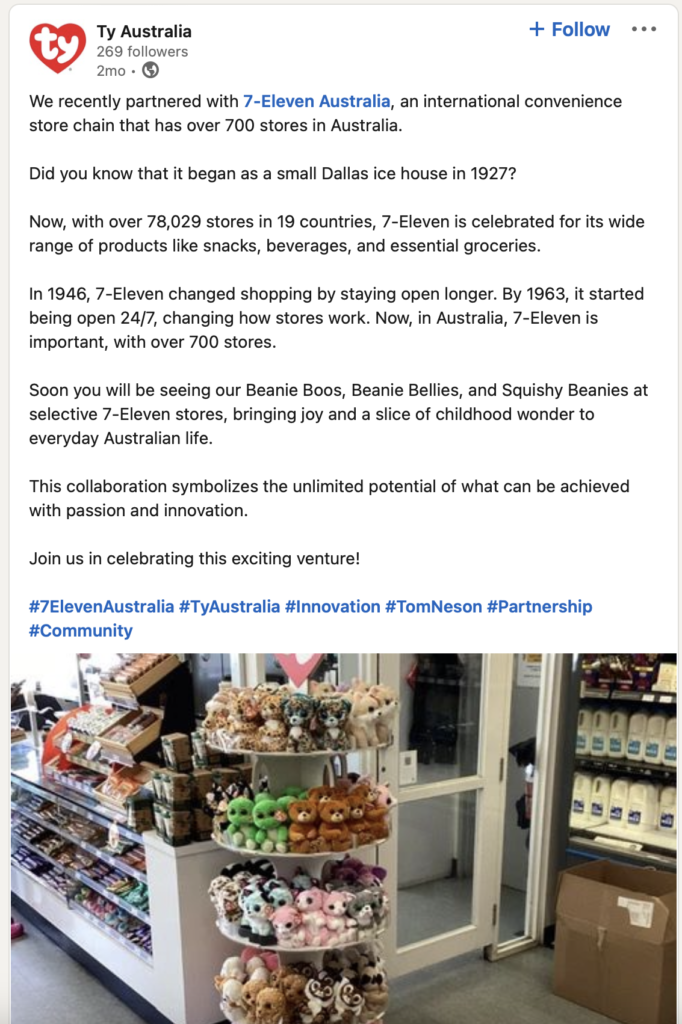
Last year, Ty Australia set a maximum retail price at $1 lower than what had been traditional for Beanie Boos. They said sales would increase as a result. That has not been my experience. It’s unfortunate there was no consultation prior to their pricing decision, no consideration of past experience that showed it did not boost sales and that other tactics were far more successful at boosting sales.
Time change, trends come and go, I understand that. What has happened here is not that. Collector interest was as strong as ever. The decline has been driven by the company for reasons only it understands.
Communication from Ty Australia has been non-existent. This has not been helped by a succession of senior staffing changes. I’m not sure why people with good experience in the field are not staying with the company that long.
Maybe what is happening with Ty in Australia is the same as we see happening with some other overseas suppliers: disconnecting with previously successful local retailers in pursuit of change for reasons not explained. It will be interesting to see how that plays out for them. In the meantime, I’ve found other uses for the freed space and new customers to attract as a result.
We had an excellent and profitable run with Beanie Boos and other Ty products in my shops for many years, and maybe we will at some point in the future. For now, though, the company is more interested elsewhere. Good luck to them.
Has Ty lost its way in Australia? Time will tell.
UK Spring Fair offers plenty of inspiration and opportunities
I am grateful for the opportunity to visit the UK Spring fair last week in Birmingham.
Several times the size of Australia’s largest gift fair, we got to see suppliers not currently represented in Australia as well as broader ranges from suppliers already represented. It was also good to meet Aussie suppliers to show what we liked.
It was wonderful seeing how suppliers presented their ranges, like Paper Salad, which is available in Australia via Waterlyn. The stand was stunning and inspiring.
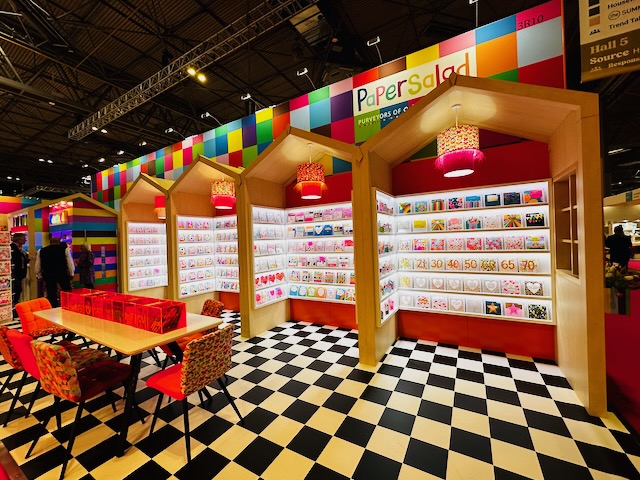
Spring Fair is far more diverse in product categories than we see in Australia. We bought from several suppliers not represented locally. We also picked up some visual merchandising as well as product ranging tips that I think we will be able to use in-store.
A big trend at the fair was British made. This was good to see. While cheaper offshore sourced products from bigger companies tended to have bigger stands, the British made message did stand out. Another noticeable trend was ethically copurced, sustainably sourced. These trends of product source and sustainable supply matter especially to Gen Alpha and Gen Z – important co-horts to our businesses.
I appreciate not everyone can get to overseas trade shows. If you can, go. If you can’t see if your marketing group has people who go and can share their insights.
Retail continues to evolve apace, especially in our channel. What we are and what we can sell continues to change and in this there are many opportunities. Getting offshore to see some ahead of us can be helpful, advantageous.
Fujifilm and Scribbler unite to offer card kiosk in Australia
I have been watching the roll out of the Scribbler branded card vending kiosk from Fujifilm in the UK for over a year. I first used the kiosk myself a year ago and I spoke with Fujifilm people at the Spring Fair in Birmingham in 2023.
Now, Fujifilm Australia have confirmed this is coming to Australia.
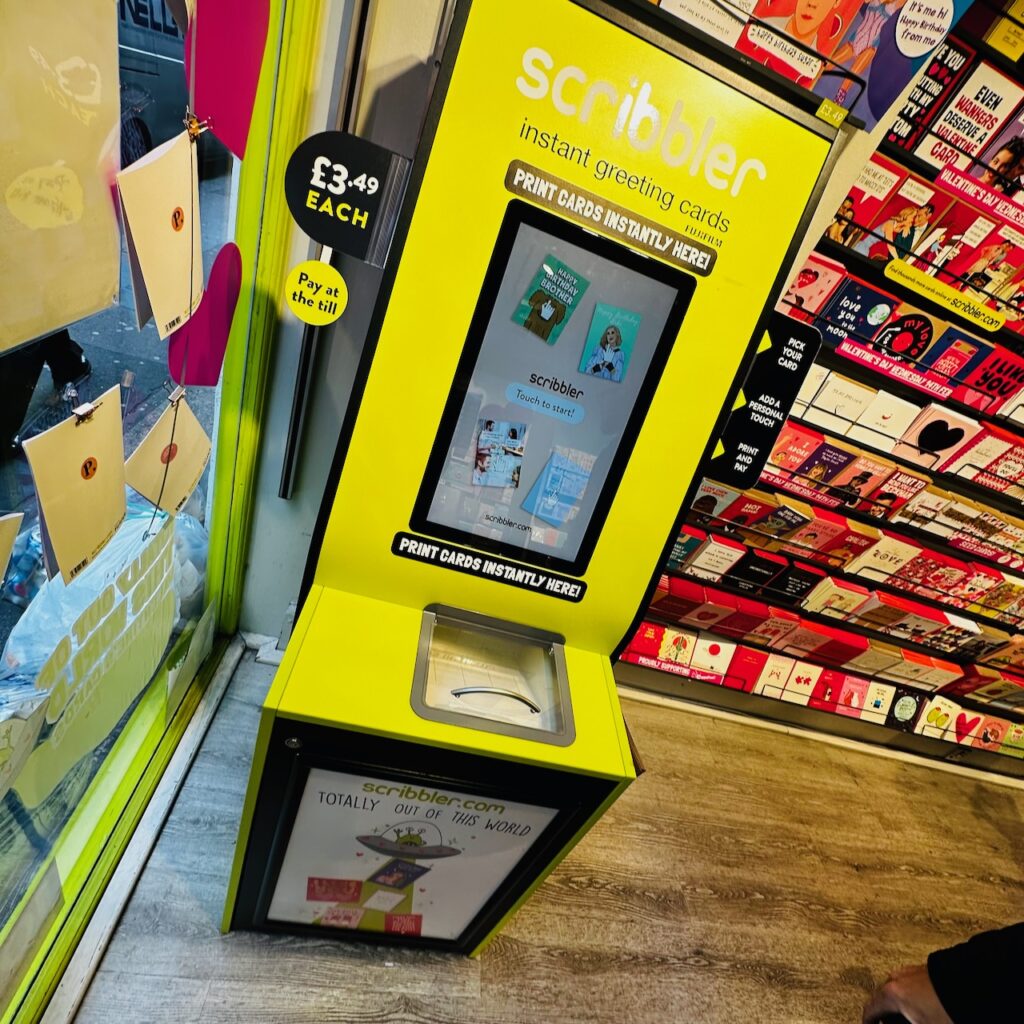
In the UK, in addition to placement in the popular Scribbler stores, I am told they have these kiosks placed in some university and non retail commercial locations.
The card printed is on bigger paper that is not as thick as a usual card. The selling feature is the range of cards that you may not find in-store.
The hardware costs around $14,000 in Australia and the initial kit of consumables costs around $1,200.
I don’t have visibility of the licence fee or wholesale cost of each card. They are yet to release integrated payment options for Australia.
It will be interesting to see the take up in Australia. In the UK, where I am at the moment, the Scribbler retail network footprint has enabled a broad roll out to educate shoppers. The company does na excellent job promoting the kiosk cards on the front window of its stores.
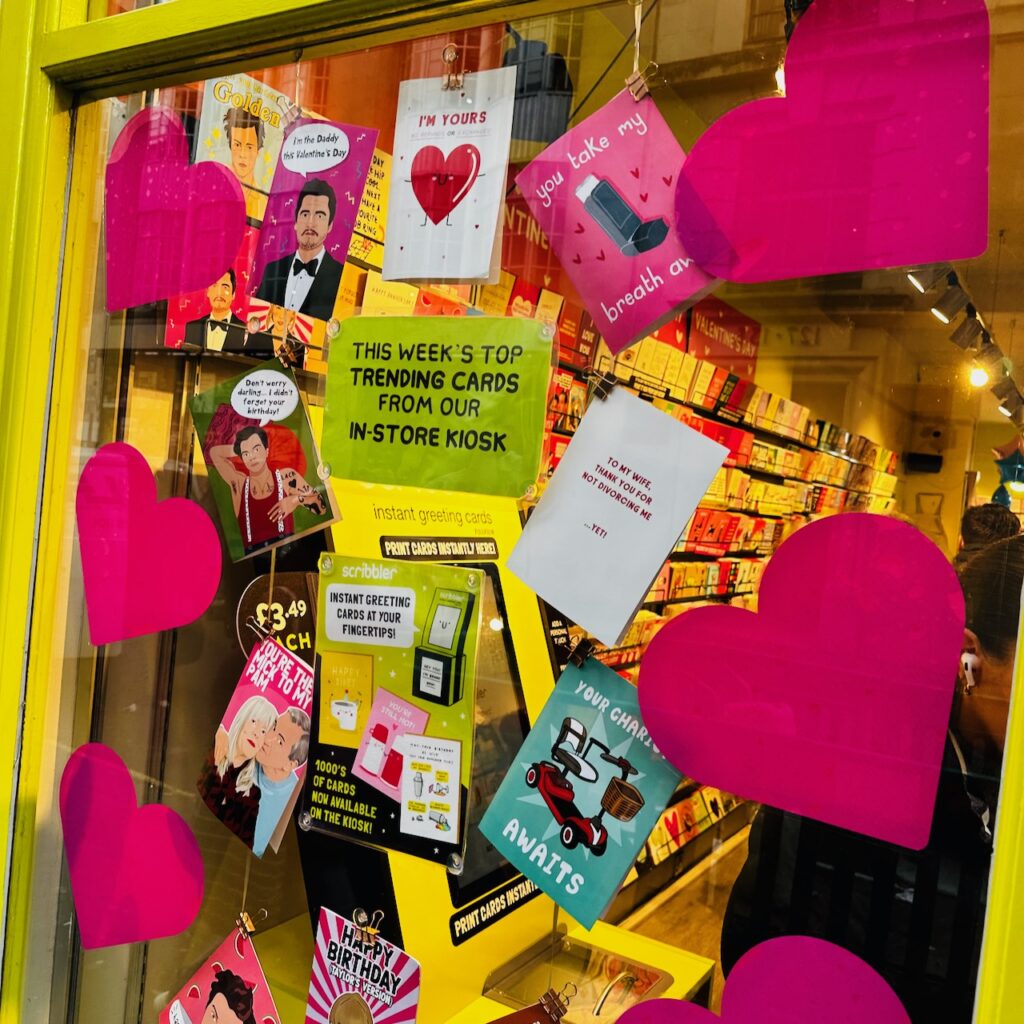
While time will tell if this is a disruptor in the creating card space, I do think that this is out in the market is good for cards. I also think it especially works with the Scribbler brand because of their 100% humour focus.
There are a few misses in my view:
- The paper stock is not ideal.
- The kiosks I have tried have had some cards that are also in the shop and the kiosk version does not feel as good.
- There is only one size currently from what I can tell.
- The shop has to be open to make the purchase in the Scribbler versions I have seen.
The plusses are:
- The kiosk may broaden card appeal.
- It can make more products available in less space.
- You can write on the card from a keyboard.
While I have no knowledge of specific plans in Australia and no connection whatsoever with this product, I expect we will start to hear more about it soon. I expect they’ll have a stand at one or more trade shows to launch.
The innovation by Scribbler and Fujifilm encourages those of us with greeting cards in our shops to innovate, to appeal to a broader range of people and to encourage people to buy more cards.
For more on the kiosk roll out, there was a story by Printweek and a launch announcement by Fujufilm.
AFL Record promotes newsagents
While I’d prefer them to list newsagents ahead of the supermarket giants, it is good to see the channel pitched. If only other publishers would do this.
On sale NOW. Your complete guide to @AFLFantasy including player rankings plus great pre-season content including our annual Movers & Shapers list. $9.95 at Coles, Woolies and newsagents or by visiting https://t.co/cDEpSM9qSg. @1116sen @AFLNation pic.twitter.com/0r9F6nHUYq
— AFL Record (@AFLrecord) February 7, 2024
Are trade shows less important to retailers and suppliers?
As trade shows kick off in Australia for 2024, it’s a good time to contemplate the value of these events for suppliers and retailers.
I’ve already been to three trade shows overseas this year and several suppliers at two of these shows have told me that the trade shows are not what they used to be, that they have not bounced back post-Covid.
One supplier I spoke to earlier this week told me they were ending their 15-year commitment to the UK Spring Fair trade show. The A$10,000 stand cost and associated costs of A$4,000 plus the 4 days away were not generating sufficient return. This supplier has found plenty of new customers in other places thanks to tech innovation and change in how, where and when retailers purchase inventory.
I think how we discover new products for our shops and how we buy them has fundamentally changed for many of us. Whereas in the past getting to trade shows was the must do thing in the year, it is no longer the case.
For sure, there are some retailers who rely on and will continue to rely on trade shows. I think those less likely to are those chasing newer products, those chasing retail innovation.
As a supplier to several retail channels, I can share that in my own case the percentage of the marketing budget committed to trade shows in 2024 will be barely 10% of what it was in 2019 and new customer business will be considerably more than 2019. We, like so many suppliers, have found other ways to discover and connect with new customers.
From a retailer perspective it means we need to be engaged with other places where we can discover new suppliers. There are new online platforms. Smart marketing groups are pitching products in different ways. We are able to easily source more products from overseas than before.
For the newsagency channel, the value of trade shows has changed in part because of changes to our product mix.
I am not saying that trade shows are dead. Rather, the engagement of some suppliers and retailers with them has changed. No longer, for example, do we need 3 or 4 days at a Gift Fair. It can be a 1 or 2 day thing. Smart suppliers use the trade shows to showcase and back this with tech that enables easy purchasing online.
Trade shows are expensive for suppliers and for retailers. The cost of space has continued to rise while the foot traffic attracted has been flat, in decline or, at the very least, less commercially valuable than in the past.
I think the changes we are seeing here are reflective of changes we are seeing elsewhere in business. Ultimately, the changes are good, healthy, as they help us see changes we can make.
I spent two days at the huge Spring Fair in Birmingham UK and I am grateful to have connected with several new suppliers and to have met some Australian suppliers to talk with them about what they found and what we found. It is in this type of networking that one of the values of trade shows remains.
Are trade shows less important to retailers and suppliers? For some, yes, while for others, no. It’s worth contemplating the return on the investment.
Owning and running a newsagency helps Tower Systems make better software for newsagents
I’m the owner of newsagency software company Tower Systems and back in 1996 I bought a newsagency business in Melbourne to gain first-hand experience running a newsagency. We think that has played a key role in our software being used in more newsagencies in Australia than all other software companies combined.
We still own and run newsagency businesses today. This video, shot Jan 13, 2024, features magazines at our newsXpress Malvern shop. It’s a magazine specialist business.
Magazines require unique management tools in software and our Tower Systems newsagency software has those. In addition to linking with magazine distributors, our newsagency management software plays a key role in helping newsagents to transition their businesses to be less reliant on print products.
Using our software, newsagency can also easily sell online through our Shopping, Big Commerce, WooCommerce and Magento integrations. Plus, we like to 3 awesome roster tools and a ton of payments platforms including Tyro, Linkly Cloud and Linkly. Oh, and we link direct to Xero, of course.
Owning and running a newsagency gives is a place where we can play with our software, experiment, innovate. It is part of our research and development experience as we test to see what is possible for newsagency businesses and other retailers. With AI and software more broadly playing a bigger role in evolving retail, being a software company with our own shops is an advantage we are grateful to have.
Newsagents benefit from the Tower Systems newsagency software in plenty of ways, including:
1. Exclusive smart greeting card reporting Embedded in our software is category / segment level reporting that newsagents are using to grow card sales 25% and more. That’s money in the bank.
2. You can bank on loyalty. Our fresh and successful approach to loyalty can help you drive a deeper basket and bring people back sooner.
3. Safe decisions make for a better P&L. From data feeds from suppliers through to Xero, we help you nurture data for the safe decisions.
4. Not every shopper will walk past your door. A seamless connection between your software and a beautiful website can help you sell to people you will never meet. We develop websites for newsagents.
5. Easily accessed personal service. A key reason 4 times more newsagents have chosen Tower than any other software is customer service. We are here for you, with you, every day.
6. Current software. Current technology. Fresh, current design.
Our newsagency software also helps newsagents run businesses that rely less on revenue from lottery product sales, which matters since they are transition more to a direct to consumer model online.
I am grateful for the trust newsagents show in Tower Systems and that this has helped the company to continue to grow and serve newsagents, and to help them navigate change.
ABC Radio: Is the Murdoch empire’s influence weakening?
Click here to listen to an interview from ABC Radio Melbourne with Sean Kelly on his article in Mother Jones. The article is a must-read for anyone interested in news reporting, media ownership and the political influence savagely wielded by the Murdoch engine for decades.

Read the whole article and listen to the interview before forming a view. They are both balanced.
Suppliers: please stop wasting retailer time
Some suppliers really do waste our time with bloated communications and out of date ordering practices. They don’t realise that each out of date practice gives retailers a reason to not order from them.
If suppliers do these things, they will get better attention:
- Stop sending bloated communications. Thoughtfully edit. Tell me what I need to know in order to make a decision. Back it with evidence.
- Have all ordering done either via digital forms or online – with a copy of each order sent by email back to the retailer for their records. Having to download, print and hand complete a PDF is ridiculous. It’s 2024.
- Have all contracts and agreements completed online via DocuSign or similar.
- Provide a digital product catalogue from which retailers can order in one-click.
- Provide electronic invoices.
- Produce easy access to professional product images.
- List your retail stockists on your website.
- If you use reps, ensure they make appointments first and stick to allotted time.
- Stop cold-calling.
Some of our oldest suppliers are the worst at these things. They waste too much time.
Looking at Valentine’s Day through different lenses
I’m grateful for the opportunity to look at a variety of retail in Dallas, Atlanta and New York last week on the back of the awesome Atlanta gift fair. While looking at different shops, I noticed a terrific variety of Valentine’s Day offerings:
Buy your Valentine’s Day card at your local newsagency and feel the love you want to give
Okay, you can buy a Valentine’s Day card online, you can even buy one from Hallmark online direct since they are competing with the retailers they supply. But buying a Valentine’s Day card online is not the same as buying in-store.
Giving a card to the one you love is sharing feelings. You want to pick up different cards, feel them, read them, and then you can choose the card that feels right to you.
Doing this, visiting your local newsagency, to find the card that feels right to you says more than a couple of clicks online that all too often send money offshore. Supporting local retailers shows you love local and appreciate local.
Feeling the card you choose matters because there is a big difference between the way cards feel. From the card stock itself (how thick it is, whether it is a smooth finish or rougher, whether it is made from recycled material) to the type of printing to any treatments that enhance the card, feeling different cards can certainly help with your card purchase selection. This is why shopping your local newsagency for a Valentine’s Day card really does matter.
Another choice you may make when buying a Valentine’s Day card is where it is made. Turn the card over and see where it is printed. Some websites make it very hard to do this, to see the back of the card.
If you want to choose a Valentine’s Day card that feels right to you, shopping local, especially at your local newsagency, gives you the best opportunity to compare feelings, to find the Valentine’s Day card that feels right to you.
Now, for the type of shop you buy your card from, please preference local and, especially, locally owned. While supermarkets have Valentine’s Day cards, they are unlikely to be locally owned. Shopping locally owned is a way of loving your local community, especially if you or anyone you know will ask local shops to support local community groups.
Valentine’s Day is an opportunity to connect with feelings. Finding the card the feels right is a terrific way to embrace the day and to embrace the relationship – through a tactile Valentine’s Day card.
Are we seeing AI generated news stories in Toowoomba, Gold Coast, Townsville, Rockhampton and Mackay?
Tobi Lotus of the ABC posted an excellent thread to Twitter (X) sharing compelling evidence:
Hey @ABCmediawatch @TheRealPBarry… I just got a sponsored ad on Instagram for this thing called the Toowoomba Minute. As a local ABC reporter in Toowoomba, I was confused as I had never heard of this organisation before. I went to the website and noticed a few things: pic.twitter.com/CZsVWtm0Pl
— Tobi Loftus (@tobiloftus) January 24, 2024
Be sure to read the entire thread on Twitter. I think use of AI in news coverage is problematic.
Why aren’t all Australian newsagents the same?
Each newsagency in Australia is locally owned and run. Right there, that is the key reason not all newsagents are the same, and it is a good reason. These are locally owned and run businesses, serving locals, reflecting local needs.
Back in the day you could count on every newsagency to sell stationery, magazines, newspapers, greeting cards, lottery tickets and cigarettes.
Today, there are some newsagents who do not sell magazines, some who do not sell newspapers, some who do not sell stationery, plenty who do not sell lottery products and plenty more ho do not sell cigarettes.
Some newsagents specialise in unique area such as secondhand goods, clothing, haberdashery, firearms, farm supplies, plants and plenty more.
There are no rules about what a newsagency business must sell to be regarded as a newsagency.
Decades ago, we’d be referred to as authorised as that’s what we were, an authorised newsagency. It has some weight to it, and plenty of obligation to the masters of the day, the newspaper publishers. Those days are gone. There are no authorised newsagencies.
Aussie newsagencies are not the same because times have changed. What sells has changed. Good retailers evolve with the changes, ideally ahead of the changes.
Even in the different newsagency banner groups there are considerable differences among businesses, which is odd for a couple that are more franchise like but not run the way plenty of franchises are run – in a cookie cutter way. You only have to walk in the shops to see the differences.
None of this is a bad thing because local retail is, after all, in service of locals and what the folks of Cairns will want is different to what the folks of Devonport will want. This is what local retail is about.
All Aussie newsagents aren’t the same because they are local.
My point is that each newsagency in Australia is different and should be considered that way. There is no common set of products and services we sell, no expectation you should have regarding any newsagency business in Australia, no expectation that products, prices and / or service would be the same in each. The difference between newsagency businesses is something to celebrate, just as every locally owned and run retail business is something to celebrate in the local community.
Why don’t all newsagents sell lotto?
It’s expected by many that all newsagents sell lotto, or lottery products. The thing is, not all of us do. Indeed, not all newsagents do what many expect all newsagents do do.
Each newsagency in Australia is locally owned and run.
Sometimes, these local retailers make choices outside of what you may expect for a newsagency. There at also situations where a supplier, like a lottery business, may decide a local newsagent is not the right fit for them because they already have another business near by, or for some other reason.
What Australians expect from their local newsagency has changed, and continues to change, to evolve, as the world evolved.
In terms of lotteries being in every local newsagency, while many newsagents do sell lottery products, there are many who do not. It would be wrong to judge them for this situation.
There is no shortage of lottery outlets in Australia. Plus, there is online, where, for example, it is easy to buy syndicate shares for syndicates put together and managed by local lottery retailers, including newsagents. Just because you can’t find a local shop right now does not mean you can’t support a local shop right now.
I’ve posed the question Why don’t all newsagents sell lotto? because I can see people asking this online. I suspect there has been a surge in the question because of the $150M Powerball jackpot.
The answer to Why don’t all newsagents sell lotto? is because either they choose not to or the lottery licence holder chooses to not allow them to.
I’ve chose to not sell lottery products in my own newsagencies for the last 11 years. I used to sell lottery products, from 1996 to 2013. It was good money. But there were many rules, restrictive rules, rules that got in the way offing the best retailer we could be, rules that got in the way of customer service.
Lotteries was not a good fit for me and I was not a good fit for them. But, there are many retailers who are a good fit and kudos to them.
My point is that each newsagency in Australia is different and should be considered that way. There is no common set of products and services we sell, no expectation you should have regarding any newsagency business in Australia, no expectation that products, prices and / or service would be the same in each. The difference between newsagency businesses is something to celebrate, just as every locally owned and run retail business is something to celebrate in the local community.
Well done to those behind the 50% discount off some magazines at Coles
There is a deal at Coles at the moment offering 50% off selected magazine titles, making Coles far more attractive for purchasing these titles than local newsagency businesses. Clearly, those behind the promotion preference the supermarket giant over local newsagency businesses.

While I am sure those behind the promotion will have their reasons, their justifications, this promotion is a boost for Coles and a slap in the face to our channel. Well done.
Generic social media posts are a waste of time for newsagents
There is no shortage or people and organisations offering retailers generic social media posts for your business page.
Generic social media posts are a waste of time. People quickly scroll on by as these generic posts are seen as noise to ignore. Being in someone’s news feed is of no value unless they value your content.
Generic may be what we see big businesses do with many stores across the country. But, they are all the same. No two newsagents are the same in Australia.
Posts about what many others have such as magazines, greeting cards, stationery and lottery products are likely to be of little value unless you post about them in a way that is unique, useful and entertaining. Generic posts are not this.
The best social media posts are those by you and about your business, posts that are unique, engaging, enjoyable and useful. Posts that share appreciated knowledge do well, as do posts that are informative re the local community and posts that are fun.
There is no shortcut for better social media posts. You must do the work, put in the time, your time, to make social media work for you.
While I understand that time is short and you may not feel sufficiently creative to invest time in social media. Give it a go. Find your voice.
Be yourself as being yourself is the only way to stand out, to be noticed on social media. Again, generic posts don’t cut it.
Given assumptions made about the local Aussie newsagency, how you engage on social media is vital in terms of how people will see your business. Take this as a challenge and an opportunity.
The distraction of a $150M lottery jackpot
Powerball jackpotting last night and setting up a $150M first prize draw for Thursday next week will be a distraction in plenty of shops over the next week, unfortunately.
While many will cheer the sales and commission boost, sustained value for retailers is a challenge given many who will visit a shop for the first time to buy a lottery ticket will not look around, get acquainted with the business and plan to return. That’s not the fault of the retailer. rather, it’s what happens with huge jackpots like this.
Given the selfish and tough rules from The Lott as to how the space they control can be used, retailers have few options to leverage greater value from the lottery jackpot shopper.
A chunk of hours allocated for the next week on back to school, Valentine’s Day and other better margin and more sustained opportunities will take a back seat in labour challenged shops.
The jackpot is good for most retailers for sure. I suspect, however, it will be of even more benefit for online sales.
If you have lotteries in your newsagency, I hope the week is huge and profitable for you.
Closing in 5 weeks: submissions to Senate Committee inquiry on on Bank closures in regional Australia
You have 5 weeks left to make a submission to the Senate inquiry into Bank closures in regional Australia.
While there are 500+ submissions already, more from those directly impacted won’t hurt. I know of plenty of newsagents impacted by bank branch closures. The more the committee members hear from people directly affected the better.
Here is the submission I lodged last year on behalf of newsXpress members:
SUBMISSION TO THE RURAL AND REGIONAL AFFAIRS AND TRANSPORT REFERENCES COMMITTEE BANK CLOSURES IN REGIONAL AUSTRALIA INQUIRY
This submission is on behalf of independently owned retail newsagency businesses that belong to the newsXpress marketing group.
More than 75% of newsXpress businesses are in regional Australia and most of these have been negatively impacted by bank closures.
Some of these businesses were, themselves, agents for banks, and have had the agency business taken from them, closed. In these businesses the impact has been even more considerable.
Many of the remaining 25% of our members, in city and suburban areas have also been impacted by bank branch closures.
The banks have been poor at communicating their closure decisions and vague in explaining reasons for closures.
While there has been less cash pass through the business in favor of electronic transactions in recent years, cash remains the biggest method of payment for goods and services sold by local newsXpress businesses. This is because of the type of products sold.
Bank branches are important for not only banking takings for but also for accessing banknote and coin change. With the average transaction value in our local retail businesses under $15.00, having available change is an important need.
newsXpress businesses impacted by bank closures have a higher cost of doing business as a result due to:
- The need to drive to another town to do the banking for the business. The drive time each way ranged from 30 minutes to close to 2 hours.
- Carrying more cash, especially smaller denomination notes and all denominations of coins, so the business does not run out between banking days.
- The need, for some, to switch banks because the usual bank for the business is now several hours away.
- Covering the cost of growing EFTPOS payments due to the fixed price nature of much of what is sold in a typical newsXpress business.
Bank branch closures have added on average for those newsXpress businesses impacted, additional operating costs of between $250.00 and $500.00 a week.
With many newsXpress businesses selling lottery products, the call on cash for the payment of prizes varies, and often cannot be adequately predicted.
In addition to the actual additional cost is additional pressure on the business owners since going to the bank no longer can be done in a few minutes. It needs to be scheduled, rostered for.
There is an emotional cost to bank branch closures, too, as there is more pressure on managing cash since the safety net of the local bank branch has been removed. This extends to the drive to the further away bank branch with cash takings from several days and worry about the safety of this compared to banking at the local branch across the road.
POSSIBLE SOLUTIONS
- A communal banking model. In a town where a branch is not viable, the banks could work together, maybe under a government overseen storefront, to offer banking services for all Australian banks.
- Mobile banking. Require the banks to provide regular access to their services through a mobile banking service that visits each impacted town.
- Easier agency access. If existing banking agencies could be enhanced to be agents for all banks this could open more local banking options.
- Reduced fees. Where banks withdraw, or have withdrawn, local bank branch services, require them to compensate business customers with significant fee reduction, to help them feel the cost of their decisions.
The newsXpress retail businesses impacted by local bank branch closures feel ignored by their banks, not listened to and unable to rely on a reasonable resolution.
They feel left to figure out what to do themselves so that the banks can maximise shareholder value.
While maximising shareholder value is the most important requirement for the board of any public company, banks often pitch themselves as being more community engaged and socially aware.
The closure of bank branches in regional Australia does not reflect care or concern for the regional Australian community.
Sincerely and on behalf of all local newsXpress member retail businesses,
Mark Fletcher
Managing Director
Mobile: 0418 321 338.
Email: mark@newsxpress.com.au
Online is the biggest growth opportunity for newsagents in 2024
The revenue opportunities of online present the biggest opportunities for newsagents in 2024 I think, regardless of whether you already have a website or not.
The latest benchmark for Aussie retail reports online as 10% of total business revenue.
In the Aussie newsagency channel, the average figure for those with a website is just under 5%. If you don’t have a website, what would a 5% bump in revenue feel like?
There are newsagents doing plenty more online.
The thing about online is that the opportunities are limitless. You are not constrained by your location or what you sell. You can mine success by leveraging your time and pursuing what people are searching for.
Through my Tower Systems software company and the newsXpress newsagency marketing group and through my own shops I have many years experience in online B2C sales.
If you can’t increase local physical shopper traffic, online is a smart move to improve business reach and profitability.
One newsXpress member launched a website with us last year and added $50,000 in good margin revenue in six months.
Another newsXpress member used their website to pitch an entirely new product category and found a profitable second business as a result, using existing labour and facilities in the shop.
Here are the top reasons why I think every retail business needs a website:
- Capture sales when you are closed. Typically, more than 50% of online purchases are then the brick and mortar business is closed.
- Engage when you are closed. Use chat to answer questions from anywhere, or you geek-out and have an AI chatbot do this.
- Reach people not currently shopping with you. Typically, 75% of sales are from people located nowhere near your shop.
- Have a second outlet for quitting stock.
- Have a place where you can experiment.
- Playing with a plan Bin case your shop finds itself in choppy waters.
- To learn. A website, especially your first website, teaches you so much: What people want. What they could pay. Haw awful some people are.
- To get you out of a rut. If you’ve been in your shop for ages and are mailing it in each day, a website could put a spring in your step.
- To make your shop more valuable. Having a website can make your shop more appealing when you decide to sell.
- To find a secondary brand. Could be the first step in a shop rebrand.
- To drive traffic to the shop. People will find products on your website and visit as a result, for sure.
- To give you another source of revenue that is completely unrelated to anything you do in your shop.
- To harvest email addresses. Email marketing from Shopify is a breeze.
Getting online can feel daunting. It can be expensive if you choose a web developer who does not understand your business and your needs. Too many of them push what they want on a business, often resulting in a failure of a website.
It’s important you know what you want and that you understand that a website is a hungry beast, which will soak up time and cash in pursuit of finding new shoppers. Get it right, and the payoff can be wonderful.
If you don’t have a website for your newsagency business, make it your goal for 2024. There are many opportunities out there for the taking, plenty you can pursue on a tight budget.