A blog on issues affecting Australia's newsagents, media and small business generally. More ...

Another example of dressing old fixtures

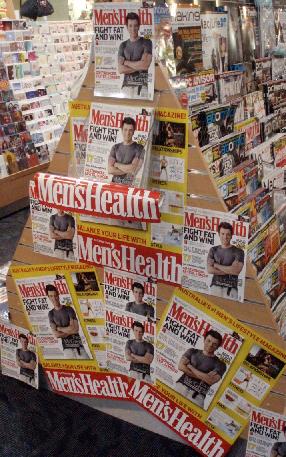
womens_health_frank1.jpgFurther to my last post, here is another aisle end from our newsagency in Frankston – promoting the May issue of  Women’s Health.  Again, the customer can purchase off of the display.  Also, the display covers the older magazine fixtures and gives the shop a brighter feel.  I appreciate that some will argue that we should be paid extra for this in-store work.  maybe we should.  In the meantime we will continue to boldly display marketing collateral for titles which we know will respond to such in-store effort.  Women’s Health is one such title.  Every time we create a bold in-store display, sales lift.

0 likes
magazines

Dressing the old magazine fixtures

belle_frankston.jpgThe magazine fixtures in our Frankston shop are the old (inflexible) style.  This does not stop them being dressed with collateral for brands we are happy to support.  The aisle end display for Belle is a good example.  Belle responds well to this type of display in terms of sales lift.  Note the acrylic fixture off of which customers can buy the title.  While I can appreciate that a more modern shop would struggle to support this older type of magazine display, it works a treat at Frankston.  Our annual magazine sales are close to $500,000 and year on year our decline in the current market is below average.  I put this down 100% to brilliant in-store merchandising by our Frankston team.

0 likes
magazines

Promoting the Zoo Weekly cash giveaway

zoo_weekly_cash.jpgWe have a column in front of our counter at Frankston which our creative team finds ways to dress.  This week, the column is dressed with collateral promoting Zoo Weekly and the $50,000 cash giveaway.  We started using the column for magazine promotions earlier this year and it is working well.

The acrylic unit off of which customers can purchase Zoo is essential for a display like this.

0 likes
magazines

Promoting Weight Watchers magazine

weight_watchers_frank.jpgWeight Watchers magazine moving to monthly is working in our newsagencies.  Our team at Frankston is pitching the latest issue at the counter.  They have done this before – the title performs well in this location next to our two busiest register points.  Indeed, I have seen seveal stores where Weight Watchers sells better from the counter than in the usual location.  I think this is due to the transition to monthy.  I’m happy to pitch it at the counter based on sales achieved.

0 likes
magazines

Is Playboy on the ropes?

While sales of adult magazines are increasing in my newsagencies, Playboy is in difficult waters internationally.

The current trend in my newsagencies is double digit growth for adult titles off a low base.  I have no explanation for this and it is contrary to what I would expect given the satisfaction available online without cost. Last night, I went back over the data for the January through March 2009 versus 2008 sales benchmark and found that, overall, Adult magazine sales are down 8% in newsagencies.

Playboy, on the other hand, is reporting growing losses.  ABC News in the US has a good wrap up of the current situation including an explanation of why the magazine itself is unlikely to fold.

0 likes
magazines

Dismissing the Kindle DX

I heard Gay Alcorn, editor of The Sunday Age, speaking with Jon Faine on 774 ABC radio in Melbourne yesterday as they guest in a weekly feature on media.  The part of the discussion which piqued my interest was Alcorn’s ignorance of the new Kindle DX.  Alcorn’s comments were at odds with reporting out of the US.  They lacked the objectivity of a good reporter.  She more or less dismissed the device.

The new Kindle from Amazon, which is not available in Australia, supports books, magazines and newspapers.  Indeed, it is well supported by several publishers.  The Kindle is certainly showing US publishers how to cut the distance between their journalists and consumers and thereby eliminate many distribution costs.

While it will not suit anyone working for a newspaper publisher to contemplate dramatic change to the business model of your employer, editors and journalists who agree to take part in discussion of any aspect of their work need to be open minded about the disruption of new devices like the Kindle.  Alcorn’s dismissiveness of the Kindle gave me reason to take less notice of her other views.

Imagine if the Kindle was here in Australia, now.  The newsagency business model would be turned on its ear.  We need to contemplate and prepare for such change.  Even it it does not unfold this way, the preparation will make us stronger and more focused on pursuing our own future.

One reason newsagents do not engage in contemplation of considerable change is the comments from publishers and journalists working for publishers that the changes in the US and elsewhere are not relevant to Australia.

0 likes
Media disruption

Overloaded with Photoshop magazines

photoshop_mags.JPGAustralian newsagents are overloaded Photoshop magazines.  We have more than the five titles in the photo through the course of the month at my Forest Hill shop.  I am confident that we could lose half the titles we receive and still achieve the same revenue from Photoshop related titles.  This oversupply is an example of why newsagents need to have control over the titles which gain access to our retail network. Until we centrally manage access to our retail network we will continue to receive more titles than we need.  While magazine range represents an important point of difference for us, it is unsustainable for 4,500 newsagents to provide the point of difference.

The code of conduct being discussed by magazine distributors will not address this issue.

0 likes
magazine distribution

Online women’s magazine launched

The Slate Group, an online publishing subsidiary of The Washington Post, has launched DoubleX, and online “magazine” for women and written by women.  Launches of new online titles like DoubleX continue apace.  This is another reason magazines are more affected this recession than previously – there is considerably more choice online.

0 likes
magazines

Promoting the nightshirt and bed socks with Dolly

fhn_dolly_jun09.JPGDolly magazine gains access to our prime retail counter promotional position this week with the free Davenport nightshirt and bedsocks which come with the title.  We think the gift speaks to the demographic and is unique enough to justify the prime space allocation for Dolly magazine.

Both Dolly and Girlfriend are chasing a tough demographic at the best of times.  Today’s challenges are evidenced by the regularity of tip-ons with each.

The other important and topical interest for this issue of Dolly is that it is retouch-free.  That is, photographs have not been retouched.  This is receiving good media coverage and should, therefore, be more top of mind to customers.

0 likes
magazines

Pitching magazines around newspapers

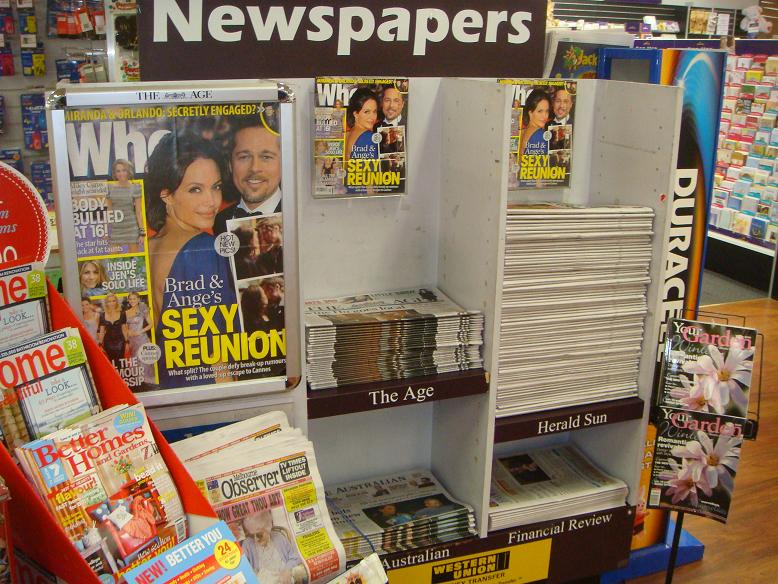
newspapers_mags_may09.JPGWe are pitching Home Beautiful, the Melbourne Observer, OK!, Time and Super Food Ideas around our newspapers this week.  We have cover the two biggest magazine publishers, support an independent newspaper, recycle an old magazine display unit and support two lower volume magazines – good use of newspaper space I’d say.  The OK! display is the Alpha magazine stand recycled.

0 likes
magazines

This blog facilitates publisher engagement

Following a discussion here about marketing collateral provided by publishers, Quentin Long, Managing Director of Australian Traveller has written to newsagents with news of a change which came out of comments published here.

Dear Newsagent Partner,

At Australian Traveller magazine we recognise that our newsagents are our most important business partners – the more you succeed, the more we can succeed. Therefore we are keen to support you in any way possible.

After much discussion with some of your colleagues in the industry and our distributor NDD, we have concluded that one way to assist you is to launch an Opt In Program of Merchandising.

You have been selected as an appropriate agent for this program based on the sales history of our magazine in your store.

This opt in merchandising simply means we will endeavour to supply you with posters and cover run ons as part of your magazine deliveries absolutely FREE.

here are no allocation implications whatsoever and you can opt out at any time.

You can then use these materials to create displays to appeal to your customers with a product they may have never considered.

We believe you are in the best position to determine whether this program would work for your store.

It is easy to opt in to this program.  Simply reply to this email with “YES” in the text and I will add you to the list.We will follow up in three issues time to see if the program has been helpful to you and if you would like to continue to be part of the service.

Thank you in advance.

Cheers
Quentin Long
Managing Director
Australian Traveller magazine

I hope newsagents take up this offer and opt in to receive the collateral and that, better still, they use this collateral to promote Australian Traveller.  A publisher directly engaging with us and responding to newsagent requests is something to cherish.

0 likes
magazines

Government misses tax break opportunity

Wayne Swan, Treasurer, and Craig Emerson, the Minister for Small Business tonight are making plenty of noise about the Government’s decision to increase the tax break for capital investment in small business – from 30% to 50% for items purchased prior to the end of this year.  Their joint press release outlines examples:

The increased Tax Break provides small businesses with an even greater incentive to invest in new capital items, such as computer hardware and business vehicles, and to make capital improvements to existing machinery and equipment.

While the 50% tax break is an incentive, I’d note that computer hardware without any form of software is no investment at all. 

If the government was serious about helping small business improve productivity they would have extended the temporary tax break to business software, especially Australian business software.

Smart business software, coupled with quality hardware and appropriate training could help a small business better cope with the challenges of today’s marketplace.  Indeed, good software could help small businesses more effectively compete.

This is a missed opportunity by the Federal Government.  I was the only newsagency representative to make a submission on this.  Unfortunately it did not achieve its goal.

Disclosure: I own Tower Systems, the software company serving more newsagents than any other – in excesss of 1,600 Australian newsagencies.

0 likes
Ugh!

Magazine numbers improving?

The performance of the Women’s Weeklies segment of magazines in newsagencies is a good indicator of overall health of the magazine category.  I am seeing sales data which indicates that the year on year decline of 10% and more which we experienced in January through March has slowed.  The more recent average year on year performance from a small group of stores over recent weeks has been 2%.  While the period is short and the dataset is small, I am watching to see is this is the trend.  I’d be interested in sales results from others.

The Women’s Weeklies segment includes key high volume titles: New Idea, Woman’s Day, Take 5, That’s Life, NW, Who, OK! and Famous.

0 likes
magazines

Early magazine returns can be a self fulfilling prophecy

I have seen data which proves that some newsagents are returning some titles too soon in the on-sale period, thus driving sales on a downward spiral.

Newsagents I have spoken with say that publishers overloading them drives early returns.

Newsagent business data shows a different story. It shows, in the cases I have seen, that some newsagents returned stock less than half way through the on-sale and that they could have expected to sell at least two thirds of the stock they returned. Their early returns stopped them achieving sales their data history indicated would have been made.  Early returns of these specific titles for which I have seen data cost these newsagents money.

Early returns based on gut feel can drive a self fulfilling prophecy. The newsagent thinks they are oversupplied and that stock will not sell based on what is on the shelf. Without reference to data they send the stock back early. They don’t have the stock to sell. Sales fall. Eventually the title dies in that newsagency.

Newsagents need to take care when early returning – make sure you are not losing sales. Check your sales history for a title before you make the move. Understand when in the sales cycle you sell a title before removing it early.  Smart publishers provide access to data which helps newsagents – such as the data I was shown recently. I’d gladly put newsagents in touch with publishers who are proactive in this area if they are concerned about early returns.

Of course, magazine distributors can reduce early returns by supplying to achieve a 60% or better sell through for all titles and not just the top sellers. Newsagents who see a poor performing title have been known to hit back at this by early returning other titles.  I can understand this from a cash management perspective.  Magazine distributors often have only themselves to blame in such situations.

The other way publishers can reduce early returns is to supply 30 day stock.  By this I mean, eliminate stock we are to hold for longer than 30 days.  Many longer on-sale products are supplied in larger quantities to satisfy the selflife.  Split the delivery and reduce the cash-flow strain on newsagents.  There will be fewer early returns as a result.

Early returning because you have no space is a different story, one for another day because that is an industry problem.

0 likes
magazine distribution

The expensive print model

Printing and physical distribution are expensive. For as long as they still print and mail publications, publishers should do it less frequently. Monthly magazines can be printed bimonthly; weekly magazines can be printed biweekly; newspapers can print on weekends only.

This quote is from an excellent article, How to Save Media by Jason Pontin and published at Technology Review from MIT.  This considered piece takes the reader through the challenges being faced by newspapers and magazines in the US – some of which we see here in Australia.  It pays particular attention to structural issues.  We need to be looking at structural issues in our businesses.  The structure of newspaper and magazine distribution, the structure within retail necessary to support the specific requirements for retailing the range of newspapers and magazines we carry.

It seems that every day there are more articles, reports and blog posts being published out of the US and Europe which challenge the foundations of the newsagency model here in Australia yet those who claim to lead newsagents remain silent on the issue of fundamental disruption of core products on which we have relied for traffic and revenue since the first newsagencies began in the 1800s. They either do not understand what is coming or are scared of upsetting suppliers and or newsagents by opening a discussion on structural change.

Personally, I see what is happening in the US and elsewhere as an excellent opportunity for my newsagencies and the channel more widely.  The opportunity is to seize the disruption of the model, build stronger businesses and exert more control over our own businesses than ever before.  Some of us are doing this already – but not enough.

0 likes
magazines

Craft magazines tracking 15% growth

craft_mags.jpgWe recently relocated our craft titles to a better position from where they will be seen by more customers. We also featured the category in a display out the front of our newsagency. The result is currently tracking at a 15% uplift in sales on a year on year basis – more than other magazine categories in the current period. We are very happy with these results.

Craft and hobby titles account for 12% of all of our magazine sales. This is our second most popular category.

0 likes
magazines

Oversupply of greeting cards

As part of helping a business recently I reviewed stock on hand for greeting cards.  One card company was found to have more than thirty pockets with ten or more cards per pocket.  In three cases, there were twelve cards.  In thirteen pockets there were  two designs with more than three cards for each of the two designs.  This is unconscionable behaviour by any measure.

The sales pattern in the store did not require pulling on anything more than one card in a pocket.  So, at worst case I would accept seven cards in a pocket.  Twelve cannot be justified.

The card audit indicated that oversupply by the card company in question was costing the business in excess of $8,000.

Newsagents need to closely monitor card company performance.  While the category is feel good, it has to be financially viable.  This means delivering a healthy stock turn, driving an equitable return on investment and return on floor space.

I’d note for the record that the card company involved was not John Sands or Hallmark.

0 likes
Greeting Cards

Moving stock sells stock

fhn_journals.JPGWe moved our social stationery recently and in the course of undertaking this work customers noticed items and purchased them on impulse.  Every retailer has stories like this.  Experiencing it is a reminder of the value of moving stock regularly, or working with stock on the shop floor – being more accessible to customers who want to ask questions but who will not ask over the counter.

The new location for our social stationery is working well, sales lifted immediately.  Customers buying a newspaper easily see this range as do many of our magazine customers – leveraging this circulation traffic is a key goal of the move.

By moving the social stationery, we have been able to create a better retail story in our cards and gifts department.

0 likes
retail

Promoting green magazines

green_magazines.JPGWe have moved four magazines which always feature articles on green environmentally friendly living to a new location and created better retail story. We have placed Green Living, Green Smart, ReNew and G Magazine in our home, living and garden magazine section.

While sales of green titles are not strong, I am certain that better placement, together and in a higher traffic location, will help – in our newsagencies at least.

Previously, these titles were in separate locations, where each is guided to be placed based on their Magazine Publishers of Australia segment codes. Bringing them together creates a more noticeable story. Placing them between Notebook, House and Garden, Better Homes and Gardens and Inside Out ensure they are browsed by more people.

If another title comes out with a green issue, we will place it with these magazines. We will also play this the display in the photo to visually frame these green titles, so they stand out more.

I noticed a report at Environmental Leader over the weekend saying that environmentally-themed issues of US magazines are underperforming. My sense is that we will gain more traction from promoting the titles which are dedicated to these issues rather than infrequent special issues.  Hence our moving of the four titled mentioned to a better location.

NOTE TO MAGAZINE PUBLISHERS: This post highlights a key benefit of the newsagency channel.  We can create opportunities like this – around a new retail segment placed in a high-traffic location – from which various publishers stand to benefit.  Try and negotiate this with a supermarket or petrol outlet.  They will not do it unless you do the work.  Newsagents are your best friends if you want to innovate.  Try working together as publishers and engaging with newsagents.

0 likes
Environment

New Idea TV show

B&T has reported that the Seven Network has produced a pilot for a new daily TV series in association with New Idea.  From a magazine sales perspective, the Better Homes and Gardens TV show / magazine marriage works a treat.

0 likes
magazines

The payment for content debate

Vanessa Thorpe has an excellent article at The Guardian website which covers the debate this week about whether news content should be free online.  The debate was reignited by Rupert Murdoch when he indicated, during the annoncement of a huge fall profits for his News Corp. business in the latest quarter, that it was time to charge for content.

“We are now in the midst of an epochal debate over the value of content and it is clear to many newspapers that the current model is malfunctioning,” Murdoch said. His volte-face followed background news that profits from News Corp newspapers were down year-on-year from $216m to $7m and that British newspaper advertising revenues were down 21%.

The upshot was, Murdoch concluded, that within a year the web would have utterly changed its financial model and his titles would be leading the pack. Earlier in the week, reports that the Guardian Media Group, the owner of this newspaper, was thinking along similar lines had ricocheted around the globe.

A pay wall to access news is an an old business approach to a new business problem.  Just as us newspaper and magzine vendors need to find a new modelforthe evolving circumstances, so too will publishers.

0 likes
Media disruption

Excellent Mother’s Day sales

fhn_mothersdays.jpgThe day before Mother’s Day is usually the busiest of the Mother’s Day season.  This is when Dad and the younger kids get out to buy cards and gifts for the first time in the season along with others who shop at the last minute.  All of the stores in which I have a financial stake experienced excellent trading.  We were ready for last minute shoppers.  Mother’s Day cards were the stand out.  Double digit growth in most situations.  Gifts were strong as well as magazines.

I spoke to newsagents in several states, city and rural, shopping centre and high street during the course of yesterday.  All reported excellent business.  Many had crowds even bigger than at the height of Christmas.  While only anecdotal, I’d expect the card companies to report an excellent Mother’s day 2009.

Newsagents own these seasons.  This is why we need to embrace them wholeheartedly.  Father’s Day is next.  It is another opportunity to re-present ourselves to infrequent visitors.

0 likes
Greeting Cards

The last minute display

fhn_tvweek.JPGWe did not receive our TV Week marketing collateral until late in the week, well after our prime display space was allocated.  To give the Logies edition coverage in-store, our team at Forest Hill created the display in the photo next to the Herald Sun, our top selling newspaper.  They built the display around a small wire stand.    It’s another example of found space – a place we can create a display where there would otherwise be none and without getting too much in the way of customer traffic.  I saw the display yesterday when in the shop for the first time in a few days and it looks stunning in person.

0 likes
magazines