A blog on issues affecting Australia's newsagents, media and small business generally. More ...

Newspapers

$1 a month for the Herald Sun digital subscription

$1 a month for the first 2 months for the Herald Sun. Then, $17 charged monthly for 3 months, after which it automatically renews to $34 monthly.

Compare the $1 a month to the cost of the dying print product. You can see their focus is on digital scrscribers.

Now, if you;re enticed by the $1 a month, in my experience, cancelling a News Corp subscription is time consuming with plenty of barriers to jump. So, beware!

3 likes
Newspapers

At what point are newspapers not profitable

Talking to a newsagent yesterday, more days than not they sell 2 copies of a daily newspaper. Allowing for labour, retail space and other costs, you have to wonder why bother with this level of loss making.

The numbers for retailers will vary based on retail occupancy cost. The question for everyone days to be: at what point is a newspaper not worth caring in the shop?

This is a critical strategic question that newsagents are grappling with.

The core economic challenge of low-velocity staples, like newspapers

The scenario outlined is a classic example of a product line’s viability erosion. When a product is sold, its profitability isn’t just the sticker price minus the wholesale cost. A more accurate calculation involves:

  1. Direct costs: The wholesale price of the newspaper.
  2. Allocated overhead:
    • Occupancy cost: The retail space is a business’s most valuable asset. That newspaper stand or shelf space occupies square footage that has a specific cost per day. If it’s in a prime location (like the front of the store), its opportunity cost is even higher.
    • Labour costs: This is often overlooked. It includes the time spent receiving the delivery, setting up the display, handling the transaction, and, critically for newspapers, managing the complex and time-consuming returns process for unsold copies.
    • Capital cost: The money used to purchase the stock (even for just a day) is capital that could be used elsewhere.

When sales volumes drop to such low levels, the gross profit from those two sales (which is typically minimal on newspapers) is almost certainly eclipsed by the daily allocated costs. This turns a traditional staple product into a consistent financial drain.

The strategic question: why bother?

If it’s a clear loss-maker, the decision to continue stocking the product moves from a purely financial one to a strategic one. Retailers often continue for several complex, and increasingly debatable, reasons:

  • As a “Destination Driver”: The primary historical justification. The newspaper was a “destination” product, an item that drove guaranteed daily foot traffic. The business model relied on this customer coming in for their paper and also purchasing a high-margin greeting card, a magazine, or a lottery ticket. The newspaper was a loss-leader that generated profitable, ancillary sales.
  • Customer habit and loyalty: A small-business retailer, especially one embedded in a local community, builds long-term relationships. There may be a small cohort of elderly or long-time customers who expect the paper. The retailer may choose to absorb the loss simply to retain the loyalty of these patrons, fearing that if they go elsewhere for their paper, they will also move their other, more profitable purchases.
  • Brand identity: For a business named “XYZ Newsagency,” there is a powerful brand-identity component. Removing newspapers can feel like a fundamental betrayal of the business’s name and purpose.

The tipping point: when is it not worth carrying?

This is the central question, and the answer is different for every retailer. The decision to delete a product line like newspapers is reached when the strategic justifications no longer outweigh the financial losses.

This tipping point often arrives when:

  1. The opportunity cost is quantified: The retailer calculates that the same physical space could be dedicated to a product with a better sales velocity and a higher margin (e.g., gifts, collectibles, coffee, and more), and the potential profit from that new line is greater than the total profit from the customers who buy the newspaper.
  2. The “Destination Driver” Fails: The retailer observes that the newspaper customer is no longer buying those ancillary products. They are simply buying the low-margin paper and leaving. At this point, the product is no longer driving traffic; it is simply serving traffic at a loss.
  3. Labour costs become untenable: The time spent managing the administrative burden of returns and distribution becomes so significant that it physically pulls staff away from more profitable activities, such as customer service, merchandising, or managing online sales.
  4. The customer base dwindles: Eventually, the small number of loyal customers who demand the product either moves away, stops purchasing, or transitions to digital, at which point the retailer is absorbing a loss for almost no tangible benefit.

The question for each retailer is no longer How do I sell more newspapers? but How much am I paying to keep this product line, and is the benefit it provides in foot traffic and loyalty still worth that price?

In more newsagencies than not these days newspapers are loss-making for the retailer.


Mark Fletcher founded newsagency software company Tower Systems and is the CEO of newsXpress, a marketing group serving innovative newsagents keen to evolve their businesses for a bright future. You can reach him on mark@newsxpress.com.au or 0418 321 338.

13 likes
newsagency of the future

Has the pace of decline of over the counter newspaper sales increased in 2025?

The data I’ve seen from a range of Australian newsagencies suggests the answer is an unequivocal yes: the pace of decline of over the counter newspaper sales increased in 2025. While the dataset is small, it points to an accelerated decline in 2025, a trend that should be an urgent wake-up call for every newsagent. And, it’s not as if this is the first such wake-up call for Aussie newsagents.

Looking at data from several capital city newsagencies, unit sales of newspapers are down a staggering 13% year-on-year so far in 2025. That is a significant increase in the rate of decline compared to previous years.

Data Don’t Lie: Newspapers vs. Magazines

(Note: data data is technically the plural of the Latin word datum)

To understand how serious the situation is, we need to compare it to other categories. In the same businesses I’ve analysed, magazine unit sales have declined at the same pace or even slower than in previous years.

In one newsagency, while newspaper sales have declines by 13.5% this year, magazine unit sales are down  7.9%. If I remove sales spikes from that data, the magazine decline drops to under 7%. The gap between the newspaper crisis and the magazine slowdown is stark.

The situation for international newspapers is even more dire, with a decline of over 50%. While this could be a data categorisation issue, it more likely signals that these titles are in the most serious trouble of all.

From Profit Centre to Community Service

For generations, newspapers drove our businesses. They created valuable, reliable foot traffic. Today, that is no longer the case.

The gross profit contribution from newspapers now rarely covers the labour, space, and administrative costs of carrying them. For many, it has become a community service rather than a commercial imperative. Any newsagent still relying on newspapers for either their business purpose or their revenue needs to urgently reconsider that position.

Your Action Plan: Making Business-First Decisions

While offering newspapers may feel like a community obligation, we are businesspeople who must make commercial decisions. The newspaper publishers are theirs, you can see it in the products they give us to sell, where genuine news can often be hard to find.

It’s time to reflect this new reality in your own business.

  1. Relocate Your Newspapers: Move newspapers to a low-cost position in the shop, away from the prime real estate at the front door and counter.
  2. Minimise Your Costs: Streamline every process for managing newspapers. Handle returns, ordering, and merchandising in the most time-efficient and least costly way possible.
  3. Stop External Promotion: Cease any active promotion of newspapers outside your business. Your marketing dollars and efforts are better spent elsewhere.
  4. Re-evaluate Your Signage: Reconsider any “Newspaper” brand signs on your shopfront. They may be creating customer expectations that no longer align with the future of your business.
  5. Set Your Exit Point: For every title, determine the point at which it is no longer viable for you to carry it. Be prepared to make that call.

The Writing is on the Wall

It is only a matter of time before a major Australian capital city daily stops being published seven days a week. We’ve seen this movie before. Back in 2009, the Seattle Post-Intelligencer moved to a digital-only model. While the move was challenging, the title survived and exists today: SeattlePI.

The print medium is challenged, but the shift is bigger than that. How, when, and why we consume content, including news, has fundamentally changed. Our businesses, originally created for the distribution of news, are at the heart of these changes.

Newspapers are far less important to our businesses than ever before. It’s time our business decisions reflected that.

Our future is not news.

Our future, your future, is 100% yours to set, without the boundaries of legacy media. But that’s a topic for another day, including a discussion around what to call your business. Watch out, I’ll have something more on this very soon.


Mark Fletcher founded newsagency software company Tower Systems and is the CEO of newsXpress, a marketing group serving innovative newsagents keen to evolve their businesses for a bright future. You can reach him on mark@newsxpress.com.au or 0418 321 338.

19 likes
newsagency of the future

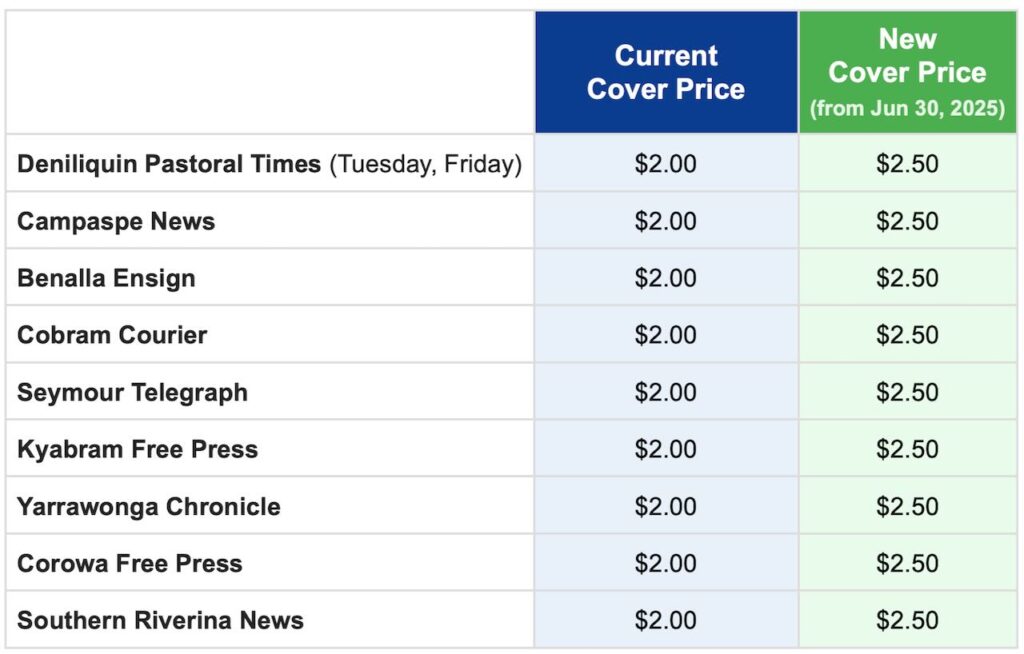
Significant price increase for McPherson Group newspapers

Wow, the prices rise announced by the McPherson Media Group for its newspapers are considerable. These take effect from June 30.

It will be interesting to see if this 25% increase impacts unit sales.

On the 25% increase: while each cost point of print newspaper production has increased, I suspect it’s the physical distribution cost that has gone up the most. certainly this is what we are seeing elsewhere in retail – the cost of physically moving products is much higher today than a year ago.

6 likes
Newspapers

Are print newspapers worth it any more?

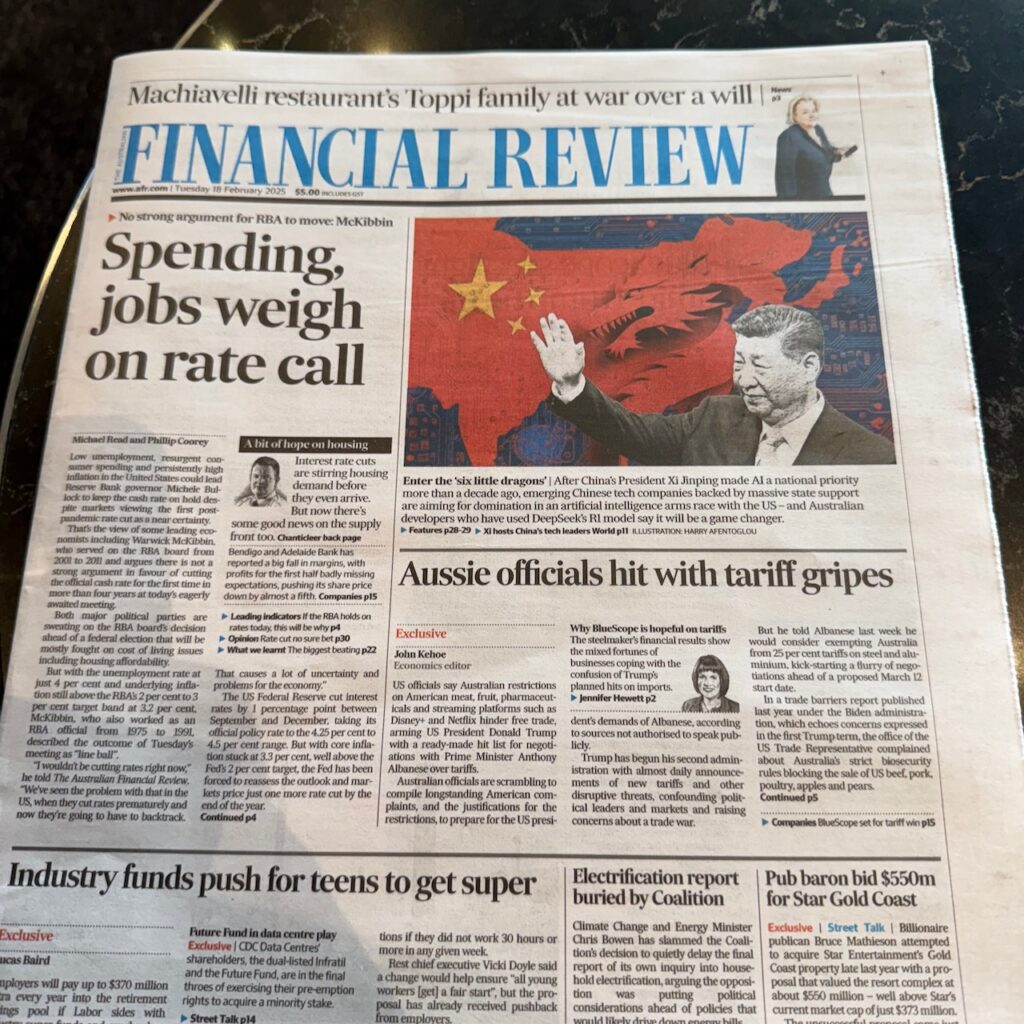
I read the print edition  Australian Financial Review cover to cover yesterday for the first time in years, for free, in a hotel lounge in Sydney.

32 pages.

No breaking news – how can there be anyway with such an old production method.

Plenty of PR dressed as analysis.

Odd news too, like the story about the Toppi family and Machiavelli restaurant.

Even the business gossip was tired.

It wasn’t bad, it just wasn’t good, or valuable – that’s it, it wasn’t valuable.

At the end I had no feeling of $5 of value from the experience. Again, not that I paid for it.

While it’s unfair to consider the future of daily capital city and national newspapers on this one experience, it is the only such recent experience I have.

Back in the day, I’d read newspapers for news – that is, new information that has been rigorously research and fact-checked. I never read newspapers to confirm my own beliefs or biases. I wanted news, discovery.

The AFR yesterday did not provide news. Stories felt more like reinforcement of held views of the intended audience. The whole product felt like a platform of promotion, to a niche audience. I am surprised some people will pay $5 for it.

The AFR yesterday to me did not feel like a newspaper. On some pages it felt more like a lobbying pamphlet.

Certainly in newsagencies, for years, we have seen the value of newspapers to our businesses fade in terms of traffic and margin dollar generation. Those are reasons smart newsagents place newspapers in low cost space rather than the premium value front of store locations they once commanded.

A problem for us with newspapers is the costs of carrying them: retail space, labour in out of date handling practices dictated by the publishers and, theft.

I suspect many newsagents lose money on carrying newspapers.

Reading the AFR yesterday reminded me of the diminishing value of what was once a vital product category for our businesses. We have to be careful to manage the demise of newspapers in our businesses. Newspaper publishers have been doing this for years – making decisions to deliver a soft landing for when they eventually stop print editions. They put their business needs ahead of all else, we should look more critically at this for ourselves.

We know that print newspapers are dead.  The timing of the death of each will depend on the value of them to advertisers, readers and publishers.

There remain some good and valuable print newspapers out there I am sure. If my experience yesterday was anything to go by, the AFR is not one of them. Who am I to judge though – I don’t feel like I am their target audience.

12 likes
newsagency of the future

How newspapers used to be

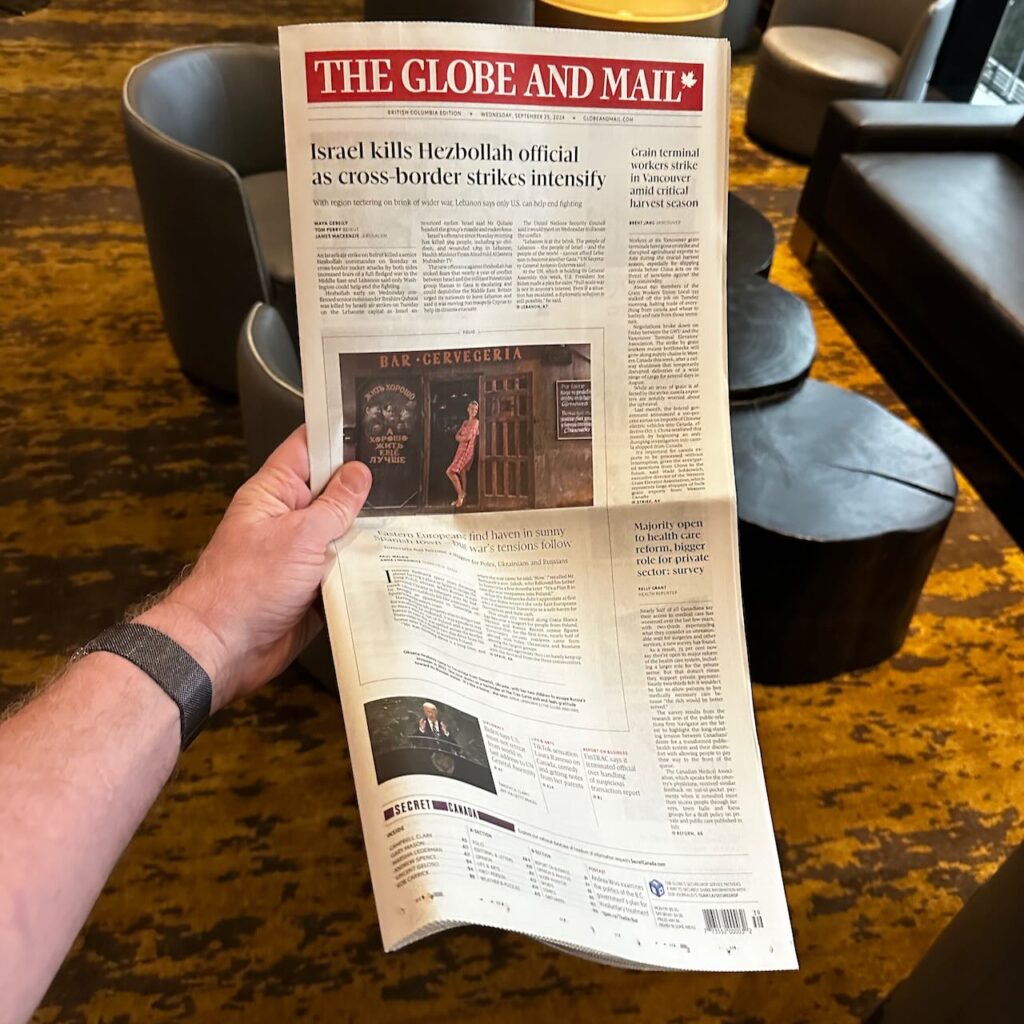
I am in Vancouver and enjoying reading The Globe and Mail. This is a newspaper how I remember it – compared to what we now see in Australia.

The Globe and Mail features actual news on the front cover and inside. There is little or no clickbait. No ads cluttering the front page either. It’s a narrow paper physically, 30.48cm wide. I like this format, Berliner I think it is called.

From WAN-IFRA I can see that The Globe and Mail has 300,000 subscribers, of which 210,000 are digital-only and 95,000 are print subscribers. Elsewhere I found out that print circulation is reportedly 65,000 copies a day.

It’s readily available in shops and hotels.

Here in Canada newspapers appear less engaged in politics. They report it for sure. What’s missing is the lobbying and agitation we see often in Australian newspapers.

6 likes
Newspapers

The shrinking value of newspapers in retail newsagencies

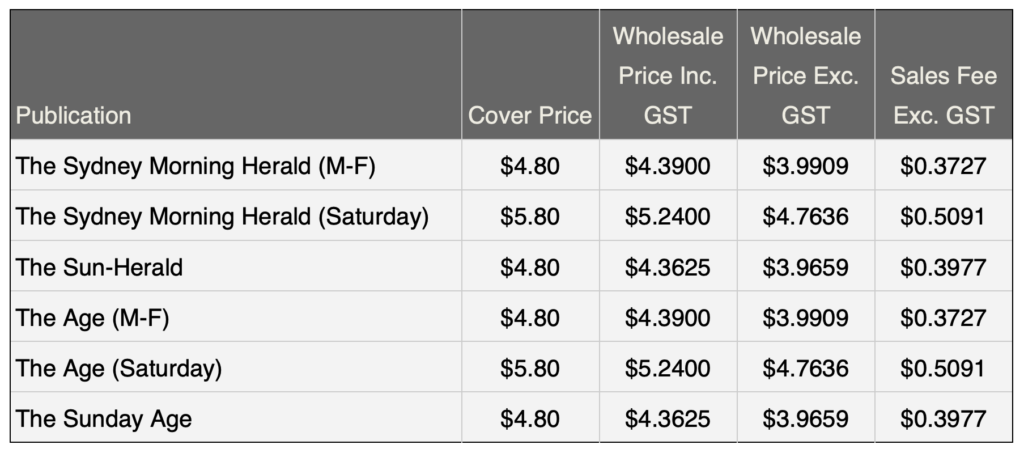
Nine Media has announced to newsagents price increases for its newspapers effective from August 26. At 10% (or less) gross profit per title, we need to wonder about the value of stocking these products. They are loss making in all but the newsagencies doing the biggest sales. We have to sell 10 copies of a paper to cover the cost of one being stolen and, yes, newspaper theft in newsagencies is a problem.

Years ago we would make 25% of the cover price. Today, as this table shows, we are at 10% or less.

In today’s cashless world, the cost is more with EFTPOS fees ranging from 1% to 1.5% of purchase price.

With 80% and more newspaper purchases for a newspaper alone, the basket value of the category is not there for us. And to publisher reps who may say that’s it’s on newsagents to leverage newspaper traffic, studies have shown that getting destination newspaper shoppers to purchase something else in the visit is next to impossible.

Just as newspaper publishers are managing their businesses for the ultimate exit from the print medium, so much newsagents. Smart newsagents have been working toward this inevitable day for many years.

13 likes
Newspapers

15 years

While Rupert is far more expert than me, I think 15 years is optimistic. You only have to look at what they publish today to see how removed they are from delivering access to news.

The timing of the demise of print newspapers is dependent on the value achieved by the advertisers who fund the medium. The Murdoch outlets are good at selling ad space. There has been a big shift in recent years demonstrating the focus on revenue over news.

6 likes
Newspapers

News Corp continues to fail newspaper home delivery subscribers with road-block customer service

Complaints about News Corp management of newspaper home deliver subscriptions to newsagents who stopped home delivery months and years ago continue. regulars here would have seen the comments by many subscribers.

From my own experience when I signed up for a subscription to The Australian and then sought to cancel after the initial period, the News Corp process is clearly structured to frustrate to a point that people give up. That is how it felt to me.

Subscribers ought be able to go to a website and cancel their subscription with one click. News Corp does not offer this service.

You have to call them. The first response after wanting to know why you want to cancel is to offer a deal. I’ve heard of people being offered an even better deal. The call process is layered with road blocks.

This is appalling customer service from News Corp in my opinion, and in my experience. For a company so invested in shouting at Australians and trying to tell us what to think, they appear disinterested in providing a good customer experience.

It’s as if the call centre mandate is to keep a subscriber at all costs – financial and emotional.

My advice for News Corp newspaper subscribers experiencing difficulties in cancelling their subscription because of road blocks by News Corp is to complain to your local office of consumer affairs and to email the ACCC. If you are owed a refund or the company has charged more than they should have in your opinion, and if you have the time, consider a claim to a small claims tribunal, like VCAT in Victoria. The more state and federal government agencies are made aware of what is happening here the better.

12 likes
Ethics

Over the counter newspaper sales down 8% year on year

Looking at data for a selection of newsagency businesses in the city and regionally, unit sales of newspapers over the counter declines 8% in January – May 2024 compared to the same period in 2023.

While the data pool is small, the businesses have been a good indicator for years as to what is happening nationally.

It’s challenging to compare with publisher data because they don’t report audited sales the way they used to.

I mention it today to encourage newsagents to look at the data for their businesses, to calculate the gross profit value of newspapers and consider this in the context of the value of the space they occupy and the labour involved. If your newspapers are in a higher valued position in-store and the grow profit contribution is declining, move them to a less valuable location and use the freed space for higher margin products you are likely to gain a sales boost from given a better position.

Where you place product in your shop should be based on a the financial value to you. That’s why I say look at your data.

In one shop I was working with recently, they moved newspapers from prime position front of store to a lower cost location part way down the shop. There was no negative imact to newspaper sales from the move. They are making more money fro the space newspapers used to occupy.

10 likes
Newspapers

The Australian Financial Review all but out of Western Australia

This note has been sent to newsagents by Nine Media:

Supply of The Australian Financial Review

Nine has been notified of a substantial increase to printing costs of copies of The Australian Financial Review (the AFR) supplied to newsagents, distributors and sub-agents in Western Australia.

As a result of these increased costs, the supply and distribution of print copies of the AFR in Western Australia is no longer commercially viable.

Our existing print distribution arrangements for the AFR to newsagents, distributors and sub-agents in Western Australia will cease effective close of business on Wednesday, 22 May 2024. Your business has been identified as currently receiving print copies of the AFR and as a result, you will no longer receive these print copies effective close of business on Wednesday, 22 May 2024.

We will be contacting all AFR subscribers to advise them that home and office delivery of print copies of the AFR will no longer be possible after that date.

We kindly request that you make a copy of this notice available to any sub-agents or other retail outlets supplied and billed by you (i.e. those retailers who do not have a direct account with Nine).

Separately, Nine will distribute retail copies of The Australian Financial Review Magazine and the quarterly Fin! magazine in metropolitan Perth from the end of the month. If you are interested in receiving supply of any other publications that Nine may determine is commercially viable to distribute within Western Australia from time to time, please notify us of your interest via email at circsales@nine.com.au

We thank you for your past support of The Australian Financial Review. If you have any questions in relation to this matter, please contact us via email at newsagencycontracts@nine.com.au.

It’s an odd move by Seven West. Maybe they think this may help with sales of their local paper or boost interest in their new online after nine product. It will be interesting to watch how it plays out.

Aussie daily newspapers have hung on to print editions for longer than in plenty of other parts of the world. While I am no expert, I suspect that somewhere around half the daily newspapers in Australia are not profitable on the majority of days they publish. They are thin and loaded with ads from a small group of businesses.

I suspect that if were see a capital city daily close it’s print edition, several others would follow quite quickly.

There is no upside for print newspapers. Publishers have repurposed the print product to rely far less on news and to give advertisers more control of their once respected mastheads. Smart newsagents long ago adjusted their businesses to not rely on them.

Newspapers themselves are inefficient products with more than 75% of newspaper purchases in a newsagency being a newspaper and nothing else. This basket inefficiency has been a challenge for our channel for decades. Back in the 1990s the inefficiency percentage was 85% or more. It has dropped a little, not enough though and this is despite extraordinary effort to engage with newspaper shoppers to try and sell other better margin products.

In their treatment of newsagents over recent years, newspaper publishers have shown little respect. Our margin is down, which makes newspapers less valuable. It’s at a point that there are newsagents in our channel who no longer sell newspapers.

What’s happening in Western Australia with The Australian Financial Review is interesting yet far from the bigger story about newspapers that is playing out nationally.

4 likes
Newspaper distribution

Why is Nine media paying WA newsagents a lower percentage to sell The Australian Financial Review? And, at what point is the paltry margin NOT worth it?

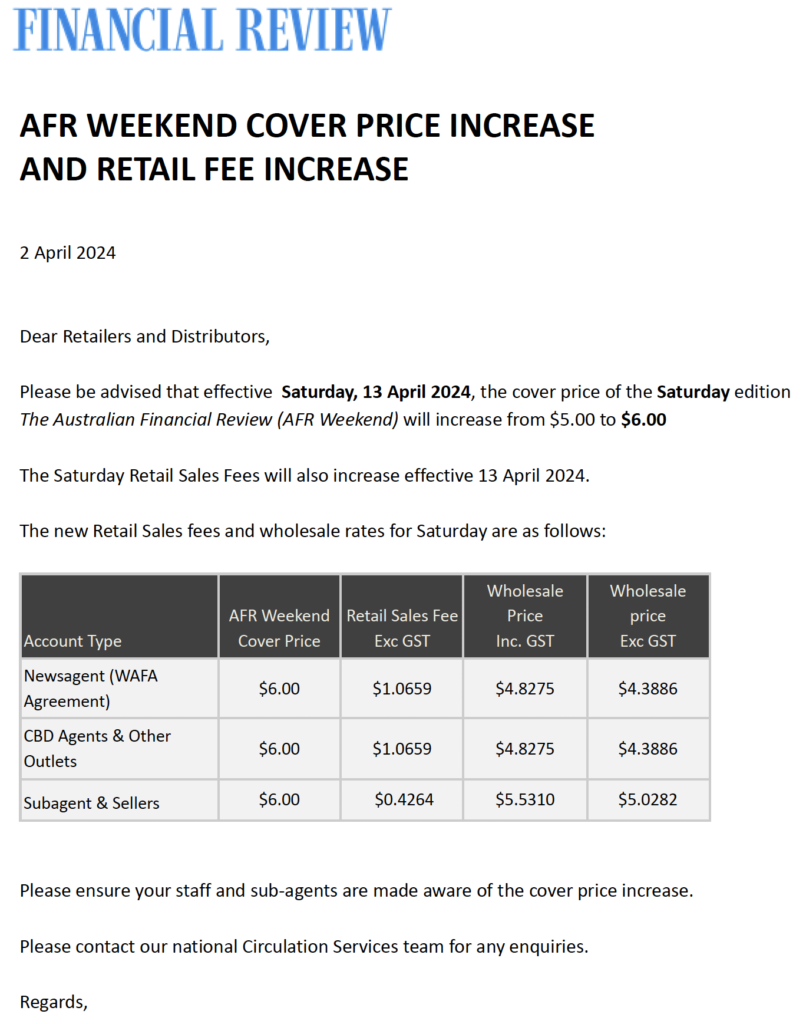
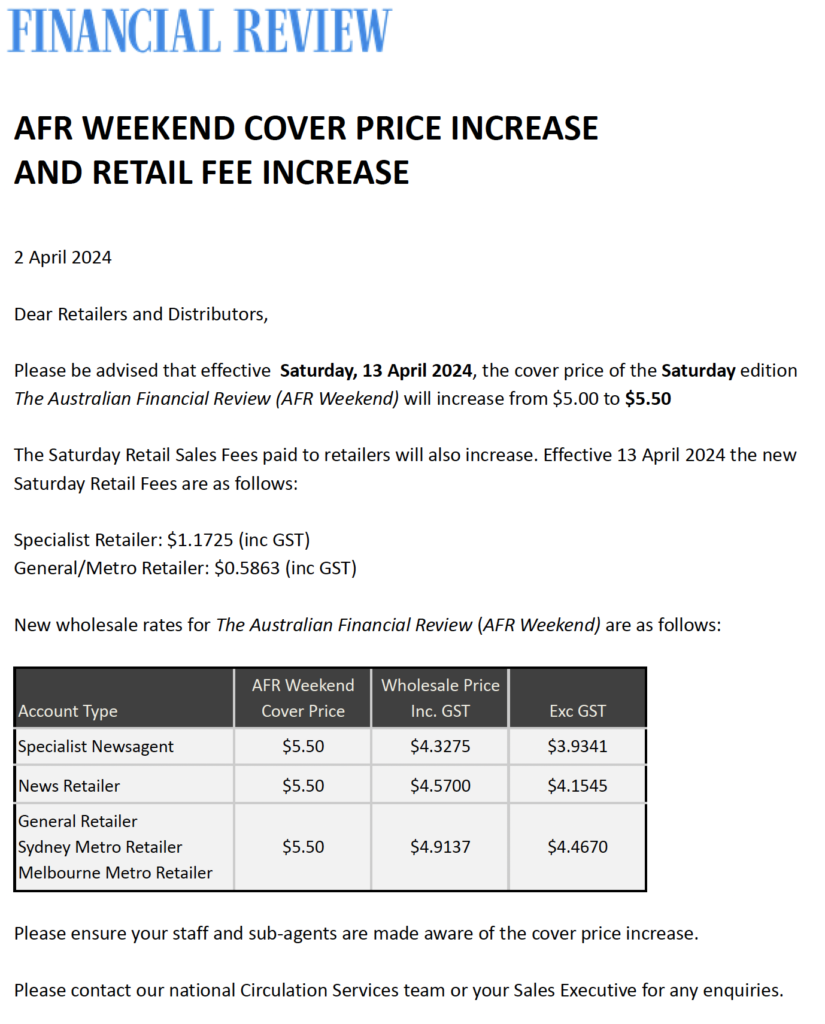
Retail newsagents in Western Australia make 7.8% gross profit from selling the weekend edition of The Australian Financial Review while east coast retail newsagents make 10.6% for the same product. Here is the evidence. First up, the WA notice:

Now, the east coast notice:

Both of these notes come from Paul Munro, Director, Circulation Sales & Operations Nine Publishing, who is based in Sydney.

They value Western Australian retail newsagents less than their east coast counterparts, yet labour and occupancy costs in WA are the same as elsewhere.

Then there is the broader question of whether stocking the AFR is worth it to any retail newsagent. By the time you unpack the product, count what you have received, place it in-store and do other requisite overhead, 10% does not cover costs and that does not even account for theft, for which the retailer is responsible.

Maybe the newsagents who no longer sell newspapers have made the right move.

In the past when I have raised margin with newspaper and magazine publishers and mentioned supermarkets, they have said supermarkets get the same margin. When challenges, a couple have mentioned that there are other fees paid to supermarkets for stand placement or, back in the day, guaranteed checkout pocket placement. I am not sure if Nine Media has any such arrangement in place for supermarkets.

An adult retail employee working in a newsagency on a Saturday is paid $36 an hour or more. Assuming trading 7 days a week and considering average occupancy costs outside of a shopping centre, the daily rent and related costs for an average size retail newsagency will bet $250.00 or more. So in just these two cost points, a retail newsagency needs to cover $538.00 in costs. Based on the industry average GP% range of 28% – 32%, they need sales of $1,793 to cover costs.

But that’s not accurate as it’s based on average GP%. A product like the AFR on the weekend drags the average GP down. Newsagents selling it rely on better margin products, like cards that achieve 60% GP and more, and gifts that perform similarly, to subsidise poor margin products, like newspapers and magazines.

Publishers created the Australian newsagency channel in the 1800s. They controlled us for decades. Then, they abandoned us. Today, they disrespect us with paltry margins. They make matters worse with out of date practices that waste time and make us uncompetitive.

They price their product as if it has other benefits, like attracting shoppers. That may have been the case ten or more years ago, not today in 2024. Newspapers are offered as a service, a loss making service.

I suspect publishers treat newsagents this way because they know newsagents will not do anything about the situation.

26 likes
Newspaper distribution

Are we seeing AI generated news stories in Toowoomba, Gold Coast, Townsville, Rockhampton and Mackay?

Tobi Lotus of the ABC posted an excellent thread to Twitter (X) sharing compelling evidence:

Be sure to read the entire thread on Twitter. I think use of AI in news coverage is problematic.

4 likes
Ethics

It’s always worth celebrating the launch of a new newspaper, especially a genuinely independent one

In the UK this week, the Byline Times was released.

Here in Australia, we have The Saturday Paper, genuinely independent and well established. Online, we he have some excellent options.

4 likes
Newspapers

Herald Sun cartoon turns off customers

A couple of Herald Sun readers contacted me yesterday saying they will no longer purchase the paper following its publication of the cartoon featuring a naked, pixelated but naked, Premier of Victoria, Jacinta Allen.

I’d been on the road all day and was not across the story. I checked out coverage at the ABC, Nine Media and The Guardian.

The readers contacted me because they wanted to speak to someone. I couldn’t;t help them, of course. But I listened to their anger.

Having looked at the cartoon and read reports in other outlets, I like this from The Guardian:

Victoria’s inaugural Public Sector Gender Equality commissioner, Niki Vincent, said she found the cartoon tiresome and suggested it used sexism.

“Often we see women leaders with their bodies focused on, their clothing focused on,” Vincent told ABC Radio Melbourne.

“So this is another example of how to make fun of a woman leader using their body.”

It seems to me that News Corp courts anger, not only in its shrill headlines but also in deliberately provocative cartoon content. It’s moved a long way from being a trustworthy newspaper and a platform of enjoyable content.

14 likes
Newspapers

Confusion for newspaper retailers as News Corp increases Saturday newspapers 14.3% with late advice

News Corp’s decision to increase the cover price metro Saturday newspapers 14.3% didn’t;t make it to the electronic files that set the price of the newspapers for retailers, like newsagents.

This meant manual work Saturday to sell at the connect price and accounting adjustments for wrong electronic invoices.

It all it took up a chunk of time.

If only those at News responsible understood the time cost of this.

2 likes
Newspapers

Scathing reviews for Herald Sun subscription management

News Corp’s management of subscriptions for the Herald Sun has received scathing reviews at the ProductReview.com.au website.

From 102 reviews, the company is rated at 1.1 out of a possible 5 stars.

While some reviews talk about the complex and cumbersome steps needed to cancel a subscription, others talk about home delivery, including this one that may interest newsagents:

Been receiving news paper HOME DELIVERY for over 12 years from local new agency never a problem. Once News Corp Australia took over on the 4th July WE HAVE NEVER RECEIVED A PAPER SINCE it’s now NOVEMBER. Contacted them many, many times, emailed, repeatedly asked the same questions and no follow up. NOW BEEN SENT AN INVOICE emailed and called to say NOT PAYING AS I HAVEN’T RECEIVED THE SERVICE NOW I HAVE BEEN SUSPENDED FOR NOT PAYINIG FOR A SERVICE THEY HAVE NEVER FULLFILLED. Apparently they DO NOT DELIVER OUT HERE (Yarra Valley) Very disappointed.

This reviewer is not alone in having such experiences following the takeover of newspaper home delivery by News Corp from local newsagents.

For a company that likes telling others how to think and what to do, you;d think they could benefit from investing some of that arrogance internally.

15 likes
Newspapers

Magazines vs. newspapers at the airport

It’s interesting seeing how magazine publishers pitch at the airport compared to newspaper publishers. My understanding is that the publisher subsidises the price offer for magazines. It’s telling that the newspaper companies do not do that for what is a pretty captive market. There was a time they’d give away papers at every departure gate.

This what I saw at Melbourne airport today.

1 likes
Newspapers