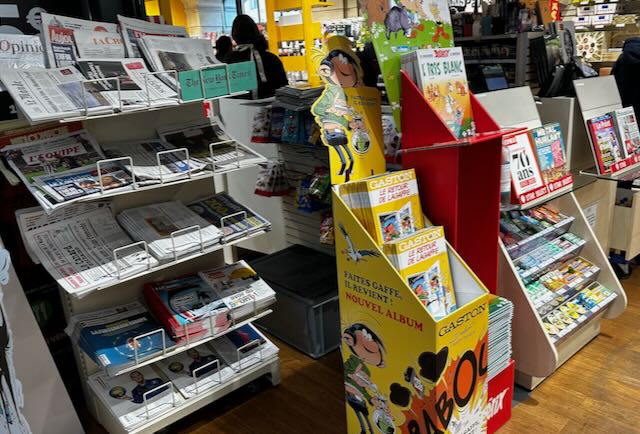
It’s always great to see an Aussie on the cover of Rolling Stone magazine
This is an excellent issue to pitch on social media.

This is an excellent issue to pitch on social media.

What they do with cards is clever. More newsagents need to do this.
Quoted in the nationally distributed mediaweek email and online Monday, Andrew Cook is quoted speaking about our channel:
“A lot of people who are under 30 don’t often walk into a newsagent; they often don’t buy a tangible printed product”
I wrote to senior contacts at Are Media Monday within minutes of the email being circulated:
Maybe Andrew Cook should find out who actually shops in newsagencies.
Young people are buying cards, journals and social stationery in numbers not seen in decades. They are also consumers of pop culture, which newsagents dominate.
It is disappointing to see Are Media’s Director of Sales throw our channel under the bus.
I’ve not received a response.
I’d love to see the data on which Cook based his comments. Newsagents I have spoken with over the last couple of days disagree with his assessment.
Maybe it’s the magazines that Are Media publishers that inform Cook’s view because, for sure, folks under 30 are not likely to buy Who, New Idea, Woman’s Day, AWW, Take 5, That’s Life and others in their stable.
Some card companies started focussing more on younger card shoppers years ago. We see under 30s buying cards in our shops. Some stationery manufacturers have created products for this younger age once they realised that journaling is more popular than ever.
Then, there is pop culture. That space is huge and plenty of us do well in it. And, when I talk about pop culture, there is the usual licensed products you could think of, and then there are subsets, like Japanese stationery, which is huge in parts of Australia.
The newsagency shingle is meaningless today because of the extent of diversity of businesses in our channel.
Sure there are some newsagency businesses living in the past and relying on lottery products and an old looking shop for daily trade. There are many more, however, that have transitioned into vibrant fun retail experiences, shops having terrific success at attracting younger shoppers.
But let’s get back to Are Media director of sales Andrew Cook. What was he thinking? Why did he make a point of singling out the Aussie newsagency channel for the negative focus of what he said? Has he done this to create distance between the Are Media business and the newsagency channel?
I expect at some point some people from Are Media will tell newsagents how important they are, how much they appreciate them and to not dwell on Andrew Cook’s comments. Maybe they will say he was taken out of context. 48 hours later is a bit late to walk back what was so widely circulated.
Maybe Are Media does feel disconnected from the newsagency channel. I suspect they have less space in newsagencies with their magazines than they had a few years ago. Newsagents continue to reduce space allocated to magazines. It happens when you have a low margin product sent through an archaic magazine distribution system that rarely listens to retailers as to what could work in their businesses.
One of my shops does well over $400,000 a year in magazines. The category is important to us. Our magazine sales continue to increase. August 2023 was up 9% on August 2022. And, yes, we have user 30s buying some magazines, like skateboard titles, surfer titles, mountain biking titles and on-trend fashion titles.
Maybe I am making more of Cook’s comment than it deserves. To be honest though, I am tired of ignorant comments about our channel. We had a good Covid. Newsagencies are selling easily, because they are seen as good businesses. And, as I noted earlier, many of us have evolved to make our businesses appealing to demographics outside what was traditional for our channel years ago.
See for yourself Cook’s quote featured prominently in the email circulated to thousands of media professionals and on the mediaweek website.

Rant over, I’m going back to running my businesses. People in supplier big businesses come and go while many of us who own businesses are the ones doing the real long-term work in our channel.
I appreciate it’s a big call but I do think The Ripped Bodice in Brooklyn New York is the best bookshop I’ve ever visited and here’s why: when you enter the shop you enter a unique world, their are clear in their focus, the shopping experience is wonderful. Here’s a video where I explain:
Tuesday September 5 @ 3pm Melbourne time I’ll host a free and open to all workshop on websites for newsagents.
So much has changed in the last few months in terms pop getting online and being easily found. I’ll talk about that, show what some newsagents are doing and answer any questions.
Every retailer I have spoken with who has taken their business online has been surprised at the results. Today in retail, being online is more important than ever – there is plenty of evidence supporting this.
Here’s how to connect:
https://us06web.zoom.us/j/82707011293?pwd=MnpjSFk2ZUFUL0NHcmlkUFpjdG1YQT09 Meeting ID: 827 0701 1293 Passcode: 199001
Please have your camera and mic on so you can actively participate.
This is not a sales or marketing event. It is practical advice and an exploration of what other newsagents are already doing.
A supplier earlier this week told me they made sure to stay within what we could sell when pitching products.
What do mean what we could sell, I asked. You know, nothing over $25, they said. Who set that limit?, I asked.
They were stumped. They had no idea how the $25 became a limit in their head, a limit as to what they would pitch.
This discussion became a thing because I could see they were pitching less than a third of the products they had. Whatever set the limit was stopping them pitching $200 and more items I am sure we could sell.
If you are a supplier to newsagents, stop limiting what you pitch based on some price ceiling you think exists as to what newsagents could sell. Let the retailer decide. Be prepared to be surprised by what sells in engaged newsagency businesses.
There are no boundaries to what Aussie newsagents can sell in their businesses. I know newsagents who run full fashion businesses in-store, others with firearms businesses, others strong in the camping space while others offer a deep range of homewares.
We are at a point in time when suppliers likely have little idea on what is possible in a retail business in our channel.
#AUTOACTION’s latest issue is out now in all good newsagents and stockists near you!
Subscribe to the print or digital edition of the magazine https://t.co/wEQkPmBwRC
Latest digital edition https://t.co/sBHfom6WkX#Jacksmall #nascar pic.twitter.com/Ch8j2pBtq6— Auto Action (@Auto_Action) August 27, 2023
The latest Annual Report of The Lottery Corporation, released this week, is worth reading if you’re a lottery retailer. as it provides a good roadmap on their plans. It also includes insights on digital (online) revenue versus in-store.
A continual focus on digital innovation, combined with leveraging data to personalise marketing and optimise customer experiences, saw the digital share of Lotteries turnover grow to 38.4%, driving margin improvement. Customer analytics and personalised communication continues to deliver commercial uplift, increasing the efficiency and effectiveness of our advertising.
Digital was 18% 5 years ago. While it has grown over time, the growth in recent times is modest.
For context, further in the document (pg 17):
In terms of distribution channels, digital turnover increased by 0.4% and retail turnover decreased 2.7% – a solid result considering overall Division 1 prize money on offer, which drives store traffic, was down. Digital turnover accounted for 38.4% of all Lotteries turnover. The introduction of Store Syndicates Online added to digital performance, and active registered Lotteries customers grew by approximately 132k in the year to 4.2 million. Across our two distribution channels, we’re investing in accelerating convergence and in enhanced personalisation of digital experiences.
I think this is a key note (pg 20):
We invest in a digital program that aims to align with the way customers consume media and engage with our product.
And this is interesting (pg 20):
We continue to strengthen and diversify our physical retail footprint to meet our customers’ evolving preferences.
From a lottery retailer’s perspective the report reads well. It certainly notes the value of introducing store level syndicates to the digital offering. Retailers tell me they certainly like this. Customers I have spoken with like it too.
I’d like to see TLC relax in-store space and location requirements so as to enable retailers to more easily leverage lottery traffic and drive lottery traffic. I wonder if that will happen as they further diversify their retail mix.
I’d also like to better understand the apparent shift I retailer focus. It feels like they are approving more tobacco outlets, which if true, would be at odds with words from the company about community and health. I mean, what good comes from tobacco products. Also, reports this year show that retail channel to be loaded with challenges.
We have been grouping products by colour in one of my newsagency shops. The only rule is that every product in the display has to represent the colour of the week. This week, it’s pink:

If you zoom in you can see the variety of products: manila folder, marker, plush, cards, gifts, soap, jewellery, sensory putty, luggage tag, gift bags, seeds, journals, books and candy. That’s a key point here – the diversity of products that are at home in a colour specific display like this.
We have the display situated so that everyone entering the shop through the front door sees it. You can also see it from out on the street.
This is the fourth week of this colour-wave pitch. We don’t purchase products for it. Everything is from shop floor stock.
Anyone can do this. And, because the colour is the feature, you don’t need to be a visual merchandising whiz to make it work. It takes around 10 minutes to choose products and create the display. This time note is important as it reflects our approach of not overthinking things.
We leave the display up for no longer than a week, which ties back to my advice to not overthink this.
The shopper reaction has been terrific.
Now, if you do try this – it may take a couple of weeks, a couple of colour blocked displays, for shoppers to engage, or even comment. This is not, initially, about sales. rather, it is about products being noticed, change being noticed, things in the shop other than the destination purchase being noticed.
In case you are wondering, here is our first one: yellow.

And, here is our second one: green.


Have a crack, it’s easy, and there is no inventory cost. There’s a bonus of the person doing it learning more about products in the shop.
Small businesses employ more Australians than any other business block, but they often receive less attention from politicians. This is partly due to the fact that small businesses are often fragmented and lack a unified voice.
One way to address this disconnect is to require every politician, federal and state, to spend a week a year working in a small business in their electorate. This would give them a firsthand experience of the challenges and opportunities facing small businesses.
The business should be chosen by random ballot to ensure that politicians do not choose businesses that are already aligned with their interests. The work should be paid so that politicians understand the value of the work and what it is like to live on a small business income.
I believe that this small business work experience program would help politicians to develop a more practical understanding of the economy and the challenges facing small businesses. It would also help them to connect with small business owners and their employees on a personal level.
I first shared this idea 10 years ago, in a post here, on this blog.
Small businesses are the backbone of the Australian economy, and they deserve more attention from politicians. Too many politicians do not understand the day to day challenges of working in and running a small business, and those who do probably are not heard when it comes to decision making.
Here are some specific ways in which a small business work experience program would benefit politicians:
I believe that a small business work experience program would be a win-win-win for politicians, small businesses, and, most important of all, the community. It would help politicians to better understand the needs of small businesses, and it would help small businesses to get their voices heard by politicians.
The 50th Anniversary of the Sydney Opera House 2023 $100 Gold Domed Proof Coin is a truly beautiful coin, one I am grateful to say we have in stock. It’s only just been released. We had 2 in stock, and sold 1 the other day.
With only 750 minted, this coin is rare, and in demand by collectors. That it features the Memorial Obverse of Her Majesty, Queen Elizabeth II, makes it even more sought after.
Newsagents can sell this and other highly sought after, high-priced collectibles. Long gone are the days we focussed on items priced at $20 or less. And, this is my point: it is vital we are not constrained by the agent mentality when choosing inventory for our shops. We need to think about what could be, without the constraints of the agent history.


While I write about this beautiful coin, the post is actually about thinking beyond the traditional, looking for inventory through which to attract new shoppers, to broaden the appeal of the shop. there are so many categories and products through which we can do this. Yes, it’s a risk, but there can be a terrific reward.
You can’t avoid the importance on online to any retail business today. The percentage of retail sales made online continues yes to grow, and at some cost to physical retail.
While there are plenty of online failures, they are no different to physical store failures. There are plenty of online successes.
The year on year growth of 49% for a website connected to one off my shops is terrific, as this graph from Shopify from yesterday shows.

This business transacts more sales outside usual trading hours for a shop. More than 90% of shoppers are not local – they are people not in easy reach of the shop.
We are not doing anything special here. Indeed, we are following the advice we give to other retailers setting up a website for their business.
I urge newsagents who do not have a website connected to their business to get one – but be clever about it, don’t be constrained by what you do today, treat the website as a start up opportunity.
I have 4 Shopify sites connected to 3 shops and about to setup a 4th. There are many opportunities out there that can add real value to a retail business – as the Shopify graph shows.
The advice in this post was written for and shared with newsXpress members last year. I gave it to ALNA recently, to share it with their members. I share it here today to try and reach more newsagents.
This is free advice that costs nothing to implement and is likely to attract shoppers to your business.
Having an up to date Google profile is more important than ever. Google uses profile content to deliver search results.
Google‘s own data indicate that 46% of all searches have local intent. Use of Google Maps is common by people looking for something right now. Maintaining your Google My Business profile is the most important step to indexing well in local search and map results.
Google preferences Google My Business content in providing search results since it is verified content.
Sharing posts via Google My Business is possibly more important than what you share on social media.
Okay, so where do you start, what do you have to do? Here’s a simple to follow list. I have done this over the last few days for 2 of my businesses to ensure the advice is current.
Once you have done this, you should see the profile and post online in less than a day. Once that happens, the Google door is open for you.
Our advice is that you add a post at least weekly. Each post should be about a single product or single brand, something people are likely searching for. Keep the focus narrow. Write as you. Be relaxed. What is it you love about the product? Who is it for? Be grateful about having it available.
If you are just starting, consider a post a day for the first two weeks to get your content up and running, to encourage Google to notice you.
On the posts themselves, they should be more informative than, say, an Instagram post. remember, you are writing for people on their phones searching.
Google will preference profiles that offer fresh content. This is why I say posting weekly is important.
Your Google business profile works best for you when you have a website as that facilitates shopper browsing.
The other benefit of creating and maintaining a Google business profile that reflects your businesstoday is that suppliers will see it. This could help suppliers who pigeonhole you as a newsagency realise that you are not.
We appreciate some of you may have read this and thought it’s the last thing I need – more work to do. The thing is, more shoppers today search online than not.
Footnote: if you are thinking of paying someone to do this for you, I advise against that. This is your business. You know what you want people to find, and buy. A marketer or a friend will do more of what they want, and that may not match what you and your business need.
Now, we asked ourselves some questions for you:
Of course, it’s up to you if you create a profile for your business. It costs nothing and is likely to help people find you, and visit.
News Corp’s decision to increase the cover price metro Saturday newspapers 14.3% didn’t;t make it to the electronic files that set the price of the newspapers for retailers, like newsagents.
This meant manual work Saturday to sell at the connect price and accounting adjustments for wrong electronic invoices.
It all it took up a chunk of time.
If only those at News responsible understood the time cost of this.
Sorry, we don’t think newsagents are right for us.
No, we only supply gift shops.
Newsagents aren’t right for us we prefer to be in baby shops.
Sorry but we prefer homewares shops over newsagents.
Yep, these are comments from a small number of wilfully ignorant suppliers at the gift fair in Melbourne this past weekend. They said it based on what they think a shingle stands for without looking at the business of the person asking, their website or their sales breakdown.
One gift wholesaler turned a newsagent doing $300,000 a year in gifts – more than plenty of gift shops near the newsagency.
One baby product supplier turned down a newsagent doing $60,000 a year in baby plush and related without even asking their baby related sales data.
The small number of suppliers turning down newsagents because they are newsagents are idiots. I kinda hope they lose sales as a result.
Now, on to good news about the trade show. There were plenty of premium gift and homewares suppliers happy to supply newsagents from businesses that are advanced in their transition from the traditional. These suppliers see opportunity.
Stand alone gift shops are finding it tough, you can see that in business closure and change of hands rates. The diversity of shopper reach many in our channel achieve is what makes us appealing to suppliers (smart suppliers at least) looking for longer term relationships.
As the number of newsagency businesses in Australia and the foot traffic into newsagency businesses declines we have to wonder about our relevance.
There was a time when we were at the centre of each town. While some newsagencies are, and plenty are thriving, the channel, nationally, is confronting a relevance crisis.
Not that it would happen but I wonder what the impact might be if we, as a channel, took a stand on the Voice referendum and actively promoted a Yes vote.
We are uniquely positioned because many of us sell News Corp newspapers that have been actively campaigning against a Yes vote. Whether we like it or not, our shops are being used to magnify the News Corp interference in the referendum, their interference in our democracy.
What if we as a channel put up signs in our windows promoting yes, and on our social media. What if we placed a poster like this one above News Corp titles:

I get that some customers might be unhappy, but I suspect they might be among the perennially unhappy group because they read content designed to make them unhappy.
Taking a stand says something about us, what we believe, what we support, and that we are unafraid to make that statement.
If we do nothing out of fear for what customers and would-be customers might think, we commit ourselves to being ignored, we show ourselves as being irrelevant.
What our channel has is location, across the country. If we leveraged that for a national, channel wide, statement of support, we run the risk of lifting the perception of our channel out of the 1980s and into the mindset of 2023. It’s a scary thought. One we should want, well those of us who plan to be in the channel for the long term at least. This question of the relevance of the newsagency in the mind of an everyday Aussie should matter to us.
I’d love to see consideration given to this: the associations and various other groups coming together to take a stand nationally, in our front window and next to newspapers.
We could even be the local outlet for yard signs others could collect and put up in support of a yes vote. Talk about being relevant.
I reckon plenty of folks would be happy to see us do this.
We’d run the risk of feeling better about ourselves for doing this, and how great would that be!
And to customers who disagree, I’d say: isn’t it great that we live in a country where we can disagree and still offer a g’day and a smile every morning.
The poster is one being pitched by Dr Monique Ryan to Kooyong (VIC) voters.
Across at https://www.yes23.com.au/ there are plenty of resources including art for posters and other formats. Here is one example:

There are so many resources, some many opportunities for supporting Yes. I do think that if our channel engaged as I hope we would, that we would do so in a visually unifying way as that’s part of our key need.
My personal position is that I will vote Yes. It makes sense to me. There is nothing to fear. It’s long overdue.
Plenty of newsagency businesses are changing hands. I think that is in part because the channel had a good Covid. Retail businesses in our industry are looking sweet, and there’s some cracking opportunities out there.
A common question I get asked is, “What should I ask for when I’m looking to buy a newsagency?”
The question itself shows how green a prospective buyer is when it comes to buying a business. My first piece of advice is to get your head around the newsagency business of today, so you know what you’re getting into. And, I do mean today. The newsagency of today and into the future is not the agency focussed business of the past.
Here’s a list of data I suggest prospective newsagency buyers request from the vendor or their representative:
This is all basic information that any buyer should have access to in order to assess a business. A business for sale for which this information is not readily available is not, itself, ready for sale.
Once you have the information, analyse it yourself. You should not outsource your decision as to whether a business is a good business to buy or not.
My advice to newsagents who are looking to sell and are concerned about this list is to think about it now and focus on your business so that the data I’ve listed looks good. The time to prepare your newsagency for sale is every day you’re in the business.
This is why I say that every day is your payday. Run a smart, lean, and profit-focused business and you’ll have a good payday today and a good one when you come to sell.
The most appealing businesses are those that are easy to run and are making money. Sure, a buyer can turn a business around, but they should get the rewards if they’re expected to do that for your business.
The price you can sell your business for will be based on what it is making now.
So get your house in order and make your newsagency as appealing as possible to buyers. The rewards will be worth it.
I first shared a list like this more than 15 years ago. Today’s list is the latest refinement.
I was drawn to the celebrating local souvenirs stand in the WH Smith store at Adelaide airport. What a terrific pitch I thought, until I checked out some of the products.

Pitching products made overseas on this display represents a fail in my view. But, hey, maybe enough shoppers either don’t check or don’t care. It’s up to the individual as to how they read this.
For plenty of the products on this stand, the celebrating local part is the local image or Adelaide printed on a product. It’s hardly a celebration of local in may opinion.
Back in my own shops I know most people who are keen to support local want to know where products are made. Some make the point they do not want to be caught buying something made overseas and presented as local.
Thank you to the 107 newsagents trading under a variety of shingles and in a variety of settings (rural, regional and suburban high street) who provided sales data for this benchmark study. The only connection is that they use newsagency software from my POS software company. Their transparency will help many in our channel.
Many newsagents who participated in the latest newsagency sales benchmark study have reported a good first half of 2023 compared to 2022.
While growth has slowed that there is growth at all is good news given the stellar results for the channel through the Covid peaks of 2020, 2021 and 2022 when retailers in our channel were essential and open.
The best growth is in non retail newsagency traditional categories such as collectibles, higher end gifts, homewares and self care.
Old-school retail newsagencies focussed primarily on lottery products, papers, magazines and convenience lines made up most of the less successful pool.
After comparing data from the businesses in the benchmark dataset here are the averages for business performance measurement points and categories, comparing 2022 with 2019:
There is also interesting data within departments, like stationery and magazines:
For a few stores I have done a deeper dive to look at the last 2 months. This was illuminating because for those stores, which all reported growth in the six months, reported flat results or a decline for May and June. Not a big decline, but a decline nevertheless.
My advice to any retailer right now is to run the business as if conditions are tough, sales are declining, and people are being more careful with their spending. Following that advice will not hurt the business. Indeed, it should achieve the opposite with you buying more carefully, promoting for new traffic more consistently and working to turn the stock you have at a faster rate.
Sightseer retailers will have stories to tell. Not is not a time to be a sightseer. Be ahead of the curve, the wave, the lava from the volcano, whatever image you have – and if it never catches you, you’re ahead, and if it does catch you, you’re ahead. But the sightseer, they’re done.
There is no one size fits all solution, anyone who says there is is wrong.
The first step is to understand where you are at, from the data evidence in your business. next, you need a plan. Then, you execute with clarity and commitment, and draw on the support of others who have done this.
I own newsXpress, a marketing group supporting newsagents. newsXpress helps with this. If it interests you, please email help@newsxpress.com.au or call Michael Elvey on 0400 331 055 – he’s not a sales person, he’s part of the team encouraging success.
Mark Fletcher
M | 0418 321 338
https://www.linkedin.com/in/mark-fletcher-tower/
Dead stock is a waste of money and space in any retail business. In newsagency businesses, we tend to see plenty of dead stock in the stationery department. Too often, we see it in the card department too.
newsXpress provides contextual training to its members for sharing with staff. These short, snackable, videos relay training in a way anyone can understand. Here’s the latest (six-minute) training video on dead stock:
Here is a short video on how to easily identify dead stock using the newsagency software from Tower Systems, software used by more than 1,700 newsagents:
Working on dead stock is an easy win for any newsagency business where it has not been an active focus for a year or more. These videos are designed to encourage that engagement to release capital and space for more productive use in the business.
Why am I sharing this today? Primarily, to encourage all newsagents to work on dead stock. I know of one newsagency not that long ago where working on dead stock unlocked $15,000 in cash and a chunk of space. I know of another where the party buying the business contracted for a discount for old stock – they ended up paying less than half wholesale for 25% of the stock in the business.
This advice is designed to help newsagents today to run more efficient and valuable shops.
There is the bonus benefit from freely sharing this information of showing another way my businesses, newsXpress and Tower Systems, help newsagents to run more efficient and valuable businesses. It is important to me to show rather than tell. You can watch both videos without logging in or giving over your details, or signing up to some training course.
If you’re not a Tower newsagency software customer you can find out more here: https://www.towersystems.com.au/newsagency-software.html
If you’re interested in newsXpress, you can find out more here.
Now, if you think you don’t have dead stock, I think you’d be wrong. Every business I have looked at for dead stock has had dead stock. Yes, every business. Often this is because of a attitude of denial. Something does not exist if we deny it, right?!
You can easily see it it’s an issue in your business. In a couple of minutes you can see the value of dead stock. That alone is likely to have you making good decisions in your shop.
If you act and remove the bloat of dead stock you have a fitter, healthier and more focussed business.
But you have to act. As the leader of the business you have to act, even if it is to delegate the work. The videos are designed to be shared that way.
Go.