A blog on issues affecting Australia's newsagents, media and small business generally. More ...

If you are experiencing falling Facebook numbers

If you are experiencing falling Facebook numbers there may be a reason for this.

If you are promoting lotteries products, the Facebook algorithm will reduce who your page can reach. I have seen evidence of this. My advice to newsagents with lotteries is that they do not promote lotteries on Facebook.

If you have news in your name, Facebook may see your site as news related. Some are reporting a decline in traffic since the government initiated action seeking Facebook to pay for access to news. While I have not seen clear evidence of this, there is anecdotal commentary that it could be an issue.

Facebook is an evolving beast. Like anything you rely on in your business, it is not forever. It is important to spread your reliance across multiple platforms with on one thing playing a major role in generating traffic.

One option I have found success with is for the business to have more than one Facebook presence. This allows you to reach different people through different voices, from the one business.

6 likes
marketing

Tabcorp ignores retailers, encourages online purchase

At the website for TheLott, Tabcorp aggressively pitches online purchase and faintly offers help in finding a retail outlet. This screen shows their focus on online and their disregard for retail.

Add two this their relentless promotion on social media through paid advertising.

Then, there is their App promotion, encouraging people to purchase before November 24 for a gift of $5 for more spending. They say it can be used in-store, but the core focus is online spending.

I have heard from several newsagents over the weekend that they are angry by the actions fo tab copy promoting online. My, somewhat unfair, response is so? I have been saying for years online is their focus and that there is no upside for over the counter lottery product purchases.

Tabcorp has a responsibility that trumps all others and that is to its shareholders. Online serves that focus more so than in-store retail.

Years ago, before online, lotteries were rivers of gold for retailers. No more.

If you are a lottery retailer and update about their focus online, either get out of lotteries, or make your business less reliant on lottery revenue. But, for sure, stop complaining as it will achieve nothing and that Tabcorp is doing is nothing new.

That said, their behaviour toward retail compared to online is contrary to undertakings they have provided regarding promoting in-store purchase.

12 likes
Ethics

Why do newsagents rely on legacy suppliers for future direction?

It surprises me how much newsagents and others associated with newsagency businesses rely on legacy suppliers such as magazine publishers, magazine distribution businesses, lottery businesses, stationery suppliers, newspaper publishers and card companies for the future direction of the channel.

These supplier representatives are clueless about the future possibilities for the newsagency channel. I appreciate that sounds offensive,. That is not my intent.

They have no choice but to serve their needs and the needs of those who pay them, ahead of all others, ahead of the needs of newsagents.

When they are asked for ideas, advice or suggestions about the future for and of newsagents, they can only answer in the context of their needs, the needs of the businesses they work for, and what they know.

While they are nice people in these businesses, they do not usually have skin in the game, their own money, or the skill set to suggest a pathway to a brighter future for retail newsagents.

Most supplier representatives are not business owners, their investment is not the same as the investment of the owner of a newsagency. For them, what is at stake is likely not the same as what is at stake for newsagents.

Most supplier representatives are not retailers.

Most supplier representatives are not consumer facing.

Most supplier representatives are not innovative – you only have to look at their campaigns and their engagement with newsagents to see how old-school it often is.

Their hearts are in the right place. As I noted, they are nice people. However, they are not the people to engage with if you want a conversation about the future direction of your business or your channel.

Look, I own newsXpress, and in that newsagency marketing group there is an on-going discussion about the future. It’s been going on for years, as has change. It is an every day thing. But it is more than discussion. There is regular action for the group and stores in the group. The discussions and actions are evidence based, based on data from retail and based on sound research outside the channel, from other legacy business situations confronting change.

Dinosaurs will not save dinosaurs.

Much of the core traffic generators for our businesses are dinosaur businesses, facing extinction. Again, run by nice people with their hearts in the right place. But … their focus is on a soft landing for their business whereas your focus is on growth for your business.

Newspapers and magazines are in decline. despite the spin, sales data does not lie.

Stationery for most is in decline.

Lotteries will move online. I get Tabcorp publicly disagrees. Their actions, though, say something else.

None of this matters because there is much good news, much growth.

As I noted recently, there are plenty of newsagency businesses experiencing double digit growth in 2020 over 2019. 25% and more growth. better still, in most of those businesses there is a GP% growth, making the revenue growth more valuable.

To anyone wanting to talk about the future options for the newsagency channel, I’d say talk to those having success as they are already well ahead in the jungle, hacking a pathway forward, and having a good and successful time doing this.

11 likes
newsagency of the future

Reminder: newsXpress creative writing competition

Newsagency marketing group newsXpress has launched a national creative writing competition seeking entries of short stories, poems and songs that relate, somehow, in some way, to the Aussie newsagency.

Already, plenty of entries have been received.

Two cash prizes of $1,000 each will be awarded, one for anyone aged up to and including 17 and the second for anyone aged more than 17.

Writers are invited to submit a short story, first person narrative, song or poem. Each entry is required to in some way reference a newsagency, either a specific business or the type of business generally.

The local newsagency is the quintessential Australian small business, and through Covid the newsagency channel proved it’s value as an essential service to local communities. We wanted to explore a way of celebrating that.

The idea of this competition is to encourage creative writing by Australians, to shine a light on local stories and through these reference in some way the local Aussie newsagency.

newsXpress is a collective of over 200 local family owned and run newsagency businesses across Australia, mainly rural and regional. Most shops in the group have transitioned from the traditional to be modern. newsXpress businesses showcase Australian made products that help Australians express themselves.

To me, this is a perfect newsagency marketing group activity. It is fresh, creative and not tied to shoppers spending money in the business. It fits with my view that sometimes the best way to get from A to B is to head for C. I like it too because there is no supplier connection, no outstretched arm asking for help.

newsXpress is funding this itself, including providing retailers with A1 colour posters.

Here is more information about the competition:

This competition is run by newsXpress Pty Ltd.

There are 2 prizes: one of $1,000 for entrant up to and including 17 years of age and one of $1,000 for an entrant more than 17 years of age. Each winner will receive a certificate.

TERMS.

  1. All entries are to be submitted by email to writing@newsxpress.com.au.
  2. Each entry is to include a first page with entrant name, age in years and months, email address, name of local newsXpress business if known (not mandatory) and the name of the piece.
  3. Each page of the entry is to have only the name of the piece.
  4. Entries to be an original, previously unpublished short story, a song, a poem or first person narrative. Maximum word length: 1,000.
  5. Page format is to be A4, font is to be arial, 12pt. No images. For short stories and first person narrative, double spaced please.
  6. Entries to be in PDF or Microsoft Word format or a format easily read by either.
  7. There is no limit on entries per person.
  8. There is no entry cost.
  9. Entries close at midnight December 11, 2020.
  10. Each entry must, in some way, reference a newsagency. We are not being prescriptive as to how central a newsagency is to the story, song or poem. We leave that up to the writer. But, we do want there to be a reference at some point to a newsagency, any newsagency.
  11. The decision of the judges will be final.
  12. The winner will be announced on the newsXpress Facebook page and elsewhere no later than January 30, 2021.
  13. newsXpress will publish the winning stories on its blog, crediting the writer.
  14. Once the competition is over, all entries will be destroyed.
  15. newsXpress will not share entrant details or use them in marketing.

A newsXpress local store may choose to offer a local prize or prizes for entries from their area. This will be entirely managed at that local store level by the local store.

Footnote: I am the Managing Director of newsXpress.

2 likes
newsagency marketing

Hey, newsagents near Bermagui or Cobargo…

If you have a newsagency in or near Bermagui or Cobargo, you may be able to help…

6 likes
Newspapers

The importance of online as a Plan B

One thing, of many, we have learnt this year is the importance of a Plan B revenue stream.

That’s what online revenue is, Plan B revenue, revenue for when your prime source of revenue is challenged.

Even if your shop is closed and cannot fulfil, you can collect orders. In Victoria, stores that were closed were permitted to fulfil online orders.

What is happening in South Australia should encourage newsagents to be active on a Plan B revenue stream.

If you are not online, get online. This means selling online. That’s my recommendation. What you do is up to you. However, if you are not online you are missing out for sure.

While I’d love the web team of my newsagency software company to create your site for you, shop around. Look at locally based Shopify developers with a small business retail track record. Shopify has the widest use. It also offers the marketing and sales tools key to give your business a competitive edge online.

The biggest challenge newsagents seem to have with online is what to sell. yes, it can be a challenge to work this out. However, it is worth the effort to work it out. Even if you fail the first time, lessons learned can be valuable.

Work on a Plan B so that lockdowns and other challenges may be less impactful for your business.

8 likes
newsagency of the future

Gay Christmas ornaments selling well in Australia

Through my suburban newsagency we are selling the December Diamonds range of gay Christmas ornaments. They are selling well, primarily online though.

While we have been selling Christmas ornaments in-store and online for some years, this is our first year selling gay Christmas ornaments. It was a risk as the December Diamonds range was not readily available in Australia.

While we were at the Atlanta gift fair in January this year, we selected a a sizeable range of gay Christmas ornaments products and broader LGBTQI Christmas ornaments to offer in the Australian marketplace.

We received the products in late August and started offering them for sale in-store from September. Customers have reacted wonderfully. While they are pitched as gay Christmas ornaments, there are plenty that serve dual purposes, such as this one:

In-store they are placed on a tree, so shoppers can see them as they would look at home or work.

What is interesting is how people are purchasing these gay Christmas ornaments. It is rare they buy one at a time. Most common is 3, with plenty of sales at 4 and 5. Three is $210.00. That’s a nice sale.

This is opening a whole new market for the business, helping to expand how we see Christmas and ornaments more specifically. That is also helping our other ornament sales too, which is good.

We have promoted the gay Christmas ornaments with a series of social media posts of images, and videos like this one:

Here is another video we used early on to announce the range.

My point here is that we have not spent any money on marketing. rather, we wanted to see if we could build, traffic naturally, without promotions or deals.

We have not done anything significantly unique in promoting the range. The key has been in product selection, nurturing the supplier relationship to show what can be done here in Australia with a unique niche Christmas ornament range.

Overall, ornament sales for us this year are up 45% on 2019. Most of that has been online. In mention this to demonstrate that the in-store pitch is incidental to the core focus of the business. The shop offers primarily the fulfilment infrastructure.

While a core of the revenue from ornaments has come from repeat shoppers, we are serving a healthy mix of new shoppers, which is terrific.

Our hope is that next year, we will see even more business for the gay Christmas ornament range, further expanding the reach of the online business.

7 likes
newsagency marketing

SMH: Ovato seeks ‘restructure at the taxpayer’s expense’

From Nick Bonyhady at the Sydney Morning Herald, a story about the possible multi million dollar cost to taxpayers as a result of the proposed Ovato restructure, which is backed by Mercury Capital, owners of Are Media (formerly Bauer Media).

Printing giant seeks ‘restructure at the taxpayer’s expense’
A company controlled by one of Australia’s richest families has gone to court asking for a restructure that would see the taxpayer foot the bill for millions of dollars in workers’ entitlements.

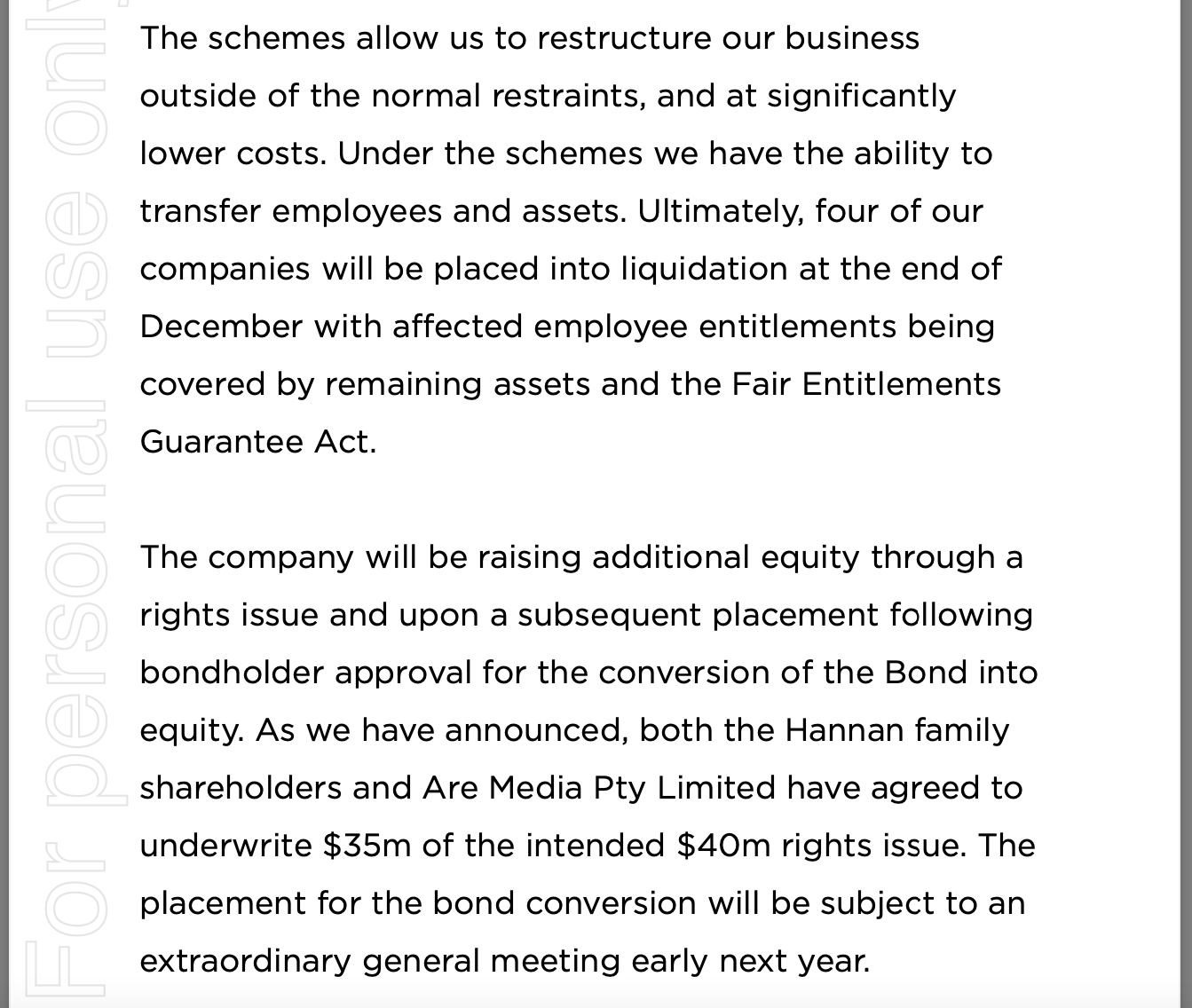
Printing giant Ovato, which rolls magazines including The Australian Women’s Weekly and TV Week off its presses, is set to get a cash injection of $40 million backed by some of its largest shareholders including the wealthy Hannan family as part of the same restructure.

Australia’s taxpayer-funded Fair Entitlements Guarantee scheme is designed as a “last resort” to cover workers’ redundancy and leave payouts when a company collapses without enough money to cover them and there is no legal barrier to Ovato using it to restructure.

Ovato argues the restructure, which involves the loss of about 300 jobs in cities including Melbourne and Sydney, is necessary to keep the broader company afloat and save many more jobs in the future as the economy continues to struggle.

A report from advisory firm McGrathNicoll commissioned by Ovato said after the restructure about 300 workers would be employed by four Ovato companies with few assets and an estimated $18.3 million owing in workers’ entitlements.

The companies “will have no ongoing business or purpose and as a result in my opinion… will be insolvent” the report reads.

In documents released to the stock exchange, Ovato notes its former employees could turn to the FEG, which has seen its cost spiral from about $60 million in 2007-8 to a predicted $1.3 billion over the next three years.

Australian Manufacturing Workers Union official Lorraine Cassin branded Ovato’s actions a “disgrace” because workers face a delay getting their entitlements through FEG during the Christmas season and had repeatedly compromised with the company to keep it running.

Read the rest of the article here.

If true, this would be appalling. I would not want taxpayer funds used to settle costs flowing from any restructure.

5 likes
Ethics

Why the decision of the South Australian government to close newsagents during the second Covid lockdown is wrong

When the South Australian government announced this week the strong lockdown due to a new Covid outbreak in the state, the list of what could be open was tight, focussed. It fitted with how the Premier and the Chief Health Officer described the situation.

A few hours after the announcement, they started making changes. Bottle shops could be open. Pet shops, too.

As it evolved, the list from the state government was odd. For example, if they really wanted to stop movement, why allow all petrol outlets and all hardware stores to be open?

Newsagents expected their channel of locally owned and run community businesses to be added to the list. It has not happened.

Having lived and worked through the second lockdown in Victoria, here is why I think the South Australian government decision to not include newsagents on the list of businesses that can open is wrong.

News. While plenty of newsagencies have diversified, providing access to news remains a key traffic activity. While some may say petrol outlets and supermarkets sell papers too, they do not sell the range.

Foreign language news. In the stage 23 lockdown in Melbourne, the sales of foreign language newspapers spiked more so than local newspapers. In many places newsagents are the only outlet for these titles. It’s like the government has ignored those who rely on foreign language newspapers for news. This alone should be the reason newsagents are allowed to be open.

Local magazine publishers. Newsagents are the only retailers stocking many local, niche, Aussie magazine titles. With newsagencies closed in South Australia, those titles lose sales.

Financial transactions. Many newsagents offer financial transaction services.

Parcel collection and drop off. Many newsagents offer parcel services.

Mental health. As the main retailer of greeting cards, we naturally saw sales spike in the stage 2 lockdown in Victoria as people found other ways to connect. We know from what they said across the counter that they appreciated being able to do that.

Happiness at home. People at home crave things to do. Newsagencies are the best diverse outlet for crosswords, jigsaws, craft magazines, craft kits and related products. sales of these spiked in the stage 2 lockdown in Victoria.

The decision by the South Australian government has provided key competitors of retail newsagents a valuable free kick. Here is how…

Lottery products. The On the Run stores all qualify to be open. They have papers, magazines and TheLott lottery products.  Them being open while newsagencies are closed provides an opportunity to break shopper habits. It gives them a competitive advantage.

Greeting cards. Supermarkets and Post offices sell cards, again allowing the habit of the card purchase at a newsagency to be broken.

Magazines. The habit based newsagency magazine shopper may look at the supermarket range, find what they want and break their habit.

The potential for harm to so many small, family run, businesses in South Australia is considerable.

Newsagencies has been proven through Covid to be safe retail spaces. They were early adopters of an entry / exit strategy, acrylic screen protection at the counter, easy access to hand sanitiser and early users of masks.

I guess the biggest surprise related to pet shops that were added to the list of what could open after the list was first published. Supermarkets and vets cover all that pet owners could need. Yet, the government added them to the open list. The case for newsagents is stronger than pet shops in my view.

Don’t take that as me saying pet shops should not be open. I am not saying that.

Given the scope of the evolving SA list, I think the case for keeping newsagents closed has become weaker by the hour.

I hope the South Australian government, the politicians, the bureaucrats, the police reconsider and permit newsagents to open. Many in the community would applaud such a move.

9 likes
Social responsibility

Why are newsagents not on the list of retail businesses permitted to be open in South Australia in the latest Covid lockdown?

It does not make sense that those in control of the list of retail businesses that can be open in the second Covid lockdown in South Australia, which came into effect at midnight, does not include newsagents.

All through late yesterday and into the night the list evolved, as you’d expect in such a situation.

First to be added to the list of businesses that could open is bottle shops. In terms of priorities, that sends an odd message.

Now on the list, in addition to supermarkets from the original list, we can see pet shops, butchers, fruit and vegetable shops and fishmongers.

But not newsagents.

Distribution centres can be open. If I was a distribution newsagent I’d take this as permission to open.

Newsagents play a key role in keeping people informed and connected. They were identified as essential in the first national Covid lockdown and also identified as essential early in the second, and more restrictive, lockdown in Victoria.

My suggestion to South Australian newsagents is that they urgently reach out to local members of parliament as well as at the leadership level. make the case that your business is essential, be clear as to why. Urge them to lobby for the decision to be reconsidered. Keep the contact civil and stick to the facts.

In Victoria we saw News Corp. actively engaged on behalf of newsagents early on, seeking to ensure newsagencies remained open. Indeed, I think I recall seeing newsagents on a list from the Herald Sun of businesses that would be open before the government issued the list. I wondered at the time if that was a lobbying move.

I’d love to see News Corp outlets in South Australia lobby publicly on behalf of the channel.

Given how these things go, I urge newsagents to engage on this  now. In addition to calling and emailing local members of parliament, be active on your business Facebook page and the Facebook page of politicians. Don’t be whiney or needy. rather, speak to the importance of maintaining easy access to news and people to people connection. Stress that you are a Covid safe business, with all the necessary protocols in place.

The changes to the list of what can be open from the. it was first announced indicate flexibility.

One thing I thought all governments would have learned from the Victorian experience is to be prepared. Lists of essential businesses should be well established and thoroughly debated as part of good planning. That appears to not have been done in SA.

13 likes
Newsagency challenges

SA newsagents not listed on the SA government list of businesses permitted to remain operational during snap Covid lockdown

Here is the list issued by the state government a few minutes ago:

The following will be permitted to remain OPERATIONAL to maintain critical services only:

  • Critical infrastructure including power, telecommunications, water;
  • Supermarkets for essential food;
  • Medical supplies and medical services;
  • Public transport;
  • Airport and essential freight;
  • Petrol stations;
  • Post Offices and Banking institutions;
  • Child care and schools for essential services workers only;
  • Veterinary;
  • Essential agriculture services ;
  • Factories remain open for essential machinery upkeep and production of essential products only; and
  • Mining and smelting for continuity and to prevent damage.

In that state statement from the government a few minutes ago is this:

People will only be able to leave the house for the following reasons:

  • To go to work as an emergency services worker or to worker providing essential services;
  • For agricultural work;
  • To receive medical care including seeking COVID-19 testing;
  • To obtain medical supplies;
  • One person from the household once a day to attend supermarkets to obtain essential supplies;
  • Organised end of life visits;
  • In an emergency situation.

This is even clearer:

The following businesses will CLOSE:

  • Takeaway food services
  • Shops (excluding essential food services)
  • Universities and tertiary education facilities
  • Pubs/restaurants/café/food courts
  • Elective surgery/ except cancer
  • Open inspections and auctions
  • Fly in fly out worker
  • Aged care  and disability facilities will go into lockdown
  • Construction industry
  • Holiday homes and other holiday accommodation and no further bookings
  • Wedding and funerals cancelled and banned
  • Outdoor sport/fitness/exercise not permitted
  • Regional travel not permitted

Taking those three together, supermarkets are explicitly names, as are post offices, banks and petrol stations in terms of retail.

It is unexpected among suppliers and others involved with the newsagency channel that newsagents are not listed on this list. My understanding is that discussions are under way. The situation may change.

6 likes
Newsagency management

A note on News Corp. request for data from home delivery newsagents

I Queensland home delivery newsagent mentioned to me a request from News Corp for them to enter data manually in advance of New Corp. taking over newspaper home deliveries.

I have spoken to the News Corp manager for the project. They confirmed that they have the instructions for harvesting the data from the Tower software and other newsagency software.

If a newsagent does not want to or does not have time to enter the data manually, they can go back to their area manager and suggest that the data upload approach is followed. This is what happened in NSW.

Newsagents with a home delivery customer list below a small size are the ones who will be requested to enter the data manually.

2 likes
newspaper home delivery

The significant hit of regional newspaper closures

I am grateful to have seen comprehensive sales data for October 2020 compared to 2019 for a range of regional newsagencies. In this data, the impact of the loss of regional newspapers is laid bare.

In one case, the business lost several thousand transactions in a month. With more than half their local newspaper sales being a local newspaper and nothing else, the paper closure removes a reason for a chunk of shopper visits.

Remove enough of these reasons and you impact the broader health of the newsagency.

More traditional newsagencies rely on layered traffic courses, with regional / local newsapapers being one of these.

While the loss of a local newspaper is not easily addressed by newsagents, the businesses that fare best are those that pull shoppers for a diverse mix of purposes.

Net new traffic attraction remains a key business activity for all retailers in our channel. Our suppliers focus on their category, as they should. It is up to us to focus on traffic for our businesses.

2 likes
Newsagency management

COSBOA on Australia Post and Are Media magazines

Cosboa has published an article that will interest newsagents at their website:

Has Australia Post lost its way?

It is not responsible for a fully owned government entity to be using its market power to damage small businesses.

Australia Post was once known simply as a post office and a postal delivery service, but these days the company has become something far removed from its core purpose and, if recent developments are anything to go by, it is continuing to grow into new markets.

In addition to selling books, gadgets, souvenirs, technology, drones, gift cards for big businesses, chocolates, toys and stationery, Australia Post has developed partnerships with overseas competitors of Australian small businesses and Australian communities, such as Amazon.

In essence, Australia Post is a Government Business Enterprise (GBE) using its special and protected status to take business from other SMEs.

It even offers personal finance products, such as car and travel insurance, as well as currency conversion.

The company also provides a number of digital services outside of its mail and logistics operations. These include employment screening, online payment services, and a digital identity platform.

It appears Australia Post seems to be branching out into everything it can and drifting further away from its core purpose. Shouldn’t Australia Post be focussing on getting its postal services working well instead of monopolising the products and services of small businesses?

While the use of postal agents, who are small businesses, does provide people in the private sector an opportunity to add value to their own private businesses, the major post offices continue to compete unfairly with the self-employed. This year it has gotten worse.

This year, Australian small businesses have been battling external circumstances outside of their control during the biggest economic shock in over a century. Then we find StarTrack, a dominant delivery service wholly owned by Australia Post, deciding that this is a good time to further punish small businesses by increasing its prices for businesses by 4.9%. Currently the CPI is less than one percent, but Australia Post just up and increased its price without any real reason. Small businesses who are forced to rely on slow postal services more than ever due to the pandemic are being hit again while they are already down.

And now, having formed a partnership with ‘Are Media,’ Australia Post will sell the top ten most popular magazines in Australia in Post Offices – and most likely on different or more favourable terms to small businesses such as newsagents. There are over 3000 newsagents in Australia that Australia Post seems comfortable to make collateral damage when they are vulnerable.Taking a core identifying product category like magazines from newsagents in the middle of a recession, and particularly in a pandemic when there are a range of other limitations in their businesses, is not only unprincipled, but personally distressing for the individuals involved.

Australia Post has a unique competitive advantage that other small business cannot compete with. It receives all kinds of benefits such as retail price maintenance on stamps and limited liability on damaged parcels while small businesses like newsagents operate in a more competitive environment.

Furthermore, Australia Post may not be complying with Section 16 (2) of the Australian Postal Corporation Act in relation to selling magazines and other products. It is convenient for Australia Post to play the free market card on one hand, when it wants to take from small business, but not when it comes to putting up its prices (as a monopoly) with basically no competition due to its market dominance – and this is while being supported by taxpayers.

The optics of a large government owned corporation seeking to take advantage over thousands of struggling small retailers in a pandemic-induced recession is extraordinary. This is unfair practice.

What will come next? Will Australia Post provide flowers in competition with florists? Coffee and snacks in competition with coffee shops? Clothing? Hardware? Airline tickets? All being sold from big post offices where there is the physical space to do so. Will the main streets around Australia eventually consist of one shop the Government owned Post Office – selling everything? That would kill community, choice, and jobs. In our opinion, Australia Post should stick to postal issues and leave the rest to the private sector

This issue needs to be addressed before it’s too late. In fact, in this post COVID era, the big end of town needs to be more careful and socially responsible. Small business has to be allowed to recover and while we all need to innovate, the country needs big business to show leadership. This starts with Australia Post.

It is un-Australian for Australia Post to use its competitive advantage as a protected Government Business Enterprise, with a model that lacks competitive neutrality, to target vulnerable small businesses. And as the owner and sole shareholder, the Government should make a clear statement to Australia Post that it must not pursue strategies that damage small businesses.

For years, we have seen Australia Post chip away at various product categories like greeting cards, games, toys, gifts, sewing machines and more. The government owned enterprise does this, in my opinion, leveraging the benefits of government ownership and relying on that protection and its provision of extraordinary resources to enable the corporation with a competitive advantage.

Now, newsagents can either sit back and let this Are media move play out, or they can act. I say the channel needs to act. Having 800+ corporate run government owned outlets taking money from our shops is appalling. This is the government competing with us, taking revenue and taking products we are challenged to get in our own businesses.

ALNA is part of COSBOA. They are working for newsagents on this issue through the lobbying route. Newsagents themselves need to think about what they might do about this, especially in the light of the possibility of Are media, through their owners, having a considerable stake in the Ovato business.

In case you missed it, here is a video I shot the morning after the Are Media / Australia Post announcement.

6 likes
Australia Post

An early look at Christmas 2020 in local small business retail in Australia

I am grateful to the many retailers who have shared recent year on year comparative sales data. This has enabled me to a deep dive into shopper traffic, basket depth and product category performance. I have done this to get an early look into what Christmas 2020 in local small business retail might look like.

The headline is that Christmas 2020 looks good in local small business retail.

Local high street retailers are doing considerably better than shopping mall retail. Suburban, regional and rural high street retail businesses, for which we have comprehensive sales data, are doing very well. They are experiencing solid double-digit year-on-year growth. For the dataset of 60+ businesses in our latest analysis, the average year on year revenue growth is 22%.

What is interesting is that the spike in revenue growth is not matched in a spike in shopper traffic. Rather, the revenue spike has come from shoppers buying more in each visit, driving better shopper efficiency. We are seeing average sale value increase by between 10% and 25%.

The dataset includes business across all states and territories except for the Northern Territory. The results are universal. There appears to be no difference between Victoria, which was in lockdown for some of the weeks under analysis and other states that were not in lockdown.

In terms of Christmas specifically, data indicate excellent year on year growth in Christmas card sales. The same is true for Christmas decorations, Christmas-themed home decor and gift wrap. Year on year growth is, again, 20% and more.

Locally made products are doing particularly well. Shoppers continue to engage with supply chain questions. A common question relates to sourcing from China.

Also of note is excellent growth in sales of calendars and diaries. The diaries growth encourages an optimistic outlook on 2021. Smart retailers are pitching it as that and having some fun with putting 2020 in the past.

Back in March, in the early days of Covid in Australia, jigsaws were hot. They sold out fast. Some expected the surge to fade over time. The latest sales data for October and even into the first two weeks of November suggest otherwise. Yes, jigsaw sales remain strong. half of the stores in the latest dataset sell jigsaws and every one of them is reporting year on year growth. The average of that growth is 150%. Key is breadth of range of supply.

In addition to the jigsaw growth, crafts, art, maker kits and similar are all showing strong results.

Comfort gifts are especially strong. Core in this category is plush. Plush is often dismissed as being tired or ho hum. We have seen sales in the plush space up as much as 50% off a strong base. In one local high street retail business in one recent week, for example, they did $1,850.00 in everyday plush, more than double their usual sales. Range, again, is key this this success.

Not reflected in the POS software collected data is anecdotal evidence that people are spending more this Christmas. Many retailers spoke to this. They spoke of shoppers saying they were spending more on loved ones as well as buying gifts for some they would not usually buy for.

There is the wonder as to the role of government stimulus funding on the sales results. While retailers think is is a factor, they do not see it as the key factor. If time does reveal it as a key factor, local small business retailers will respond accordingly. They are an agile bunch.

Considering the sales data and the and the anecdotal comments, Christmas 2020 looks strong. Plenty of retailers are already talking up the first quarter of 2021.

FOOTNOTE: I wrote this for my POS software company yesterday as it relates to not only data from newsagencies. I share it here as it speaks to optimism so many newsagents feel right now.

7 likes
retail

Australian shoppers preference high street retail over shopping malls

Looking at retail newsagency sales data for October and the first 2 weeks of November of 2020 compared to the same period in 2019, there is evidence that Australian shoppers are preferencing high street retail over shopping mall retail.

Newsagencies in high street situations, city and country, are doing much better, often reporting strong double-digit growth, compared to shopping mall businesses.

In the dataset I can see plenty of good news flowing from the easing of Covid related restrictions across retail in the newsagency channel. The news for high street situated retail newsagencies is considerably better than for those in shopping mall situations.

Looking at the core category of magazines. While the overall channel average is a year on year decline, even in locations where Covid restrictions have been relaxed for months, it is in high street situations that I am more likely see growth in the sales data.

Digging deeper into the women’s weeklies segment of magazines, decline in shopping mall businesses yet growth in some high street city and regional businesses.

So, what sort of growth am I talking about? There are high street newsagencies reporting 45% year on year growth, off a good base. The majority of this growth is coming from high margin lines such as gifts, homewares, games and toys. This is driving up overall business GP%.

One factor at play here is the diversity in high street businesses. They tend to offer more product categories, thereby appealing to a broader range of shoppers. I do wonder if this is a consequence of narrow permitted use clauses required by shopping mall landlords.

While it is early days in the recovery, there are indications of a stickiness to high street retail. That is, shoppers who found high street newsagencies are tending to stay, liking what they saw when those were the only general retail businesses open during lockdown.

While I don’t want to read too much into the year on year sales results I have seen so far, I like what I am seeing and am encouraged that the growth plenty saw during the Covid lockdown is continuing.

Based on the sales data, newsagency type businesses are, in my opinion, worth more today than they were this time last year and that has to be good news for the newsagency channel and those who supply the newsagency channel.

4 likes
Newsagency management

What is a newsagent?

At around am hour and twenty minutes in, this UK podcast includes a discussion about what you call a newsagent in the UK. Only a passing topic. I share it here as it may interest some wondering about how they identify their business.

1 likes
newsagency of the future

Advice for leveraging Christmas now

Here is a small selection of some of the Christmas marketing and management advice that is part of the newsXpress store management / advice kit:

  1. Always:
    1. Pitch 3 Christmas cards at the counter, on the newsXpress stand – carefully selected, changed weekly.
    2. Have gift wrap tape with wrapping paper.
    3. Have a selection wrapping paper and bags with cards, at the counter and with newspapers.
    4. Run your loyalty programs through Christmas – to bring them back.
    5. Make the shop smell like Christmas.
    6. Keep all everyday and lifestyle cards up – they sell through.
  2. Let your customers help each other. Setup a whiteboard or sheets of butcher’s paper, yes keep it simple. Get customers to write gift suggestions under different age/gender groups. For example: Girls 18 – 25, Boys 55+. Encourage your customers to help each other through their suggestions.
  3. Facilitate sharing stories. Find space in your shop for customers to share their Christmas stories. It could be a story wall inside or in front of the shop. This initiative encourages storytelling by locals and better connects the business with the community.
  4. Share Christmas recipes. Each week for, say, four weeks, give customers a family Christmas recipe. This personalises Christmas in your business, creates a talking point and makes shopping with you different to your bigger competitors.
  5. Help people rest and recharge. Create a Christmas shopping rest and recovery zone. Offer free tea, coffee, water and something to eat. Encourage people to take a break in your shop – without any obligation for them to spend money with you.

I am sharing this today to encourage others to think about and engage with Christmas 2020. It’s an odd year and results will benefit from fresh, not your usual, engagement.

6 likes
marketing

Friday 13th sale a hit

We ran an online only sale for 24 hours through Friday November 13th. The offer was simple, 13% off for a product category with a GP% of 55%. We did $3,675.00 over the 24 hours. Marketing spend was $0.00. We used fun and targeted free social media posts.

Online is key in our businesses for finding shoppers we would otherwise not reach and driving efficiency from existing infrastructure.

3 likes
marketing

Attracting shoppers to the newsagency using video

Here’s a video I made this week for my Westfield Southland business. I shot it on my phone, tweaked the visit using iMovie and then added text and music using the Promo platform. The goal of the video is to use ‘retail theatre’ to reflect range, encouraging that any Christmas card need could be satisfied in our shop.

10 likes
marketing

Ovato rights issue backed by Mercury Capital

A major announcement impacting Ovato released this afternoon with the company announcing a rights issue to be backed by mercury Capital, owners of Are media (formerly Bauer).

Click here for the creditors’ scheme of arrangement document as lodged with the ASX.

This line from the release release is telling: The plan would provide a viable future for Ovato and prevent possible insolvency. 

Ovato announces plans for $40 million rights issue and restructure

Ovato Limited, one of Australia’s largest print and distribution businesses, today announced a plan for a $40 million rights issue and restructure aimed at saving 900 jobs in the Australian manufacturing industry.

The plan would provide a viable future for Ovato and prevent possible insolvency. The plan includes 300 redundancies primarily through the closure of the Clayton printing plant in Melbourne.

The majority Ovato shareholder, the Hannan family, and a Mercury Capital entity Are Media Pty Limited have agreed to underwrite $35 million of the rights issue.

The Scheme is subject to completion of the rights issue and approval by creditors and the Supreme Court of NSW.

The Managing Director of Ovato, Mr Kevin Slaven, said:

“Print-based industries have been significantly affected in recent years and the COVID-19 pandemic has increased the pain this year for many parts of our group.

“Our industry has gone about as far as it can with mergers and consolidations in the last five years. Ovato has suffered losses for several years because of the costs of measures to meet the reduced demand for printed communications. This restructure allows for the company to get back to profitability and a sustainable future.

“Unfortunately, it means that over 300 employees will lose their jobs. However, the restructure will save 900 other jobs because the company would be facing an uncertain future without the restructure we are proposing.

“The proposed new equity, underwritten by two significant players in the printing and media sectors, together with the indicative support of our major suppliers and financiers to restructure our balance sheet, provides the foundation for a viable, sustainable and exciting future for our Group.

“Critical to the implementation of the Scheme, there will be no impact on our customers or all other suppliers outside of the Scheme, other than the positive impact of providing the Company with a stronger balance sheet and a viable, sustainable future. Our view, and the view of the independent expert, is that without this Scheme, the outlook for the whole group is unpalatable. We have searched for alternative solutions to the massive disruption in our industry, but they were unworkable.

“The Scheme will reduce our cost base, make us more sustainable and provide customers, suppliers and the 900 remaining staff certainty around a viable and profitable future.”

Ovato, which operates in Australia and New Zealand with print, distribution and marketing services. Ovato made a net loss after tax of $108.8 million last financial year, on revenue of $539.3 million. Creditors will meet on 30 November. All Ovato businesses outside of the Australian print operations are unaffected by the restructure.

UPDATE: November 13, 2020:

My view is that we need to consider what is happening with Ovato in the context of my recent post: What if the most important stream of revenue for your business was cut off overnight?. Okay, this may not be overnight, and it relies on a truckload of assumption … but what if Mercury get into a position of significant influence over Ovato? What if they saw a brighter future for top selling magazines through Australia Post, Supermarkets and Convenience, with newsagents way down the line?

I know the folks at Ovato will say that is hot a consideration. I accept that in their offices it would not be a consideration. But, what if Mercury gained a position of influence. It is what Mercury wants that would matter more.

Ovato is two main businesses print and distribution. I suspect that given the pivot of supermarkets and mass retail away from catalogues and flyers the print business is challenges. I suspect the magazine distribution part of distribution is doing well. However, that business is currently tied to the print business.

While I am no accountant or business strategy expert, what if the magazine distribution part of the business was spun out of a Mercury influenced Ovato, what would that look like for Mercury, their Are media business and for magazine distribution.

This is all speculation.

I have read a chunk of the Project Walker document. While it is considerable, 624 pages, it does not address how this may ultimately play out. It certainly speaks to the immediate need. Does it speak to what actually matters to us.

Ovato has a cash challenge brought on by decay within its core businesses and accelerated by Covid. In the print part of the business especially it appears the company did not have a solid plan b in the event of the lost of an important revenue stream.

What was lodged with the ASX yesterday represents an early step. The next few weeks will be interesting for all involved with the business.

From a newsagent perspective, I am keen to hear what Mercury Capital has to say, in particular about the future of the magazine distribution side of the Ovato business. Had Are media not pursured the Australia Post trial I would be less concerned.

6 likes
magazines

Late newspapers today in NSW

Today’s Daily Telegraph was printed hours late, reportedly because of the State of Origin.

As a consequence, you have newspapers being delivered now and, likely until mid morning. From a workplace health and safety perspective this is not ideal. You have more traffic on the road now at 8am compared to 5am, plus more pedestrians as kids are off to school.

Already, newsagencies are being hit with calls from irate customers. I suspect the publishers will be, too.

Newsagents have contacted me, frustrated with poor communication from News Corp.

What a mess.

If you are a newspaper customer and reading this, please don’t be anger at your local newsagent. The lateness is 100% the fault of the newspaper publisher.

8 likes
Newspaper distribution

Challenging financials from GNS

Several newsagents have sent me the GNS annual report for the year to June 30, 2020. It details a decline in revenue and an increase in losses.

With all newsagents remaining open through Covid and many doing so well that they did not qualify for JobKeeper, it is surprising to see the extent of the GNS losses. But … the business is going through realignment so time may show these results to be transitory.

The note in the annual report about the reduction in the number of newsagencies cited as a material risk needs to be noted:

For what it’s worth, I think the company continues fail on the technology front. Smarter and more modern engagement with retailers, including newsagents could reduce leakage to other suppliers, increase purchase, and provide data that can be leveraged to help newsagents increase stationery sales.

1 likes
Stationery