ACCC takes action against CardCall
The ACCC has commenced legal action against CardCall Pty Ltd for alleged contravention of the Trade Practices Act in relation to the sale of their Talk Tomato, Daybreak, OZcall and Green pre-paid phonecards.
The ACCC has commenced legal action against CardCall Pty Ltd for alleged contravention of the Trade Practices Act in relation to the sale of their Talk Tomato, Daybreak, OZcall and Green pre-paid phonecards.
Twitter is the social website of the year. The latest race for followers in proof of that. Kutcher was in a race with CNN to get to 1 million followers. The interest in this story is evidenced by the 1,500 news items accessible through Google about the race. Kutcher’s victory was announced by Oprah Winfrey on her TV show. On a side issue – MTV has a story asking whether Oprah joining the Twitter community is a tipping point to the end for Twitter.
Ashton Kutcher on Twitter Magazine was launched yesterday on Ulitzer. This is an online magazine offering live news and comments on Kutcher’s Twitter journey. At the Ulitzer page you can subscribe to updates for free.
CNN refers to Twitter regularly on its programs and is hailed as a pioneer in mainstream media on the use of Twitter.
The amazing growth of Twitter this year is relevant to newsagents because it reflects a significant shift in how gen x and gen y receive and pass on news and other information. Celebrities are embracing Twitter at a phenomenal rate. By tweeting on Twitter they are able to cut out middlemen and control more of their story. From a media company perspective, such as CNN, it is another distribution channel for content. In the US, content is delivered free by mobile phone. Here in Australia, you need a special app for your iPhone to get this.
I am not sure how we can use Twitter in our newsagencies. It could be a channel for promoting special deals. It could also be how we pass on story headlines to encourage people into the shop to buy a magazine – but that feels like a poor idea to me. One thing is for certain, if any newsagent does use Twitter, tweets need to be relevant to the newsagency – otherwise what is the commercial value?
Can we ignore Twitter? No! Our businesses were founded on being a news and information distribution channel. Twitter is a news and information distribution channel. The success of the race between Kutcher and CNN is a reminder that the core of our business model is changing. We need to embrace that. It is a terrific opportunity.
I have been a Twitter user since January 2008. I joined to see what was happening and to use it to publish anything I thought was newsworthy. How Twitter is used has changed significantly since then.
For those who don’t know much about Kutcher, he is an American actor, married to Demi Moore, creator and host of TV show Punk’d and star of a bunch of flms including Dude, Where’s My Car?, Just Married, The Butterfly Effect and The Guardian. He is also the co-creator of several other successful TV shows.
For more about Twitter, go to Wikipedia – also check out their definition for a Tweet.
LATER: Folio magazine reports that talk of Twitter and other social media sites dominated the Magazine Day conference held in News York this past week.
I have been talking this week with some newsagents who participated in the recent sales benchmark study and in particular about their success with stationery.
54% of newsagents particpating in the study reported growth in stationery sales between January and March this year compared to the same period in 2008 – with the average increase in revenue reported as 7%.
When you are talking about upwards of $50,000 in stationery for the quarter the increase is quite valuable, significant in a tough marketplace. I wanted to understand how some of these newsagents achieved such good numbers. Their feedback on why they have been successful with stationery can be distilled to three points:
Stationery is hard work. But the rewards are worth it – more than twice the margin for newspapers and magazines. If we buy well we can establish a significant local point of difference. I saw this first hand last weekend in a newsagency which dominates the town for stationery. This is not just a country town opportunity, we can be the 7-eleven of stationery if we are smart. Newsagents reporting growth this year are doing this now.
One of the reasons I do the benchmark studies is to show that there are newsagents driving excellent success – in the hope that this encourages others to engage more deeply with their business.
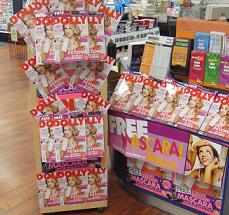 We are promoting the latest issue of Dolly magazine in this new space we created by using the back of another stand. This space is at the end of our two main magazine aisles and is passed by considerable foot-traffic. Our team at Forest Hill created this space around two months ago and it has worked well for us, driving some excellent sales results.
This was was previously dead space in our shop – generating no revenue. I am grateful to the local in-store initiative which has turned this into sales success.
I have seen someone leave an aisle with their purchase and then purchase off this stand.
Below is a draft of the artwork we have developed at Tower Systems for newsagents to use to invite customers to spend their federal government stimulus money in a local newsagency. I felt it was important for newsagents to respond in some way to marketing from electrical, furniture and other outlets chasing the stimulus money.
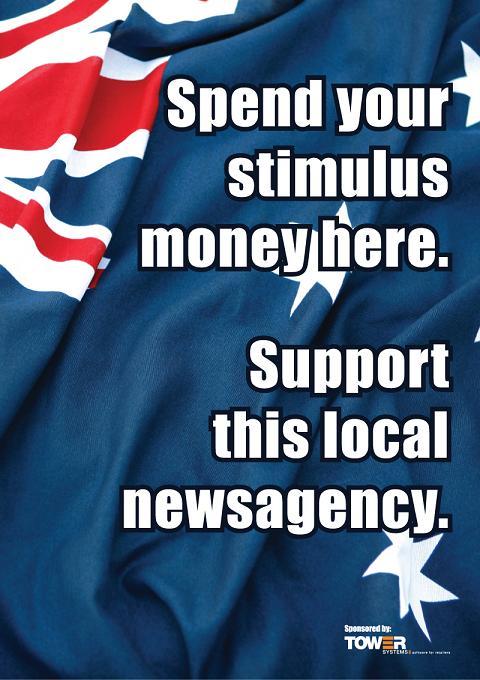
I’d be interested feedback – direct or as comments here. I am not sure that this artwork is quite where it needs to be.
My goal was to tell people that buying a plasma sends money offshore whereas more of what you spend in a newsagency stays here, local.
VANA (an association representing Victorian newsagents) sent out the following correspondence from News Ltd yesterday in relation to the speculation this week about free newspapers. It is in the form of a letter to Peter Cowley, VANA CEO.
Dear Peter,
Thank you for sharing the concerns of VANA members about the recent online article “Could News Ltd take its newspapers free?”.
Your members can safely disregard the suggestion that metropolitan daily newspapers like the Herald Sun might one day be given away free of charge.
It’s idle speculation and completely off-the-mark.
You’ll note that News Limited Director of Corporate Affairs, Greg Baxter has already issued a flat denial, which was included in the online article.
But if further reassurance is required, here’s a quick reality check.
At a cover price of $1.10, the Herald Sun sells more than 500,00 copies Monday to Friday, week in, week out. And more than 600,000 copies every Sunday at $1.80.
That’s an awful lot of sales revenue to forgo.
But if you believe the online expert, dropping the price to zero would increase our readership.
Problem is, according to Roy Morgan Research more than 1 in 4 adult Victorians already read the Herald Sun, giving us one of the highest per capita readership levels in the world.
Dropping the price to zero might grow our readership enormously, but then again it might not. A newspaper’s cover price is just one of many factors influencing consumer behaviour.
The Herald Sun’s connection with the Victorian community is undoubtedly our most powerful tool for attracting readers and advertisers
It’s a connection that has never been more apparent than during the recent Victorian Bushfires.
Delivering that connection through quality journalism is one of the fundamentals of our business. It’s also very expensive.
Why would we put it all at risk for so little potential gain?
Warm regards,
Andrew Hockley
General Manager, Sales & Marketing
Herald & Weekly Times Pty Ltd
40 City Road Southbank 3006
 We are supporting Secretary’s Day or Administrative Professionals Day as it is called now. We have a small selection of cards available and some appropriate gift lines. While this is not a major retail season, we felt that we needed to have an offer if we want to call ourselves greeting card specialists.
The more we are known for having cards for even the most minor occasion the more people will talk about us to their friends as to go to place for cards.
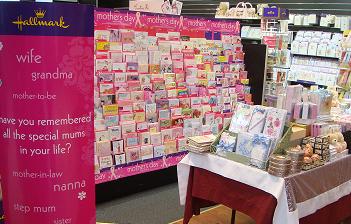 With Easter later this year the pressure was on to get Mother’s Day out and into promotional space. It is an important season for us in terms of sales of cards and gifts. Mother’s Day is also important in connecting us with the National Breast Cancer Foundation though the sale of Hallmark cards as part of their Cards For Cure commitment.
Last year we achieved a 22.% lift in Mother’s Day card sales over 2007. We are chasing double digit growth again this year and triple digit growth in gift sales – we have a much bigger range of gifts than a year ago.
Mother’s Day is an excellent opportunity for newsagents to take a stronger stand in the gift department, or start with gifts if you are not in this space already.
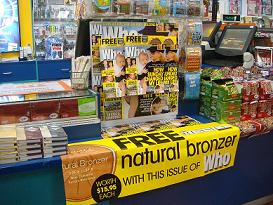 We are promoting the latest issue of Who at the counter of our newsagencies. The free Rimmel natural bronze product which comes with the magazine should result in excellent weekend sales. This is an excellent impulse offer – newsagents would be crazy to not leverage this to the max.
 I wonder how many newsagents placed the current issue of Go Natural magazine next to their fashion titles. Cover girls Trinny and Susannah are fashion icons after all.
While it may upset some to see these ladies naked it could give us a moment of excitement.
 The speculation about the possibility of News Ltd moving to a free newspaper model sent me back to data gathered for the Q1 2009 Newsagent Sales Benchmark Study last week. I wanted to check in with how important newspapers were to the average newsagency – from a gtraffic and a financial perspective.
Across all participating newsagencies, newspaper sales account for between 3% and 27% of retail (non agency -lotteries etc) revenue. The difference between newsagencies is considerable.
Newsagencies with 15% or more revenue coming from newspapers, would be most concerned at the prospect of newspapers moving to a free model or pushing their product into more retail outlets. Typically, these are newsagencies which are not being managed for change. I am not critical of these newsagents, just concerned for them – that they are yet to embrace change.
For years, newspaper publishers have been saying it is business as usual. Retail sales and home delivery activity suggests this is true. That said, publisher financial performance tells a different story. Plunging ad revenue, higher distribution costs and alternative distribution platforms mean that change is inevitable – at some point in the next couple of years.
Smart newsagents are running their businesses as if the model has changed today. These are the newsagents with newspaper revenue accounting for less than 10% of retail sales.
Considering the data I have analysed, my view is that newspaper revenue ought to be below 10% of overall newsagency retail revenue. This would mean that the business is relying on higher margin lines such as gifts, stationery, greeting cards and service – over most of which the business owner has more control on range, merchandising and other business decisions.
Diversifying in this way need not negatively impact newspaper sales. It is a matter of adjusting the business away from the traditional approach to newspapers and, most likely, magazines so that it has scope to play in the newer (for newsagents) categories of gifts and related areas.
There are some in the newsagency channel who say that I am preaching doom and gloom when I write about these challenges or deliver a speech at a conference on similar themes. That would be true if all I did was talk about this in a negative way. I see many positives ahead, certainly many opportunities.
I see the changes coming in the newspaper distribution model as an opportunity for entrepreneurial newsagents to reinvent their businesses, to become more relevant for today’s circumstances. This is what many of the newsagents with a lower reliance on newspaper revenue are doing. It is what I have seen in the latest benchmark study – where newsagents have gone from deriving 20% and more of their revenue from newspapers to 15% without cutting actual newspaper revenue.
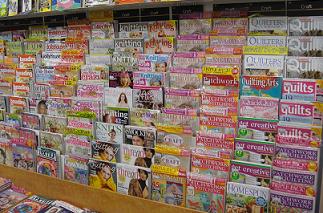 We completed a relay of 150 titles in our craft, quilting, knitting and cards magazine segments last week. This was done as part of our commitment to keeping our magazine offer fresh for our customers and ourselves. This area of our magazine department is important in sales for us and because it is at the end of our main magazine aisle, on our back wall. Previously, walking down the aisle you faces scrapbook titles. Now, you face quilting titles.
In deciding on changed to layout, we focus on top selling, efficient, Australian titles first. This is a challenge because of the double and triple packs of craft titles which make many inefficient from a real-estate perspective.
 I was surprised to see Marvellous Mince arrive in-store this week. Published under the Woman’s Day brand, this $6.95 cookbook is from ACP Magazines, publisher of the successful ACP cookbooks which retail in newsagencies for $12.95.
If more cookbooks are released under the Woman’s Day banner we will need to reallocate space – a challenge in dealing with some publishers and distributors.
This is a good example of where the channel needs to manage access. Since we don’t do this, any titme which wants shelf space can get it. We lose because we carry under performing titles for far longer than any retail competitor would.
I’ll support Marvellous Mince but I will be on the look out to reduce my exposure elsewhere in food to balance the cost of the new title.
Check out Green & Design magazine, a soon to launch digital monthly published by Nielsen Business Media in the US. PaidContent has more on this story.
Rob Lake, writing at Business Spectator, joins in the discussion about the possibility of free newspapers.
Many newsagents believe they make dollars from selling papers in their shops. In reality, the average profit is around $25 per week. The cash cow is distribution, currently heavily subsidised by the newspapers and dominated by the tabloids. A new pricing model may see this income stream damaged for newsagents.
I think his numbers are off. Newspapers remain a profitable product for retail newsagencies. Home delivery, for many, is loss making.
Assume weekly retail sales of 1,500 newspapers at a gross profit of 25% from an average cover price of $1.10 (yes this is low but it is an average). The GP for the week from newspapers would be $412.50. Over a year this is $21,450. The total space allocation is less than one square metre and in most major centres this would cost under $1,500 a year.
If it is a retail-only newsagency then the return will be around half that because retail-only newsagents generally do not have a direct newspaper publisher account. Even in this scenario, newspapers generate more gross profit per square metre of retail real-estate than most other products in a newsagency.
I know from my basket analysis of sales data from many newsagencies that newspapers sell alone around 70% of the time in the city and 50% of the time in rural areas – that is, there is nothing in the shopping basket but a newspaper. While this appears to be inefficient, discussions with counter staff and my own experience support a view that today’s newspaper customer is tomorrow’s stationery or lottery customer.
Newspapers are crucial to the habit based trek to the local newsagency – for the paper, magazines, lottery products, greeting cards and home and office stationery. This is where the free model is a risk for us – it could break the habit connection.
If a publisher did go free and asked newsagents to be the collection point for the free newspaper, I suspect that many newsagents would agree – because they would want to maintain their current newspaper traffic as long as possible.
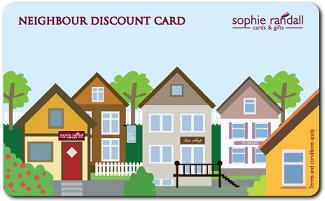 We are introducing a loyalty cards for people who work near our Sophie Randall card and gift stores. A holder of the Sophie’s Neighbour Discount Card will receive a discount off each purchase and have access to other neighbour only offers and promotions. We have business processes (including in our POS software) behind the offer to track the business benefit. This is important because if it works we will trial it in the newsagency space.
The neighbour card is different to a VIP card or volume based loyalty card. It is innovative. The card unashamedly seeks to recognise and appreciate our neighbours. Our research suggests that this is important in several of our locations – Melbourne CBD especially.
The traditional VIP club offer has had its day in my view since so many stores play in this space. Shoppers I talk with are cynical about the real value of many loyalty cards. We figured that by focusing on a specific group with a common location connection we can break free from a me-too loyalty program offer.
RetailWeek reports that Amazon in the UK is now offering home and office stationery online.
What statred as an online book store has become a diverse online retailer. The move into stationery is a natural progression for them and will, I suspect, hurt bricks and mortar stationery retailers in the UK – especially their exceptional upselling technique.
 We are promoting the latest issue of Wartime the official magazine of the Australian War Memorial next to our newspapers this week. With Anzac Day so close we figured this high-traffic placement was appropriate – especially to our demographic at Forest Hill. History magazines are popular for us.
Promoting Wartime reinforces our point of difference in magazine range – you won’t see this title in a convenience store, petrol outlet or a supermarket.
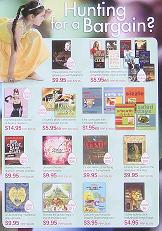 Our Book Sale at Forest Hill is working very well. Customers love the offers in the flyers – they always do. Book sales are very easy to run when you partner with a good supplier and back by investing in external marketing. This is another excellent way to draw new customers to the business. Books, Ink, calendars – they all work the same: great sales, good margin and new customers getting to know the business. The key linkage between them is external promotion.
Customers react to event sales lick this book sale this more over time, as they get to know your brand and that your business is different to other newsagencies.
Newsagents need to seize every opportunity to promote outside the business – like this book sale. Bringing in new customers every week is crucial to the health of our businesses. It started immediately after our last HOT Ink! brochure which also sought to bring new customers to the shop.
These new customers buy other items, they are shoppers and browse well. This drives good business in other departments which are browser friendly such as magazines and cards.
The book sale we are running is a newsXpress strategy.
 We put the Wearables range of purses and related gift items from Russ into our Forest Hill and Frankston stores two weeks ago. Sales at Frankston have been slow while at Forest Hill they have been excellent – to the point that we need to re-order. We liked the offer from the outset since the range comes in a display box which sets the Art Deco theme and because the products have an attractive price point and good margin.
Crikey.com runs the story today asking whether News Ltd is considering a free newspaper model. While I don’t know whether this is under serious consideration within News, I do understand that they considering many changes as they assess their newspaper distribution model.
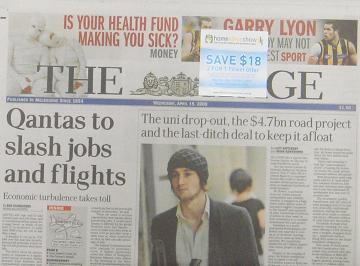 THE AGE newspaper was renamed THE GE on the front page this morning thanks to an ad for the home ideas show stuck over the masthead and part of the crest. So much for respecting the brand.
For readers who are not reagular readers here, I have a ‘thing’ about the desecration of newspaper brands by Fairfax. While I am sure they like the ad revenue, covering the masthead in this way speaks volumes about what they think of their brand.
I was in a newsagency earlier this week and they were playing the TV commercial I funded late last year for the channel on their in-store TV.
If money were no object I’d like this and related commercials to run regularly on TV and in-store to remind the community about our community connection. While shoppers can buy everything we sell elsewhere, they cannot buy our local community connection, our customer service or our genuine smile.
Sales of special interest magazines fell in the first quarter of 2009 according to the newsagent sales benchmark study I completed last week. The average fall of unit sales of special interest titles was 7% among the 97 newsagents participating in the benchmark study.
This fall is a concern because special interest titles are a key point of difference for us in the magazine department. It is rare to record a fall in sales. In most newsagencies for which I have data, the percentage fall in sales of special interest magazines was greater than the fall in store traffic.
If we were a cohesive channel we would find a way to promote the comfort to be found in our special interest range and thereby promote a point of difference for newsagencies.