A blog on issues affecting Australia's newsagents, media and small business generally. More ...

Evidence of real transition by a newsagency business

This data is from one regional newsagency in Australia. It reflects a comparison of 2 weeks in December this year to the same 2 weeks last year. On top of the more than 50% in revenue growth and and excellent growth in overall business gross profit percentage, there is this:

Here we see, on the left, data for 14 days in December this year, next, data for the same 14 days in December 2019, and, finally, the difference.

The transaction count is down because several regional newspapers closed. It is the compounding value of average sales value, average item value and average items per sale that fuel an excellent result.

If you have been able to gently drive higher prices as well as bring in new product categories from which you can achieve higher than your average gross profit, focussing on basket depth can deliver the valuable compounded result. This is about guiding a shopper to purchase more in a list than they might have otherwise.

Achieving a higher average items per sale result comes from an ideal shop floor layout, good product placement, leveraging hotspots, having awesome shop floor staff and having a counter configured for easy impulse purchase decisions.

Building this level of success is like building a jigsaw, without having a clear picture of what the end result will look like. But … it does involve placing many pieces. It’s trial and error, daily work, small steps work.

Any newsagent can do it. Capital is not a barrier. Location is not a barrier.

Focussing on smaller datapoint is a good start as small wins from small steps can be motivating.

Our success is up to us.

14 likes
Newsagency management

News Ltd. throws QLD newsagents under the bus on newspaper home delivery

After decades of loyal, low cost, accurate newspaper home delivery service, News Ltd. is planning to send letters to subscribers in which they throw newsagents under the bus, inferring their service has sub-standard.

News Ltd. has send impacted Queensland distribution newsagents newsagents a package, including letters to be sent to subscription customers. This paragraph is from the second letter:

This is appalling wording. Improved customer experience? To do that, News Ltd. will need to:

  1. Be contactable 24/7. That is, human contact, not a recording or a computer system.
  2. Have people dealing with queries who understand local situations.
  3. Get the papers out on time – this relates to many complaints.
  4. Be a good listener as many customer complaints relate to matters under control of News Ltd.

Back to the paragraph from the letter, it suggests that News Ltd. has been delivering the paper, when it has not. Sure, there is a nod to the accuracy of newsagents – but News Ltd. claims this is their achievement, when it is not.

For a company in the communication business, this letter is appalling.

I feel for Queensland newsagents and what they, and their customers, are about to endure.

17 likes
Newspaper distribution

Journalists need to do better when writing about newsagency closures

The story by the ABC about the closure of Vizes City News in Rockhampton reports on the closure of a long-established newsagency. While the story offers balance in reporting on success at newsXpress Mount Morgan it fails in needed detail in some areas.

  1. The story says the business has adapted. I have been to the shops several times, as recently as late last year. yet, they adapted primarily into one new category. It was not enough. It was sort of a separate business, too. The newsagency core needed adaptation.
  2. The story says that newspaper closures are the reason for the closure of the business. I can’t see this as they were anticipated. I’ve certainly been writing about the need for newsagents to manage for the decline of newspaper and magazine traffic for 15+ years.
  3. The story talks down the value of newsagencies. Recent sales and the spike in interest in buying a newsagency suggest otherwise.

I get that people leaving or who have left the channel prefer a narrative that suites them, the evidence does not support them.

Newsagency closures reasons are complex. Newsagents often have had opportunities to avoid them, if they wanted to.

I have seen data today for a newsagency an hour or so away from this business in Rockhampton that is closing. Revenue is up 64% off a good base. New product categories are helping to drive revenue growth of some traditional newsagency categories like magazines and card. In this business, newspapers are down 24%, with no bottom line impact. The BIG news is that GP% is way up, based on the new product mix introduced over the last year.

We all make our own success.

18 likes
Newsagency challenges

Murdochs up gambling stake

In a move that shows them thinking about future revenue streams, there Murdochs have increased their investment non gambling.

This, from Crikey, last week.

Toxic betting industry no barrier to the Murdochs as they up gambling stake

STEPHEN MAYNE

The Murdoch family has profited big time from the gambling industry over the years and they are doing it again with Dublin-based Flutter Entertainment, which last week bought an additional 37% stake in US fantasy sports outfit FanDuel for a whopping US$4.2 billion.

The deal was partly funded by a $1.8 billion Flutter share placement which the Murdoch-controlled Fox Corp was happy to back once again.

The Flutter announcement included this 16-page presentation, plus this approving quote from Fox Corp CEO Lachlan Murdoch:

We are delighted to participate in this capital raising. Maintaining our ownership stake in Flutter signifies our long-term commitment to Flutter, and ongoing confidence in management’s ability to execute against the fast growing US [sports gambling] opportunity. FOX’s audiences have proven to be highly engaged with free to play and wagering content, and we are excited to offer them access to products from Flutter’s market leading stable of US brands.

Flutter is fast becoming a global behemoth. Through its NT-licensed Sportsbet brand, it is now Australia’s biggest online gambling company with an estimated market share of 52% after including the recently merged BetEasy business. It is forecast to extract around $2 billion of the $25 billion that Australian gamblers are expected to lose in 2020-21 and has been making a fortune during COVID-19, particularly because the racing industry was nationally exempt for the shutdowns.

These two fantasy sports businesses are now seen as the fastest way to access gamblers as deregulation sweeps across America and cash-strapped states look for new revenue streams after their budgets were ravaged by COVID-19 shutdowns.

Rupert Murdoch used to be against gambling, partly on the grounds that it took dollars away from consumers who might buy his media products.

But then he saw the profit potential of linking gambling with sports broadcasting and in 2005 successfully lobbied Tony Blair to deregulate gambling rules in the UK.

As Crikey has noted before, the Murdochs then built up Sky Betting & Gaming which ended up delivering clear profits of about $2 billion to the broader Murdoch interests (via Sky PLC) when that business was sold to Canada’s The Stars Group for US$4.7 billion in 2018.

Having tasted success in the UK, Fox Corp subsequently created the 50-50 Fox Bet joint venture in the US with The Stars Group once the US Supreme Court legalised sports gambling in May 2018.

Fox Corp took a 5% stake in Stars for US$236 million as part of the Fox Bet joint venture which then became a 2.6% stake in Flutter once those two businesses merged earlier this year. The original 3.23 million Flutter shares which Fox Corp inherited through the merger are now worth around US$650 million but Fox Corp has subsequently supported two further placements by Flutter this year as it dives further into the gambling business.

Like denying climate change, backing Trump and tolerating industrial-scale phone hacking, there are few ethical barriers which stand in the way of the Murdoch modus operandi. They seem to have no problems whatsoever profiting from the toxic gambling industry.

I have two points here:

  1. This story is a reminder to newsagents to work on new traffic revenue, it’s critical to any business.
  2. This is not a story that would be covered in this detail in mass media in Australia, given the concentration of ownership.
5 likes
Newspapers

Crikey: tax minimisation in the Murdoch businesses

This article by Bernard Keane at Crikey should anger any everyday taxpayer in Australia.

Tax dodging News Corp continues to rip Australia off — and is subsidised by taxpayers to do so

News Corp retains its crown as a champion tax rorter, yet again paying next to nothing in tax despite billions in revenue.

Next time you see a News Corp employee or contributor, or a News Corp editorial, opining about fiscal policy in Australia, or how tax revenue should be spent, or how the economy should be run, there’s a simple question to bear in mind.

How much tax has the foreign-owned Coalition propaganda arm paid in tax in Australia in the five years to 2018-19? During that time News Australia Holdings has earned more than $360 million in profits from nearly $13.1 billion in revenue.

The answer, of course, is zero. It hasn’t paid a single cent in tax.

It’s a different story for News Australia Investments. In 2017-18 it reported $291 million in taxable income, on which it paid … $201,000 in tax. And no, there isn’t a zero missing.

Admittedly News Pay TV Financing — the vehicle for News Corp’s takeover of Foxtel and Premier Media Group nearly a decade ago — reported a $27 million profit way back in 2015-16. It paid tax on that that year: $8.2 million.

So, including everything, in five years News Corp has paid $8.5 million in tax on more than $680 million in profits and $13 billion in revenue.

In that time the Coalition has handed $40 million to it in untied grants, swamping even the miserable $8 million. The net position is that off revenues of more than $13 billion, taxpayers have actually paid the Murdochs more than $30 million.

All this is because News Corp is one of the worst tax rorters and dodgers in the country. That’s why, in 2015, the ATO deemed it the highest tax risk in the country.

The recently released ATO corporate tax data for 2018-19 — well before the pandemic — shows that the US-owned News Corp earned $2.1 billion in revenue, down from $2.4 billion the previous year, but claims to have made no profit at all — in contrast to previous years when profits where sneaked away offshore.

The numbers illustrate the extent to which News Corp has nothing to do with Australia and Australians. It is foreign-owned, Rupert Murdoch is a foreigner, and the company pays no tax in Australia.

Of course, that doesn’t prevent the company’s outlets from lecturing real Australians who live here and pay tax here about what they should do, how they should live and vote, and what fiscal and economic policies we should follow.

Read the rest of the article online.

I get that some may say it is smart to take steps to minimise tax. News Corp. is different. It openly meddles in democracy, plays with the truth to serve its needs, tells us how to live our lives. Yet, it pays no tax. This alone should strip of what it seeks to do.

I think what News Corp. does re tax is un-Australian, wrong and purely selfish.

All companies have a social responsibility to the countries in which they operate. In my opinion, News Corp. is not demonstrating social responsibility in its tax arrangements in Australia.

Shame on all politicians who pass the rules that allow News Corp and so many other companies to pay fair tax.

12 likes
Ethics

What has we learned from Covid that will stick in small business retail?

I’ve been thinking about the changes we made in our businesses during the peak of the Covid challenge and, in particular, what is likely to stay with us.

  • Cleaning. Daily surface cleaning of the counter, front door and other places people are likely to touch, with an anti-bacterial wipe at least daily is good for shoppers as well as those working the the business.
  • Hand washing. I think there is value in reminding staff to do this. A key benefit will be their own health.
  • Hand sanitiser. Keeping pump packs of this at the counter for staff and for customers its good practice, especially if you take cash. The best way to see if this is a good move is whether customers use it. I suspect they will.
  • Airflow. We have learned through the year that good airflow is important. Improving this could be a good move.
  • People flow. making ti easy for people to move around the shop was important through Covid and is good for retail more broadly.
  • Making shopping easy. Having experienced easy shopping of packs, click and collect, home delivery and all the other approached used through Covid, some customers will be keen for these to continue.

If you can find the time, think about what you did through Covid that you may continue with as part of usual operation on the other side.

I think we have learnt plenty that can benefit us and our customers post-pandemic.

6 likes
Newsagency management

Christmas marketing tips for local retailers

Christmas is a noisy time for shoppers. Every retailer is pitching to them on TV, radio, in print, on social media and in-store … even more so in 2020.

Christmas marketing tends to be the same: jolly, celebratory and, often, price based.

It is a challenge for small business retailers to cut through all of this noise. Here are some tips for cutting through.

  1. Make it easy. People often talk about how hard Christmas is. Be the business that makes it easy. The ways to do this are have bundled gifts ready to go, pre-bagged or wrapped, with some card selections that are relevant, offer easy payment options including buy now pay later, free wrapping, better shop floor help, guide buying advice or tips on perfect gifts no one else will think of. Consider making Christmas easy as being a key part of your messaging.
  2. Be thrilled people are in your shop. Your personal smile or greeting is something they may not see in a big business where employees are less invested in each shopper and where the owner is usually thousands of kilometers away.
  3. Make the giving easy. If people purchase form you to send somewhere else. Offer a one-stop shop. Save them the trip to the post office.
  4. Make the shop less about Christmas. Consider pulling back on the Christmas visual noise. Go for something simple, muted, respecting the season but making a calm statement. Consider declaring the shop a Christmas carol free zone – not because you hate carols but because you want to help customers take a break.
  5. Help people rest and recharge. Create a Christmas shopping rest and recovery zone. Offer free tea, coffee, water and something to eat. Encourage people to take a break in your shop – without any obligation for them to spend money with you.
  6. Let your customers help each other. Setup a whiteboard or sheets of butcher’s paper, yes keep it simple. Get customers to write gift suggestions under different age/gender groups. For example: Girls 18 – 25, Boys 55+. Encourage your customers to help each other.
  7. Make price comparison difficult. If you sell items people are likely to price compare with other businesses, package them so price comparison is not easy. Put items into a hamper as a perfect Boy 8 to 12 bundle for example. Or offer the item with pre packages services if appropriate for an item.
  8. Less is The stack em high watch em fly mantra can be wrong. Indeed, it is often wrong in retail. Shoppers can be store blind because a shop is too full or a display is too busy. Consider creating simpler less cluttered displays and window promotions. Draw attention to what you want people to see by promoting that one thing.
  9. Christmas season in your shop should evolve. Major change weekly is vital for people to see what you have that they could buy.
  10. Be socially engaged. On Facebook, Instagram, twitter and elsewhere, be the calm voice, the person people enjoy reading or seeing photos from. Provide entertainment this Christmas rather than the usual retailer shrill of come and shop here!

The key to a more successful Christmas is to be different to what people expect from your business.

6 likes
marketing

POS software integration with TheLott

Weeks ago my newsagency software company completed acceptance testing of its integration for TheLott products. Here’s a brief video showing how it works for those interested in seeing it:

7 likes
newsagent software

What are the key drivers for boxed Christmas card purchases

Talking with retailers over the last couple of weeks, it is clear that the charity support and being Australian made and made are the two most important factors for boxed Christmas card purchases in shops that have products from three and more suppliers. Design comes in a close third.

Okay, it is not a scientific study with enough data to say it is accurate across the board, but, it feels right based on what I have heard. The charity connection is especially key. Card companies get it – they promote the charity being supported on the front of their card boxes.

In my own experience, the more we promote the charity connection the stronger the sales. This year even more so that in the past. This is especially true on social media. Support for a charity can see that charity promote your post to their community, which expands the reach of your business.

Here is one example from a range of socials produced for newsXpress members this year.

5 likes
Greeting Cards

Toy-focussed newsagents benefit from extraordinary toy sales growth

The latest toy sales basket data analysis by the NPD group based on sales data from independent toy retailers, not newsagents, for The Australian Toy Association reveals terrific results in the toy space. Newsagents active in toys with a defined department offer would be doing as well. The headlines from the October sales analysis are excellent

  1. October is the 8th consecutive month of double digit dollar growth.
  2. All major categories posted growth:
    Youth Electronics +86 %
    Arts & Crafts +68%
    Games & Puzzles 48%
  3. Average price grew 3%
  4. 19 of 20 Key Manufacturers grew for month
  5. YTD Games & Puzzles largest growing category
    – With building Sets the largest $$$ gain
  6. Top 5 gaining properties Oct 2019 v Oct 2020
    BLUEY
    NINTENDO
    OUR GENERATION
    LEGO SUPER MARIO BROTHERS
    POKEMON

These are excellent results revealed in this comprehensive report. Here is a snapshot from one page of the NPD report FYI:

Now, bringing the analysis closer to home and looking at data for toys in newsagencies, and specifically newsagencies where toys are 10% or more of revenue, the results are excellent. In October, those businesses meeting this criteria reported year on year revenue growth in toys of 65% or more.

These stores typically have a permeant toy department offer in-store with established brands and regular enhancement of range. Typically, they cover all ages from baby to 80+ because, as the sales this year have shown, everyone can be a toy customer.

Diving even deeper, newsagencies with a webstore more than 3 months old saw 25% of toy revenue come from online.

While it might be reasonable to say these results are Covid related, the reality is that some ope the growth will stick as some shoppers have discovered new retailers and new ways of in home and out of home entertainment.

Suppliers and analysis I speak with in Australia and overseas are predicting a good year for toys in 2021 on the back of what has been achieved in 2020.

Now, to a footnote – there are a couple of categories within toys that some old and tired retailers wrote off as done and over. These categories have lead the growth and delivered extradorinaiy sales. My point is saying this is that customers tell you what’s hot and not more so than tired old retailer eyes.

6 likes
Newsagency benchmark

The Lottery Office promoting overseas lotteries on social media in Australia

Here is their current Facebook ad, which I saw today.

Here is their daily traffic this month 7,931 clicks paid for yesterday.

Businesses spend money to make money. In this case, they are trying to win lottery revenue that otherwise may have reached the pockets on lottery retailers. That said, they actively promote the Aussie Charities they have supported.

6 likes
Lotteries

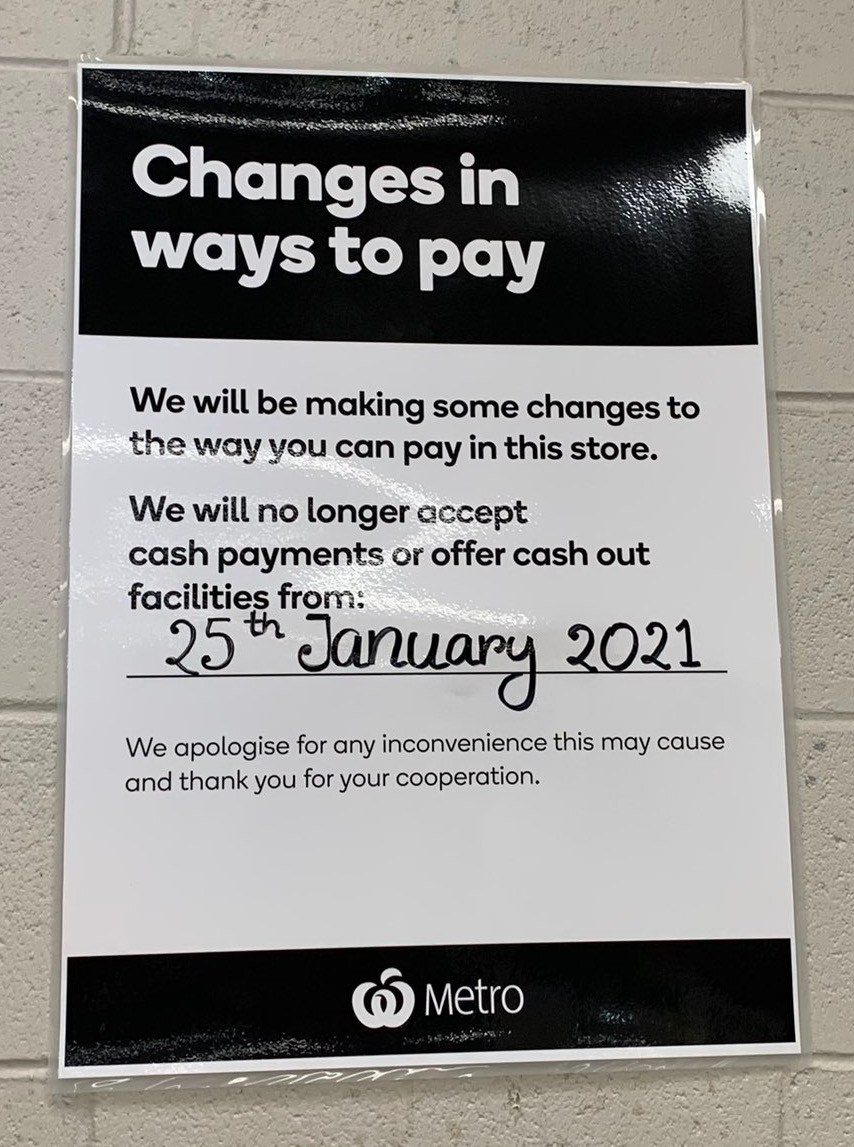
Are the banks forcing Australian retailers to go cashless?

A few months ago, a retailer switched banks because their usual bank closed the local branch. Now, the new bank has announced the planned closure of the local branch early in 2021, leaving the town without a bank branch.

With the nearest deposit branch a 20 minute drive away, the business is actively contemplating going cashless.

At the peak of Covid, they traded cashless for six weeks and it did not impact the business. Some customers who switched to cashless and remained cashless.

Looking at recent bank branch closures, I do wonder if banks are guiding all of us to go cashless. The wonder makes sense since the costs of dealing with cash have gone up.

Of course, retailers don’t like credit card and EFTPOS fees. However, when balanced against the labour cost and rick cost of cash, cashless is barely more expensive.

I was in a shop in suburban Hawthorn last weekend and went to pay with cash, we only take cards, sorry, was the response. I asked abut it and it turns out they started accepting cash after the Covid lockdown but after two weeks stopped because so few used it that it was not worth the time it took to manage for. Indeed, they have gone as far as to remove the cash drawers from their registers.

But, back to the banks. It feels like they want us to move away from cash. I know from talking with newsagents directly impacted by local bank branch closures that they feel the same way.

What do you think?

9 likes
newsagency of the future

We need to stop asking / telling people to shop local

The signs we see on the streets and on social media asking people to shop local are not cutting through, they have become tiresome, something to ignore or scroll past.

They can sound shouty and entitled.

They can come across as selfish.

I get that they feel like a reasonable pitch that is easy to make.

I think a better approach is to say thank you.

By being genuinely grateful to shoppers for their business is an excellent step.

By sharing your gratefulness through active and public community engagement is an excellent store.

By saying thank you in your social media posts is good, too.

These are some ways you can show shopping local as being beneficial and appreciated. I think that will work better than telling people to shop local.

Here is an example of the approach we are using within newsXpress. This is a simple social media post that expresses gratitude for people shopping local. They key to me here is that that the post does not say thank you for shopping with us. It’s not about us. It’s about local, the community.

By sharing several of these with the same or similar messages, we are supporting the broader local community – businesses, community groups and folks who live locally.

While I am no marketing expert, my sense is that locals are more likely to appreciate this simple appreciation message than the longer request notice (and others like it) that I have shared in this post.

If you have looked at social media content for newsXpress that I have shared on this blog, you will notice that on videos I almost always use Thank you for shopping local at the end. I have done this for several years, again, reinforcing that it is appreciation for local shipping that I preference ahead of a more personal appreciation. I don’t want to assume that everyone seeing this content has shopped with us.

What you do in your business is, of course, up to you. For me, it’s about gratitude and appreciation of people shopping locally, because I think that plays well for my own local business.

12 likes
Social responsibility

Pitching Australian made in the newsagency

In each of my shops we have at least one location where we bring together gifts and related items that are Australian made, and pitch them as such. This works well as more and more customers ask what we have that is Australian made.

The photo shows part of what we have in one location.

Of course, we have much more than this elsewhere, in cards as well as with some other gifts. This range is about nesting and personal care.

One of the consequences of Covid and the China trade battle is the renewed interest in Australian made. I think it will be here for a long time to come.

6 likes
Social responsibility

New magazine: Galah

Galah sounds like an interesting niche new magazine. I found a story about it at the Brisbane Times site. This, from the creator, Annabelle Hickson:

“I want to reflect all the amazing, smart, interesting people I would see when I looked around me but I also want it to be a bridge between the country and the city, to educate city people that these are not second rate lives.”

Regional media did not escape the impact of bushfires which ravaged much of the rural landscape at the beginning of the year. News Corp Australia and Australian Community Media, the two biggest newspaper outlets in rural areas slashed costs dramatically and closed the print editions of some publications due to sharp falls in advertising spend.

At the same time, Australia’s magazine industry was on its knees. The country’s biggest magazine publisher Bauer (now known as Are Media) closed titles such as Elle, Harper’s Bazaar NW and OK!, but already their demise has prompted the creation of new titles with alternative business models.

Hickson is determined to create her own green shoots and with the coronavirus pandemic prompting some to think about relocating from the city, she kicked her plans into gear. Galah, which has more than 140 pages, will run three times a year and be sold in boutique stores and newsagents across Australia.

3 likes
magazines

Christmas at Knox

Here’s a video I shot a week ago to promote Christmas at my Westfield Knox store. We are using it several times to introduce part of the Christmas range in-store to shoppers through social media. It’s worked a treat. We made the video on a $0 budget.

I share this here to encourage other newsagents to use video content on social media to pitch their businesses in a way that plays against the assumptions many shoppers make about the Aussie newsagency.

We set our own narrative through posts like this.

7 likes
marketing

Is News Corp selling its metro newspapers

This is an interesting and thoughtful piece from Crikey yesterday on the prospect of News Corp putting its capital city papers up for sale:

Psst! Wanna buy a paper? Well, you’re in luck. Looks like News Corp might have a few on the market.

The Murdochs appear to be looking for a buyer for their chain of metropolitan tabloids like the Herald Sun, The Daily Telegraph and The Courier-Mail. Only hitch: it doesn’t seem any of them are making much — if any — money.

If the sale happens, expect it to be soon: Rupert has always liked timing deals leading into Christmas, allowing any unavoidable huffing and puffing to fade in the torpor of the holiday season.

The tabloids have become too large a problem to be managed. Ever since the Murdochs split their media business into two back in 2013, the old media News Corp has been an ungainly mix of assets that make money (The Wall Street Journal, realestate.com.au) and those that don’t (the tabloids, regional newspapers, Foxtel).

News Corp shares have been worth less than they would if the company were smaller, thinned down, without those loss-making parts. That’s a conundrum for a family trust much of whose wealth is tied up in those shares.

Over the past year, the company has been methodically working through its portfolio, closing and shedding the parts that don’t work. In March, it sold off its coupons business, News America Marketing, to private equity for about $335 million.

In May, it stopped printing over 100 of its regional and community newspapers, closing some and leaving others to limp on with a purely digital presence. The residue has been considered on the market, perhaps to Australian Community Media that bought Nine’s similar portfolio last year.

News Corp predicts this restructure is reducing revenues this financial year by about $160 million. According to the published accounts, it cost most of the $150 million the company spent on termination payments last year.

Then, in August, the end of year figures separately reported results for the loss-making mastheads in Australia, the UK and US and for the money-making WSJ. The reporting put the difference up in lights: the remnant News Media revenues fell by about 20% (much of it before the COVID-19 crash); in the new Dow Jones-WSJ segment revenues were up.

The stock market seems to have sniffed something is up: over the past month, News Corp shares listed on the NASDAQ exchange have jumped almost 40%, over twice the market’s broader post-Trump bump.

The challenge for the tabloids is the challenge faced by traditional local or city-based media around the world: an audience too diffuse to resist the flood of advertisers to the micro-targeting of the tech platforms; yet too geographically focussed to find enough people prepared to pay subscriptions.

In a surprise for long-term Murdoch watchers, it looks like the once-vanity project of The Australian is now more financially stable — even profitable, maybe powerful — than the once-dominant tabloids. At June 30, the company says, The Australian had about 200,000 paying subscribers (in digital and print), the most the paper has ever had. It positions the paper to claim a lion’s share of any payment for news from Google and Facebook.

News Corp will be betting that, along with Sky News, The Australian will sustain its clout in Canberra without the tabloids

By comparison, the Herald Sun, once Australia’s largest paper with more than 600,000 in circulation, now claims only 125,000 paying subscribers. Like The Courier-Mail, it failed spectacularly in turning its power against the local Labor premier.

London’s The Sun, which boasted a circulation well over 3 million back when it was making and breaking British governments, now limps along at about 1 million. It has no paid-for digital offering.

Traditionally, when Murdoch has sold mastheads, he’s sold to other media players or to a management buyout. For the Australian tabloids, that would make local management and Seven West Media the front-runners. Owner Kerry Stokes has been a long-term ally of Rupert. The West Australian already shares copy with News Corp.

And the price? Nine’s sale of New Zealand’s Stuff earlier this year may have set the market: NZ$1 to its local CEO. Sounds about right, but expect that to be buried in exchanges of rights, share-holdings and liabilities.

Regulars here will know my response – we should all be running our businesses to rely less of traffic freeways and more on traffic laneways. In other words, more sources of shopper traffic than the usual regular ones on which we, as a channel, grew up.

8 likes
Media disruption

Is Tabcorp unfair in its expansion of the retail lottery network?

Tabcorp has approved plenty of new lottery outlets recently, expanding the network of retailers selling its lottery products.

The speed of growth in outlets does not feel connected to an increase in demand for over the counter purchase of lottery tickets. It does not feel as if there is a justification for the expansion in sales. Retailers say it feels like something else is in play. Maybe it has something to do with talk of some or all of Tabcorp being up for sale. Who knows? Not me, that’s for sure.

A chunk of new outlets have been fuel and convenience focussed, often open 24 hours a day. If Tabcorp adjusting its preferred retail format focus?

If you ask Tabcorp about the new approvals, they will say they have a thoughtful process they follow in considering each new outlet application and that existing retailers can appeal and any appeal is thoroughly considered.

To that, I’d say prove it. Rarely is an appeal successful. Rarely does the company explain why it made the decision it did.

Adding an outlet in a town of 5,000 where the existing outlet is not under pressure, is gold standard and have considerably grown sales does not make sense.

Adding 2 outlets within 5 minutes of another existing gold standard outlet with an excellent track record does not make sense.

I get that Tabcorp thinks adding outlets can add to its sales. Retailers will tell you no evidence flows from the company showing this to be the case.

The big issue here is that while Tabcorp is actively expanding its retail network, while at the same time rapidly expanding its online sales, the company continues to lay heavy and expensive demands on retailers as to the premium space to be allocated in-store, the considerable capital investment in fixtures and fittings and the extraordinary demands on training.

To plenty of existing lottery retailers it feels like the same rules do not apply to some of the new outlets, such as fuel. They say it feels like the existing retailers are penalised without consideration by Tabcorp.

Given that Tabcorp wants to considerably expand its retail network: to be fair to existing retailers, the company should stop demanding premium in-store space, reduce the considerable shopfit requirements and be more flexible in overseeing the operational rules.

Talking with some lottery retailers, the moves by Tabcorp are upsetting them, distressing them. I hear in their voices the harm this is doing.

Shame on those at Tabcorp who are responsible. Shame for what feels like a lack of care for the existing retail network.

Expanding as Tabcorp is its retail lottery outlet network does not feel social responsible.

The mental health of existing lottery retailers is being impacted by the expansion. The stress some facing a new competition is considerable. It taken them closer to breaking point. Not only because of the decision but also because of the dreadful processes Tabcorp has that make the existing lottery retailer feel helpless.

This is a mental health issue Tabcorp! It demands urgent senior management attention.

Regulars will know this does not affect me personally. I’ve not had a retail lottery outlet since 2013. Newsagencies and other shops can and do thrive without lotteries.

The best move a lottery retailer can make in their business today is to do everything possible to reduce reliance in the business on lottery product traffic and revenue.

13 likes
Ethics

Showing off changes in the card range

Too often, newsagents bring in new cards either by a supplier led refresh or introducing a change to supplier and don’t shout about it. In my shops we take a different approach, letting shoppers know about our changes, as they are happening.

In one of my stores we are introducing new cards and even though we are really only just beginning, we are pitching about it on social media. This pretty basic and quick to produce (less than 5 minutes) video shows some of the range change as well as, more importantly, the fixture change.

Content like this matters is social media is the most cost effective way right now to reach beyond the four walls of your business to find new shoppers.

6 likes
Greeting Cards

Appalling customer service from Nine Media’s Fairfax business when I try and cancel by subscription to The Age

I decided to cancel my subscription to The Age a three days ago. I figured it would be easy – log into their website, select my account and click cancel from the next billing cycle.

I figured, 1, 2, 3 and I’d be done. I figured that because that’s how online works. It’s easy, self-serve, fast.

But, not at Fairfax Media. Their approach is broken, cumbersome and laden with barriers.

I logged in. Then, I had to log in again when I selected my account. There was no explanation as to why I had to log in twice. I guess it as because they are two different tech systems.

Anyone, I got in. But once in, there was no button I could click to self manage the account.

I had to call or email the. So, I selected email, thinking I could write an email. But, no, that would be too simple for Fairfax Media to implement.

On selecting email, it took me to another page that I had to complete. They asked for my subscriber number. I went back to my account page, there is no subscriber number. I checked and checked and could not find it. So, back to the web form, I completed the details including having to tell them why I wanted to cancel.

But that was not enough. They will consider my request. They emailed suggesting I call them if it is a time sensitive request. It’s not, so I’ll let it play out. Gees, I hope they don’t call. I don’t want to speak with anyone. But … here we are 3 days later and I’ve heard nothing.

As I said, appalling customer service from Nine Media’s Fairfax.

If I was a Fairfax shareholder I’d be thinking about the manpower cost of such a broken subscription management system. Talk about broken, old-school, out of date. It’s a joke. My own small business subscription related consumer websites offer far better customer self-service experiences.

It’s simple really, Fairfax Media. I want to cancel my subscription. These hoops and barriers feel like it is a business strategy to keep customers, by making it too hard to quit.

The experience turns me off. It makes me want to tell others how bad dealing with them is.

The approach by Fairfax Media to managing online subscriptions is what I’d expect from a dinosaur business, a business out of touch with online. Oh, wait…

22 likes
Customer Service

Black Friday is here to stay in Australia

Whether we like it or not, the Black Friday retail sales event is here to stay. I say this based on personal experience and the experience of other Aussie retailers.

A gift shop I spoke with yesterday told me they doubled last year’s results and sole more than $5,000 in gifts online.

A homewares store owner told me that sales this year tripled what they did last year, delivering more than $10,000 in additional business.

Both commented that they considered the event itself boosted traffic to their websites from people looking at what was available and that, in each case, at least half purchases were at full price.

In our own case, we kicked it off in-store and online Thursday at lunchtime. While in-store store has been good, online has been excellent, achieving 100% growth off a good based from 2019.

We didn’t spend any money on ads or paid social media. Rather, we leveraged our email database and free social media posts.

Looking at online sales for one store, a small high street store, I can attribute more than $5,000 in online sales to the Black Friday event, with most of this coming from new shoppers. Now, it’s taken 3 years to get here, the be ranked by google, to have a good email database and to have access to sought-after products in a niche retailers who focus on price don’t play in. This has means that our Black Friday discount can be modest, yet interesting.

Whether retailers like it or not, you have no choice but to engage with seasons like Black Friday and Cyber Monday. There is money to be made.

Online is the best way to engage with Black Friday / Cyber Monday. While plenty of retailers have success with in-store, it is online where there is the most traffic. Also, as I harp on about, online never closes so you can transact with shoppers online at 1am and 2am and happily take their money if you have what they are looking for.

I get that plenty of small business retailers are yet to embrace online for their businesses because it seems too hard. I’d note that in almost every situation, the comment after getting online is I wish I’d done it sooner, I had no idea.

If you want to make money from Black Friday / Cyber Monday next year or any other growing online sales event, get online asap, so you are ready.

9 likes
Newsagency management

Herald Sun number stickers around Melbourne

Anti-Herald Sun bumper stickers are appearing around Melbourne as well as on social media. An online store has them. Here are a couple of them.

From what I can see there are at least 4 in the series, including this one:

Some are stronger in their word choice, like this one, which I grabbed from social media, from the folks behind the stickers from what I understand – The Shot.

It’s a sticker placed on a laptop. It’s certainly a clear message.

On social media, there is a push for people to buy them and give them to cafes that have banned the paper. I have seen a couple of posts from people suggesting they be used to deface outlets selling the paper, which would be wrong to do in my view.

There are some elements of this that remind me of the campaign in the UK against The Sun. The Shot has a story that draws parallels. It’s worth a read if you are interested in the history of a movement against Murdoch owned ‘news’ outlets.

It will be interesting to see if there is any long-term impact on the Herald Sun brand.

13 likes
Social responsibility

Ovato: taxpayer funds to cover employee entitlements?

This, from the Chairman’s address at last weeks (Nov. 26) Ovato AGM indicates that the company is restructuring in such a way that the financial responsibility to a chunk of employees who will lose employment is shifted to the Australian taxpayers.

In my opinion, it sucks. But … I don’t have the time to lobby on this. If I did, I’d say that in my opinion the trajectory of the company was set well before Covid, that those running the company should have known for years that restructuring was inevitable and that, for these reasons, the shareholders in the company should be responsible for funding employee entitlements, and, if they can’t, the whole business should collapse.

The restructure appears to be movements specifically designed to shift the liability for employee entitlements to taxpayers, and retaining, for shareholders, a smaller and, I guess, more profitable business.

But, hey, these are just my opinions. I am no expert.

I am, however, a long-suffering customer of the Ovato business, a business with inadequate infrastructure and inadequate strategic planning. It is my experience with these that feed into my wondering why Ovato is making the moves it is making and whether the reasons put forward as to justification for the restructure stand up.

Now, to be clear, I respect the folks working at Ovato. In my experience, they are professional and committee to Ovato customers. My issue is that the company does not provide them the resources they need to deliver the level of service we (customers) need.

But, more broadly on the restructure, I am curious as to the motives and long term plans of Are Media in all this.

I think it is important that employee entitlements are protected. However, I do not think companies should be able to shift things around through various structures controlled by essentially the same body for the purpose of avoiding the obligation of fully paying employee entitlements.

To me, what is happening at Ovato, the transfer of employee entitlement responsibility from the company to the taxpayer, could be considered through the lease of social responsibility. each time I see Ovato in the news, on social media and in emails touting business, there will be the reminder of how much taxpayers invested in remnants of the business so that the remaining business itself could trade.

Down here in small business land, most of us are not structured so that we can slice and dice and manoeuvre such that we keep the good bits and have others fund the funeral of the bad bits. I appreciate that sounds dramatic. Maybe I am missing someone but it is how it reads to this non accountant.

Newsagents continue to be treated poorly by Ovato., We do not have control over our level of indebtedness to the company, we carry considerable costs for wrong decisions by the company, we make bugger all margin on their products. Yet, we do it because magazines are a core category. That we do it, and they know we will, allows them to by inefficient and maybe that is a factor in getting them to the point of needing the restructure.

Who knows.

What I do know from the Chairman’s own words is that Ovato plans to restructure such that us taxpayers pay money towards the costs that will be a consequence of the restructure.

14 likes
Ethics