The weight of magazine inserts
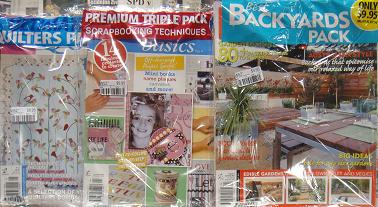
Newsagents, have you every collected all of the advertising inserts from magazines you receive on any given day?
I have heard from a newsagent who did just that recently. The stack was 25cm high and weighed close to ten kilograms. The newsagents dumped the lot, prefering to fit more magazines per pocket than give the expensive retail space over to advertising from which newsagents receive no share.
Thinking about this, imagine how much we spend paying to return full copies of unsold stock with these advertising inserts. What a waste.
Leveraging the AFL Grand Final opportunity
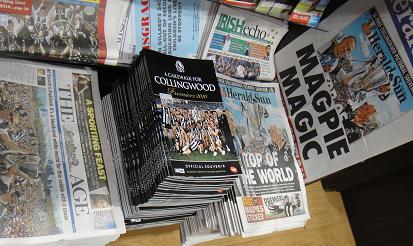
The team at my newsXpress Knox store created a terrific counter display promoting items related to the AFL Grand Final. The display has been working a treat with customers using it as a kind of menu and ordering items. In many cases, the purchases are in addition to other unrelated products which brought the shoppers to the store in the first place.
The display is brilliant, fantastic – even better in person than the photo. It is colourful, attractive, attention drawing and commercially successful.
The display is a good example of why newsagencies need the capacity to make local display decisions. Too often today we have publishers telling us what to display, where to display it and even how to display it or risk being reprimanded. This can see us promoting low margin product which is not appropriate to the store.
Smart retailer newsagents need the freedom to create local displays which are appropriate to the needs of the local shoppers.
UK supermarket refuses newspaper in margin dispute
UK supermarket chain ASDA refused to carry the Sunday Times last weekend over a margin dispute with News International. Roy Greenslade writing at The Guardian has the story.
The part of the story which may interest Australian newsagents is that News increased the cover price but did not pass on to retailers the usual 25% of the cover price increase. Based on the new cover price and commission, the retailer margin falls to 23.5%.
Summary of magazine distribution challenges for newsagents
I have received a few calls this week from small publishers and people outside the newsagency channel wanting to talk about the problems with the magazine distribution model. I thought it might be worthwhile putting together a summary…
A brief history
For over 100 years, newsagents had a monopoly over the distribution of newspapers and magazines. That changed in 1999 when the federal government engaged the ACCC to oversee deregulation. The deregulation opened access to newspapers and magazines for other outlets but failed to address the supply model which had been created to serve the monopoly arrangements. Newsagents were poorly represented through this deregulation process. Newsagents were left with a more competitive retail marketplace but without the levers necessary to enable them to make competitive business decisions.
What is wrong with the current magazine distribution model?
Newsagents are treated differently to other magazine retail channels – petrol, convenience, supermarkets and majors.
Newsagents have no control over the titles received nor the quantities received. Our competitors do have this control.
Newsagents are provided some titles with an extended, three months and beyond, shelf life. Our competitors rarely receive titles with more than a 20 day shelf life.
Newsagents have to pay to return unsold magazine stock. Many of our come=petitors do not have to do this.
Newsagents are forced to follow time consuming and accident prone processes for handling the return of unsold stock. Most of our competitors do not have to follow these processes.
Newsagents only make money from sales, our margin is 25% of cover price. Many of our competitors receive other financial compensation which takes them beyond the 25%.
Recent magazine cash flow studies I have undertaken indicate that 65% of all magazines sent to newsagents are cash flow negative once we take into account the cost of retail real estate, labour and returns costs. This significant financial burden disadvantages newsagents against our competitors.
I have evidence from many newsagencies where magazine distributors have supplied stock on the basis of a sell through at 20% or even less over a long period of time, knowing that the newsagents will absolutely lose money on such a supply volume.
How would I like it changed?
If newsagents are to be accountable for paying their magazine suppliers on time, we MUST be given the ability to control the level of indebtedness we incur. This means we must have control over the titles we receive and the quantity of each title we receive.
If we are not given the ability to control titles and volume, we must be compensated for use of our stores as a warehouse and our cash to fund oversupply. I would suggest a fee based on sell-through. If a title has a sell through of less than, say, 60%, newsagents are compensated with a fee to reflect the cost of real estate, labour and cash used to support the oversupply.
Why is nothing done?
Magazine distributors make money by trucking stock out and processing unsold stock when it is returned. There is little or no financial incentive for them to do anything other than to ship out as much stock as possible. This makes newsagents financially responsible for the distributors wanting to keep their trucks full.
While newsagents could use collective bargaining to negotiate more equitable terms, the distributors have demonstrated little appetite to engage in such commercial discussions in the past. Further, newsagents have had poor leadership for many years and this has led to a decline in newsagent support for representative bodies.
What we should do
Newsagents need to present evidence of gross over supply to appropriate government authorities like the ACCC. The more evidence from individual newsagents the greater the opportunity for getting appropriate attention.
We ought to also look at state based bodies which could help. In New South Wales for example, individual newsagents could easily bring a case to the Consumer, Trader & Tenancy Tribunal. In Victoria, newsagents could engage with the Office of the Small Business Commissioner.
Why we will do nothing
We are tired, weak and scared.
Magazine cash flow study reveals unsustainable model
Here is a graph indicating the cash flow impact of magazines supplied by Network Services (excluding ACP Magazines titles) and Gordon and Gotch (exclusive Pacific Magazines titles)to a newsagency between May 2009 and April 2010. The data was collected and analysed using Tower Systems newsagency software. To determine the cash flow impact of a title, the software considers the cost of goods, cost of retail real estate by title, cost of labour plus revenue from sales achieved.
How can small business newsagents manage cash flow with such peaks and troughs? With difficulty. The cash flow challenge is far more pronounced in shopping centre based newsagencies where rent per square metre is much higher than elsewhere.
Newsagents manage by subsidising magazines some months with cash from other parts of their business.
I first wrote about this in my Magazine Cash Flow Report of 2006. I have spent time this year updating the data and things have not changed.
Magazine distributors control the model. They will say that the don’t but they do. They are paid regardless of sales. Newsagents only make money from sales. We are the weakest link in the chain yet pay the highest price.
The cash flow peaks and troughs of the current magazine distribution model cannot continue.
Before the magazine distributors complain to each other that I am unfairly blaming them again, I challenge them to look at the cash flow data. This will show that I am right. It will show that the current magazine model is cash flow negative for 65% of all magazines distributed.
Some simple changes could turn this situation around.
What is grossly unfair to newsagents is that no other retail channel competing with us in selling magazines has the limitation imposed by the magazine distributors on us.
One day, people will look back and wonder why they acted as they did commercially against newsagents.
What, another fat loss magazine?
We received a new title yesterday, Fatloss. While Gotch has promised to get our permission before supplying new titles, this one slipped through. I suspect because of its connection with Oxygen magazine. regardless, do we really need another weight loss title in Australia? If this title had to pay, if we were able to charge access to the newsagent network, I suspect it would never get here. I early returned all of our stock but I will miss the end of the month cut off so Gotch gets my money for 30 days.
Why the 35% lift in stock for Uncensored?
We received a 35% lift in supply of Uncensored magazine yesterday for no apparent reason. Other newsagents may want to check their numbers. While this title has a good following and it nicely anchors a popular segment in our magazine department, a 35% increase in supply is unwarranted from where I sit.
News Magazines engages with newsagents
News Magazines is engaging with parts of the newsagency channel in a refreshing way which is certain to lead to greater success for their titles. By working with some marketing groups, News Magazines is able to encourage more proactive engagement in return for other benefits.
While some newsagents will say that News and other suppliers should deal with all newsagents, this is not practical. The same is true for dealing with industry associations. Newsagent suppliers need mechanisms of compliance and communication channels which are reliable. There is where marketing groups can help suppliers.
Knox City Shopping Centre closed for the day
Here it is the first week of school holidays, and the Knox City Shopping Centre in Melbourne has been closed and all staff told to evacuate for the day due to a burst water main. While our newsXpress newsagency and the nextra store in the centre will lose sales, I feel for the food outlets, the bakeries and others with products made with a one day shelf life. Ah, the joys of retail…
Gotch email demonstrates a core problem with the magazine distribution model
Magazine distributor Gordon and Gotch yesterday emailed many newsagents reminding them that their account was due to be paid yesterday:
Dear Customer,
We take this opportunity to remind you that your Aug’10 account was due on the 20th of Sep. As has previously been communicated, continued disregard of trading terms may result in supplies being suspended.
We urge you to promptly settle the debt due at present and adhere to our terms of trade going forward, thus avoiding any disruption to trade. Attached below are our banking details for electronic transfers.
I know of several newsagents who received this email who had already paid their account. While that is disappointing, it is not what galls me the most about the email. The email reflects the abuse of small business newsagents by the magazine distributors. Consider these points:
- Most newsagents do not have access to appropriate levers with which to control the amount they will owe Gotch each month.
- Newsagents have to fund retail real estate in store, labour for managing magazines and the freight cost of returning unsold stock.
- Newsagents are billed for product supplied to the end of the month.
- Gotch operates with a ‘fluid’ end of the month for processing returns from newsagents – we are not told when the end of a month will be and can find that we have missed it by a few days and therefore miss needed credits.
It is unfair for a magazine distributor to aggressively pursue newsagents to pay bills on time if they do not provide newsagents with the capacity to manage the amount they will owe.
The current magazine distribution model is unfair to newsagents.
Halloween 2010 kicks off early
You know you have a winner of a season when customers are buying stock as you are putting it out. This happened for us at our Forest Hill store as we were putting out our Halloween range. With not even half the stock out nor this year’s collateral up sales are already strong. It helped that it is school holidays with plenty of families with time on their hands in the shopping centre.
The window display is attracting shoppers, young and old, stopping for a look at the display and inside – as you want with a window display. Our team has made sure that you can easily see through the display and into the store.
For many years now newsXpress has owned Halloween in the newsagency channel with some stores selling in excess of $15,000 worth of Halloween product at an excellent margin. While we will not do that much, it is in our top four seasons for non greeting card sales.
While it may be premature, we are wondering if we will have enough stock.
Moving Oprah’s O magazine
Given the blitz of publicity since the announcement that Oprah is to bring her show to Australia in December, we have moved the O magazine to a more prominent location. While we only sell two or three copies, I’d expect there to be a jump for the next few issues.
iTunes for newspapers and magazines
The long awaited iTunes for newspapers and magazines appears closed from news reports over the last 24 hours. The Wall Street Journal has the story, Mashable has a good summary. Ken Doctor at Newsonomics asks nine pertinent questions about the move.
From a newsagent perspective, the move by Apple is another challenge to print. While publishers tell is that the digital channel is different to print, I disagree. There will be migration. I know from my own iPad experience that I am reaching for a print product less today than six months ago.
It remains to be seen how many newsagents seize the opportunity of the news from Apple, the opportunity to look carefully at the investment in print into the future in terms of shopfits and space allocation.
Why the late return for the AFL Footy Record Gotch?
Gordon & Gotch has asked newsagents to retain the AFL Grand Final Footy record until the end of October, saying that the title will sell for weeks after the Grand Final. I am not sure where they get their data as my experience is that we would be lucky see sales beyond the big day.
If newsagents follow the Gotch advice, returns for the Footy record will fall into November returns and a credit not appear until the December statement.
I will be returning my stock, if there is any, the week after the Grand Final. It’s my money.
AFL Grand Final Lottery Syndicates
We are embracing AFL finals fever with house syndicates for Collingwood and St Kilda for Saturday night’s Tattslotto draw. From the moment we put signs up customers started commenting about the game and their preferences. These syndicates are priced lower than our usual syndicates to encourage them being purchased in addition to regular purchases.
The early preferred Grand Final favourite based on sales – St Kilda.
Books the great story of 2010
We are seeing book sales continue to grow with food and children’s titles doing exceptionally well. We all but sold out of children’s books which we brought in for our Father’s Day Book Sale and are close to selling out of food. We are adding stock as there appears to be no let up in demand and school holidays will provide an opportunity for growth.
With a margin above 50% and sale or return terms, books are also popular from a management and risk perspective. The margin allows us to compete with outposts in the shopping centre. We do this by running 25% off sales occasionally for a short period.
Books are key to us achieving an above average overall gross profit for the business. They are also a central part of our basket building strategy.
For what it’s worth, our approach to books in-store is as follows:
- Four to five book sales a year.
- Display on trestle tables. No frills.
- Place close to the greeting card department – in a high traffic location. The basket penetration of books with cards is high.
- Simple signage: BOOK SALE.
- Refresh the table regularly during each day.
- Move categories within the sale each week.
- Change the high traffic sides of the tables at least weekly.
- Segment books by interest.
- Promote the launch of each sale with a catalogue in around 5,000 letterboxes around the store.
- Understand that stock – to guide customers looking for a gift.
I am sure that others have their success stories with books. Make a comment and share…
The challenge of displaying a free magazine with another title
The latest issue of Shape magazine which went on sale yesterday was supplied with an old copy of Men’s Fitness from may this year The two magazines were held together with a paper strap (see photo) half way down the cover which would not be seen once the magazines are traditional newsagency shelves. Indeed, this strap would be easily damaged by customers shoving the stock back into the pocket.
Considering the flimsy paper strap and the state of the old copies of Men’s Fitness I decided to remove the free magazine from the offer. This also enabled me to fit all the stock in one pocket and thereby better manage the real estate costs associated with this issue of Shape.
While applaud a publisher looking for more browser friendly ways of placing a few magazine with a current issue, the approach taken with Shape is not ideal.
Did You Know 4.0
A fascinating video which is certain to interest newsagents and those who work with newsagents.
Chasing a sell out of the AFL Footy record
We have placed the AFL Footy record in the best location of impulse purchases, between the Herald Sun and The Age. If all goes to plan we will be sold out by mid week. We are also running St Kilda and Collingwood syndicates as well as stocking up on white, black and red crepe paper and balloons. We are all set for a good AFL Grand Final week.
Are you located near Kenny’s Cardiology store?
Allied Brands, the business behind the Kenny’s Cardiology card and gift stores, is experiencing challenging times. The Kenny’s business is suffering as a result. Several company owned stores have been closed with more expected. In July, the company had 47 stores and announced that it expected to close 10 of these.
If your newsagency is near a Kenny’s store, you may want to scope out the opportunity for increasing your focus on cards and gifts.
While it is a challenge to kick a competitor when they are down, in this instance newsagents could argue that it is fair. Kenny’s opened around twenty years ago and took considerable greeting card business from newsagents. Their difficulties today provide us with an opportunity to win some of this business back.
Newsagents can win back card business by becoming more actively engaged in the category. While greeting cards deliver almost the best margin in a newsagency, newsagents are less engaged than with most other categories. Some greeting card suppliers would argue that many newsagents are not engaged at all.
Here are my tips for creating a more competitive offer in the card category:
- Talk to your card main card supplier and request a performance review.
- Compare your supplier’s performance numbers with your own sales data.
- Have slow moving items replaced by faster moving stock.
- Carefully assess the performance of lifestyle cards against everyday. Everyday sells significantly more in newsagencies that lifestyle.
- Have your staff trained in putting out cards so that new stock gets on the shelves sooner.
- Promote cards in all major seasonal displays.
- Start a card of the week program – featuring a card which will appal to your customers at the counter.
- Find ways to include cards in your high traffic area displays to drive impulse business.
The opportunity for newsagents reaches beyond what is happening with Kenny’s Cardiology. Newsagencies have excellent traffic and it is easier to leverage this for additional card business than it is for a stand alone card and gift shop to attract a customer to purchase a card.
It’s business and we owe it to ourselves and the rest of the newsagency channel to leverage our excellent traffic for a greater share of the card and gift categories.
Woman’s Day make over
It is good to see Woman’s Day get a make over – out today. The $4.5M TV campaign should generate considerable interest. We are leveraging this with strategic placement of the title in two locations for the next two days. But that is about it since ACP has not provided any special collateral with which to promote the make over.
When New Idea did the same earlier this year we saw a lift. That was in part due to excellent collateral designed to drive impulse purchases.
How to free up capital in your newsagency
Dead stock, stock which is not paying its way, can cost a newsagency thousands of dollars a year, tens of thousands in some cases.
The non-circulation categories where I see the most dead stock are: everyday pens, premium pens, home office products, lifestyle greeting cards, maps and certain social stationery / gift lines.
Tobacco related products is probably the best managed category.
Newsagents who rely on supplier representatives to order for them have, from what I see, more dead stock than those who order using their newsagency computer system based on actual sales. This is especially true in the pen and social stationery / gift areas.
Supplier representatives are usually at least part paid by commission and while they will protest at what I am writing here, human nature is such that they will put their needs ahead of the needs of their customers given that few newsagents check the stock turn and return on investment of what is ordered on their behalf.
Newsagents like that suppliers provide the labour to order, price and put out stock. They see this as a benefit without realising that this benefit can come with an extraordinarily high cost.
If you have a computer system, use it. Stop letting suppliers order on your behalf. Start ordering for yourself based on sales. You will save time and money. Profitability will rise as a result.
In the lifestyle card area, ask your car company for an in-depth analysis of sales for each lifestyle range you have. Look carefully at stock turn and analyse this against the cost of the real estate these cards are taking in your store. You could probably lose some lifestyle ranges without any impact on overall revenue.
My core point here is that we need to take control of the stock on our shop floor. We bleat and moan about magazines yet we all too often to not apply even basic retail management principles to the areas of our business over which we do have control.
Start with pens:
- Tell your reps that you will order for yourself.
- Set up your desired stock on hand in your computer system so that an order is triggered at a stock level you feel is right.
- Do a spot stock take to gauge the impact of theft.
- Reorder yourself for six months and compare your stock investment to the same six months a year earlier.
- Quit entire brands which are not paying their way. Let the numbers guide your decisions and not your relationship with your sales rep.
If you are like other newsagents who have done this you will find that sales are the same or higher and that your cost of goods is down by as much as 25%. That is money in your pocket.
Sure there is extra work involved. It means you take more control over your newsagency. There is no harm in that!
ANZ and Commonwealth Bank pull back on newsagency lending
I am told that the ANZ and Commonwealth banks have pulled back from their considerable support for funding people buying and operating newsagencies. Their moves are contrary to what the federal government understands to be the position of banks in terms of support for small business.
Both the Commonwealth and the ANZ have been major supporters of newsagents for many years. The ANZ actively sought to support the channel with access to finance for the purchase and operation of newsagencies.
Their pull back may impact the sale of businesses. It may also lead to some existing newsagents are required to reduce their exposure to the banks.
The changed circumstances of bank lending for newsagents is something which needs to be covered in detail with our key suppliers.